CRUSH SCHOOL

I blog on Brain-Based Learning, Metacognition, EdTech, and Social-Emotional Learning. I am the author of the Crush School Series of Books, which help students understand how their brains process information and learn. I also wrote The Power of Three: How to Simplify Your Life to Amplify Your Personal and Professional Success, but be warned that it's meant for adults who want to thrive and are comfortable with four letter words.

How to Develop Good Habits. Part 2: Replace

How to Develop Good Habits. Part 2: Replace

This is a follow up post to How to Develop Good Habits. Part 1: Understand

In Part 1, I explained that to change bad habits, you must first identify the habits you want to change and the "opposite" habits that help you become more successful. The reason for this is simple - if you just tell yourself you'll change, you most often won't change. This is not because of the lack of desire but rather due to not knowing what actions to take so old habits go away and new ones stick.

The plan of action that has the highest chance of success involves replacing an old habit with a new one. This is the easiest (though it may still prove difficult) way to rewire your brain.

If you're a not-so-proud owner of a bad habit, the patterns and actions associated with this habit are wired into your brain. This means that whenever you "do" the habit the routine you follow is automated. Let me exemplify.

While I have been tobacco-free for more than a decade, I used to smoke one pack of cigarettes a day for 10 years. This is why I almost never ate breakfast in my twenties. I replaced it with "a coffee and a cigarette." I'd put the pot on to brew, put my contact lenses in, pour the coffee, head to the laundry room of the Chicago apartment my wife and I lived in at the time, and light up. Every. Single. Day.

I'd be lying if I told you I hated it.

No. I loved it! In fact, the memory is so well-encoded in my brain that I can imagine the taste of that first morning drag to this day. DOPAMINE.

The point is that my morning "coffee and cigarette" routine was so strongly wired into my brain, I was on autopilot. This may be akin to your morning commute to work. You no longer pay attention to the streets, but rather, your mind is elsewhere - listening to audio, in conversation etc.

I tried quitting smoking several times before I was finally successful. It didn't work. I did not know it then but I know now that it was because I tried to "will it" and did not create an effective plan to rewire my brain.

Rewiring Your Brain

If you're a little bit scared right now you should be. While lobotomy proved to impair patients' intellectual and emotional abilities and was eventually deemed less than effective or humane, we are not that far off from a time when scientists will be able to use technology to change your brain's neural networks. UCLA doctors are already seeing some success using magnetic waves to rewire brains of people with depression

But fear not - the things you need to do to rewire habits do not involve surgeries or exposure to radiation. 

What you need to do is come up with a plan for what to do when the old bad habit starts creeping back into your life. 

I eventually quit smoking on April 1st, 2007 by playing guitar. A lot. My plan was simple: Every time I had a cigarette craving, I would pick up my guitar and play until I stopped thinking about smoking. And it worked!

There are three reasons for why it worked.

First, I did something with my hands instead of holding a cigarette. My present understanding of this is that doing this slowly rewired my brain's networks that associated my sense of touch and smoking. This was the physical aspect of the habit.

Second, playing guitar is an enjoyable activity for me. Just as I loved smoking, I loved playing guitar. It was easier to replace smoking with playing than it would have been to replace it with, say, mowing the lawn. My brain still received the dopamine reward it craved but it happened in a much healthier way. 

Third, playing an instrument is a highly challenging cognitive activity. It requires focus, hand-eye coordination, rhythm, receiving feedback (listening), applying feedback (adjustment of hand positions etc.), constant processing of the song structure, and more. If I just settled on turning the TV on every time I got the urge to smoke I'd be smoking till this day (and likely watching too much TV while at it).

In a similar way, I replaced my online poker addiction with writing. 

Thus, to change a bad habit, you need to replace it with a productive habit that is hopefully rewarding but definitely highly engaging. Then, you must do it repeatedly until your brain is rewired.

And don't believe anyone who tells you it will take two weeks, a month, or 21 days. These would-be-experts are in the business of assigning arbitrary numbers to the methods they fashion themselves. While research shows that developing new habits is tied to the frequency of exposure and the intensity of exposure, the time it takes to change habits greatly varies. The more you do it and the more engaged you are in it during each exposure, the faster you will rewire your brain for the new, more advantageous habit but it's impossible to know exactly how long it will take.

Identify and understand your bad habits first. Then, create a plan that helps you replace them with good habits.

This is how I explain it to the teens I teach. I openly discuss my past tobacco and poker addictions. I find being honest (and flawed) helps when working with adolescents. I encourage you to do the same with yours.

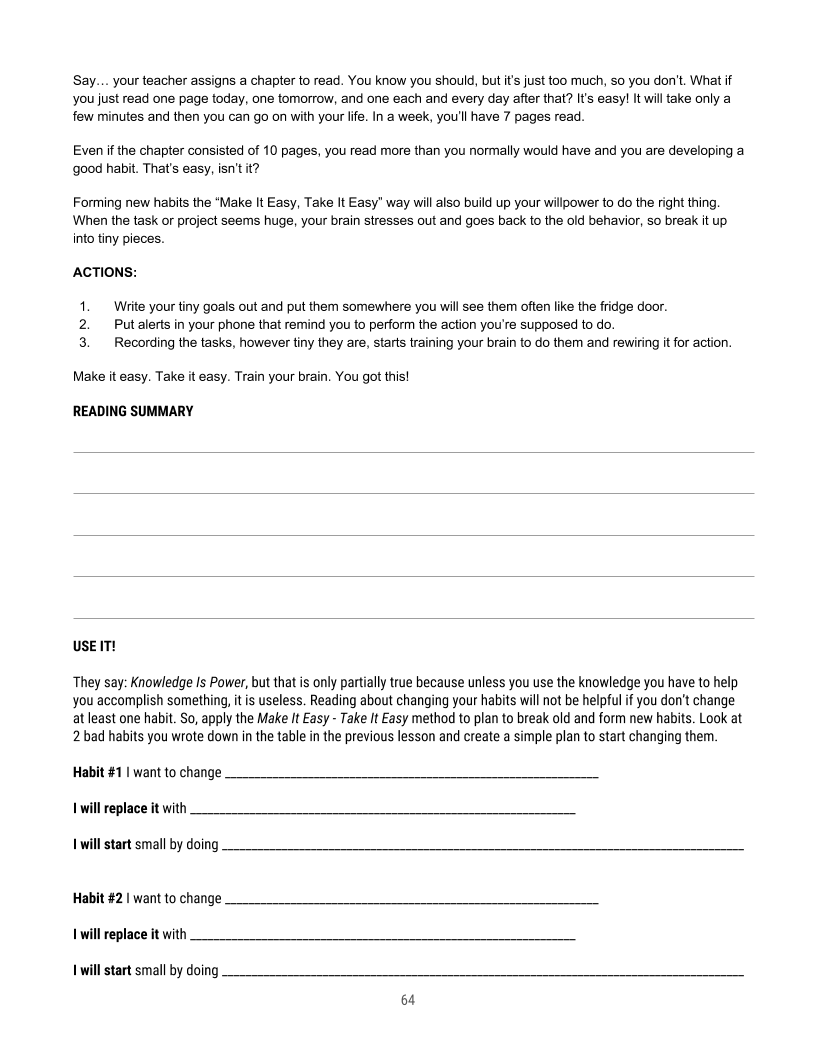
Check out Lesson 21 - Changing Your Habits I use with my students and include in my new book Crush School Student Guide: Learn Faster, Study Smarter, Remember More, and Make School Easier below.

Crush School Student Guide.png

The book contains 65 unique lessons such as setting academic goals, understanding and using the brain the way it evolved to learn, completing projects, studying for tests, improving reading speed and memory etc.

I will share the full Table of Contents with you on Sunday The book becomes available on Amazon tomorrow. You can preorder it here.

You can download the 2 Habits Lessons to use with your teens FREE here.

Thank you,

Oskar

You have the power to change lives. Use it often so they can change the world. 


Sources:

UCLA doctors use magnetic stimulation to ‘rewire’ the brain for people with depression. http://newsroom.ucla.edu/releases/tms-depression-ucla

How are habits formed: Modelling habit formation in the real world. http://repositorio.ispa.pt/bitstream/10400.12/3364/1/IJSP_998-1009.pdf

This column will change your life: How long does it really take to change a habit? https://www.theguardian.com/lifeandstyle/2009/oct/10/change-your-life-habit-28-day-rule

How to Develop Good Habits. Part 1: Understand

Develop Good Habits - Understand Your Habits

In my previous post, I shared a free lesson you can use to help kids master difficult concepts faster, which is something they can use to make their school experience less frustrating and more rewarding. 

In my next two articles, I want to share with you a strategy that works well for developing good study, work, or life habits.

As habits are automatic behaviors, we rarely think about them. We just "do" them. That's the first problem we face - we don't take the time to identify our detrimental habits. The second problem is we don't devise clear plans to change because of this limited introspection and lack of expertise on how to even begin. You might know from experience that telling yourself I'll try to do better tomorrow rarely works.

To develop good habits you must first identify your bad habits. Next, you must identify the "opposite" habits - good habits that contrast the bad ones. Then, you must come up with an effective plan to replace a bad habit with a good one. Finally, you must do it consistently until you achieve "automation."

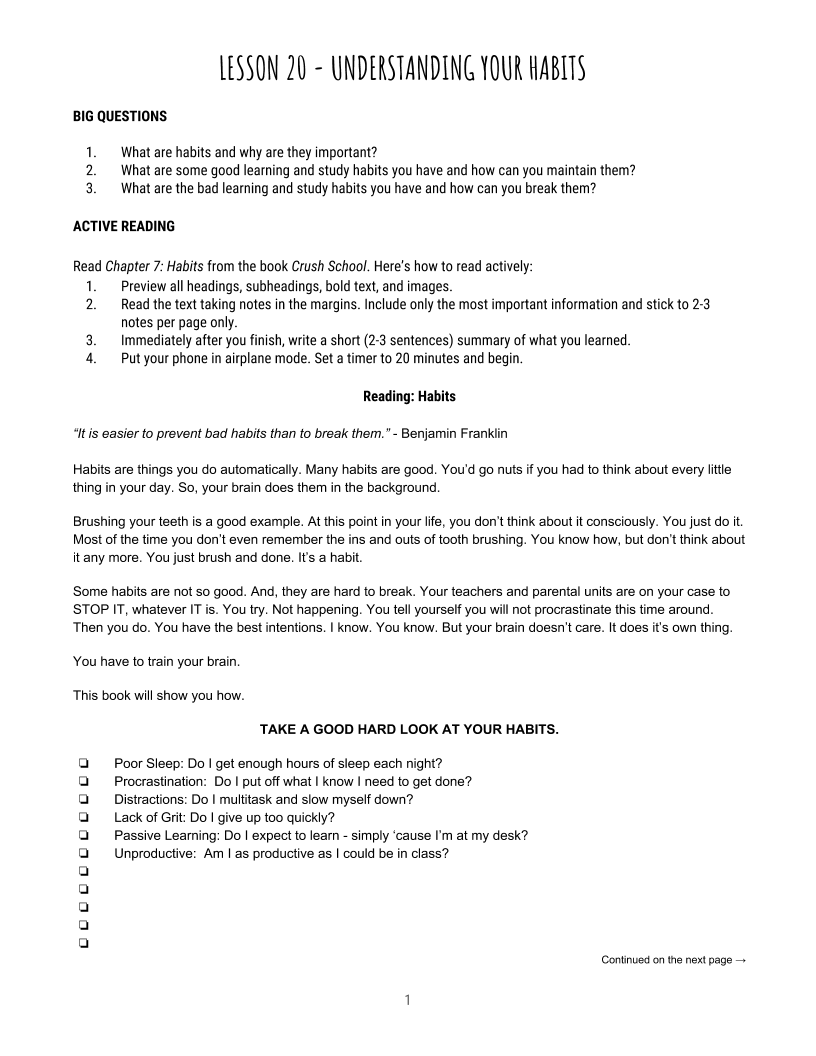
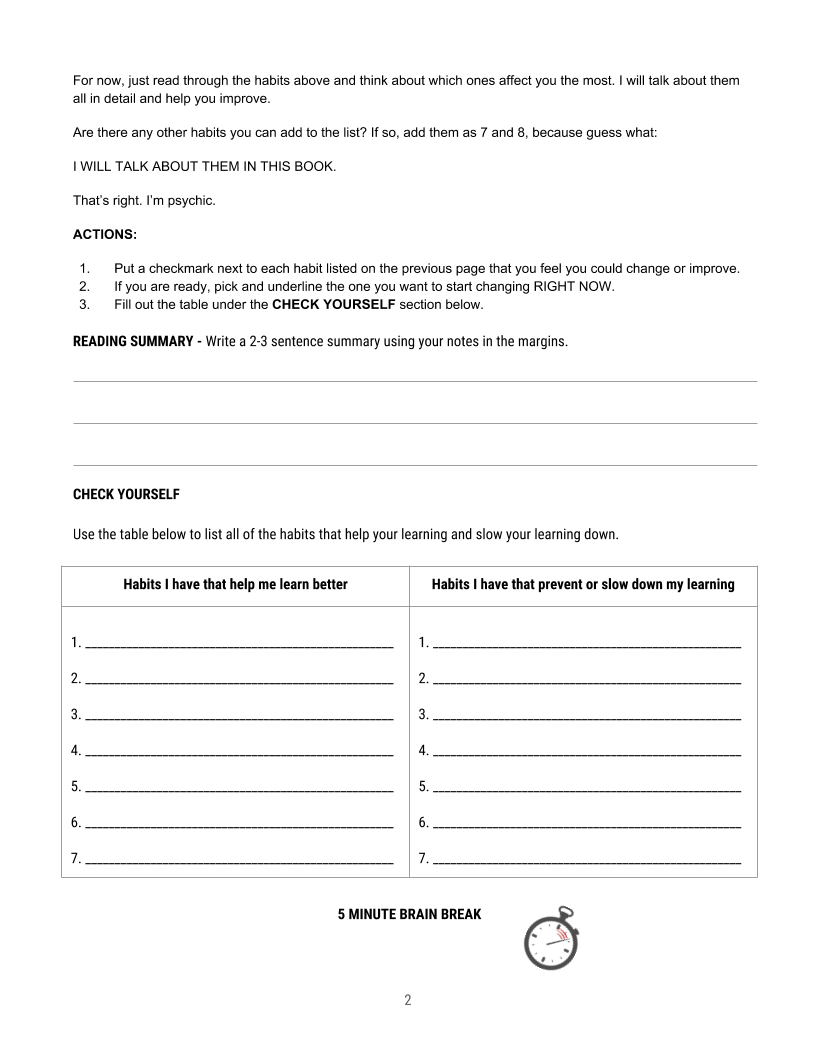
The images below show a lesson I use in my Learning to Study Effectively class to help high school students identify and understand their habits.

I usually start with a short activity (not written on the document) asking each student to write down 5 ineffective school, study, or lifestyle habits they have, share them with a group of peers, and list the ones most or all of them struggle with. This is followed by each group using a representative to quickly share and explain their bad habits. This is engaging because students like learning about themselves and they realize that many of their peers experience the same struggles.

When the discussion is over, I ask the students to read actively (another strategy I teach), use the checklist provided in the reading to check off and add any unlisted bad habits they identified, and summarize the key points of the reading.

Finally - and this is the most important part - I ask them to apply what they learned.

First, they identify the effective learning habits which helps them realize things "aren't so horrible."

Second, they list habits that slow down or prevent their learning which helps them specify what they need to work on. 

Third, they work in small groups to research, write a script, and record a short video on habits. Communicating in this way helps them better understand what habits are, how they form, why they are so darn difficult to change, and begin identifying the things they can do to start developing more effective habits.

Fourth, they reflect on what they learned and self-assess their understanding of their own patterns.

Notice that the majority of time is spent processing information (reflecting, communicating, designing, creating etc.) not receiving it.

Untitled presentation (2).png

The lesson above is one of the two lessons on habits I use with my students. I included this lesson, and Lesson 21 - Changing Your Habits, in my new book Crush School Student Guide: Learn Faster, Study Smarter, Remember More, and Make School Easier 

There are 64 more such lessons in the book. The skills taught are:

  • Setting academic goals
  • How the brain learns and how to use it effectively
  • Active reading, learning, and note-taking
  • Completing projects effectively
  • Creating, practicing, and delivering engaging presentations
  • Faster learning
  • Memory techniques
  • Focus
  • Listening better
  • Creativity
  • Critical thinking
  • Multiple study and test practice techniques
  • Teamwork
  • Mastering difficult concepts, and more...

Please feel free to use the Understanding Your Habits Lesson in any way you want. It is my gift to you. It can help anyone understand their habits so they can start working on changing them. You can download the Free PDF copy here

My next post will feature the "Changing Your Habits" lesson, so that you have the complete set you can use to teach your students or children about habit development and show them how to take action on developing more effective habits.

The book comes out on Amazon this Friday. You can pre-order it here.

Here are the FREE Bonuses it comes with:

BONUS 1: PDF copy of my book Crush School 2: 10 Study Secrets Every High Schooler Should Know

BONUS 2: Project Completion Template PDF (with directions)

BONUS 3: Create a Killer Presentation Template (with directions)

BONUS 4: Cush Tests Checklist

If you're not sure if the book is for you, don't buy it until you know you or your kids can use it. I will continue sharing different lessons I created for it in my future posts and you can decide then.

As always, I am grateful for your time.

Oskar

You have the power to change lives. Use it often so they can change the world.

Mastering Difficult Concepts the Easy Way

Mastering Difficult Concepts the Easy Way

In my previous article How to Make Learning and Life Easier for Your Kids I shared this FREE sample lesson on Mastering Difficult Concepts. Today, I want to explain how parents and teachers can use it to help kids approach learning challenging topics and avoid becoming overwhelmed and frustrated while at it.

The lesson, just as each of the 65 contained in my newest book Crush School Student Guide begins with the Big Idea. All learning should begin with a goal - a sense of purpose and the understanding what one wants to know more about when the learning session is finished.

I chose to use a video to deliver the information on The Feynman Technique, which is a 4-step approach to understanding difficult topics. But while the link will take the student to the video she does not merely watch it - I used a program called EdPuzzle to embed reflection questions so the student can process the information as she is receiving it.

After the 3-minute video concludes, the student is asked to name the 4 steps and represent them graphically. By recalling what the steps are she can remember them better and if she forgot any she can return to the video to find them. By stretching her mind to represent her understanding of the steps graphically she develops a better understanding of them and forms more connections in her brain, which aids both understanding and memory. As a bonus, creating graphics with descriptions allows the student to practice creativity, communication, and critical thinking.

Finally, the lesson walks her through the process of mastering a difficult concept she's currently learning in one of her classes. By applying what she learned immediately after the learning session the student's brain begins forming long-term memories. While weak at first, these memories can be made stronger with repeated use of the learning strategy.

The student isn't just told: "Use The Feynman Technique." She is guided through the process step-by-step, which deepens her understanding and turns the learning into a skill. The only thing left is to improve the skill by continually using it when learning. Because the student has the book and the completed lesson at her disposal she can refer to it and use it as a reminder whenever needed.

When she masters the technique and internalizes and uses it consistently she will begin to notice that learning difficult concepts is becoming easier. This is because she will have at her disposal an effective learning strategy that gives her brain a way to process the information it is learning multiple times and in a multitude of ways. As the brain uses more brain cells to store the information and forms new connections between these neurons, learning new, more difficult information becomes progressively easier. This is due to experience and increased brain mass.

This is what the process of "getting smarter" looks like.

Please feel free to use the Mastering Difficult Concepts Lesson any way you want. It is my gift to you. It will help anyone understand challenging concepts more effectively. 

I structured each lesson of the Crush School Student Guide: Learn Faster, Study Smarter, Remember More, and Make School Easier in the same way to maximize understanding, application, and retention - or what I call "true" learning.

The book comes out on Amazon this Friday.

Here are the FREE Bonuses it comes with:

BONUS 1: PDF copy of my book Crush School 2: 10 Study Secrets Every High Schooler Should Know ((also available here)

BONUS 2: Project Completion Template PDF (with directions)

BONUS 3: Create a Killer Presentation Template (with directions)

BONUS 4: Cush Tests Checklist (also available here)

The Crush School Student Guide might or might not be for you but it can help pre-teens, teens, and young adults learn faster and smarter and improve their memory. You can get it here

And don't worry, if you're not sure if you can use the book, you don't have to buy it now. I will be sharing more lessons and resources it contains in my next few posts with no strings attached. 

Thanks for taking a look!

You have the power to change lives. Use it often so they can change the world.


NOTE: The final 20 seconds of The Feynman Technique video on YouTube contains inappropriate content which I cut out for the book to include only the technique.

2026 Crush School