CRUSH SCHOOL

I blog on Brain-Based Learning, Metacognition, EdTech, and Social-Emotional Learning. I am the author of the Crush School Series of Books, which help students understand how their brains process information and learn. I also wrote The Power of Three: How to Simplify Your Life to Amplify Your Personal and Professional Success, but be warned that it's meant for adults who want to thrive and are comfortable with four letter words.

Filtering by Category: Teaching

I’mma Starbucks My Classroom: My 21st Century Manifesto

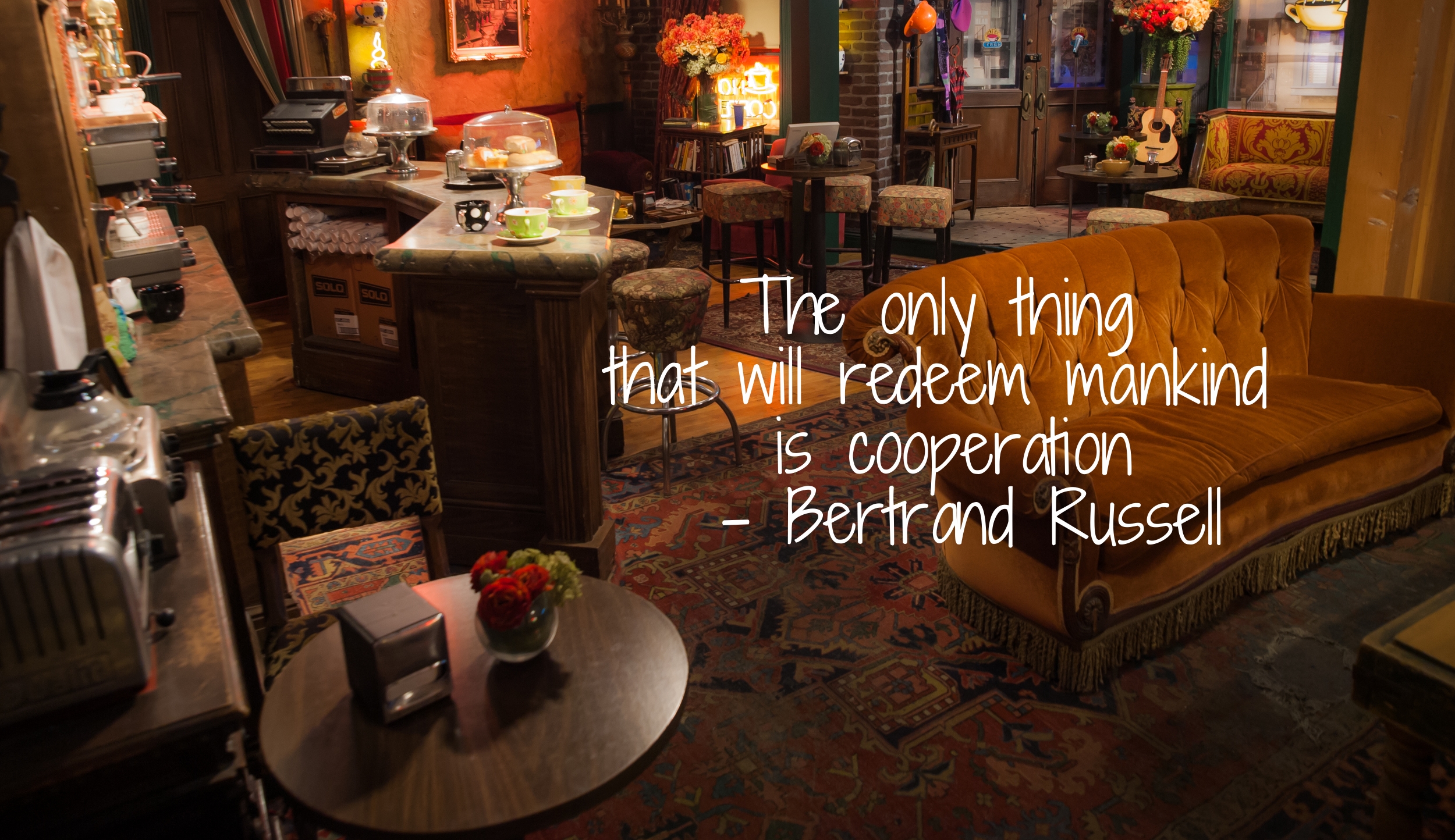
Coffee shop seating - cooperation

Have you ever told yourself you’re gonna do something and didn’t do it?

I have. More than a few times. On a scale of trivial to life-changing most of those things were somewhere in between. I regretted not following through on some for sure. Writing a book is one of those. I always wanted to write one. Never did.

Why does that happen? Why do we flake out so much? I’m not a psychologist, but I think it has a lot to do with who we hold ourselves accountable to. Think about it. If you tell yourself you’re gonna do something and only a few people know about it and then don’t do it, you’ll just waive your mental white flag and move on. You might regret it later, but face no real consequence. You can make up your own excuses for not taking action and no one will think any less of you.

Except maybe yourself. Because you know the excuses are BS.

The Antidote? Tell Everyone You Are Doing IT. Whatever IT is. Really. Write IT down in your journal/phone/notebook and then tell the world about IT. Tell your whole family. Tell everyone at work. Tell everyone at church. Tell everyone at school. Tell them on social media. Blog about it. Brag. Brag. Brag. Do it all when the energy is high, the motivation plentiful, and the sense of purpose grand. Try punking out now!

So, in the spirit of calling ourselves on our own BS, here’s my

“I’mma Starbucks My Classroom Manifesto”

I want my classroom to be like Starbucks! And I don't mean the coffee - though I like it too. The plan is to throw out the traditional student desks and replace them with couches, armchairs, coffee tables, high tables with stools, restaurant style tables, standing tables, a rug etc.

I participated in a Twitter chat recently and Kayla Delzer, a 2nd grade teacher from North Dakota popped in for a few to say "Hi." Shortly before the chat, I read an article she wrote for edutopia titled Flexible Seating and Student-Centered Classroom Redesign and it inspired me to "Starbucks" my high school chemistry classroom. Somehow the chat discussion shifted to that very topic and Evan Robb, a middle school principal from Virginia tweeted: "Starbucks is designed for communication- rows are for compliance." 

light bulb moment

That's exactly it! Traditional student desks promote compliance, while coffee shop type seating encourages community building and creative problem solving through increased and deliberate emphasis on communication and collaboration. The question I asked myself was: Do I want compliance or cooperation? The answer was easy: I'mma Starbucks My Classroom.

Research proves that our physical environment has a significant effect on our social-emotional being and student learning. I want to provide all of my students with the opportunity to gain 21st century skills by creating a 21st century learning environment that promotes creativity and innovation, but also builds a community in which students learn to not just accept, but embrace personal differences.

I believe that as a teacher I need to be intentional in how I set up my room if I want students to work together toward a common goal. It is one thing to "wish that students work in groups," but it's entirely another to understand that community/team building is a process a teacher needs to deliberately put into action.

Teamwork does not "just happen." Teachers must support it with the right physical, social, and emotional environment and build it "from the ground up."

Sharing ideas and learning with and from others through collaboration has been shown to increase school success and retention. Success (deeper learning first, grades second) improves the social-emotional well-being of students. In turn, they learn better. The cycle of awesomeness perpetuates.

Upon creating the new learning environment, my students will work together every single day and I will be working with them as part of the team. And, we will be moving around, which is crucial to learning. physical health, and emotional well-being. Humans are not meant to sit in one place. We are born curious and we learn by exploring our world, which requires all of the senses.

I am convinced that traditional educational settings dull the senses. We know that breaks and interruptions after periods of focused activity actually help in learning. The "Starbucks" environment will promote freedom and movement.

Freedom is the key ingredient to social emotional well being and deeper learning. Rows and columns constrict. They hold and stifle. That is the truth. That is the reality in many US classrooms of today. But no longer in mine. Never again.

I’mma Starbucks My Classroom. Free WiFi and all.

I’mma Starbucks My Classroom. BYOC.

I’mma Starbucks My Classroom. For my students. For myself. For the future.

What will you do?

PS. I AM WRITING A BOOK RIGHT NOW. There, I’ve said it. Proclaimed it. What can I say? I got things to say. Coming to the screen near you in July/August 2016.

Thanks for reading! Check me out on BAm! Sign Up for my Newsletter on the science of learning, teaching and learning strategies, and finding inspiration in the little things. And, you can always count on me to encourage others to ask questions, look for answers, and gulp (not sip) life.

Remember: You Have the Power to Change the World (and Starbucks Your Room). Use It Often!

Crush That Test with 12 Yeses and 4 Tips

By Oskar Cymerman | @focus2achieve | BAm! Radio Network EdWords Blogger
"Test" is a loaded word. Plenty of Ed folk out there start hyperventilating hearing the word alone. Put STD in front of "Test" and some educators will roundhouse kick you Chuck Norris style.

Had my arm twisted to proctor a few Standardized Tests this year, uhm... every year. Good times...

STD Ts are a drag. So are STDs, but that's a story no one wants to hear.

"Grades" - that's another hot topic. Keep them? Kick them? I have my preferences. So do you.

Regardless, tests and grades pervade education. They'll be here a while. Good, bad, or ugly we gotta deal with them. Tests get grades. Grades get diplomas. Diplomas get jobs.

But first we gotta get tests. And then crush them.

Help students crush tests.

Here's how:

Crush That Test

Here's the Crush That Test Checklist PDF style for your printing pleasures.

Thanks for your time! I hope you find the infographic above useful. Please share it with other teachers, students, and parents. You can access all other Brain-Based Learning infographics I created by scrolling down my ED!Blog. I will feature more Brain-Based Learning teaching tools, metacognitive strategies, and posts on social-emotional learning in my future NEWSLETTERS, so please SIGN UP if you would like to receive tips that help students become better learners and you're looking to add more weapons of mass creation to your teaching arsenal :)

If you find the information in the infographic useful, consider buying "Crush School: Every Student's Guide To Killing It In The Classroom", which is a book I wrote to help students learn more efficiently and effectively using proven research based strategies.

You Have the Power to Change the World. Use it Often.

Sources:

1. Richard M. Felder MEMO TO STUDENTS WHO ARE DISAPPOINTED WITH THEIR LAST TEST GRADE.
2. Coursera Learning How To Learn MOOC by Barbara Oakley PhD & Terrence Sejnowski PhD.

Brain Hacking 411: Making Teamwork Work

By Oskar Cymerman | @focus2achieve | BAm! Radio Network EdWords Blogger

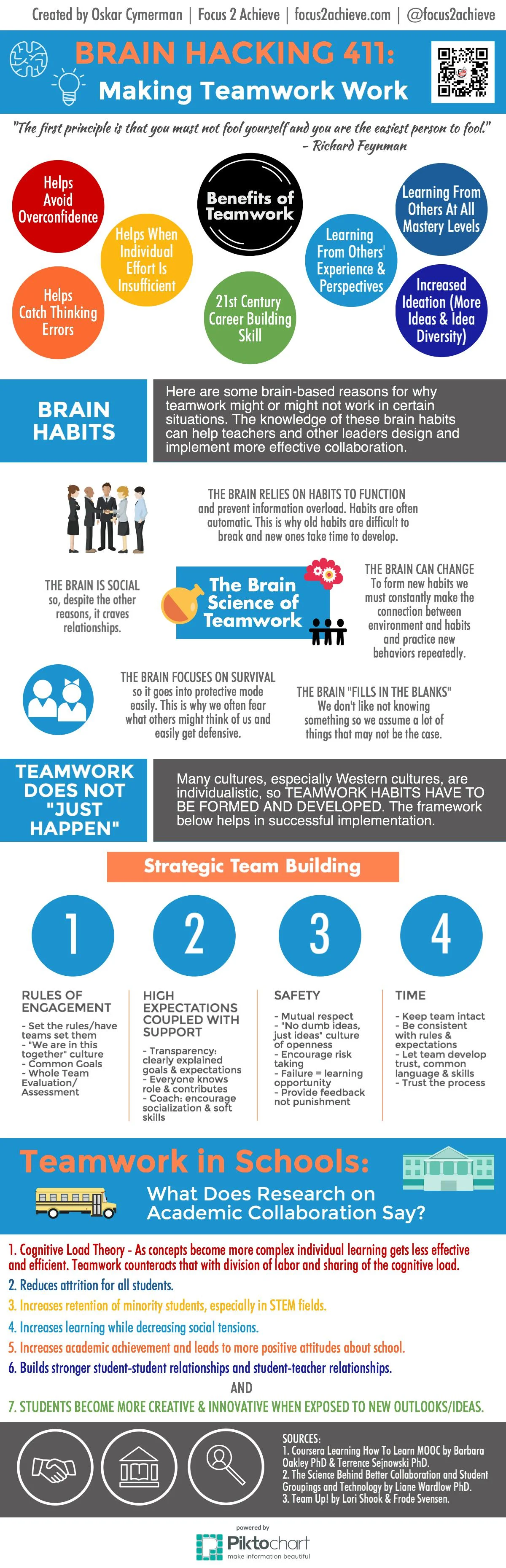
Leaders such as a teachers, administrators, coaches, and supervisors are tasked with developing effective and efficient practices to increase the performance of the individuals they lead and their organization's prestige. While there are many practices that lead to improvement, there is one that is vital to the very survival of any group or organization: Collaboration.

Collaboration is so important that it, along with Critical Thinking, Communication, and Creativity, has been slapped with the "21st Century Skill" tag, and rightfully so as research cites effective team building and collaboration as game changers to the health and performance of organizations. Moreover, Collaboration improves Critical Thinking, Communication, and Creativity in individuals as they benefit from others' wisdom and experience, continually look for effective ways to present ideas and influence other team member's decisions, and combine their skill sets with those of others.

Efficient and effective teamwork however, is not automatic. At any level, elementary to executive, successful collaboration doesn't just happen. In fact, much like an NBA team may be built around a young up-and-coming leader, a "floor general", classroom groups or business task forces are a sum of their complementary pieces with the leader at the helm. The teacher is the floor general (or captain awesome) in his/her classroom and it is up to him/her to lead the troops into battle. And, this ain't just any battle. This is the battle for our future, the future of our kids, and the future of their children. This one's big and it must be won.

And it will be.

We will succeed not through competition and the undermining of others, but through combining and compounding our forces.

Together is the destination; Collaboration is the way. Let us take it and not stray.

Today, I give you a weapon that will aid you in successful team building. Use it well.

Teamwork Infographic

Teamwork Infographic

Thanks for your time! I hope you find the infographic above useful. Please share it with other leaders. You can access the other Brain-Based Learning infographics I created by scrolling down my ED!Blog. I will feature more Brain-Based Learning teaching tools, metacognitive strategies, and posts on social-emotional learning in my future NEWSLETTERS, so please SIGN UP if you would like to receive tips that help students become better learners and you're looking to add more weapons of mass creation to your teaching arsenal :)

If you find the information in the infographic useful, consider buying "Crush School: Every Student's Guide To Killing It In The Classroom", which is a book I wrote to help students learn more efficiently and effectively using proven research based strategies.

You Have the Power to Change the World. Use it Well. Use it Often.

2026 Crush School