CRUSH SCHOOL

I blog on Brain-Based Learning, Metacognition, EdTech, and Social-Emotional Learning. I am the author of the Crush School Series of Books, which help students understand how their brains process information and learn. I also wrote The Power of Three: How to Simplify Your Life to Amplify Your Personal and Professional Success, but be warned that it's meant for adults who want to thrive and are comfortable with four letter words.

Educational Myth #5: ONLINE Learning Should Be Used More Because It’s Better At Educating The 21st Century Learners

by Oskar Cymerman       @focus2achieve

ONLINE LEARNING VS. TRADITIONAL LEARNING

ONLINE LEARNING VS. TRADITIONAL LEARNING

Does online (distance/web-based) learning work? If so, is it a better academic medium? Does it lead to more learning?

These are some of the questions I want to answer for myself and for all of you wondering about this sometimes-controversial topic. With the proliferation of online “schooling,” beginning with more and more traditional institutions, such as K-12 schools and colleges, offering more and more online courses, and ending with new, exclusively online schools, non-profits, and corporate organizations seemingly popping up every day, it is easy to conclude that if the instruction is delivered via the world wide web it must be better than the brick-and-mortar way of educating.

Does it work?

It can, but it might not.

For a sophisticated learner, online learning may be just what the doctor ordered as it allows more flexibility. For many others, especially the K-12 students, trying to learn while sitting in front of the computer screen ends up disheartening and detrimental to their success, as they find the coursework more difficult and more time-consuming.

One of the most ubiquitous myths about online learning is that it is easy, or at least easier than classroom learning. Many students fall into the trap of thinking that they can drop a tough high school course and do it online or resolve to complete a web-based college degree thinking it will be less time-consuming and stress free.

Many colleges and universities, including UNLV, report that online courses offer the same rigor and expectations as face-to-face classes. While flexible and convenient, online courses have deadlines and due dates for completing assigned reading, projects, and other activities.

In fact, when comparing face-to-face and online education, either coursework might be more difficult than the other, depending on the reading, instructors, projects, and assessments a student must complete.

So, a student expecting an “easy ride” in an online class is in for a rude awakening.

I have experienced this first hand as someone who has taken online college courses and as an online credit recovery facilitator in my school. All of the classes I completed via the web required discipline and major time commitment and the same is proving to be the case for the high school students I work with. Out of the 51 enrolled in online credit recovery courses 14 made any progress, and out of those only a few are on track to actually receive credit.

What I learned is that online education:

·      is not for everyone and not a sensible option for struggling or at-risk pupils.

·      requires a well-developed learning skill set that includes strong reading and writing skills, self-motivation, independence, and good time management.

Is it better?

 To put it succinctly: the two models of learning are different.

Rigor is essential in the traditional classroom and is equally important online, as it leads to the understanding, knowledge, applications, skills, and competencies that are required for academic success. Institutions and organizations that offer online education claim the expectations and content are the same as in the physical classroom, and that flexibility students have is not synonymous with lack of rigor.

In a nutshell: While students can pick the times they choose to work on the online class content, there are deadlines they have to meet and learning objectives they must accomplish to successfully satisfy credit requirements.

I compiled a table of PROS AND CONS OF WEB-BASED LEARNING below to take a closer look of what a learner might encounter and should expect while completing on-line coursework.

PROS AND CONS OF ONLINE EDUCATION

Does it lead to more learning?

Answering this question requires to again look at the student and what I call his learning sophistication. As there is very little “hand-holding” in an online environment, the pupil has a much greater responsibility for his own learning.

Therefore, an independent, organized, and motivated strong reader has the potential to “get more out” of online learning than he would by being “stuck” in a face-to-face classroom.

However, a pupil who struggles with decision-making, needs frequent problem-solving instruction, or requires help with organization and time-management will likely experience many barriers to content and skill mastery.

So What’s The Verdict?

There is nothing wrong with online education when it is done well. There is nothing wrong with traditional education when it is done well.

Both models have their advantages and disadvantages.

The quality of instruction and student outcomes is essentially the same; so much so, that the phrase: “no significant difference” has become the comparison paradigm between web-based and classical learning.

Sometimes, a learner is better suited for online education. Sometimes he does not possess the necessary skills and habits to survive and thrive in an online environment.

AND FOR THOSE REASONS, WE SHOULD CONTINUE TO IMPLEMENT AND IMPROVE BOTH :-)


What are your thoughts on online vs. traditional learning? Do you have any personal stories you can share? Please comment below and let’s get the conversation going. Remember: You have the power. Use it.


Please share this article below and sign up to receive the newsletter (on the right) when I publish new articles. Thank you for visiting!
Educational Myth #4: Teacher Experience Doesn’t Matter If You Care

by Oskar Cymerman       @focus2achieve

DOES TEACHER EXPERIENCE MATTER?

DOES TEACHER EXPERIENCE MATTER?

"The sky is the limit. You never have the same experience twice" - Frank McCourt

I was a “hot shot” science teacher in 2003, my first year of teaching. I mean: I was young, eager, and driven to be the best educator out there; one to change the world one action and one student at a time.

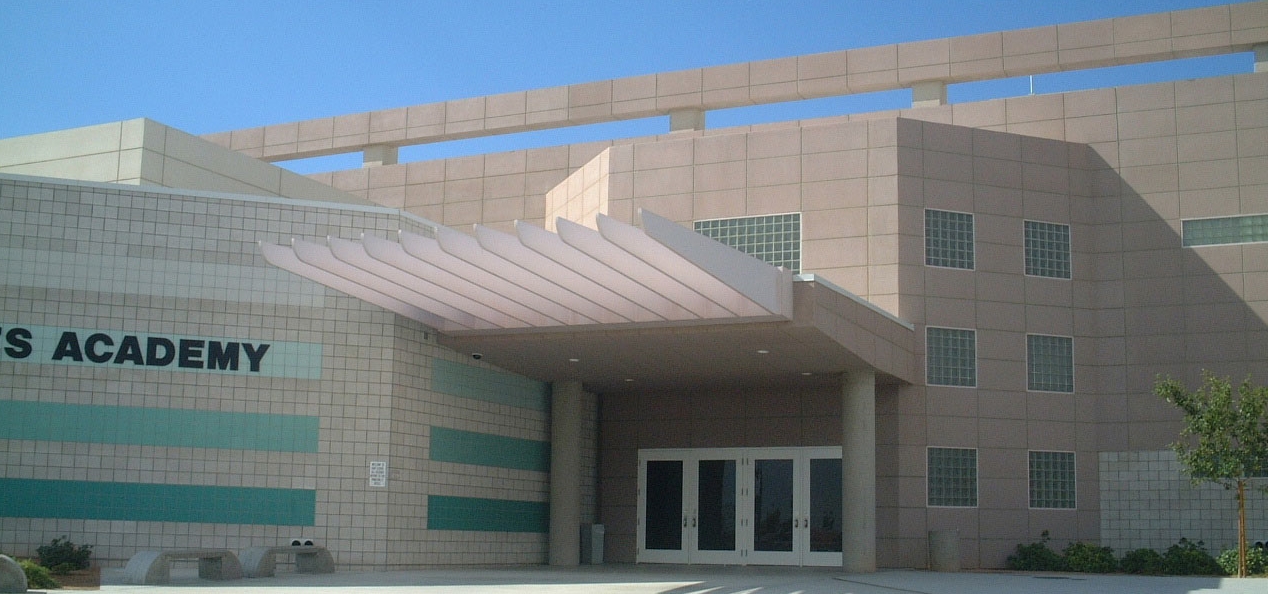
I really cared about providing the best possible education to the disadvantaged youth of the Chicago’s Dunbar Career Vocational Academy, and though I was as fresh as it gets in my profession, I held a conviction that somehow my lack of experience did not preclude me from being one of the best teachers at my school.

Was I? I don’t know, but I believe that I had an influence on how some of my students viewed the world and life as a whole even back then. My first few years at the tough Chicago south side high school were difficult to say the least, and however infrequently, it was gratifying to find out from students they appreciated me as a teacher or were thankful for opening their eyes to the world they were unaware of before. I worked hard, was adequate, and that was okay then.

But from the perspective of time, and through continuous self-reflection, I know that I perform this gig a whole lot better now. I am a better teacher and a pedagogue. I am quite simply a better and more experienced educator.

What Recent Research Says About Teacher Experience

I looked for and examined research studies conducted in the last decade, and while some were inconclusive, I found at least ten that report strong correlation between teacher experience and student achievement.

According to Clotfelter et al. (2006) “TEACHER EXPERIENCE IS CONSISTENTLY ASSOCIATED WITH ACHIEVEMENT.”

Sawchuk (2011) REVIEW OF MORE THAN 40 RESEARCH STUDIES, SYNTHESES, AND INTERVIEWS with quantitative researchers found that the EFFECT OF EXPERIENCE ON STUDENT ACHIEVEMENT APPEARS TO BE GREATER THAN MOST OTHER TEACHER CHARACTERISTICS.

Wiswall (2013) used data covering all 5TH GRADE PUBLIC SCHOOL TEACHERS FROM NORTH CAROLINA and concluded that “FOR MATHEMATICS ACHIEVEMENT THERE ARE HIGH RETURNS TO LATER CAREER TEACHING EXPERIENCE, about twice as much dispersion in initial teacher quality as previously estimated.”

Dial (2008) found that a teacher’s degree level alone had no effect on student achievement, but he discovered that EXPERIENCE HAD AN EFFECT ON STUDENT ACHIEVEMENT IN BOTH COMMUNICATION ARTS AND MATHEMATICS.

Harp (2010) studied the relationship between teacher characteristics, including experience, and eighth grade students’ science achievement. His sample consisted of 44 8th grade science teachers and 4,119 students in TEXAS PUBLIC SCHOOLS. He concluded that TEACHER EXPERIENCE ACCOUNTED FOR 24% OF THE VARIANCE with TAKS Structures and Properties of Matter.

Parsons’ (2011) study of student achievement as measured by the Iowa Test of Basic Skills (ITBS) suggests that teacher preparation and qualifications do not predict achievement, but TEACHER EXPERIENCE, ATTITUDES, AND BELIEFS ARE SIGNIFICANT PREDICTORS OF STUDENT SUCCESS. The study involved 31 CHARTER SCHOOLS operated by Mosaica Education.

Huang and Moon (2009) performed a MULTILEVEL ANALYSIS of teacher characteristics and student achievement in LOW PERFORMING SCHOOLS and concluded that “YEARS OF TEACHING EXPERIENCE AT A PARTICULAR GRADE LEVEL, WAS FOUND TO BE SIGNIFICANTLY ASSOCIATED WITH INCREASED STUDENT READING ACHIEVEMENT.”

Harris and Sass (2007) observed that “MORE EXPERIENCED TEACHERS APPEAR MORE EFFECTIVE IN TEACHING ELEMENTARY MATH AND READING AND MIDDLE SCHOOL MATH.“

Through the use of STATE STATISTICAL DATA, Rice (2010) found that the IMPACT OF EXPERIENCE IS STRONGEST DURING THE FIRST FEW YEARS OF TEACHING.

Ladd and Sorensen (2014) discovered that TEACHER EXPERIENCE WAS POSITIVELY ASSOCIATED WITH STUDENTS’ TEST SCORES AND BEHAVIOR. They found the IMPACT OF TEACHER EXPERIENCE TO EXTEND WELL BEYOND THE FIRST FEW YEARS OF TEACHING.

Thus, there is strong evidence that links teacher experience to:

1.     Enhanced student success in the classroom.

2.    Improved test scores in reading, math, and other areas.

3.    Increased positive student behaviors, such as better attendance and classroom behavior.

What I Learned

There were a lot of bad teachers out there in the school system when I started out in 2003, but there were also plenty of good and great teachers too. There were teachers who cared about their students and were really good at helping students learn then, and I observe considerably more of them now.

I think it was easier to find examples of long time teachers unwilling to adapt their methods to their learners at the turn of the century. This in turn, made the assumption that a new teacher, inexperienced but full of passion, is better than the OG (“original gangsta” = old guard), who is simply indisposed to meet their students where they are at.

However, the education reforms of the last decade-plus have all but eliminated the un-credentialed teachers and have perhaps prompted increased retirement rates among the OGs.

What Does It All Mean?

EXPERIENCE MATTERS. IS IT CRUCIAL TO BEING A GOOD TEACHER? NO.

I observe plenty of young educators working hard and well with teens every year. Often, what they lack in experience they make up with enthusiasm and persistence, and they teach their students well.

What I also witness, is that these new teachers get better at teaching every year as they arm their “teaching arsenal” with new ways of interacting with students and innovative methods of delivering instruction. If they chose so - through continuous reflection, improvement, and self-growth - they become great educators.

What is most encouraging here is that all teachers, not just the new ones, can chose to continually improve. We have the tools, the resources, and the intellectual capacity to become ever-better educators, free of charge. We do not need more advanced degrees (which can help) to achieve this, as there are free resources we can access and almost instantly grow our teaching superpowers. Our only kryptonite is ourselves.

I still observe a few OGs here and there, who think their way of doing things is best and who, despite the “learner evolution” that is constantly occurring, are unwilling to change, because they might be a few years from hanging it up and do not want to venture outside of their comfort zone.

But, if anything, I find their existence encouraging, because they are a dying breed and we now have the opportunity to once and for all entomb this way of educating, or rather “miseducating,” our students.

We can become the OGs who promote and cultivate continuous professional growth and student development, rather than the guard of antiquated educational procedures and methods that are detrimental to student success. To do this, we have to commit to grow as individuals and professionals, which requires an acceptance of the fact that some of the things we find effective now will be fruitless in the future.

This incessant improvement has to be a conscious effort. I know, because I’ve allowed myself to relent in this work in the past. I could make excuses and say that life got in the way, but I know that would only be a half-truth, as we are all responsible for our own actions. I’m back on the wagon now, as I am reading more, reflecting more, looking for new ways of teaching my students, trying new ideas, researching trends, signing up for workshops, collaborating with my colleagues to a greater degree and effect, and locating and creating new resources I can impact my students’ success with.

I would love to hear from you about what new things you are doing in your teaching/classroom now, that you haven’t done before. What are you trying out and is it working? Please comment below and let’s get the conversation going. Remember: You have the power. Use it.


Please share this article below and sign up to receive the newsletter (on the right) when I publish new articles. Thank you for visiting!
Resources:

Huang, F. L., & Moon, T. R. (2009). Is experience the best teacher? A multilevel analysis of teacher characteristics and student achievement in low performing schools. Educational Assessment, Evaluation, and Accountability, 29, 209–234. Retrieved from http://christyhiett.wiki.westga.edu/file/view/Is+experience+the+best+teacher.pdf

Clotfelter, C. T., Ladd, H. F., & Vigdor, J. L. (2006). Teacher–student matching and the assessment of teacher effectiveness (NBER Working Paper No. 11936). Cambridge, MA: National Bureau of Economic Research. Retrieved from http://www.nber.org/papers/w11936.pdf?new_window=1

Harris, D. N., & Sass, T. R. (2007). Teacher training, teacher quality, and student achievement (Working Paper No. 3). Washington, DC: National Center for Analysis of Longitudinal Data in Education Research. Retrieved from http://www.caldercenter.org/PDF/1001059_Teacher_Training.pdf

Ladd, H. F., & Sorensen, L. C. (2014). Returns to teacher experience: Student achievement and motivation in middle school. Washington, DC: National Center for the Analysis of Longitudinal Data in Education Research, American Institutes for Research. Retrieved from http://www.caldercenter.org/sites/default/files/WP-112_final.pdf

Rice, J. K. (2010). The impact of teacher experience: Examining the evidence and policy implications. Washington, DC: National Center for the Analysis of Longitudinal Data in Education Research, Urban Institute. Retrieved from http://www.urban.org/uploadedpdf/1001455-impact-teacher-experience.pdf

Sawchuk, S. (2011). EWA research brief: What studies say about teacher effectiveness. Washington, DC: National Education Writers Association. Retrieved from http://www.ewa.org/sites/main/files/file-attachments/teachereffectiveness.final.pdf

Wiswall, M. (2013). The dynamics of teacher quality. Journal of Public Economics, 100, 61–78.

Dial, J. C. (2008). The effect of teacher experience and teacher degree levels on student achievement in mathematics and communication arts. Unpublished manuscript, Baker University. Retrieved from https://www.bakeru.edu/images/pdf/SOE/EdD_Theses/Dial_Jaime.pdf

Harp, A. (2010). Eighth grade science teacher quality variables and student achievement. Unpublished manuscript, University of North Texas. Retrieved from http://digital.library.unt.edu/ark:/67531/metadc33159/.

Parsons, E. (2011). A comprehensive study of the relationships between teacher characteristics and value-added to student achievement (Doctoral dissertation). Retrieved from Proquest Dissertations and Theses (Publication number AAI3492295).

FitzGerald, Eileen (2013) Teachers retiring this year in high numbers. NewsTimes. http://www.newstimes.com/local/article/Teachers-retiring-this-year-in-high-numbers-4628502.php

EDUCATIONAL MYTH #3: PRIVATE SCHOOLS ARE BETTER THAN PUBLIC SCHOOLS.

by Oskar Cymerman       @focus2achieve

PUBLIC SCHOOLS VS PRIVATE SCHOOLS

PUBLIC SCHOOLS VS PRIVATE SCHOOLS

I am a public schools' child. When I lived in Poland, I attended a public elementary school. Upon landing in the U.S., I enrolled in the Chicago Public School's (CPS) Curie High School. Later, I received a degree from the University of Illinois at Chicago (UIC), a State University. In my career, I only taught in public schools. First in CPS, then SPPS (Saint Paul Public Schools) in St. Paul, Minnesota, and finally in SWCS (South Washington County Schools) in Woodbury, Minnesota. 

What do I know of Private Schools? Other than hear-say and the mean nun stories (I am 100% positive ALL nuns in Catholic/Christian schools are mean :-), which depict teacher-nuns smacking pupils' hands with rulers when they make grammatical errors or portray these instructors as "punishers" who make kids kneel down and hold their arms, fingers pointing to the heavens, until all blood leaves these extremities, for misbehaving.

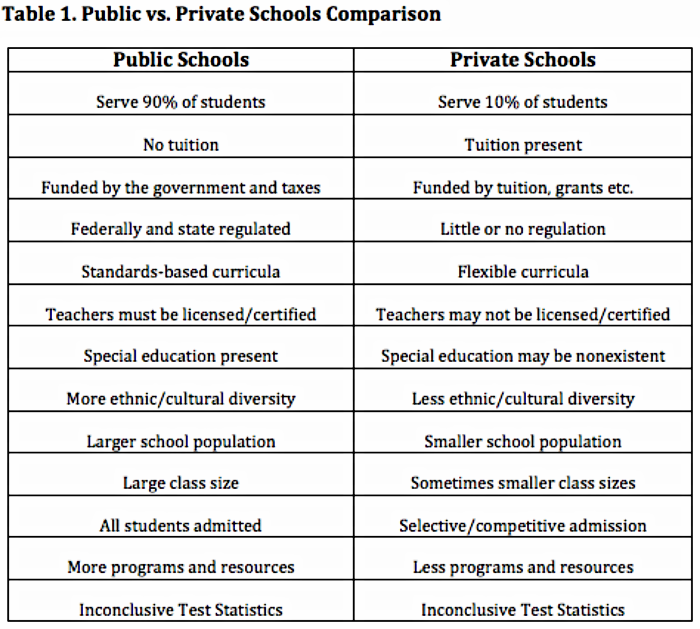
My son is not yet two, but I must confess that I never thought he might go to a private school. I am public school biased. I know it, I admit it, and I do not apologize for it. However, I realize that I know very little about what private schools are all about, so I decided to take a closer look and compare them to what I know, which is public schooling. Thus, I researched and compiled the biggest contrasts in the table below. What follows is my analysis of these differences and conclusions I draw from them. 

PUBLIC SCHOOL VS PRIVATE SCHOOL

PUBLIC SCHOOL VS PRIVATE SCHOOL

Regulation

I do not view the state standards as something that limits me as a teacher. I see them as a guide that specifies the skills and big ideas I must help my public school students learn. The way I do that is up to me and I like the curriculum planning process as I see it as practice in creativity. I strive to make my lessons meaningful, interesting, and, if possible, fun. I believe in people, so I will give the private school instructors the benefit of the doubt and trust that they do teach their students the skills and ideas they will need to use at the next level. I do admit though that such lack of oversight makes me a little uneasy, as all I have to do is close my eyes and envision a rogue teacher discrediting evolution and teaching creationism as a de facto scientific theory. Yikes!  

Credentialing

The public schools rid themselves of uncertified teachers as the G. W. Bush’s claim to fame (or infamy, depending on how you look at it) the No Child Left Behind Act (NCLB) mandates state institutions to provide “highly qualified” educators for their children. While the private sector of our industry still employs license-less instructors, sources I reviewed report that these individuals tend to possess the “real-world” experience in the subject they teach. That doesn’t seem so bad…

Diversity

Public schools are more diverse. As a 14 year-old kid leaving the country of my birth, Poland, I have seen people of different races on television only. Then, the airplane my family was on landed in Chicago, and in an instant I was immersed in the cultural and ethnic melting pot of the Midwest, as I walked the streets, played sports at the local park, and enrolled in a public high school near where we rented our attic apartment. While attending Curie High School, I had to learn to embrace and I have come to appreciate the differences, the customs, and the traditions of other ethnicities. We are all humans, and as such, we will always be more connected than divided, but I would not be able to arrive at this fact had my parents placed me in a private school. I want the same experience for my son.

 School/Class Size

On average, public schools have two time more students than their private counterparts. In general, smaller schools are better. Research seems consistent on this issue as smaller schools are reported to lessen the effects of poverty, reduce violence, and increase student accountability.

Private schools are thought to have smaller class sizes, but there is no guarantee that they will, and some, especially catholic schools, sometimes have larger classes than those in public schools. However, many publications, including Visible Learning by John Hattie, report class size having little effect on student success. 

Test Statistics

Traditionally, students in private schools are assumed to score better on assessments. However, I came across a few publications, including The Public School Advantage: Why Public Schools Outperform Private Schools, which, when apples are compared to apples, show that students in public schools indeed score higher than their private school counterparts. So rather than trying to pick the winner here I’ll say this: Anyone can be successful in most schools, he or she just has to want to.

Bottom Line

Private schools are not better than public schools. Public schools are not better than private schools. They are different. There are some things that favor private schooling and others that favor public education. Every family has to decide for itself what is best for their children and make school choices based on that. I want Adam to go to a public school, but my wife might have a different idea when we sit down to talk about it. But no matter what we decide, I will have the comfort of knowing that my son can be successful wherever he goes.

What is your preference and why?

Please leave me a comment and subscribe to the newsletter if you like what you see and remember that you have the power. Use it.

2024 Crush School