CRUSH SCHOOL

I blog on Brain-Based Learning, Metacognition, EdTech, and Social-Emotional Learning. I am the author of the Crush School Series of Books, which help students understand how their brains process information and learn. I also wrote The Power of Three: How to Simplify Your Life to Amplify Your Personal and Professional Success, but be warned that it's meant for adults who want to thrive and are comfortable with four letter words.

Filtering by Category: Teaching

Evoke Emotions To Help Students Learn

By Oskar Cymerman | @focus2achieve | BAM! Radio Network & Teaching Channel Blogger

Emotions

As the students were working on their bell ringer today (recalling radioactive decay equations), I stood in the middle of class and read the following to them:

He was the only person making his way into the city; he met hundreds and hundreds who were fleeing, and every one of them seemed to be hurt in some way. The eyebrows of some were burned off and skin hung from their faces and hands. Others, because of pain, held their arms up as if carrying something in both hands. Some were vomiting as they walked. Many were naked or in shreds of clothing. On some undressed bodies, the burns had made patterns—of undershirt straps and suspenders and, on the skin of some women (since white repelled the heat from the bomb and dark clothes absorbed it and conducted it to the skin), the shapes of flowers they had had on their kimonos. Many, although injured themselves, supported relatives who were worse off. Almost all had their heads bowed, looked straight ahead, were silent, and showed no expression whatsoever.
— "Hiroshima" by John Hersey

Then, I showed them haunting imprints of people killed by the blast...

This was my prelude to starting the discussion on nuclear fission and fusion in chemistry today. And, while the images students undoubtedly saw in their minds upon hearing the above story were gruesome, my purpose was clear. I wanted to evoke strong emotions.

I am reading "Brain Rules" by John Medina, which I enjoy and highly recommend, as the guy is an incredible writer, in addition to being a college professor and a brain guru. I recently finished a chapter titled "Attention" in which Dr. Medina explains how to grab and hold students' focus throughout the lesson.

One of the strategies he uses in his college lectures is employing "hooks." A hook is an emotionally competent stimulus (ECS) or an event that triggers strong emotions. All learning has emotions associated with it, but the stronger they are the better encoded the information becomes. During an emotionally charged event, out brain releases dopamine, which helps information processing and improves memory formation.

Thus, the "Hiroshima" story I read was a hook. But it wasn't just emotionally charged. It was also relevant, which is another key ingredient to a successful hook. If the hook information is unrelated to the topic you're getting ready to discuss, it will not be effective.

Then I got to talking about the pros and cons of nuclear reactions (Hiroshima was hit with a fission bomb named "Little Boy") and gave examples of fission and fusion reactions. That took about 10 minutes followed by students completing and identifying nuclear equations in small groups.

I felt that all students understood the material. I'll have to come back to it and have them practice more, but I feel they are well on their way to mastery of nuclear equations.

Remember the magic number 10. It is the number of minutes you can hold an audience's attention before it spikes way down. So...

1. Grab your audience with a hook to evoke emotions.

2. Teach 1 big concept for 9 minutes. Explain the big idea. elaborate. Give examples.

3a. Have students apply the concept and teach each other.

3b. Have a new hook ready if you want to keep going for another 10 minutes. The hook gives your audience a much needed brain break and can be used to introduce the next big idea.

4. Repeat, and keep it to 3 (maybe 4) big concepts tops. Less is more.

Hey. Thanks for reading! What do you think about using emotions in the classroom? Leave a comment or Sign Up for my Newsletter and we'll learn together.

You Have The Power To Change The World. Use It Often.

Sources:

Brain Rules: 12 Principles for Surviving and Thriving at Work, Home, and School by John Medina

Hiroshima By John Hersey

Overwhelmed And Overloaded: Welcome To Homework Central

By Oskar Cymerman | @focus2achieve | BAM! Radio Network & Teaching Channel Blogger

homework girl

Hi everyone,

Today, I want to tell you about a serious concern I have. It all began this morning...

She looked visibly tired entering 1st period this morning, so I asked: How are you Mandy?

Mandy: I'm really tired. I didn't get back home from gymnastics until 7:30 and then I had 50 Pre-calc problems to do. Other homework wasn't too bad, maybe 15 minutes each, but when you have 6 classes... I got done at 11:30 and couldn't fall asleep till like 1:30, so I'm kinda out of it.

All I could say was that I am sorry she had such a stressful evening and night. She replied that she gets a lot of homework in math every night...

Mandy is in my engineering class.

Later, I had my chemistry students reflect on our classroom blog about their school year so far. I asked them to write about how they feel and whether they are stressed or not. Here are a few posts:

Homewrok 4
Homework 8
Homework 7
Homework 6
Homework 5
Homework 3
Homework 2
Homework/Illness

Notice a pattern?

Not every student wrote about homework, stress, or being overwhelmed. But, these were the most common and recurring themes and it's only week 2. It's the 8th day of school!

The ironic thing is that had I not started the classroom blog this year, I would have no idea how bad this is.

I engaged one student after reading her post and she told me that her math teacher doesn't always finish the lesson in class, so she has to try to teach herself before she can do the huge homework assigned every night. Even if the teacher does finish, many students do not understand or feel confident they understand the material as there's never time to practice in class.

We have grown accustomed to homework being the holy grail that solves the "practice" dilemma.

Stress, frustration, lack of sleep...

The next day cycle repeats.

Overwhelmed, overloaded, stressed, frustrated, tired, and expected to learn.

And, many students succeed despite these things, which is a flipping miracle considering how detrimental stress, fatigue, and frustration are to the brain operating at it's full capacity.

And no one knows. Hardly any student complains. They suck it up. They power through. This is what high school's supposed to be like, right?

This is the status quo in many American high schools. But who creates it?

We, the teachers, and our inability to let go of the old paradigms, are the source of student stress. We overburden students believing we are doing them a favor. We overwhelm them with information. And then, we promptly overload them with "practice" problems, often without regard for the fact that many of our pupils have not mastered the skills and concepts necessary to "practice."

What we are not doing is seeking to understand. We are not inquiring. We are not considering.

We assume too much. We don't trust enough. And that saddens me.

But the simple truth is that we can change it. We can decide to teach the whole child and pay attention to all of the other things that are not just important, but essential in children's lives.

Standards can wait. We must have the courage to put the standards aside and do what is best for the child.

I'm talking about embracing the development of the teenage mind, body, psyche and spirit here. Helping to reduce the meaningless busy work and stress. Fostering movement and encouraging physical activity. Decreasing the load to increase rest and sleep. Nourishing the individual with understanding and respect for who he is, and not who or what we think he should be. Validating the incredible importance of relationships, family time, and things that feed our spirit.

Whatever the status quo is where we are... We can do better. We must do better.

I am hopeful we will. It's because I know that a great majority of us join the education profession to serve students and not our own devices. We are at our best when we remember this.

We affect lives. This is a fact, not a choice. We can influence change.

We are dreamers. We are believers.

Sometimes, we wear capes. It's time to earn them.

Educators Have The Power To Change The World. Let's Use It Now. Let's Use It Often.


Hey. Thanks for reading! We can get rid of most, if not all homework, and it's not that difficult. All you need is the will and a few drops of creativity. But that's my next post, so Sign Up for my Newsletter and I will drop it in your email inbox as soon as it drops. Till then :)

Google It! Collaborative Classroom Activity

By Oskar Cymerman | @focus2achieve | BAM! Radio Network & Teaching Channel Blogger

Google It!

Hiya friends!

So I switched to coffee shop style flexible seating in my chemistry classroom, which means that

  1. Students face each other and not necessarily me or the front of the classroom.

  2. I have to be intentional about building collaboration into my lessons and teaching students to collaborate..

  3. I have to change the way I deliver much of the instruction and look for ways to change my teaching to fit the environment my students and I suddenly found ourselves in.

Today, I decided to let my students "Google It." They already learn this way outside of school, so why not let them inside? I too learn a lot of things by Googling or YouTubing them. If learning this way is something students already do, they can benefit from it, and I can curate it, why not do it?

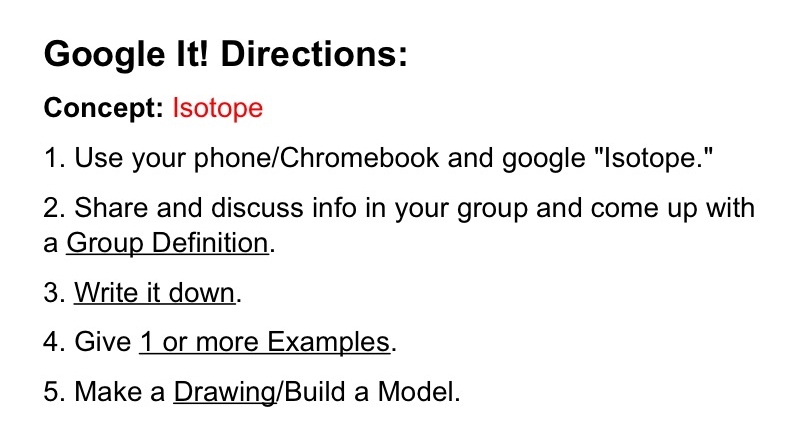
The new concept to learn was "Isotopes." We did a bell ringer activity to review from the day before and got right into it. Here are the directions I gave:

Google It! Collaborative Classroom Activity

I went over the directions and reiterated cooperation. I repeated the directions and gave them the go-ahead.

Off they went googling "isotopes." Starting out with this activity instead of direct instruction allowed me to walk around the room, talk to students, ask questions, redirect the ones who needed it, and get a glimpse into how my students learn. I could make corrections if I saw misconceptions forming and provide guidance on group work.

I found that some students are programmed by years of "same old." Instead of looking the concept up and collaborating on a group definition they'd take notes in their notebook and maybe try to discuss what they wrote later. Being in the space with them, as opposed to lecturing about isotopes from the front, allowed me to constructively explain to them the benefits of the collaborative approach. I communicated to them that I know they are good students trying to do the right thing, it's just that i wanted to show them a new way.

We collaborate every day. Group work is not this "once in a while" deal. We are getting there, but it's a process...

One group copied a definition they found on the web using a word or two that were new to them. I asked if that is the definition they want to "own" and will be likely to remember. The answer they gave was no, and they rewrote it in a way they felt would be more memorable.

One of the groups in my 4th hour team class was kind of squirrely. It was easier to redirect them and point them in the right direction, because I was able to talk to their group directly. They were distracted, but weren't called out in public. I sat down on an ottoman next to them. It was non-threatening. No power struggle ensued. They even asked for the clarification of a couple of concepts. They learned.

After each group finished with their definitions, examples, and drawings, I asked for their attention and proceeded to short direct instruction and practice.

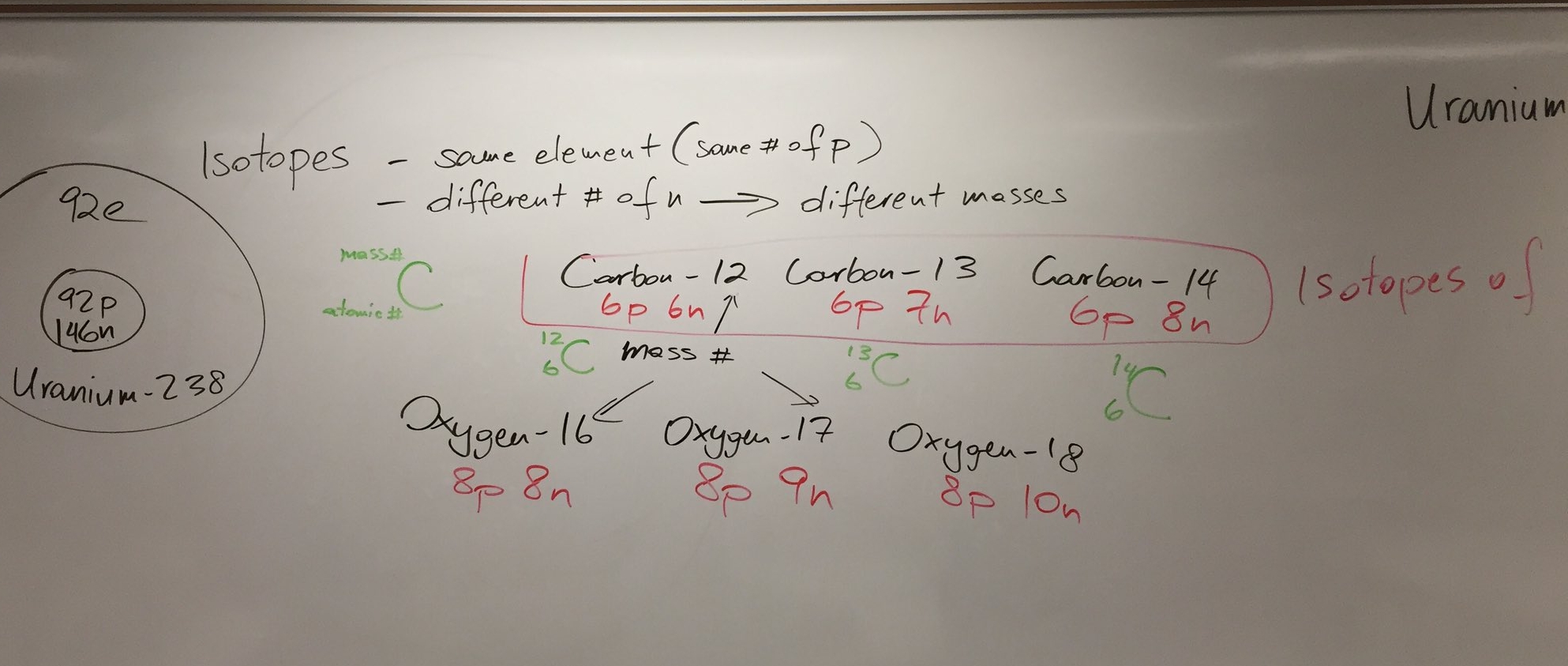
I was able to curate the content as the students were working in their groups, so everyone had the "right stuff." Students volunteered the information as I asked leading questions. I wrote it on the board. Here are the 3rd hour notes.

isotopes notes

Finally, I had students practicing figuring out the number of protons, neutrons, and electrons if given the isotope notations (hyphen notation or the nuclear notation). They rotated through by each student doing one practice problem, while others help him/her if need be. This also allowed me to check in with students in between problems.

I really felt I was able to get a lot of feedback on my students' understanding, because the wall has fallen. The teacher desk is gone. I let students teach themselves. I share the physical space with them. I can help them more in smaller groups. i can give them more attention individually.

I have to be honest here - I am sometimes concerned with using technology to replace instructional methods. But now I am finding myself using technology and the space I created to enhance instruction.

I have a strong suspicion it's working. More to come...

What do you think about the "Google It" activity I came up with this Tuesday morning? Do you see it as something you can use? Let me know in the comments below. Thanks for reading!

You Have The Power To Change The World. Use It Often.

2026 Crush School