
Owners Vs. Subscribers: Reclaiming Our Future
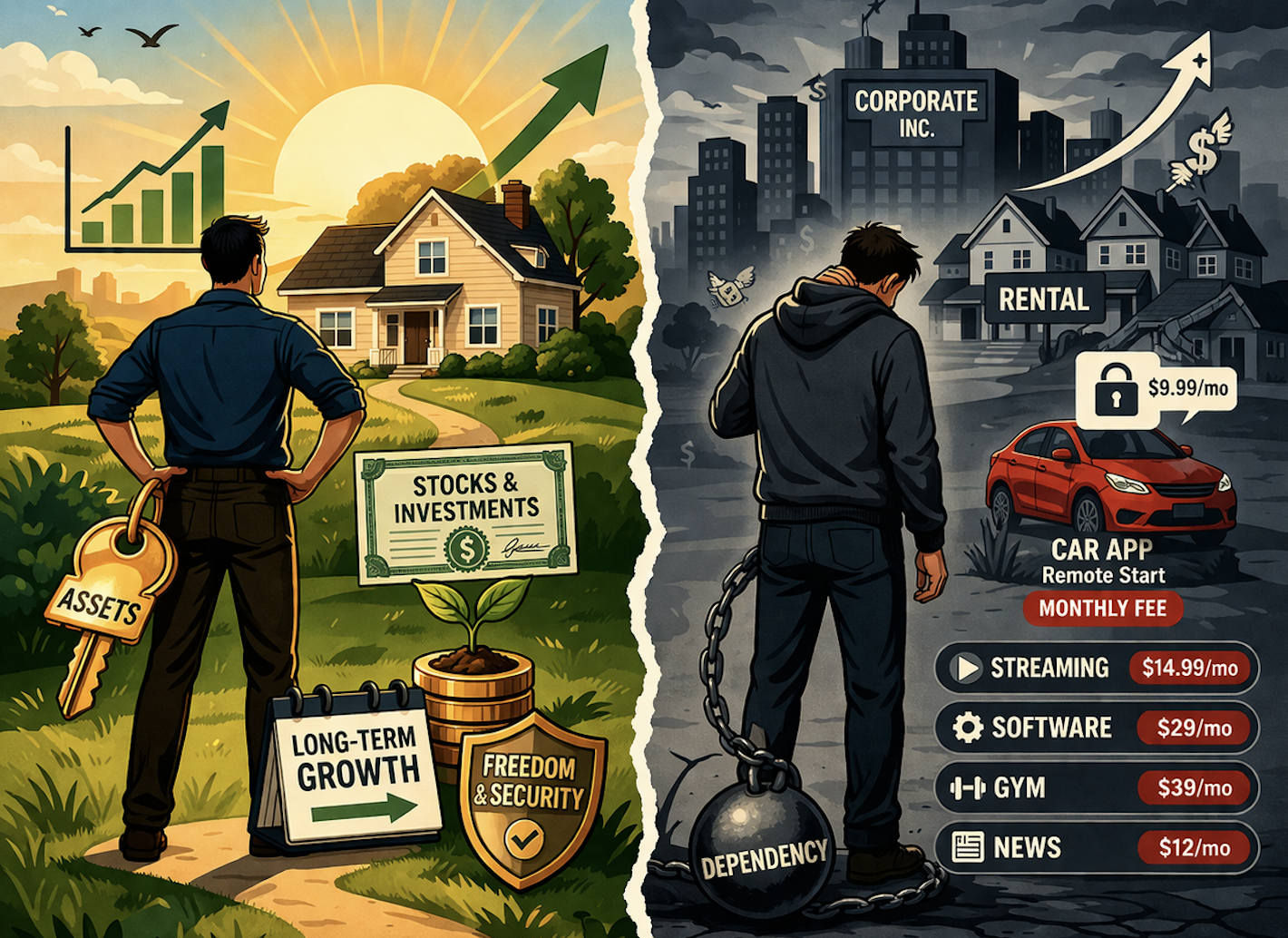
Increasingly, our economy is nudging people away from ownership and toward subscription.
My wife was due for a new car, so we went to a local Subaru dealership. Aside from the usual extended warranty and extras, such as the "undercarriage magic coating" conversation, the experience was mostly good: we got free snacks, a good deal on our trade-in, and a car she’s happy with.
The most annoying part arrived when the sales guy asked if we wanted to subscribe to the $50-per-month app now or later.
"Why would we need that?" we asked.
“It would give you the option of remote-starting your new car with a smartphone,” he explained.
The Subscription Trap
We ended up not subscribing, as it was the middle of the summer, $600 per annum seemed steep, and the Minnesota winters are not what they used to be.
But the sour aftertaste of exploitation lingers, leaving my thoughts occasionally drifting to when my car manufacturer might follow suit and slip a fee onto a feature that, for now, remains free.
Features that were once standard—like remote start or heated seats—are now being held hostage by apps with monthly fees. The hardware is already there, but you don’t fully own what you paid for, as full functionality is “pay to play.”
Paid access is replacing possession.
From Ownership To “Rentership”
“You will own nothing and be happy!”—as presented at the 2016 World Economic Forum—aimed for sustainability, but has now morphed into fears of a techno-feudalist society: a future reality in which workers own few assets, little privacy, and zero property, while corporations become overlords who possess assets and control destinies.
The shift has arrived, but the future is not set. We can counteract it yet.
We must, because ownership is the real prize of being human.
At its core, ownership is about self-determination—the ability to control your own direction, decisions, and destiny. It’s not just about owning things; it’s about navigating your own journey.
But increasingly, our economy is pulling people away from ownership and pushing them toward “rentership.”
The Stolen American Dream
As corporate portfolios grow to include property—one in every five single-family homes is now corporate-owned—individual wealth shrinks. What was once the cornerstone of middle-class wealth is rapidly turning into a stream of additional rental revenue for the “capital class.”
As this artificially created demand grows and skyrockets home values, working families are increasingly priced out of the American Dream; and, what’s more disturbing still, their dependence on those who control capital deepens.
This “rentership” model ensures wealth stays at the top and erodes the freedom and financial stability of middle-class and working families.
This trend isn’t random.
It reinforces a system where the few own most, and most own little, while being stripped of more by subscription fees.
It's the classic human-nature scenario of the rich always striving to get richer.
And while the “poor” might not be so poor—middle class and all—we are slowly getting poorer. Food, goods, services, education, and, yes, the subscription costs are outpacing inflation.
As what they earn turns into sustenance, comfort, entertainment, and profit for those who provide these things, there’s little left.
And the hard truth is that when ownership becomes out of reach, so does long-term financial stability, because ownership builds wealth and subscription extracts it.
Increasingly, we are being sold a future where we own nothing, yet pay for everything. If you don't own your assets, your home, or your choices, you aren't a citizen—you're a subscriber. And subscriptions can be canceled at any time.
This is why education has to shift.
Teaching Ownership In Schools
Not that all subscriptions are bad, but we need to show students how to become owners.
Instead of preparing kids just to earn money, we need to teach them how to give away less and keep more so they can secure their future.
We must show them how to build wealth through ownership of physical and digital assets, so they can achieve financial security and live happy lives.
This means understanding investing, thinking long-term, using the power of compounding, and viewing assets not as fleeting luxuries, but as tools for independence.
If they don't understand how the world works, they will be stuck in the rent-this, subscribe-to-that, wealth-extracting, future-destroying cycle forever.
Starting Your Teens On Their Wealth-Building Journey
To help our students and children escape the subscription trap, we have to teach them more than just how to balance a checkbook. That’s the old way. The new way is about ownership.
Ownership is a mindset. It is the difference between being a customer and being a partner in the world economy.
Here is how we can teach this to the next generation:
1. Stop Subscribing to Things You Don't Need
Explain to your kids that corporations have it all figured out.
They play a game that makes the customer feel like she’s winning, but—just like in casinos—the house always wins.
If they charge you $10 a month instead of $100 once, you will likely never stop paying. Over time, you pay a lot more, but end up with nothing.
The Problem: Like it or not, we are raising a generation of "renters." They rent their music, their movies, and even the "skins" in their video games. When the subscription ends, the items vanish.
The Lesson: Ask kids to look at their monthly money "leaks."
Example: If a student pays for a game pass, a music subscription, and a "pro" social media badge, they might be spending $40 a month. That’s nearly $500 a year.
Ask them: “In five years, will you have anything to show for that $2,500?” If the answer is no, they are just a subscriber.
2. Start Buying Things That Grow in Value
Most things kids (and adults) want are depreciating assets; they lose value the second you buy them. A new pair of Jordans is worth less the moment it leaves the box.
The Problem: We teach kids to save up for stuff. We should be teaching them to save up for assets.
The Lesson: An asset is something that puts money in your pocket while you sleep.
Example: Instead of buying a $150 pair of J's, help your child put that $150 into a low-cost index fund, like one that tracks the S&P 500.
The sneakers will smell and be too small in six months.
Owning the index fund means they own a piece of the 503 biggest companies in America. As these companies grow, their money grows.
3. Learn How To Play So You Aren’t Played By The System
The system is designed to keep people working for the capital. If you only provide labor, you will always be tired. If you own capital, your money works for you.
The Problem: Schools teach kids how to be good employees (labor). They rarely teach them how to be owners (capital).
The Lesson: Teach them about the market. Explain how to use it to build wealth.
Example: Talk about the Rule of 72. Divide 72 by the interest rate their investment earns to figure out how many years it takes for their money to double.
If the S&P 500 grows by 12% a year, their money doubles every six years.
If a student starts at age 14 with $1,000, by age 20 they will have $2,000. By age 26, they will have $4,000. This is without any additional investment.
If they keep investing regularly, they will have a fortune and the power of owning their journey and their destiny.
Playing the market game right also means helping students understand the broader forces at play: how markets evolve, how incentives shape systems, and how wealth tends to concentrate at the top unless individuals know how to participate in its creation.
Because, at the end of the day, this isn’t just about economics—it’s about human nature. Left unchecked, systems will optimize for efficiency and profit, not fairness.
Ownership requires intention. It requires awareness. And for most people, it requires being taught—early and often—that renting your life is not the way to build wealth.
The goal isn’t to reject every subscription or system. It’s to recognize the impacts of choosing one or the other.
Because if teens are taught that through “pay to play” access they give up ownership and freedom, they might start changing their patterns.
And if they understand that it is the owners who build wealth, purpose, and happiness, they will change their ways.
If we, the adults in the room—home, school, it doesn’t matter where—want the next generation to reclaim their future, we need to start teaching them how to be owners, not subscribers.
I hope you enjoyed these ideas from my upcoming book Unschooling School: Teaching Agency and Free Thinking in a System Built for Compliance and Conformity, scheduled for release in August 2026.
If you agree with my ideas and would like to hear more, consider signing up for my newsletter: articles and easy to implement high impact teaching tools (HITs). It’s 100% free and 0% pressure.
BOOKS & TOOLS

In this 3- to 4-day lesson, designed for a high school Earth and Space Science classroom, student groups are assigned and investigate 4 leading solutions to the climate change crisis our planet is experiencing. Then, they are called upon to debate against each other to try to convince others that their solution is the most viable and provide counterarguments against other solutions. It’s an intellectual thunderdome in which students are encouraged to use science to attacks each others points of view on climate change but not character.
Why and how does this learning strategy work?
Rote memorization out; seeking answers and deeper learning in.
The debate-style approach to learning is engaging and motivating for learners, because they are challenged to use real evidence and their wits to outmaneuver their opposition.
Not only do they act as investigators, developing communication, collaboration, and argumentation skills but they learn about viable solutions to the climate change conundrum we all find ourselves in. They learn Earth and Space Science content while investigating and debating solutions to a real-world phenomenon, which is what the Next Generation Science Standards (NGSS) call for.
Student Learning and Performance Objectives:
Research multiple, complex climate change solutions to discover that the world is more complicated than a single TikTok trend.
Articulate scientific arguments with actual evidence.
Listen to opposing viewpoints, to hone "social awareness" skills.
Realize that climate change solutions are multi-faceted, messy, and require more than just good vibes.
Describe and support with, not mere belief but actual evidence, the leading climate solutions proposed by, not the coven of online witches but the scientific community.
What's included:
24 slides that introduce, explain, and guide the teacher and students
Detailed teacher notes on prep, main lesson, and follow up activities
General Lesson flow for teacher to follow to make it all seamless
A short and funny “hook” to increase student buy in
Detailed student directions
A list (research starter pack) of links to legit, scientific websites for students to use.
Group roles (team jobs) with descriptions of what each entails.
4 climate change solutions to assign to 4 different student groups
Student Learning and Performance Objectives
Detailed Grading Rubric to guide students and make assessment easy
Debate Day introduction and format description
Follow up discussion questions (reflection and debrief)


In this classroom Mistakes are Expected, Respected, Inspected, Corrected!
Learned helplessness is a result of years of conditioning that mistakes are bad for learning. Nothing is further from the truth - some of the most powerful life lessons come from making mistakes, reflecting on them, and growing as a result.
This is a PNG Poster you can print and display in your classroom to encourage a culture of risk-taking and learning from mistakes.

Are your students tired of just reading about Earth? Do they gaze longingly at the night sky, dreaming of a future beyond textbook pages? Excellent! Because today, we're not just learning about science; we're making science. We're launching them into the ultimate entrepreneurial challenge: Terraforming Mars: The Red Planet "Shark Tank" Innovation Challenge!
Forget your quaint little recycling programs. We're talking about taking a dusty, desolate rock and turning it into a vacation spot for humanity.
This isn't just a project; it's a desperate plea from the future (and a cunning way to keep them engaged). Your students will become "Terraforming Tech Startups," armed with nothing but their wits, some internet access, and a burgeoning understanding of how Earth actually works. Because, let's be honest, trying to make Mars habitable without understanding our own planet's life support systems is like trying to bake a cake without knowing what flour is.
Prepare for an explosion of creativity (hopefully not literal, on Mars or in your classroom) as they grapple with the fundamental cycles that make life possible. The competitive drive to secure that "virtual investment" (and bragging rights) will channel all their boundless energy into productive, scientific output. Just try to keep the "mad scientist" cackles to a minimum.
Student Learning and Performance Objectives:
Demonstrate understanding of the Carbon, Water, Nitrogen, and Oxygen cycles.
Apply your knowledge of the principles of these cycles to design an ecosystem on a different planet (e.g. Mars).
Illustrate how biogeochemical cycles support life in a closed system (Earth, Mars colony, dome ecosystem etc.).
Pitch your solutions to practice collaboration, critical thinking, and creative problem-solving/design.
What's included:
20 slides that introduce, explain, and guide the teacher and students
Introductory popcorn reading activity
Research Guide (G-doc link): Includes Note-taking space and links to reputable websites for students to use.
Project timeline and detailed tasks for each day
Group Roles explained in detail
Detailed teacher notes on prep, main lesson, and best practices
List of materials
Student Learning and Performance Objectives
Grading Rubric and Peer Evaluation Form
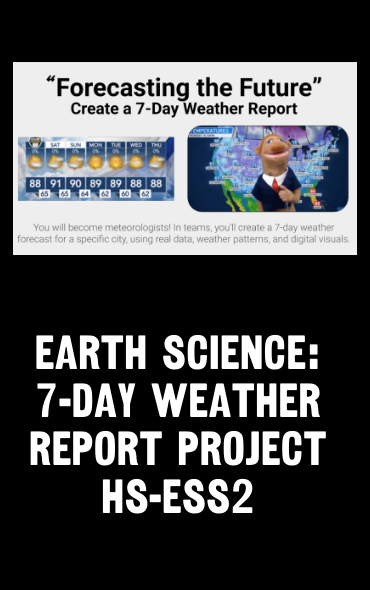
Save planning time with this Atmosphere Unit, 5-day Honors Earth and Space Science Project in which students research, design, create, and present a 7-day weather forecast for a specific city in the US or abroad.
Student Performance and Learning Objectives:
Explain how weather data is collected and interpreted.
Explain how weather patterns may be affected by geography (mountains, plains, valleys etc.).
Explain the atmospheric conditions (pressure, moisture etc.) necessary for different weather (sunny, windy, rainy etc.).
What's included:
16 slides (Google Slides link for easy use and editing to fit your purposes)
Learning Objectives
Group Roles / Jobs (up to 5 with detailed description of jobs)
Detailed Project Directions / Requirements
Materials/Web Resources List
Link to a "Wheel of Names" containing city names - students spin and receive their assigned city.
Link to a grading rubric for student and teacher use (printable doc).
The project follows the guidelines set by the Next Generation Science Standards (NGSS).
Questions?
Email me at oskar@crushschool.com. I’m happy to answer your questions.
Fair Use
Feel free to share and use this resource with your students.
Please do not share it with other parties or use for profit. All rights by crushschool.com.

The Cornell Notes on Steroids Notebookis a 8.5"x11" 120-page academic notebook that contains an organizational method that improves on the Cornell Note-Taking System. BUNDLE & SAVE.