
What If We Approached Education The Same Way We Approach Business?

A student cried in my chemistry class today.
Two days away from the big unit test and upset enough not to bother to grab a tissue and wipe off the snot dripping from her nose, she confirms to me she's freaking out.
Stressed out she'll bomb the test.
She has to work a lot to help out with the bills, so coming in for help is a challenge, but after a rough beginning, she was on a roll.
I even wrote a "good job" postcard and send it home saying I looked into my crystal ball and saw great things in her future. And now this...
I love learning, but I hate compulsory education.
I don't hate learning standards. There are perhaps too many, but it's good to have a guidance system.
I do hate the idea of force-feeding the same standards to all kids though.
You see, in Minnesota, we require students to take chemistry or physics to graduate high school. Choosing the lesser evil—or so they think—most kids who'd normally opt for something else take chemistry.
Just get through it with the best possible grade they think.
And who can blame them when the system says they have no other choice but to suck it up and pretend they like it?
And don’t get me wrong - I love chemistry.
I love science.
I teach and love teaching it.
I just do not believe in systems that force kids to take subjects they feel will not play a big role in their future.
And while I also believe that you just never know when the information you learn in the present might become helpful in what you do in the future, roughing it seems all kinds of wrong.
After all, the world wide web will have even more information in the future than it does today.
And, a more patient approach to educating our society’s youngins does not nullify the undeniable fact that the information we so painstakingly force-feed them now will still be readily accessible, but easier to understand, more relevant, and applicable when they’re older and more ready for it.
But What If We Educated The Same Way We Do Business?
Whether it's a service or a product, to be viable, the ideas and the things any business is selling must be Understandable, Relevant, and Relatable to the consumer, because let's be real: We Typically Don't Buy Stuff We Don't Comprehend or Need.
If They Don't Understand It, They Can't Learn It
If we approached educating the same way we approach business we would see the necessity of delivering content that's understandable to kids.
This means taking into account their brain development before we tell them to take this or that class.
As a chemistry teacher, I notice many kids taking my class being unable to understand chemistry. It is hard to quantify it—to put a percentage on it—but maybe half of the 16 and 17-year-olds I encounter do not possess the abstract thinking required to understand chemistry. Their brain just isn't developed well enough when they're taking this class, one full of abstract ideas and nonconcrete concepts.
The plain and simple truth is we do not take enough time to figure out if our students are ready to take certain classes. We just have them grind it out.
They hate it.
We blame it on the teenage phase.
In the business world, this would be equivalent to a company putting the blame for its incompetence on its customers.
Imagine this: A startup puts out a product nobody gets—something so abstract that most people have to work really hard to imagine what it does. How successful do you think that would be?
If They Don't Find It Relevant, They Don't Want To Learn It
If we approached educating the same way we approach business we would see that we really need to focus on delivering content that's relevant to kids.
I am not saying that everything we teach in schools is irrelevant.
What I am saying is that a lot of it is.
For example, we talk about electron configurations in an atom. Why the hell do kids need to know that? They should know what the atom looks like, but why do they need to write a bunch of numbers and letters they have no use for to represent theoretically probable locations of particles no one can see?
They cannot use it right now.
It does not fulfill a tangible pressing need.
It can't make their life better in any way, shape, or form.
They don't buy it.
Once again, imagine if someone in the business world took this approach. Maybe some startup could create a service nobody needs now but might need in the future. I wonder how that would do? Somehow, I am having difficulty visualizing people lining up to sign up for something some of them might or might not use in 5 to 10 years. Shaky.
If They Can't Relate To It, They Won't Learn It
If we approached educating the same way we approach business in today's world we would see that we really need to focus on delivering content that's relatable to kids.
In any other industry, if the user doesn't see themselves in the product, the product fails. Yet, in the classroom, we expect students to buy into a narrative that feels like it was written for a different species.
It has been a long-standing tradition to teach social studies through slideshows and packets.
It goes something like this:
First, students transfer information from the lecture slides into their notebooks—most often verbatim as processing time costs too much class time.
Second, students transfer the previously transferred information from their notebooks into packets that contain questions on the left and empty boxes for answers on the right. They often copy from each other to avoid sifting through the notes taken during what feels now like an out of body experience.
Too bad the aliens didn’t upload this shit to my brain some regret.
But what comes next takes the cake—the temporary data transfer from packet to brain, because the test is tomorrow. Just follow these simple instructions:
Read through the packet as many times as possible the night before and the morning of the test.
Get an A.
Promptly forget all this garbage and hope the final is not cumulative.
We call this education and hope kids dig it.
They don’t. They are right not to.
But they Machiavelli it ‘cause college.
The truth is, we are asking them to save lifeless, useless data. The content doesn't resonate so their brains treat it like spam and put it in the junk folder.
We turn the vibrant stories humanity was built on into hollow transcripts and we wonder why they unsubscribe.
I hope you enjoyed these ideas my upcoming book is based on.
Unschooling School: Why School Sucks and How Teachers Can Do Better in a System That Won’t is scheduled for release in August 2026.
If you’re done watching students treat your lessons like spam to be deleted the moment the test is over, this book is your guide to engineering relevance that sticks. Let’s stop training kids to Machiavelli their way through packets and start creating the loud, messy, and meaningful learning experiences they deserve.
BOOKS & TOOLS
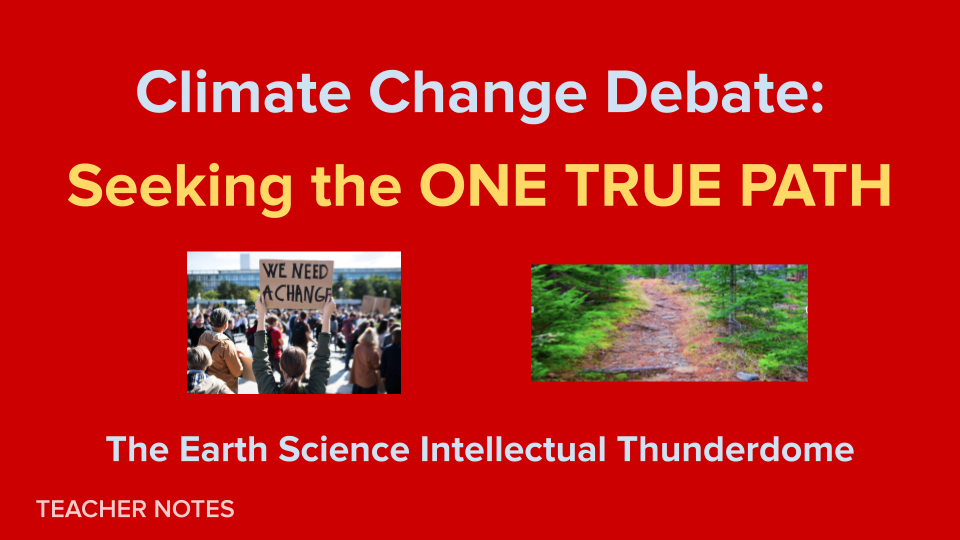
In this 3- to 4-day lesson, designed for a high school Earth and Space Science classroom, student groups are assigned and investigate 4 leading solutions to the climate change crisis our planet is experiencing. Then, they are called upon to debate against each other to try to convince others that their solution is the most viable and provide counterarguments against other solutions. It’s an intellectual thunderdome in which students are encouraged to use science to attacks each others points of view on climate change but not character.
Why and how does this learning strategy work?
Rote memorization out; seeking answers and deeper learning in.
The debate-style approach to learning is engaging and motivating for learners, because they are challenged to use real evidence and their wits to outmaneuver their opposition.
Not only do they act as investigators, developing communication, collaboration, and argumentation skills but they learn about viable solutions to the climate change conundrum we all find ourselves in. They learn Earth and Space Science content while investigating and debating solutions to a real-world phenomenon, which is what the Next Generation Science Standards (NGSS) call for.
Student Learning and Performance Objectives:
Research multiple, complex climate change solutions to discover that the world is more complicated than a single TikTok trend.
Articulate scientific arguments with actual evidence.
Listen to opposing viewpoints, to hone "social awareness" skills.
Realize that climate change solutions are multi-faceted, messy, and require more than just good vibes.
Describe and support with, not mere belief but actual evidence, the leading climate solutions proposed by, not the coven of online witches but the scientific community.
What's included:
24 slides that introduce, explain, and guide the teacher and students
Detailed teacher notes on prep, main lesson, and follow up activities
General Lesson flow for teacher to follow to make it all seamless
A short and funny “hook” to increase student buy in
Detailed student directions
A list (research starter pack) of links to legit, scientific websites for students to use.
Group roles (team jobs) with descriptions of what each entails.
4 climate change solutions to assign to 4 different student groups
Student Learning and Performance Objectives
Detailed Grading Rubric to guide students and make assessment easy
Debate Day introduction and format description
Follow up discussion questions (reflection and debrief)


In this classroom Mistakes are Expected, Respected, Inspected, Corrected!
Learned helplessness is a result of years of conditioning that mistakes are bad for learning. Nothing is further from the truth - some of the most powerful life lessons come from making mistakes, reflecting on them, and growing as a result.
This is a PNG Poster you can print and display in your classroom to encourage a culture of risk-taking and learning from mistakes.
BLOG ARCHIVE:
- April 2026 4
- March 2026 1
- December 2025 1
- September 2025 2
- August 2025 5
- July 2025 4
- June 2025 2
- August 2024 2
- July 2024 2
- June 2024 1
- October 2023 1
- September 2023 3
- August 2023 6
- July 2023 6
- July 2022 2
- June 2022 1
- November 2020 3
- October 2020 3
- April 2020 1
- March 2020 5
- July 2019 1
- June 2019 1
- April 2019 1
- January 2019 1
- November 2018 3
- October 2018 2
- September 2018 1
- August 2018 8
- July 2018 11
- June 2018 4
- May 2018 5
- April 2018 2
- March 2018 4
- February 2018 5
- January 2018 3
- December 2017 1
- November 2017 5
- October 2017 7
- September 2017 6
- August 2017 5
- July 2017 3
- June 2017 10
- May 2017 7
- April 2017 7
- March 2017 15
- February 2017 12
- January 2017 13
- December 2016 15
- November 2016 8
- October 2016 7
- September 2016 12
- August 2016 14
- July 2016 10
- June 2016 13
- May 2016 10
- April 2016 8
- March 2016 5
- February 2016 7
- January 2016 6
- December 2015 5
- November 2015 8
- October 2015 2
![[Earth Science] Terraforming Mars: The Red Planet](https://images.squarespace-cdn.com/content/v1/5611dbcce4b0b27692201460/cf20dede-a655-4803-9af0-1ef1b49c8747/Terraforming+Mars_+The+Red+Planet+_Shark+Tank_+Innovation+Challenge.png)
Are your students tired of just reading about Earth? Do they gaze longingly at the night sky, dreaming of a future beyond textbook pages? Excellent! Because today, we're not just learning about science; we're making science. We're launching them into the ultimate entrepreneurial challenge: Terraforming Mars: The Red Planet "Shark Tank" Innovation Challenge!
Forget your quaint little recycling programs. We're talking about taking a dusty, desolate rock and turning it into a vacation spot for humanity.
This isn't just a project; it's a desperate plea from the future (and a cunning way to keep them engaged). Your students will become "Terraforming Tech Startups," armed with nothing but their wits, some internet access, and a burgeoning understanding of how Earth actually works. Because, let's be honest, trying to make Mars habitable without understanding our own planet's life support systems is like trying to bake a cake without knowing what flour is.
Prepare for an explosion of creativity (hopefully not literal, on Mars or in your classroom) as they grapple with the fundamental cycles that make life possible. The competitive drive to secure that "virtual investment" (and bragging rights) will channel all their boundless energy into productive, scientific output. Just try to keep the "mad scientist" cackles to a minimum.
Student Learning and Performance Objectives:
Demonstrate understanding of the Carbon, Water, Nitrogen, and Oxygen cycles.
Apply your knowledge of the principles of these cycles to design an ecosystem on a different planet (e.g. Mars).
Illustrate how biogeochemical cycles support life in a closed system (Earth, Mars colony, dome ecosystem etc.).
Pitch your solutions to practice collaboration, critical thinking, and creative problem-solving/design.
What's included:
20 slides that introduce, explain, and guide the teacher and students
Introductory popcorn reading activity
Research Guide (G-doc link): Includes Note-taking space and links to reputable websites for students to use.
Project timeline and detailed tasks for each day
Group Roles explained in detail
Detailed teacher notes on prep, main lesson, and best practices
List of materials
Student Learning and Performance Objectives
Grading Rubric and Peer Evaluation Form