Tips, Tricks, and Spells to Remembering Student Names (Hogwarts Style)
I don’t know about you, but for me, that first week of school feels more like a high-stakes memory challenge than teaching. A sea of fresh faces, each belonging to a human with their own hopes, dreams, and a unique name that I just have to know to avoid the anxiety of being seen as just another one of those unapproachable Snape-like, you know the type, teachers.
‘Cause I give a crap. A lot. I’m just an anxious freak. Three months of not doing it fearing I forgot how to do this teaching thing, I’m desperately trying to avoid the "Hey, yous," finger-pointing, and the perception I don’t care.
If that sounds somewhat familiar, fear not, my weary, holy crap it’s the beginning of the school year! educator. Learning your students' names quickly does not require Professor Snape’s Memory Potion but is absolutely magical for building connection, trust, and a classroom where everyone feels seen.
Learning names, like casting spells at Hogwarts, requires practice, purpose, and perhaps a bit of luck. But when you nail a student's name early (day one or two), it's like magic. Their eyes light up! Suddenly, they're not just another body in the room; they're Luna, Harry, Padma. And that, my friends, is the first charm you cast to create a truly welcoming learning environment.
So how about channeling your inner Hermione Granger and learning how to wield this name revealing spell? Because Nomina Revelio doesn’t just sound cool; its mastery turns muggles into wizards.
Seating Chart: Your Marauders Map to Miraculous Memory
Think of your seating chart as your personalized Marauder's Map to a thriving classroom. It’s not just for keeping track of who's kicking whom under the desk; it's your primary training tool for name recall.
Temporary Tent Towns:
On day one, I pretend to have Portkey traveled to the Quidditch World Cup and assign a temporary seating chart. I tell students that I will let them choose their own seats the following week, but in the meantime, I have student groups (my classroom has round tables) whip up a quick name tent – a folded 11x17 piece of paper with their name written large enough to read from across the room.
Next to their name, I ask them to draw their favorite thing in the world (an object, pet, hobby etc.).
On the back, they conjure a spell (phrase) that describes them. I ask them to be creative and use as many words that start with the first letter of their name in their phrase such as “Finn is truly fond of fluffy fantastic beasts.” We later use these for the Name Game Gauntlet.
These are your early warning system against forgetting, like a tiny, legible banner for each aspiring witch or wiz…. I mean student.
Patrol and Practice:
While your students are happily working, put on your stealthy name-memorizing hat. Stroll around the room, glance at your chart, look at the student, and silently (or dramatically but in your head only) repeat their name.
Make an association or create a mental picture that will help you remember each name. "Ah, yes, Ginny, likely a Griffindor, and clearly destined for greatness... or at least remembering to do their homework." The more ridiculous the association, the more memorable it will be. Just don’t suddenly yell Riddikulus!, unless you want them to turn into a black dress-wearing, red purse-wielding Professor Severus Snape.
The Verbal Vortex: Mastering the Pronunciation Charm
Your voice is a powerful tool, not just for explaining concepts, but for etching names into your brain. Think of using it as a tool for perfecting your incantation.
The Door Greeter Guru:
Become the cheerful door greeter. As students shuffle in, greet each one by name. If you draw a blank, don't panic! A polite, "Good morning! What's your name again, my brilliant apprentice?" is infinitely better than a blank stare. Remember to immediately replay the mental picture you made or repeat the phrase they created for themselves.
Instant Name Gratification:
The moment you hear a name, use it. "Thanks, Draco!" or "Could you clarify that for us, Cho?" The more you use it, the faster it sticks, like a well-aimed Accio spell used for summoning their identity instead of your broom.
Pronunciation Perfectionist:
If a name looks tricky, or you butcher it the first time (we've all been there), ask them to correct you politely. "My apologies! Could you say your name for me again so I can get it right, like a true Master of Charms?" They will appreciate the effort, and you'll avoid calling Seamus "See-mas" for the entire semester, a fate worse than facing a bat-wielding cave troll in the girls bathroom.
"Who Are You, Anyway?" Activities & Visual Mnemonics
Combine getting to know them with secret name-learning ops, turning every student into a potential magical creature for your memory.
The Name Game Gauntlet:
On day one, initiate a quick, low-stakes name game. Have students read the phrase they wrote on the back of their tent to their group and then ask each to try to remember and repeat each others phrase. You can walk from table to table and do the same and ask for hints during brain farts.
A simple template for the phrase if students are having a hard time creating their phrase could be "My name is _____ and I like _____” as in My name is Finn and I like fluffy fantastic beasts.
My Life in A Picture:
Also, ask about the favorite thing they drew on their tent next to their name (object, pet, hobby, spirit animal). These little nuggets of information become mnemonic anchors for your students’ names. Example: “Nick, spirit animal Niffler,” and imagine a mole-looking rodent with a shiny gold chain around its neck. Again, the more ridiculous the association, the more memorable it is.
Voldemort (or at Least The Devil) is in the Details:
We often think that the more information we need to remember, the harder it is, and that is mostly true. However, it is actually easier to remember one important fact if we add multiple details to it, because our brains create stronger neural connections responsible for the use and recall of this fact.
Take advantage of this by adding mental detail to each students name. The two activities above are designed exactly for that, but you can add mental details, especially for a student whose name you just can’t remember, such as a famous person or a family member or friend they remind you of.
Strategic Practice: Treat It Like a Pop Quiz (on yourself)
Learning names isn't magic; it's a skill. And like any skill (e.g., brewing a perfect Polyjuice Potion, or surviving Monday mornings), it improves with deliberate practice.
Micro-Mastery Divination Sessions:
Don't aim to learn 150 names in one sitting. Break it down. "Okay, first five students in Row 1. Go!" Or dedicate five minutes before each class to mentally reviewing names. Think of these as your Daily Prophet crosswords, but with faces.
The empty Picture Frame Game:
Grab your class roster. Read a name, then try to picture their face. If you can't, quickly find them on your seating chart. The effort of retrieval is what really locks it into your long-term memory, like an unbreakable vow (but for names, not dark lords).
Self-Correction Incantations:
As you walk around, secretly quiz yourself. "Okay, who's this brilliant young mind, possibly a future Minister for Magic?" If you draw a blank, cheat and peek at your temporary seating chart, I mean Marauder’s Map, and then immediately try to recall it again a few minutes later. No judgment, just pure, unadulterated name-learning dedication worthy of a Hogwarts prefect.
The Paper Handback Spells:
If you still use scrolls and parchment, forget just dropping those student essays on Werewolves on their desks. Personally hand back every single paper. Look at the name, make eye contact, and say the name. "Here you go, Ernie." This simple, repetitive action is pure Expelliarmus for forgetfulness, disarming your brain's tendency to blank out.
Your Personal Rogues' Gallery:
If your school provides student photos, use them! Print them out, arrange them by class, and drill yourself like you're studying for your O.W.L.s. Look at the face, say the name, flip to confirm. Repeat until you can identify them faster than Dumbledore can spot a house elf.
Enlist Your Elves (They're surprisingly helpful, like Dobby!)
Your students are often secretly thrilled that you're even trying to learn their names. Don't be afraid to leverage that!
The "Oops, Remind Me" Clause:
Be real! "Folks, I have a lot of amazing brains to learn this year. If I ever forget your name, please remind me. No offense, just helpful data for this humble Professor!" This makes it okay for them to help you, like a friendly house elf guiding you.
Peer Power:
For group work, have students introduce themselves to their group members. Then, you can float by and say, "Okay, Angelina, can you tell me a few things about Fleur?" It reinforces names for everyone involved, like a communal Pensieve for names.
The "Nailed It!" Moment:
When you successfully use a student's name, especially if you've struggled with it before, they will notice. That little spark in their eyes? That's the power of genuine connection, a bond stronger than the Imperius curse.
By making name learning an intentional (and perhaps slightly obsessive) part of your routine, you'll swiftly transform a room full of strangers into a community of individuals and avoid that dumb Petrificus Totalus look on your face.
So, what's one name-learning "spell" you're excited to use this school year?
Thanks for reading my thoughts! I hope they help you in being more ready for the impending doom of the new school year.
Check out my shop for some fun and engaging science lessons. I try to keep the prices reasonable, but if you cannot spare the fee, please email me, and if it can be emailed, I’ll email it to you for free.
BOOKS & TOOLS

Equity-Promoting Classroom Poster. What does EQUITY in the classroom look like?
Everyone has a different start and finish line
Quality is more important that quantity
Understanding that diversity makes us stronger
Inclusion despite beliefs, appearances, and circumstances
Thoughtfulness lowers barriers and reduces biases
Yesterday's mistakes are today's learning agenda
You can teach your students about equity and make it a daily classroom practice using this inspirational poster, which also includes images that accompany the equity description. You can discuss each letter characteristic with your students as a way of introducing your inclusive classroom and display it prominently as a reminder that diversity makes the classroom community stronger.
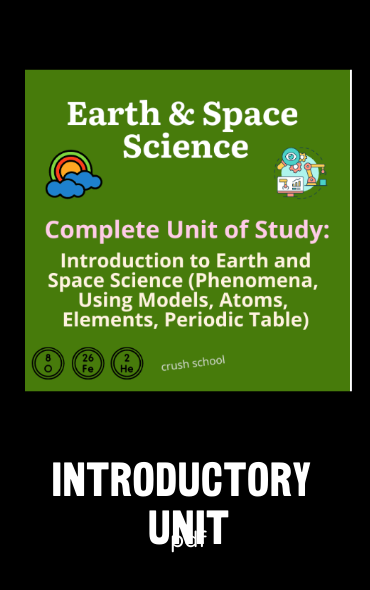
Save 2 - 3 weeks of planning time and start your Earth and Space Science school year off right using NGSS and Phenomenon Based Learning with this “Introduction to Earth and Space Science” Unit that contains 5 relevant and engaging multi-day projects.
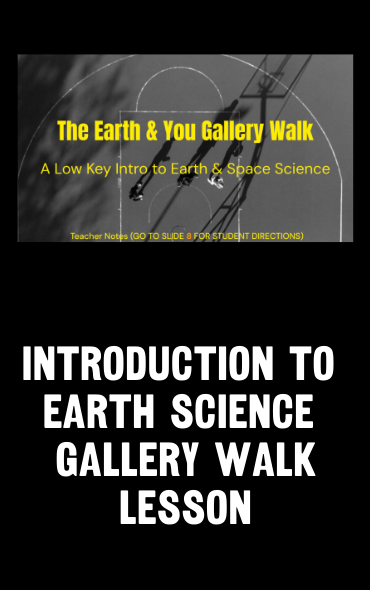
While hitting the ground running is often important, having a less stressful beginning to the new school year is key for both teachers and students to setting themselves up for a more collaborative and successful school year.
While we cannot completely eliminate the stress of doing something we all have not done for 3 months (!!!) easing into science by using a low pressure, but meaningful activity is just what the psychologist ordered.
In this one- to two- day Back to School activity, designed for a high school Earth and Space Science classroom, students share their own thoughts and feelings about the world around them. which helps in building a supportive classroom community while they are observing and reflecting on the natural and human-caused phenomena around them.
Why and how does this learning strategy work?
The main idea is to begin the new school year and your Earth science class low-stress. This benefits both students and teachers as we often find getting back to doing something we are rusty on rough (translation for non-teachers: we are barely holding it together and are ten seconds from crashing out, because we are only about 50% sure we still know how to participate in society at large, let alone teach). So rather than continuously wondering about the 10,000 things that can go wrong (but never will) in the first few days of the new school year, we can combine chemistry, social-emotional learning, and classroom community-building and get to know our students a little bit before we hit them with climate change, seismic waves, and continental drift.
Student Learning and Performance Objectives:
Share your own thoughts and feelings about the world around you.
Observe, reflect, and share what comes to mind at each station.
What's included:
11 slides that introduce, explain, and guide the teacher and students.
Detailed teacher notes on prep, main lesson, and follow up activities.
Detailed student directions.
10 station ideas, along with a link to a document that contains the printouts for each station.
Student Learning and Performance Objectives
Materials list
Follow up discussion questions
SEL connections
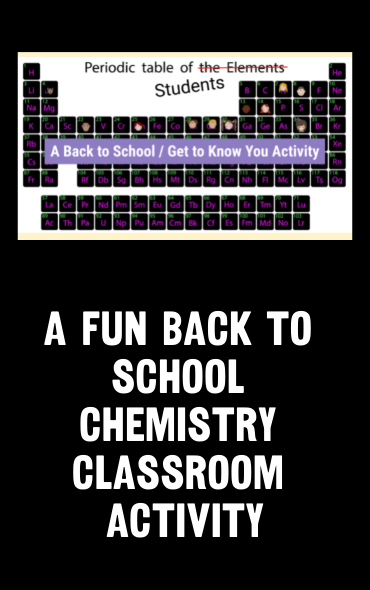
Can teachers make Chemistry less stressful for students?
I am not sure about this one. After all, chemistry gets the bad rep for being hard and a lot of work. But while this may be true, teachers can help make the beginning of the school year less stressful for their students by easing into chemistry using a low pressure, high bang for their buck activity.
In this one- to two- day Back to School activity, designed for a high school Chemistry classroom, students visually share and learn various facts about each other which helps in building a supportive classroom community and, along the way, learn some chemistry lingo and facts that will come in handy later. But, psssst! Don't tell them they are unconsciously learning chemistry. Just let them have fun getting to know each other and their teacher.
Why and how does this learning strategy work?
The main idea is to begin the new school year and your chemistry class low-stress. This benefits both students and teachers as we often find getting back to doing something we are rusty on rough (translation for non-teachers: we are barely holding it together and are ten seconds from crashing out, because we are only about 50% sure we still know how to participate in society at large, let alone teach). So rather than continuously wondering about the 10,000 things that can go wrong (but never will) in the first few days of the new school year, we can combine chemistry, social-emotional learning, and classroom community-building and get to know our students a little bit before we hit them with atoms, bonding, stoichiometry, and Le Chatelier's Principle.
Student Learning and Performance Objectives:
Put together a periodic table of chemistry students in our class.
Create an element box for each student with their characteristics, likes, dislikes etc.
Start building a classroom community.
Allow students to familiarize themselves with each other by learning a few things about their classmates.
What's included:
10 slides that introduce, explain, and guide the teacher and students through this 2-day activity
An element box/card template for either digital or old school use (you choose)
Teacher notes explaining the purpose, teacher participation, possible extensions, and the side benefits of the activity
Student Learning and Performance Objectives
Materials list
Detailed directions for what information students should include on their card
Directions on how to assemble the classroom periodic table
Follow up discussion questions
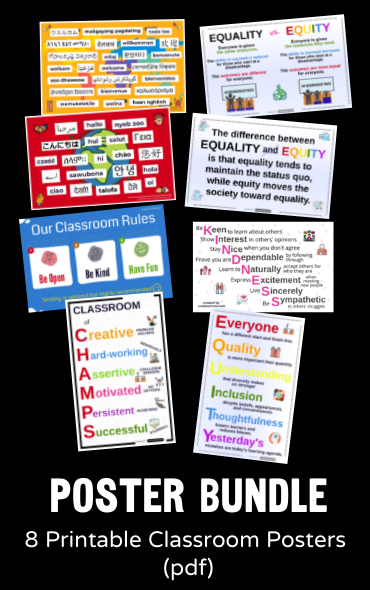
8 digital, printable, size 11 x 17 classroom posters:
“Welcome” in multiple languages
“Hi” in multiple languages
Three Equity posters
Classroom Rules: Be Open, Be Kind, Have Fun
“Classroom of Champs”
“Kindness”
ON SALE until August 30th.
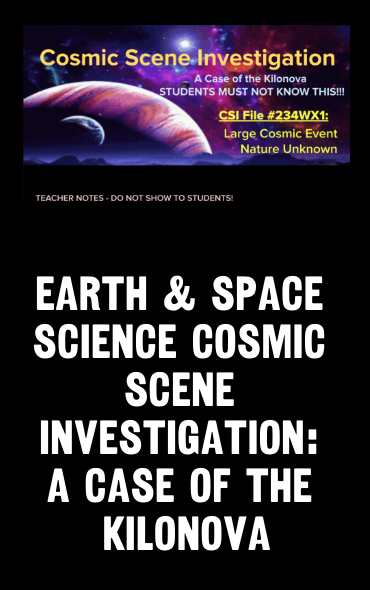
In this 50 - 70 minute, CSI-style investigation, designed for a high school Earth and Space Science classroom, students investigate a space phenomenon of kilonova. The investigation is set up so students do not know a kilonova occurred. Rather, they are given five case files on a major phenomenon that occurred in a fictional galaxy V57-1. The case files contain information they will have to interpret and research online to first understand the clues each file contains to later be able to arrive at the correct conclusion that a kilonova, caused by a collision and merging of two neutron stars has taken place.
Why and how does this learning strategy work?
Rote memorization out; seeking answers and deeper learning in.
The CSI-style approach to learning is fun, engaging, and motivating for learners, because they are called upon, thus challenged to find answers based on evidence rather than given a list of facts to study about a topic; space in this case.
When students are allowed to act as investigators, they develop skills such as analyzing evidence from various sources to understand the world and how it works. They not only hone and apply Science and Engineering Practices (SEPs), but also learn Earth and Space Science content while investigating a real-world (or real-space) phenomenon, which is what the Next Generation Science Standards (NGSS) call for.
Student Learning and Performance Objectives:
Analyze scientific evidence to arrive at a correct conclusion about the cosmic event that occurred in a distant galaxy. Synthesize multi-messenger astronomical evidence to draw conclusions about complex cosmic phenomena.
Understand the role of various astronomical instruments in space exploration.
Describe different types of data collected by these instruments.
Explain how element emission spectra are used to identify space objects and phenomena.
What's included:
13 slides that introduce, explain, and guide the teacher and students
Detailed teacher notes on prep, main lesson, and follow up activities
A link to a student-only slideshow.
Detailed student directions.
5 case files that contain data collected about the event for students to investigate
Teacher answer key describing what conclusions students should make from each case file.
Report File - guided Google Doc for students to fill out as they take note on each case file. data and generate their conclusions
Student Learning and Performance Objectives
Debriefing activity and key talking points
Follow up discussion questions and a next day bell ringer

Save planning time with this 3 to 4-day Earth and Space Science NGSS-aligned introductory lesson during which students learn about the Systems Approach to studying science and analyzing real world phenomena.
The lesson involves investigating an anthropogenic phenomenon and examining human influence on the four spheres (biosphere, hydrosphere, atmosphere, and geosphere).
During the investigation, students create models and use them to explain how each of the four spheres is affected in a video that educates viewers on the consequences of human actions and the interconnectedness of the Earth’s systems.
Includes 9 detailed slides (PDF and Google Slides link for editing) + detailed teacher directions (2 slides).
The project follows the guidelines set by the Next Generation Science Standards (NGSS) and guides students in using Science and Engineering Practices (SEPs), Crosscutting Concepts (CCCs), and Disciplinary Core Ideas (DCIs).
Student Learning Objectives:
Describe what a Phenomenon is and give examples of Natural and Anthropogenic Phenomena.
Explain how phenomena can be used to study scientific concepts.
Describe the four spheres: atmosphere, hydrosphere, geosphere, and biosphere, and give examples of different matter interactions between them.
Understand, explain, and apply the Systems Approach when investigating Earth and Space Science Phenomena.
Break down how a Specific Anthropogenic Phenomenon affects each of the four spheres.
Are your students tired of just reading about Earth? Do they gaze longingly at the night sky, dreaming of a future beyond textbook pages? Excellent! Because today, we're not just learning about science; we're making science. We're launching them into the ultimate entrepreneurial challenge: Terraforming Mars: The Red Planet "Shark Tank" Innovation Challenge!
Forget your quaint little recycling programs. We're talking about taking a dusty, desolate rock and turning it into a vacation spot for humanity.
This isn't just a project; it's a desperate plea from the future (and a cunning way to keep them engaged). Your students will become "Terraforming Tech Startups," armed with nothing but their wits, some internet access, and a burgeoning understanding of how Earth actually works. Because, let's be honest, trying to make Mars habitable without understanding our own planet's life support systems is like trying to bake a cake without knowing what flour is.
Prepare for an explosion of creativity (hopefully not literal, on Mars or in your classroom) as they grapple with the fundamental cycles that make life possible. The competitive drive to secure that "virtual investment" (and bragging rights) will channel all their boundless energy into productive, scientific output. Just try to keep the "mad scientist" cackles to a minimum.
Student Learning and Performance Objectives:
Demonstrate understanding of the Carbon, Water, Nitrogen, and Oxygen cycles.
Apply your knowledge of the principles of these cycles to design an ecosystem on a different planet (e.g. Mars).
Illustrate how biogeochemical cycles support life in a closed system (Earth, Mars colony, dome ecosystem etc.).
Pitch your solutions to practice collaboration, critical thinking, and creative problem-solving/design.
What's included:
20 slides that introduce, explain, and guide the teacher and students
Introductory popcorn reading activity
Research Guide (G-doc link): Includes Note-taking space and links to reputable websites for students to use.
Project timeline and detailed tasks for each day
Group Roles explained in detail
Detailed teacher notes on prep, main lesson, and best practices
List of materials
Student Learning and Performance Objectives
Grading Rubric and Peer Evaluation Form

Save planning time with this introductory, 3-4 day Earth and Space Science engineering challenge in which students create a computer simulation of an Earth Science topic.
Includes 12 detailed slides (PDF and Google Slides link for editing) + detailed teacher directions (last slide) + a BONUS resource: Animation Guide for Google Slides.
The project follows the guidelines set by the Next Generation Science Standards (NGSS) and guides students in using Science and Engineering Practices (SEPs).
Student Performance and Learning Objectives:
Design and create an informative computer simulation.
Use computer animation to simulate a key ESS concept.
Explain the key ideas of an ESS concept of your choice.

In this 3- to 4-day lesson, designed for a high school Earth and Space Science classroom, student groups are assigned and investigate 4 leading solutions to the climate change crisis our planet is experiencing. Then, they are called upon to debate against each other to try to convince others that their solution is the most viable and provide counterarguments against other solutions. It’s an intellectual thunderdome in which students are encouraged to use science to attacks each others points of view on climate change but not character.
Why and how does this learning strategy work?
Rote memorization out; seeking answers and deeper learning in.
The debate-style approach to learning is engaging and motivating for learners, because they are challenged to use real evidence and their wits to outmaneuver their opposition.
Not only do they act as investigators, developing communication, collaboration, and argumentation skills but they learn about viable solutions to the climate change conundrum we all find ourselves in. They learn Earth and Space Science content while investigating and debating solutions to a real-world phenomenon, which is what the Next Generation Science Standards (NGSS) call for.
Student Learning and Performance Objectives:
Research multiple, complex climate change solutions to discover that the world is more complicated than a single TikTok trend.
Articulate scientific arguments with actual evidence.
Listen to opposing viewpoints, to hone "social awareness" skills.
Realize that climate change solutions are multi-faceted, messy, and require more than just good vibes.
Describe and support with, not mere belief but actual evidence, the leading climate solutions proposed by, not the coven of online witches but the scientific community.
What's included:
24 slides that introduce, explain, and guide the teacher and students
Detailed teacher notes on prep, main lesson, and follow up activities
General Lesson flow for teacher to follow to make it all seamless
A short and funny “hook” to increase student buy in
Detailed student directions
A list (research starter pack) of links to legit, scientific websites for students to use.
Group roles (team jobs) with descriptions of what each entails.
4 climate change solutions to assign to 4 different student groups
Student Learning and Performance Objectives
Detailed Grading Rubric to guide students and make assessment easy
Debate Day introduction and format description
Follow up discussion questions (reflection and debrief)
- October 2026 3
- September 2026 6
- August 2026 9
- July 2026 7
- June 2026 9
- May 2026 9
- April 2026 7
- March 2026 1
- December 2025 1
- September 2025 2
- August 2025 5
- July 2025 4
- June 2025 2
- August 2024 2
- July 2024 2
- June 2024 1
- October 2023 1
- September 2023 3
- August 2023 6
- July 2023 6
- July 2022 2
- June 2022 1
- November 2020 3
- October 2020 3
- April 2020 1
- March 2020 5
- July 2019 1
- June 2019 1
- April 2019 1
- January 2019 1
- November 2018 3
- October 2018 2
- September 2018 1
- August 2018 7
- July 2018 11
- June 2018 4
- May 2018 5
- April 2018 2
- March 2018 4
- February 2018 5
- January 2018 3
- December 2017 1
- November 2017 5
- October 2017 7
- September 2017 6
- August 2017 5
- July 2017 3
- June 2017 10
- May 2017 7
- April 2017 7
- March 2017 15
- February 2017 12
- January 2017 13
- December 2016 15
- November 2016 8
- October 2016 7
- September 2016 12
- August 2016 14
- July 2016 10
- June 2016 13
- May 2016 10
- April 2016 8
- March 2016 5
- February 2016 7
- January 2016 6
- December 2015 5
- November 2015 8
- October 2015 2
Can teachers make Chemistry less stressful for students?
I am not sure about this one. After all, chemistry gets the bad rep for being hard and a lot of work. But while this may be true, teachers can help make the beginning of the school year less stressful for their students by easing into chemistry using a low pressure, high bang for their buck activity.
In this one- to two- day Back to School activity, designed for a high school Chemistry classroom, students visually share and learn various facts about each other which helps in building a supportive classroom community and, along the way, learn some chemistry lingo and facts that will come in handy later. But, psssst! Don't tell them they are unconsciously learning chemistry. Just let them have fun getting to know each other and their teacher.
Why and how does this learning strategy work?
The main idea is to begin the new school year and your chemistry class low-stress. This benefits both students and teachers as we often find getting back to doing something we are rusty on rough (translation for non-teachers: we are barely holding it together and are ten seconds from crashing out, because we are only about 50% sure we still know how to participate in society at large, let alone teach). So rather than continuously wondering about the 10,000 things that can go wrong (but never will) in the first few days of the new school year, we can combine chemistry, social-emotional learning, and classroom community-building and get to know our students a little bit before we hit them with atoms, bonding, stoichiometry, and Le Chatelier's Principle.
Student Learning and Performance Objectives:
Put together a periodic table of chemistry students in our class.
Create an element box for each student with their characteristics, likes, dislikes etc.
Start building a classroom community.
Allow students to familiarize themselves with each other by learning a few things about their classmates.
What's included:
10 slides that introduce, explain, and guide the teacher and students through this 2-day activity
An element box/card template for either digital or old school use (you choose)
Teacher notes explaining the purpose, teacher participation, possible extensions, and the side benefits of the activity
Student Learning and Performance Objectives
Materials list
Detailed directions for what information students should include on their card
Directions on how to assemble the classroom periodic table
Follow up discussion questions
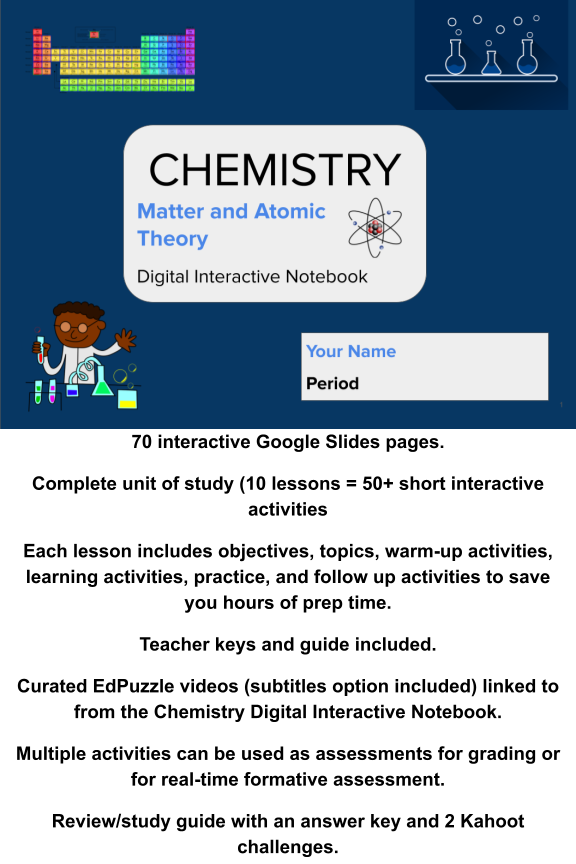
Help students learn about matter and atomic theory in an active way. Every Crush School Digital Interactive Notebook unit of study is made up of several lessons and can be used as a whole, or each lesson can be used individually, or you may choose to use specific digital activities from certain lessons with your students when and where you see fit.
UPON PAYMENT, YOU WILL RECEIVE A PDF COPY OF THE NOTEBOOK AND ONCE YOUR PAYMENT CLEARS, YOU WILL BE GIVEN ACCESS TO THE ORIGINAL NOTEBOOK IN THE GOOGLE SLIDES FORMAT VIA EMAIL YOU USE WHEN MAKING YOUR PURCHASE.
Unit Topics:
Chemistry and matter
Elements, compounds, and mixtures
Properties of matter
The atom (nucleus, electron cloud, subatomic particles, protons, neutrons, electrons, atomic number)
Periodic table (element types, groups, periods, families)
Isotopes, mass number, and average atomic mass
Atomic mass calculations
Quantum mechanical model and electron configurations
Questions? Email me at oskar@crushschool.com. I’m happy to answer your questions.
Fair Use Feel free to share and use the Digital Chemistry Notebook with your students. Please do not share it with other parties or use for profit.