CRUSH SCHOOL

I blog on Brain-Based Learning, Metacognition, EdTech, and Social-Emotional Learning. I am the author of the Crush School Series of Books, which help students understand how their brains process information and learn. I also wrote The Power of Three: How to Simplify Your Life to Amplify Your Personal and Professional Success, but be warned that it's meant for adults who want to thrive and are comfortable with four letter words.

Filtering by Tag: skills

Last Team Standing: A Fast-Paced Classroom Review Strategy Students Love

If your end of the school year review activity feels like a sleepwalking-zombie movie, the problem might not be the content.

It’s the energy.

Too many classroom review sessions involve zombiefication—a form of brain death that involves worksheets, packets, and—perhaps worst of them all—teacher asking questions and the classroom overachiever trying to answer all of them while the rest of class looks comatose.

By the end of the school year, the passive approach falls flat fast.

It’s a time when students need movement, urgency, and some friendly competition to awaken their thinking and get bodily fluids flowing.

That’s why Last Team Standing is magic.

It transforms review into a high-energy challenge that gets students retrieving information, talking through concepts, and collaborating under pressure.

In other words, it’s one of those simple active learning strategies that feels like a game while still promoting effective learning at a time when daydreams of summer slumber occupy young minds.

Classroom infographic explaining the Last Team Standing review strategy, where student teams compete by recalling concepts, vocabulary, and examples to strengthen retrieval practice, collaboration, verbal processing, and classroom engagement.

How Last Team Standing Works (5–15 Minutes)

Split the class into small teams.

Put a topic from your current unit on the board.

Examples:

  • Chemical reactions

  • Linear equations

  • Literary themes

  • Causes of World War I

Every student stands up.

Teams take turns naming:

  • vocabulary

  • concepts

  • examples

  • processes

  • formulas

  • facts

  • anything related to the topic.

Rules:

  • No repeating answers

  • Teams must answer within a few seconds

  • If a team cannot answer, you yell: SIT DOWN!

  • The last team standing wins.

Simple setup.

High energy.

Almost zero prep.

And, it’s one of those rare, low-tech classroom engagement strategies students ask to play again.

Why Last Team Standing Engages and Helps Students Learn

Retrieval Practice

Students are not passively reviewing notes. They are actively pulling information from memory under time pressure.

Retrieval builds long term retention far better and faster than copying, rereading, or underlining words.

This makes Last Team Standing one of those powerful retrieval practice activities that improves both retention and recall speed.

Because the brain grows stronger through retrieval, not mere exposure.

Increased Attention and Participation

Most traditional review activities allow students to disappear. A few students answer while everybody else watches.

Last Team Standing changes that immediately. Every student knows their team may need them at any moment. This creates urgency, attention, anticipation, and accountability.

The activity keeps students mentally engaged because the brain naturally responds to challenge and uncertainty.

That’s why strong brain based teaching strategies often include movement, novelty, competition, and social interaction.

Elaboration: Verbal Processing and Content Connections

Students are not just remembering isolated facts. They hear related vocabulary, connected concepts, peer explanations and examples.

Such repeated exposure helps students organize information into stronger mental networks.

The activity naturally builds:

  • Memory Retrieval: Pulling information from memory strengthens memory and thus learning.

  • Verbal Processing: Talking through ideas improves understanding.

  • Content Connections: Linking concepts helps learning stick.

  • Collaborative Thinking: Team discussion build better reasoning and problem-solving.

That’s why short, fast-paced science backed teaching strategies can outperform longer passive review sessions.

Why Students Love It

Students love games with quick pacing, competition, unpredictability, teamwork, and low-risk participation.

Last Team Standing feels more like a challenge than schoolwork.

Even reluctant students often participate because answers are short, teams provide support, movement lowers pressure, the pace keeps things exciting.

This helps stave off the end-of-the-school-year zombie apocalypse.

Last Team Standing Classroom Review Game: Pro Tips

  1. Keep the Pace Fast: Momentum is everything. Don’t let teams overthink.

  2. Use Small Teams: Groups of 3–5 students maximize participation.

  3. Start Easy, Then Increase Difficulty: Build confidence before pushing for deeper thinking.

  4. Require Explanations, Occasionally: Instead of just naming a term, ask: “Explain it.” Small upgrade that dramatically increases rigor.

  5. Use It as a Bell Ringer or Brain Reset

  6. Last Team Standing works especially well for review days, after lunch, during low-energy topics, and at the end of the school year.

Bottom Line

Students do not learn best by sitting quietly and watching someone else review.

Last Team Standing combines retrieval, discussion, challenge, movement, and collaboration into one fast, engaging classroom activity.

It’s simple. It’s competitive. It dezombifies the brain.

And unlike zombies trying to eat others’ brains, students’ brains actually remember the learning afterward.

Excitement = Engagement = Learning That Works—sorry math teachers…


Want more easy to implement, high impact strategies like Last Team Standing?

Sign up below and get 5 Active Learning Strategies You Can Use Today. It’s 5 Editable Activity Slides you can use in your classroom right away—any time, any subject, zero prep required + 5 Teacher Slides with pro tips and rationale.

My new book High Impact Teaching Tools: 100 Brain-Based Strategies for Building Better Learners is set for release on August 1st and I plan to offer it at 50% off to the first 100 buyers, so sign up to get notified when it drops.

BOOKS & TOOLS

 
Memory Palace - 3 Lesson Series (Teach Students a Powerful Memory Technique)
$3.00

Flashcards are okay but there's a better way. The Memory (or Mind) Palace Method is a powerful learning and memorization technique that when mastered allows a student to remember 10, 20, or even 30 vocabulary words or concepts (definitions included) with ease.

And, they actually remember what they learned using memory palaces! This series of lessons (which can be used as classroom handouts) walks students through creating their first memory palace, filling it with information they need to learn, and using it to train their memories. It also contains short readings, a video lesson, memory palace examples, and practice drills.

Fair Use

Feel free to use with your students. Please do not share it with other parties or use for profit. All rights by crushschool.com.

 
EQUITY Poster
$1.50

Equity-Promoting Classroom Poster. What does EQUITY in the classroom look like?

  • Everyone has a different start and finish line

  • Quality is more important that quantity

  • Understanding that diversity makes us stronger

  • Inclusion despite beliefs, appearances, and circumstances

  • Thoughtfulness lowers barriers and reduces biases

  • Yesterday's mistakes are today's learning agenda

You can teach your students about equity and make it a daily classroom practice using this inspirational poster, which also includes images that accompany the equity description. You can discuss each letter characteristic with your students as a way of introducing your inclusive classroom and display it prominently as a reminder that diversity makes the classroom community stronger.

 
Mistakes Are... Poster
$3.00

In this classroom Mistakes are Expected, Respected, Inspected, Corrected!

Learned helplessness is a result of years of conditioning that mistakes are bad for learning. Nothing is further from the truth - some of the most powerful life lessons come from making mistakes, reflecting on them, and growing as a result.

This is a PNG Poster you can print and display in your classroom to encourage a culture of risk-taking and learning from mistakes.
 
Climate Change Debate: The Earth Science Intellectual Thunderdome
$4.00

In this 3- to 4-day lesson, designed for a high school Earth and Space Science classroom, student groups are assigned and investigate 4 leading solutions to the climate change crisis our planet is experiencing. Then, they are called upon to debate against each other to try to convince others that their solution is the most viable and provide counterarguments against other solutions. It’s an intellectual thunderdome in which students are encouraged to use science to attacks each others points of view on climate change but not character.

Why and how does this learning strategy work?

Rote memorization out; seeking answers and deeper learning in.

The debate-style approach to learning is engaging and motivating for learners, because they are challenged to use real evidence and their wits to outmaneuver their opposition.

Not only do they act as investigators, developing communication, collaboration, and argumentation skills but they learn about viable solutions to the climate change conundrum we all find ourselves in. They learn Earth and Space Science content while investigating and debating solutions to a real-world phenomenon, which is what the Next Generation Science Standards (NGSS) call for.

Student Learning and Performance Objectives:

  1. Research multiple, complex climate change solutions to discover that the world is more complicated than a single TikTok trend.

  2. Articulate scientific arguments with actual evidence.

  3. Listen to opposing viewpoints, to hone "social awareness" skills.

  4. Realize that climate change solutions are multi-faceted, messy, and require more than just good vibes.

  5. Describe and support with, not mere belief but actual evidence, the leading climate solutions proposed by, not the coven of online witches but the scientific community.

What's included:

  1. 24 slides that introduce, explain, and guide the teacher and students

  2. Detailed teacher notes on prep, main lesson, and follow up activities

  3. General Lesson flow for teacher to follow to make it all seamless

  4. A short and funny “hook” to increase student buy in

  5. Detailed student directions

  6. A list (research starter pack) of links to legit, scientific websites for students to use.

  7. Group roles (team jobs) with descriptions of what each entails.

  8. 4 climate change solutions to assign to 4 different student groups

  9. Student Learning and Performance Objectives

  10. Detailed Grading Rubric to guide students and make assessment easy

  11. Debate Day introduction and format description

  12. Follow up discussion questions (reflection and debrief)

 
Earth Science: 7-Day Weather Report Project (NGSS) HS-ESS2
$4.00

Save planning time with this Atmosphere Unit, 5-day Honors Earth and Space Science Project in which students research, design, create, and present a 7-day weather forecast for a specific city in the US or abroad.

Student Performance and Learning Objectives:

  1. Explain how weather data is collected and interpreted.

  2. Explain how weather patterns may be affected by geography (mountains, plains, valleys etc.).

  3. Explain the atmospheric conditions (pressure, moisture etc.) necessary for different weather (sunny, windy, rainy etc.).

What's included:

  1. 16 slides (Google Slides link for easy use and editing to fit your purposes)

  2. Learning Objectives

  3. Group Roles / Jobs (up to 5 with detailed description of jobs)

  4. Detailed Project Directions / Requirements

  5. Materials/Web Resources List

  6. Link to a "Wheel of Names" containing city names - students spin and receive their assigned city.

  7. Link to a grading rubric for student and teacher use (printable doc).

The project follows the guidelines set by the Next Generation Science Standards (NGSS).


Questions?
Email me at oskar@crushschool.com. I’m happy to answer your questions.

Fair Use
Feel free to share and use this resource with your students.

Please do not share it with other parties or use for profit. All rights by crushschool.com.


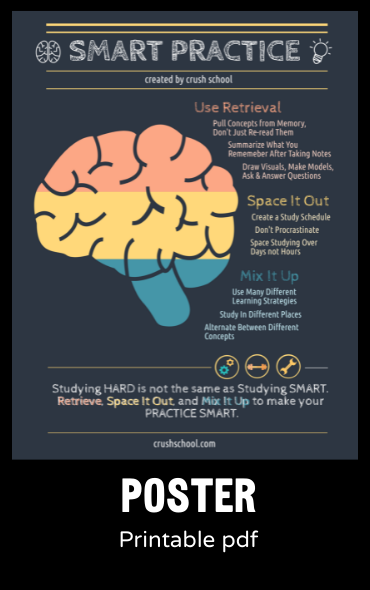
Smart Practice Digital Poster
Sale Price: $2.00 Original Price: $3.00

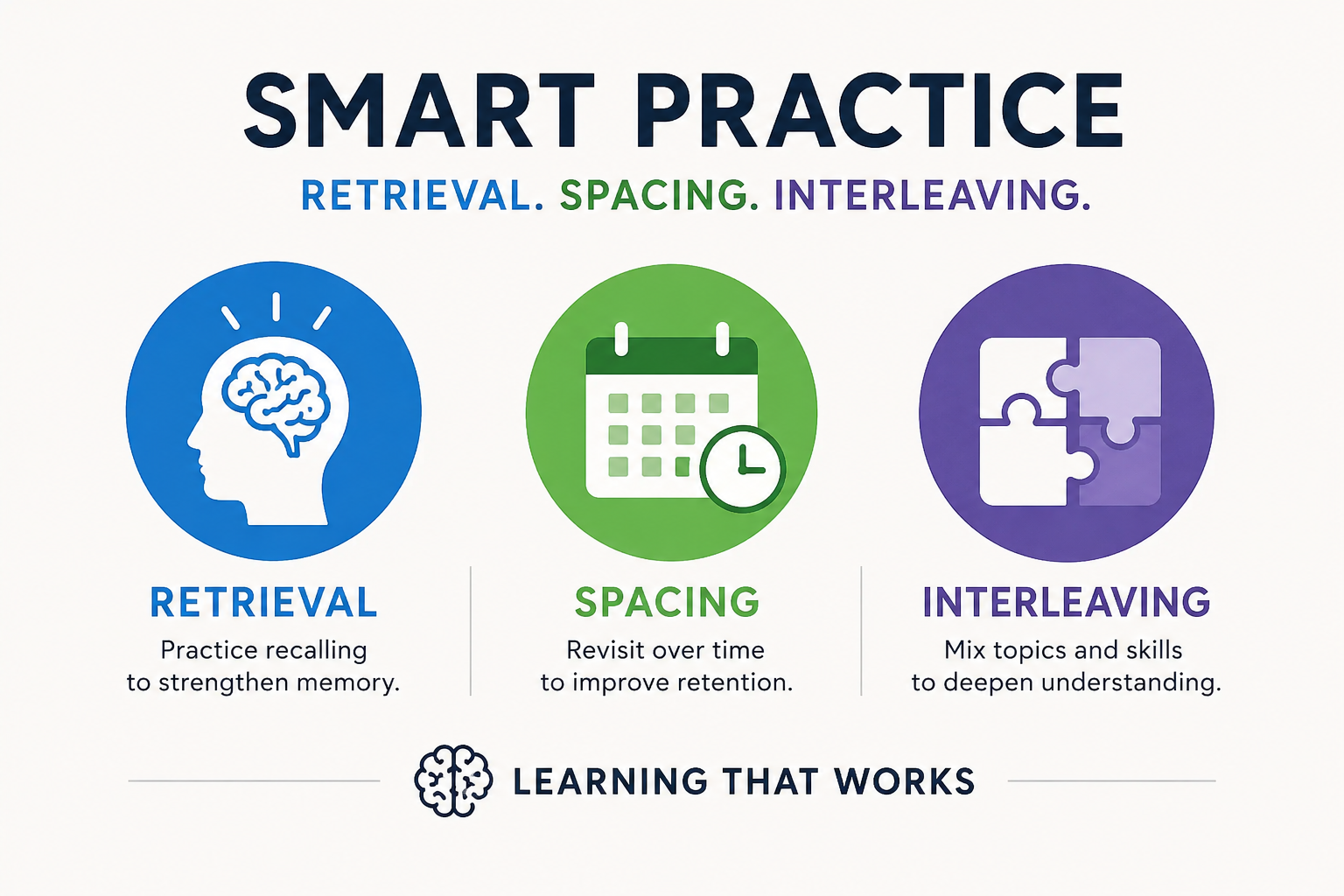
Retrieval Practice, Spaced Practice, and Mixed Practice (Interleaving).

Studying Hard is not the same as Studying Smart. This High Quality printable, digital (PNG) poster is a constant classroom reminder of best practices for teachers and learning the smart way for students.
Word Unscramble: Fun and Engaging End-of-the-School-Year Activity Students Love

Illustrated classroom infographic showing the Word Unscramble strategy, where students create smaller words from a large academic vocabulary term to increase engagement, attention, vocabulary recognition, and readiness for learning.

By mid-May, students are mentally cooked.

Their brains scrambled by the grind of the school year, even simple classroom tasks feel like a battle.

That’s why the end of the school year is not the time for long lectures, giant packets, or passive review.

Quick wins—this is what students need.

Also, movement, challenge, novelty, and interaction.

In other words, they need active learning strategies that keep the brain awake.

One of my favorite end-of-the-year classroom engagement strategies is incredibly simple.

Word Unscramble

It takes about five minutes, requires almost no prep, and students genuinely get into it.

Better yet—it secretly primes the brain for learning before the lesson even begins.

That’s learning that works.

How Word Unscramble Works (5 Minutes)

Before introducing the lesson, write a large academic vocabulary word, concept, or unit term on the board.

Examples:

  • stoichiometry

  • characterization

  • probability

  • industrialization

Students work individually or in small groups to create as many smaller words as possible using only the letters from the larger word.

No phones. No tech. Just brains and letters from the original word.

Give them 3 minutes. Time it too and give them the 30 second warning and the “3, 2, 1 stop!” countdown.

Then compare totals:

  • “Who got more than 10?”

  • “More than 20? 30? 40?”

  • “Who’s got the weirdest word?”

  • “Who found the longest word?”

Finally, transition into the lesson connected to the larger concept.

That’s it.

Simple. Fast. Competitive. Engaging.

It’s one of those easy high impact teaching strategies that immediately changes classroom energy.

Why It Helps Learning and Gets Engagement

The Brain is Primed for Learning

One of the most effective brain based teaching strategies is preparing students to notice important information (priming) before instruction or input even starts.

By repeatedly looking at, processing, and manipulating a large academic term, students become more familiar with the structure of the word, spelling patterns, prefixes and suffixes, visual recognition, and pronunciation.

That familiarity makes the concept easier to process later during the lesson.

The brain learns patterns first and Word Unscramble helps build those patterns before content instruction begins and understanding starts forming.

Immediate Attention Activation

The brain pays attention to interesting things: challenges, puzzles, novelty, uncertainty, competition etc.

That’s exactly why this works so well as a bell ringer or engagement hook.

Instead of passively sitting and waiting for class to start, students immediately begin thinking, discussing, searching, and competing. The activity creates instant cognitive engagement without feeling like traditional schoolwork.

This is what effective student-centered learning strategies do—they shift students from passive observers into active participants.

It Improves Encoding and Retention

Students are not just glancing at the word once. They repeatedly process the concept behind it visually and mentally for several minutes.

That repetition improves encoding and recognition.

Later in the lesson, when students encounter the larger academic concept again, it already feels familiar.

This matters because familiarity reduces cognitive load and improves retention. It’s one reason teachers value activating prior knowledge so much—the brain learns new information more effectively when something already feels familiar. It’s also why short, simple, science-backed teaching strategies outperform longer passive, mind-numbing activities that overload attention and working memory.

Simply, the brain values and remembers what it repeatedly notices and uses.

Why Students Actually Enjoy It

Most review activities feel predictable. Students expect worksheets, packets, note-taking, and the teacher talking.

Word Unscramble feels like a game. Students collaborate, compete, laugh, and challenge each other the same way they do outside of class. Even reluctant learners tend to participate because the activity feels low-risk and playful.

That matters a lot during the end-of-the-school-year energy “shortage.”

Pro Tips For Increasing Student Learning and Motivation

  1. Use Long Academic Terms: the longer the word, the better the activity

  2. Examples: photosynthesis, characterization, reconstruction

  3. Keep It Short: the activity works because it stays fast-paced

  4. Use Groups: Small teams increase participation and energy

  5. Transition Into the Lesson Immediately: connect the large word directly to the day’s lesson while students are already mentally engaged.

Bottom Line

Word Unscramble is simple, fast, competitive, and surprisingly effective.

It combines puzzle-solving, vocabulary exposure, and classroom energy into one quick activity that helps students focus before learning even begins.

That’s not just fun. That’s good teaching and learning that works. Because disengaged brains don’t need more information—they need reactivation.

The solution to end-of-year burnout isn’t harsher tone. It’s better structure—one that recognizes the adolescent brain.

Because once students mentally leave for the summer, lectures won’t bring them back.

But active learning just might.


Want more easy to implement, high impact strategies like Word Unscramble?

Sign up below and get 5 Active Learning Strategies You Can Use Today. It’s 5 Editable Activity Slides you can use in your classroom right away—any time, any subject, zero prep required + 5 Teacher Slides with pro tips and rationale.

My new book High Impact Teaching Tools: 100 Brain-Based Strategies for Building Better Learners is set for release on August 1st and I plan to offer it at 50% off to the first 100 buyers, so sign up to get notified when it drops.

BOOKS & TOOLS

 
Memory Palace - 3 Lesson Series (Teach Students a Powerful Memory Technique)
$3.00

Flashcards are okay but there's a better way. The Memory (or Mind) Palace Method is a powerful learning and memorization technique that when mastered allows a student to remember 10, 20, or even 30 vocabulary words or concepts (definitions included) with ease.

And, they actually remember what they learned using memory palaces! This series of lessons (which can be used as classroom handouts) walks students through creating their first memory palace, filling it with information they need to learn, and using it to train their memories. It also contains short readings, a video lesson, memory palace examples, and practice drills.

Fair Use

Feel free to use with your students. Please do not share it with other parties or use for profit. All rights by crushschool.com.

 
EQUITY Poster
$1.50

Equity-Promoting Classroom Poster. What does EQUITY in the classroom look like?

  • Everyone has a different start and finish line

  • Quality is more important that quantity

  • Understanding that diversity makes us stronger

  • Inclusion despite beliefs, appearances, and circumstances

  • Thoughtfulness lowers barriers and reduces biases

  • Yesterday's mistakes are today's learning agenda

You can teach your students about equity and make it a daily classroom practice using this inspirational poster, which also includes images that accompany the equity description. You can discuss each letter characteristic with your students as a way of introducing your inclusive classroom and display it prominently as a reminder that diversity makes the classroom community stronger.

 
Mistakes Are... Poster
$3.00

In this classroom Mistakes are Expected, Respected, Inspected, Corrected!

Learned helplessness is a result of years of conditioning that mistakes are bad for learning. Nothing is further from the truth - some of the most powerful life lessons come from making mistakes, reflecting on them, and growing as a result.

This is a PNG Poster you can print and display in your classroom to encourage a culture of risk-taking and learning from mistakes.

 
Climate Change Debate: The Earth Science Intellectual Thunderdome
$4.00

In this 3- to 4-day lesson, designed for a high school Earth and Space Science classroom, student groups are assigned and investigate 4 leading solutions to the climate change crisis our planet is experiencing. Then, they are called upon to debate against each other to try to convince others that their solution is the most viable and provide counterarguments against other solutions. It’s an intellectual thunderdome in which students are encouraged to use science to attacks each others points of view on climate change but not character.

Why and how does this learning strategy work?

Rote memorization out; seeking answers and deeper learning in.

The debate-style approach to learning is engaging and motivating for learners, because they are challenged to use real evidence and their wits to outmaneuver their opposition.

Not only do they act as investigators, developing communication, collaboration, and argumentation skills but they learn about viable solutions to the climate change conundrum we all find ourselves in. They learn Earth and Space Science content while investigating and debating solutions to a real-world phenomenon, which is what the Next Generation Science Standards (NGSS) call for.

Student Learning and Performance Objectives:

  1. Research multiple, complex climate change solutions to discover that the world is more complicated than a single TikTok trend.

  2. Articulate scientific arguments with actual evidence.

  3. Listen to opposing viewpoints, to hone "social awareness" skills.

  4. Realize that climate change solutions are multi-faceted, messy, and require more than just good vibes.

  5. Describe and support with, not mere belief but actual evidence, the leading climate solutions proposed by, not the coven of online witches but the scientific community.

What's included:

  1. 24 slides that introduce, explain, and guide the teacher and students

  2. Detailed teacher notes on prep, main lesson, and follow up activities

  3. General Lesson flow for teacher to follow to make it all seamless

  4. A short and funny “hook” to increase student buy in

  5. Detailed student directions

  6. A list (research starter pack) of links to legit, scientific websites for students to use.

  7. Group roles (team jobs) with descriptions of what each entails.

  8. 4 climate change solutions to assign to 4 different student groups

  9. Student Learning and Performance Objectives

  10. Detailed Grading Rubric to guide students and make assessment easy

  11. Debate Day introduction and format description

  12. Follow up discussion questions (reflection and debrief)

 
Earth Science: 7-Day Weather Report Project (NGSS) HS-ESS2
$4.00

Save planning time with this Atmosphere Unit, 5-day Honors Earth and Space Science Project in which students research, design, create, and present a 7-day weather forecast for a specific city in the US or abroad.

Student Performance and Learning Objectives:

  1. Explain how weather data is collected and interpreted.

  2. Explain how weather patterns may be affected by geography (mountains, plains, valleys etc.).

  3. Explain the atmospheric conditions (pressure, moisture etc.) necessary for different weather (sunny, windy, rainy etc.).

What's included:

  1. 16 slides (Google Slides link for easy use and editing to fit your purposes)

  2. Learning Objectives

  3. Group Roles / Jobs (up to 5 with detailed description of jobs)

  4. Detailed Project Directions / Requirements

  5. Materials/Web Resources List

  6. Link to a "Wheel of Names" containing city names - students spin and receive their assigned city.

  7. Link to a grading rubric for student and teacher use (printable doc).

The project follows the guidelines set by the Next Generation Science Standards (NGSS).


Questions?
Email me at oskar@crushschool.com. I’m happy to answer your questions.

Fair Use
Feel free to share and use this resource with your students.

Please do not share it with other parties or use for profit. All rights by crushschool.com.


Smart Practice Digital Poster
Sale Price: $2.00 Original Price: $3.00

Retrieval Practice, Spaced Practice, and Mixed Practice (Interleaving).

Studying Hard is not the same as Studying Smart. This High Quality printable, digital (PNG) poster is a constant classroom reminder of best practices for teachers and learning the smart way for students.

Decode + Describe: A Fun Learning Strategy That Builds Vocabulary and Understanding

The end of the school year can be tough.

As days are getting longer, school days seem to do the same.

Motivation wanes. Students want to be done. Teachers want summer.

But we still need to keep learning going and our students engaged.

So start class with a puzzle.

It’s not one of those busywork ones; I promise.

It‘s Decode + Describe—a fun, 5-minute challenge that uses retrieval practice in disguise that’s perfect for the end of the school year blues.

Just give students a scrambled key term and make them figure it out from memory—no tech, no notes.

Illustrated classroom infographic showing the “Decode & Define” retrieval activity, where students unscramble vocabulary words, define them, and connect them to prior learning to strengthen memory and understanding.

How It Works (5 minute Bell Ringer)

  1. Put a scrambled term on the board: “NOISOTPYHSESP” → (Photosynthesis)

  2. Students work individually or with a partner to decode the word

  3. Once solved, they must describe it: (1) define it in their own words, (2) give an example, and (3) make a connection to other content or real life

  4. Optional upgrade: Use the word in a diagram, sentence, or quick sketch

Why Decode + Describe Is Active, Effective Learning

  1. Forces retrieval (not recognition): No multiple choice. No word bank. Students have to pull the term from memory—that’s where learning happens.

  2. Desirable difficulty: The scramble challenge slows them down just enough to make thinking effortful. That friction strengthens memory later.

  3. Dual coding opportunity: When you add a sketch or example, you’re layering words + visuals, which leads to stronger recall.

  4. Fun Repetition: You’re revisiting key vocabulary, but it feels like a puzzle, not a soul-crushing worksheet.

Pro Tips For Classroom Implementation

  • Use recently learned key terms (prior week etc.), not brand new ones

  • Keep scrambles solvable—don’t make it frustrating

  • Require meaning after solving (definition, example, connection etc.)

  • Follow with another word for round 2 or even 3 to recall 3 key concepts

  • Make it a timed challenge or a competition between small groups (e.g. when a group completes the first word, it shows the solution to the teacher and is given the second scramble to solve.

Example Decode Words For Various Subjects

Science

  • “NOITCAVRNEOC” → Convection

  • “SISOTIM” → Mitosis

Math

  • “NOITARUQE” → Equation

  • “NOITCNUF” → Function

ELA

  • “ROHAPMET” → Metaphor

  • “ECNEREFNI” → Inference

Social Studies

  • “NOITULOVRE” → Revolution

  • “YCARCOME D” → Democracy

Bottom Line

Decode and Describe is an easy to implement, but highly effective classroom activity that moves students from re-reading information to retrieval practice.

It’s not just an effective strategy, it’s a fun end of year activity for middle school and high school students as it breaks up the monotony of completing this or filling out that.

Because you don’t just give students the word to copy—you challenge them by making them rebuild it.

When students retrieve, decode, and then explain a concept, they’re not just reviewing content—they’re recalling it, which strengthens memory.

That’s how you turn vocab practice into learning. Learning that works.


Thanks for reading!

Want more easy to implement, high impact strategies like Decode + Describe?

Sign up below and get 5 Active Learning Strategies You Can Use Today. It’s 5 Editable Activity Slides you can use in your classroom right away—any time, any subject, zero prep required + 5 Teacher Slides with pro tips and rationale.

My new book High Impact Teaching Tools: 100 Brain-Based Strategies for Building Better Learners is set for release on August 1st and I plan to offer it at 50% off to the first 100 buyers, so sign up to get notified when it drops.

BOOKS & TOOLS

 
Memory Palace - 3 Lesson Series (Teach Students a Powerful Memory Technique)
$3.00

Flashcards are okay but there's a better way. The Memory (or Mind) Palace Method is a powerful learning and memorization technique that when mastered allows a student to remember 10, 20, or even 30 vocabulary words or concepts (definitions included) with ease.

And, they actually remember what they learned using memory palaces! This series of lessons (which can be used as classroom handouts) walks students through creating their first memory palace, filling it with information they need to learn, and using it to train their memories. It also contains short readings, a video lesson, memory palace examples, and practice drills.

Fair Use

Feel free to use with your students. Please do not share it with other parties or use for profit. All rights by crushschool.com.

 
Mistakes Are... Poster
$3.00

In this classroom Mistakes are Expected, Respected, Inspected, Corrected!

Learned helplessness is a result of years of conditioning that mistakes are bad for learning. Nothing is further from the truth - some of the most powerful life lessons come from making mistakes, reflecting on them, and growing as a result.

This is a PNG Poster you can print and display in your classroom to encourage a culture of risk-taking and learning from mistakes.

 
EQUITY Poster
$1.50

Equity-Promoting Classroom Poster. What does EQUITY in the classroom look like?

  • Everyone has a different start and finish line

  • Quality is more important that quantity

  • Understanding that diversity makes us stronger

  • Inclusion despite beliefs, appearances, and circumstances

  • Thoughtfulness lowers barriers and reduces biases

  • Yesterday's mistakes are today's learning agenda

You can teach your students about equity and make it a daily classroom practice using this inspirational poster, which also includes images that accompany the equity description. You can discuss each letter characteristic with your students as a way of introducing your inclusive classroom and display it prominently as a reminder that diversity makes the classroom community stronger.

 
Smart Practice Digital Poster
Sale Price: $2.00 Original Price: $3.00

Retrieval Practice, Spaced Practice, and Mixed Practice (Interleaving).

Studying Hard is not the same as Studying Smart. This High Quality printable, digital (PNG) poster is a constant classroom reminder of best practices for teachers and learning the smart way for students.

 
Earth Science: 7-Day Weather Report Project (NGSS) HS-ESS2
$4.00

Save planning time with this Atmosphere Unit, 5-day Honors Earth and Space Science Project in which students research, design, create, and present a 7-day weather forecast for a specific city in the US or abroad.

Student Performance and Learning Objectives:

  1. Explain how weather data is collected and interpreted.

  2. Explain how weather patterns may be affected by geography (mountains, plains, valleys etc.).

  3. Explain the atmospheric conditions (pressure, moisture etc.) necessary for different weather (sunny, windy, rainy etc.).

What's included:

  1. 16 slides (Google Slides link for easy use and editing to fit your purposes)

  2. Learning Objectives

  3. Group Roles / Jobs (up to 5 with detailed description of jobs)

  4. Detailed Project Directions / Requirements

  5. Materials/Web Resources List

  6. Link to a "Wheel of Names" containing city names - students spin and receive their assigned city.

  7. Link to a grading rubric for student and teacher use (printable doc).

The project follows the guidelines set by the Next Generation Science Standards (NGSS).


Questions?
Email me at oskar@crushschool.com. I’m happy to answer your questions.

Fair Use
Feel free to share and use this resource with your students.

Please do not share it with other parties or use for profit. All rights by crushschool.com.


2026 Crush School