CRUSH SCHOOL

I blog on Brain-Based Learning, Metacognition, EdTech, and Social-Emotional Learning. I am the author of the Crush School Series of Books, which help students understand how their brains process information and learn. I also wrote The Power of Three: How to Simplify Your Life to Amplify Your Personal and Professional Success, but be warned that it's meant for adults who want to thrive and are comfortable with four letter words.

Filtering by Category: Teaching

Why Students Learn Better When They Teach (+ 4 Activities)

students learn better when they teach
When You Teach Something You Get To Learn It Twice
— Jim Kwik

Cameron, a former student of mine, who is now in college, commented on my recent post about efficient and effective learning titled Too Much What, Not Enough How. Here's what he wrote on Facebook:

As a student who graduated with a GPA well above 4.0, I completely agree specifically with the point about students teaching subject-matter. Most of what made me successful was not studying - I rarely did that - but teaching other students, and in doing so, closing gaps in and solidifying what I knew. I tutored other students in almost every single class I took throughout my high school career, especially the science courses. That was my secret to success and I didn't even realize it until senior year. The feeling you get when you help someone grasp an idea they struggled with is an awesome feeling, too.

But Why Is Teaching Such An Effective Learning Strategy?

If you closely analyze and dissect Cameron's comment you can identify at least 4 aspects that made his strategy of teaching others to learn it yourself super effective. They are Active Learning, Deeper Learning, Efficient Learning, and Emotional Learning. 

Active Learning

Active learning is about engaging the mind in processing and making meaning from the information you're trying to encode. When teaching, the student has to figure out how to explain the concept to others. While that planning might take seconds, it is an active process. Moreover, it might take multiple approaches to teach someone who thinks differently than the student-teacher. This equates to multiple ways of processing the information. If you're a teacher, a trainer, or someone who has spent time explaining new ideas to people, you get this.

Deeper Learning

When teaching, the student has to pass his understanding of the concept on to someone else and as a result, he reprocesses the learned information multiple times. This leads to an even deeper understanding of the concepts learned/taught. The reason for this is that new association happen and new neural connections form in the brain as the existing ones keep strengthening. Light bulb moments make you a lit learner. Deep, huh?

Efficient Learning

Teaching concepts is one of the most efficient ways to learn because it requires students to present information to peers in an understandable way. This requires looking at the information from different perspectives and strategizing on how to pass it on best. There's so much brain activity and processing going on in the student-teacher brain that he remembers the information through and through in a short period of time. In addition, as the student struggles to come up with ways to explain difficult concepts, his hippocampus perceives them as important, which supercharges encoding and helps storage of information.

Emotional Learning

There are emotions and then there are emotions... When learning is accompanied by strong emotions it is memorable. While Cameron mentioned the "awesome feeling" as a side note, he might not have realized that those feelings associated with satisfaction of helping others, led to the release of dopamine in his brain, which helped memory and retrieval of information. As a teacher, you undoubtedly experienced breakthrough moments when a student you've been working with suddenly got it. If you can think of a past event like this right now, you can relive it. If I'm right, you just got a small kick of dopamine. Pretty cool, huh?

4 Activities To Bring Out The Teacher In Your Students

Many teachers reading this have has had their students create slideshow presentations and present to peers. This strategy, if done right, can be a way to have students teach their peers. And while it may not always be effective for the audience receiving the information, if the presenter takes the project seriously she learns the topic well because as she prepares, she does it with the intention to teach and to be more expert in it than her peers.

Thus, teaching benefits the teacher most. And that's precisely the point.

Here are 4 easy ways to engage students in teaching I use in my classroom.

Short Instructional Videos

Recently, I asked my chemistry students to create videos explaining how to calculate atomic mass of an element. I introduced the concept the day before and students did a few practice problems in groups. The next day, I asked them to find a partner and to make a Flipgrid video. Here are the exact directions I posted in Google Classroom:

  1. Find a problem online you can solve to demo how to calculate atomic mass.

  2. Solve it and discuss the steps needed for the solution to like totally understand it!

  3. Write a script, practice it, and record the vid.

You don't have to use Flipgrid, but it is free and allows you to streamline the process. Videos are easy for students to submit and teachers to watch. 

Dry Erase Board Drawings

I am lucky to have a flexible seating classroom and student tables painted with dry erase paint. Perhaps one day I will write an article on how much of a game changer the dry erase tables are but for the purpose of this post, I want to describe how my students use them to teach each other. 

I frequently ask students to represent concepts they are learning visually. They draw diagrams showing concepts, with labels and descriptions that will allow viewers to learn about the topics they represent. It is important to make sure students consider the possibility that the audience knows little about the concepts. Such approach forces students to think like teachers. The idea is to create a product that helps others learn some concept and in the process, the diagram makers learn it more intimately. A unique Twitter hashtag is useful for capturing and sharing images of the visuals.

Spontaneously, my students often use the tables to help their group members understand the concepts better or to walk those struggling through problem-solving.

I realize not every teacher has dry erase tables. In the past, I used melamine boards sold at hardware stores. I bought two 8' x 4' boards and had each one cut into eight 2' x 2' pieces, which gave me 16 boards my students used in small groups of 2-4 students. Alternatively, students can draw on large sheets of paper.

Infographics

Using Piktochart, Canva, or Google Draw/Slides to make infographics is another way to take advantage of our visual processing power. Combining images with text to represent an idea is powerful. Going digital is not as efficient as drawing on dry-erase surfaces and Tweeting, but nevertheless effective and students learn useful design and presentation tools. If you can fit infographic making in, I highly recommend it. Check out this post I wrote for more on the benefits of using infographics in the classroom.

Paper Slide Videos

Paper slide videos marry old school posters with the digital world of smartphone video recording. In a nutshell, students research and organize information, write a script, create the slides, practice, and record a short movie in which images and speech are used more extensively than text. The process of preparing and practicing the show leads to increased expertise. Here's a video that gives more details on how to make paper slide videos.

When Students Teach They Develop Mad Skills

Call them 21st-century, future-ready, or mad skills they'll need, it is hard to argue with the fact that collaboration, communication, creativity, critical thinking, and leadership will help your students be more successful in academics and beyond. You can speed up the development of these and other skills by utilizing the Teach It strategy in your classroom. 

I talk about the Teach It and other learning strategies on my blog, teach them to my students, and describe them in my Crush School Book Series because I want all students to have these skills now.


Big thanks to Cameron for allowing me to share his story and a shout out to my sister from another mister Janet, a California teacher, for pushing me to write this post. I hope many teachers find it helpful in their practice. Thanks for reading and remember:

You have the power to change lives. Use it often. 

oc pro.png

Hi! I'm Oskar.          

I teach, write, speak, rant to make the world better.

BOOKS & TOOLS

CONTACT ME

BLOG ARCHIVE:

Too Much What, Not Enough How

Too much what not enough how in schools

A student in my 4th-hour Learning to Study Effectively class asked me today how to best memorize information for his upcoming biology test. The 10-page study guide packet all filled out, he had trouble remembering all that stuff. They say better late than never, but the test was scheduled for next hour... He wanted to learn but didn't know how... Royally screwed is what he was.

it's hard to argue with the statement that the purpose of school is for students to learn. We do that, but I think teachers focus on the what of learning much too much. The how of learning, which is transferable and transcends any subject, is often amiss from our instruction. At best, it's vague and incomplete.

Study Strategies

Most teachers (I hope) talk about spaced repetition. Problem is we're not specific enough. It seems simple enough to do, right? Students too might think it's simple, but many never do spaced repetition, because they don't know how to begin. They're not given a plan. They have to come up with their own. They don't know how to do that. We rarely teach them how. They procrastinate.

Study Habits 

Students don't know how to develop good habits. Teachers differentiate between good and bad study habits, but we don't teach how good habits are developed. We don't explain that ingrained bad habits need to be replaced gradually by new habits. We don't take the time to help our students come up with a plan to change. We say Don't do that but do this instead. It's a bad joke. 

Learning Strategies 

We might mention learning effectively and move on to the topic of the day. In high school, we assume a mention is enough and we rush to the important stuff; the curriculum. We reiterate main concepts, but we don't reiterate learning how to learn techniques. We might reteach main subject ideas students struggled with, but we don't reteach, remind, and reinforce learning how to learn strategies.

Ironically, subject struggles often result from the underlying lack of understanding of how the human brain learns; how it encodes, stores, and recalls information. If students don't know which strategies speed up learning and which waste time, how are they to learn effectively? 

Students often give up because the strategies they use are ineffective. Too hard, too passive, too slow, too boring.

So... Let's Start Teaching Students How To Learn Better

Let's teach them how to learn FASTer.

I recently started listening to Jim Kwik's podcast Kwik Brain. Besides knowing what he's talking about, Jim uses a lot of mnemonics to teach learning strategies. A lot of the information he shares is common sense, but not common practice as he puts it. Kind of like what we rarely do, but should be doing more of in schools to help our students learn...

Anyways... Let's break down the acronym FAST Jim uses to explain how anyone can learn faster and remember more.

FAST stands for Forget, Active, State, and Teach

Forget your limitations, what you know, and what you need to do.

When I said F is for Forget to my 1st-hour chemistry class, one student exclaimed: I do! All the time! But actually, the idea is to stop the negative self-talk that students often partake in.

I suck at math. I'm bad at reading and writing. Science is not my thing. Those are limitations that students reinforce all the time. Problem is that if they keep thinking that way about a subject or task, they will indeed suck, be bad, and it won't be their thing. You see, our hippocampi, the parts of the brain that decide what's important, receive the message that it's not important when we think we suck at something. And, we don't learn it as a result. 

Forget what you know. This is something I am guilty of often. When I assume I know a lot about something, I am not 100% receptive to learning. I don't know everything and I'm not a know-it-all. If I can remember that, I'll keep an open mind and learn more.

Forget what you need to do later today, tomorrow, next week and next month. Be present and focus on the task at hand. Immerse yourself in the experience that is now. If you do, you will learn faster.

Active Learning

Probably a no-brainer, but we often miss the point in the classroom. Too often, the learning is passive. Students consume the information all the while they should be creating with it. Creating meaning. Creating understanding. All we have to do is limit direct instruction to 10 minutes and allow students to discuss key ideas, draw visuals, record videos, make models etc. that show their learning.

State of Mind and Being Matters

Stressed, tired, and disengaged brains don't learn. It's true that teachers have limited influence when it comes to how a student is feeling when she's in our class. But we can do these three things:

  1. Minimize stress in our class. Be flexible and don't force it. Is homework necessary? Are deadlines more important than the learning itself? 

  2. Discuss with students how rest, sleep, and exercise affects learning. Make movement and brain breaks part of the classroom culture.

  3. Be enthusiastic, passionate, caring, active, and novel yourself.

If Your Students Can Teach a Concept, They Get to Learn It Twice

Every teacher gets this. All we need to do is reflect on the countless hours we spend strategizing how to teach concepts so they're understandable and memorable to our students. The more we do it the deeper our understanding of the concept becomes as new realizations keep coming. 

We can increase the number of such light bulb moments for our students.

The key to getting our students to employ the teaching strategy for themselves is to design lessons that ask students to teach their peers. One way to do this is to have students create instructional videos in which they explain how something works or how to do something.

Just today, I had my chemistry students use Flipgrid to explain how to calculate the average atomic mass of an element. The goal was to help them learn and remember it better. Take a peek at their videos here.

F.A.S.T. Forget. Active. State. Teach

  1. Encourage your students to Forget the limitations they place on themselves and they will learn faster.

  2. Design lessons for Active learning and your students will learn faster and understand better.

  3. Model a State of curiosity, enthusiasm, and caring and many students will follow in your footsteps and they will learn faster and remember more.

  4. Create a classroom culture in which students Teach each other and they will learn faster and deeper.

By the way... Did you think I left the student who asked me for help hanging? Not a chance! Yes, the test was the next hour, but I had to give him something. I taught him a visualization strategy I'll talk about in a near-future post. I will ask him if it helped tomorrow. In the meantime, I will make you a promise: You'll like this technique :)

Until then, remember you have the power to change lives. Use it often.

Oskar 

Thanks for reading! If you liked this article, share it with others and sign up for my Newsletter.

oc pro.png

Hi! I'm Oskar.          

I teach, write, speak, rant to make the world better.

BOOKS & TOOLS
CONTACT ME

BLOG ARCHIVE:

Design Thinking The Student Learning Experience

Tuesday the 4th is GO time for me. New room. New kids. New school year.

I'm psyched, excited, hopeful, and a little scared. The fear is completely illogical, but that's me and I learned to embrace it.

Workshop/Get Ready week done. I had the physical space ready to go Tuesday. Furniture placed. Tech working(ish). Caffeine plentiful.

But wait... How the hell do I do this teaching thing again? I mean, I haven't done it for 3 months. The mental muscle has atrophied. I spent the week being busy, but mostly avoiding planning for the thing I am tasked with doing. Teaching, or maybe helping my students learn, or maybe both are important when it says Teacher next to your name.

No wonder you're anxious! my logical part says, but year after year my brain just keeps saying it's too much fun to give up working the eleventh-hour shift. It's because a breakthrough always seems to happen at the last possible moment.

Not to say I did not have a few light bulbs come on throughout the week because I did. They were good ideas, but there were what ifs and how am I's involved. Then, unexpectedly, a fuse was lit by Kristy Kruse Louden's blog Design Thinking as a Back to School Activity last night. I read Kristy's post, looked at the slideshow, told her I'm adapting (read: stealing) it for my classes, but I was too tired to process and figure out how. I slept.

And now the bomb went off and I know. This is the one for the ages. Or, at least until next year, we'll see. But I feel like I'm really onto something. so here it is.

Design thinking the student learning experience

DAY 1

First, let's get the student minds going with something real...

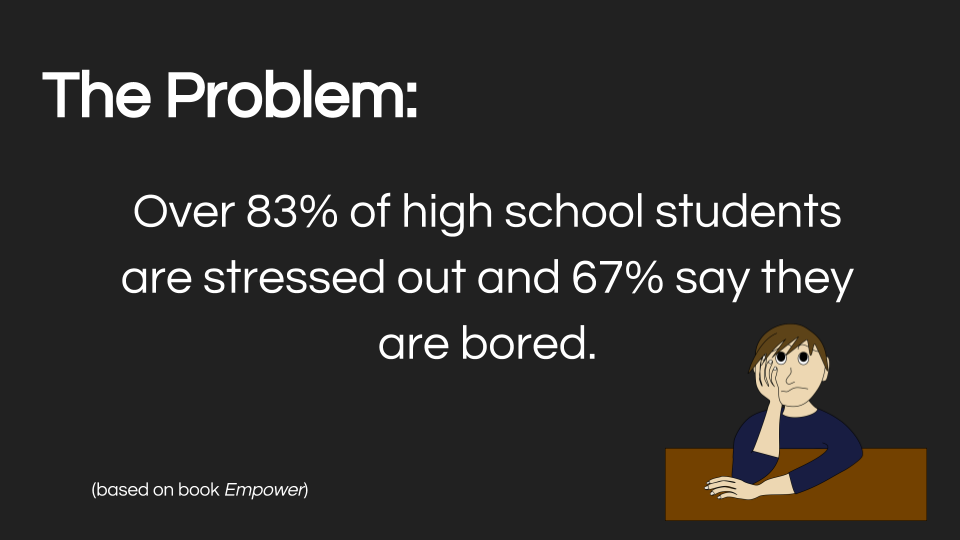
Design Thinking Learning - The problem

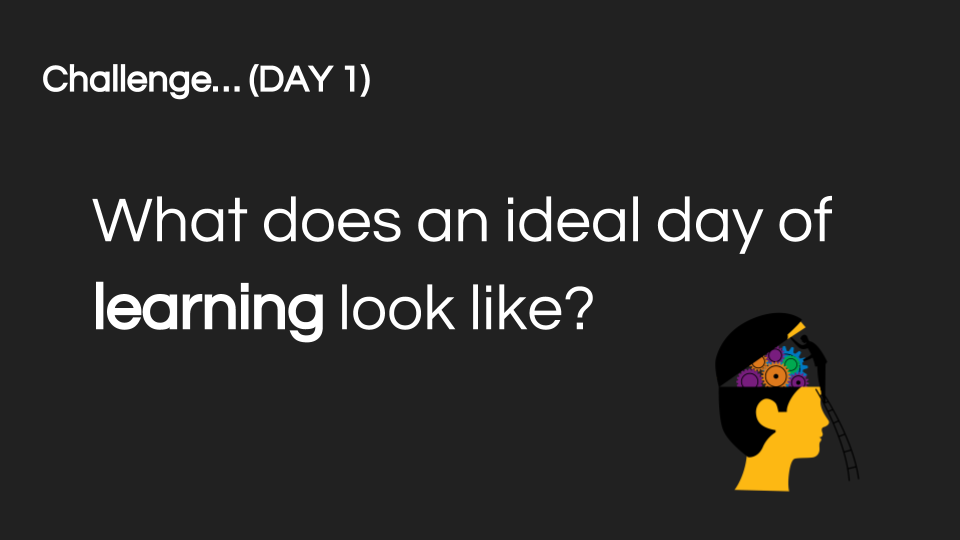
Second, let's pose a question...  

Design Thinking Learning - challenge

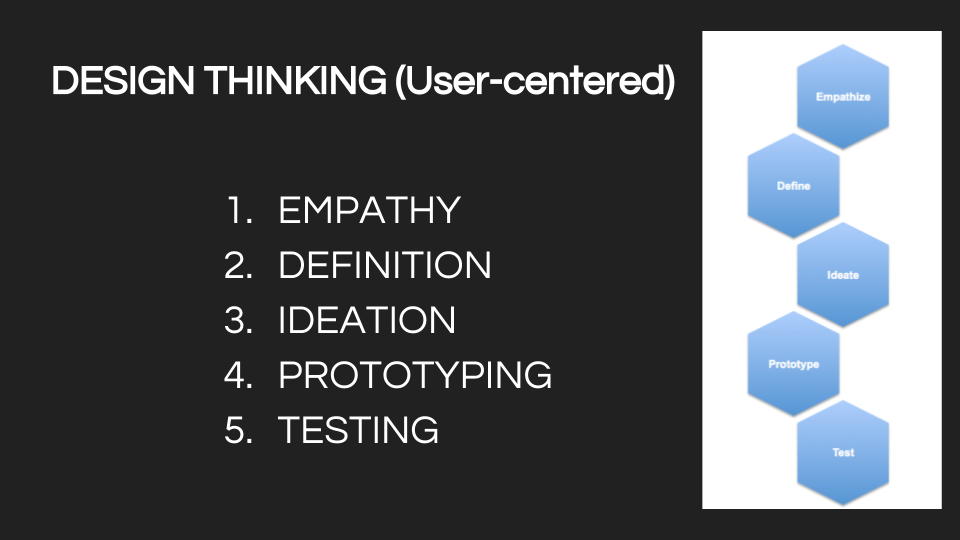
Third, let's introduce Design Thinking. No long descriptions, just explain it's a cycle/web, not a sequence, as you jump between steps.

Design Thinking Learning Cycle

Now, let's go to town! Ask students to walk around and interview/be interviewed by 5 people to get 5 answers to the 2 questions below.

Design Thinking Learning WEEK 1 (4).png

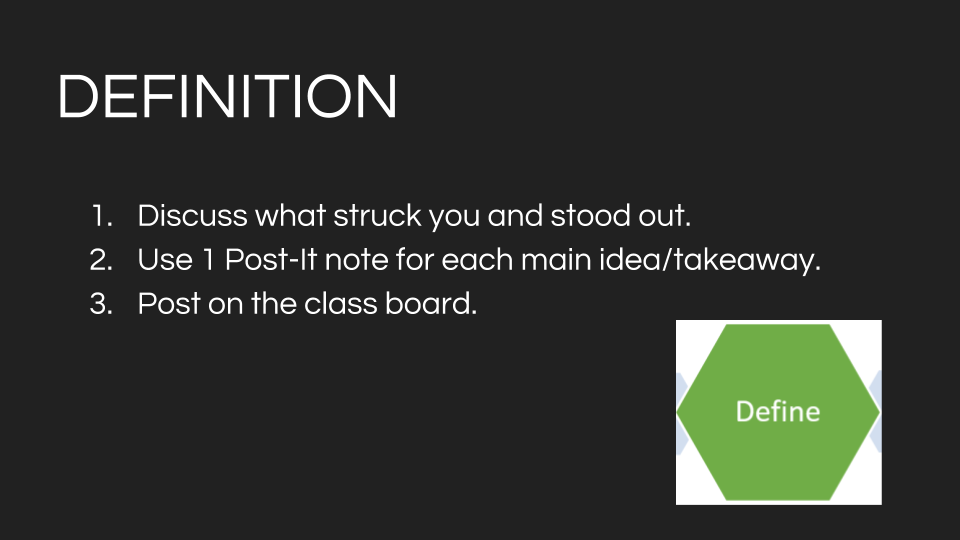
Finally, have students gather in their groups and combine their research (empathy work) into key ideas/takeaways.

Design Thinking Learning - definition

DAYS 2 & 3

Remind students of what the problem is.

Design Thinking Learning - Ideal day

Ask students to first individually review their previous work/notes and spend 5 minutes coming up with ideas for solutions. Then, they brainstorm in groups.

Design Thinking Learning - Ideation

With the Empathy, Definition, and Ideation work well on its way, it is now time to create.

Design Thinking Learning - prototyping

Each team should work on the prototype (presentation/poster/video etc.). The first 10 minutes on Day 3 can be used to show a 10-minute Shart Tank clip, so students see a good product pitch and can practice theirs.

DAY 4

Can they sell their ideas to an audience of peers? The prototypes are ready and it's GO time!

Design Thinking Learning - testing

Here's the link to the 14-slide show to go with the project.

This activity can be used anytime, not just beginning of the year and it can be applied to any problem in any class. And, it's a gift that keeps on giving. 

Students get the voice/choice personalization combo. Check.

Students create their own learning. Check.

You learn how they like to learn. Check.

They learn how Design Thinking works. Check.

They practice/hone Future Ready skills. Check.

They strain their brain and learn a lot. Check.

It's relaxed, engaging, and meaningful. Check.

The only help I plan to give is on explaining the Design Thinking Process and providing materials. Otherwise, the world is my student's oyster. Actually, it's an ocean of possibilities. I wouldn't have it any other way.

I hope you're the same.

You have the power to change lives. Use it often.

Did you enjoy this article? Want more? Sign up below!

oc pro.png

Hi! I'm Oskar.          

I teach, write, speak, rant to make the world better.

BOOKS & TOOLS
CONTACT ME

Past Articles:

2026 Crush School