CRUSH SCHOOL

I blog on Brain-Based Learning, Metacognition, EdTech, and Social-Emotional Learning. I am the author of the Crush School Series of Books, which help students understand how their brains process information and learn. I also wrote The Power of Three: How to Simplify Your Life to Amplify Your Personal and Professional Success, but be warned that it's meant for adults who want to thrive and are comfortable with four letter words.

Filtering by Category: Earth Science

Transforming Science Learning with Science and Engineering Practices

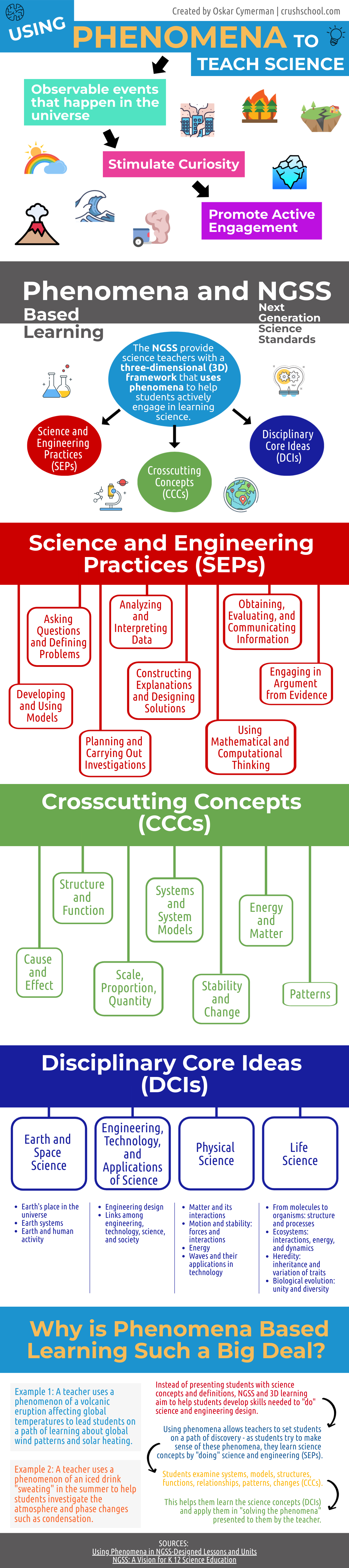
The 8 Science and Engineering Practices (SEPs) by NGSS

Whether you are the proponent of the seemingly never ending evolution of academic standards or not, I hope you will agree with me that we need to shift away from the model of education in which students are asked to memorize and mindlessly recall facts, in favor of a system that empowers them to think critically, encourages them to use creativity, and gives them ample opportunity to gain confidence in their ability to solve problems.

Enter the Next Generation Science Standards, or NGSS. The NGSS writing team recognized that present day jobs require more aptitude in science, technology, engineering, and mathematics (STEM) than in the past. They also recognized that this trend is intensifying - as we innovate and become more advanced technologically, STEM-skilled workforce is more in-demand - regardless of the job type.

To this end, the NGSS identifies eight specific Science and Engineering Practices (SEPs) that students should experience throughout their education. SEPs outline the behaviors and activities that scientists and engineers undertake as they investigate phenomena and develop solutions to problems and are a component of NGSS designed to provide a pathway to engaging students in the processes of scientific inquiry and engineering design.

Here’s the scoop:

Developing and Using Models

This practice includes creating and using physical, conceptual, and computational models to represent and understand phenomena and to predict behaviors in science and engineering.

Classroom Example: Students create a 3D “Reason for Seasons” model to show why many locations on Earth experience spring through winter.

Asking Questions and Defining Problems

This practice involves formulating questions to clarify problems, seek additional information, or challenge existing concepts in science and engineering.

Classroom Example: Students investigate the effects of an El Niño event on their local weather by asking questions about factors that affect weather and defining the problem of how the El Niño will affect factors such as temperature and precipitation.

Planning and Carrying Out Investigations

Students design and perform experiments to test hypotheses and collect data to answer specific scientific questions or solve engineering problems.

Classroom Example: Students design and perform an experiment to test the albedo of different land surfaces such as soil, sand, grass etc.

Analyzing and Interpreting Data

This practice focuses on examining data collected from investigations to identify patterns, trends, and relationships, and to draw meaningful conclusions.

Classroom Example: Students analyze weather data for a month to identify how variables such as pressure affect wind direction and precipitation in their area.

Using Mathematics and Computational Thinking

This practice involves applying mathematical concepts and computational tools to analyze data, represent physical variables, and solve scientific and engineering problems.

Classroom Example: Students use math to calculate their carbon footprints based on energy consumption, transportation, and lifestyle choices, then analyze ways to reduce it, and present it as a percentage.

Constructing Explanations and Designing Solutions

Students develop evidence-based explanations for natural phenomena in science and create innovative solutions to problems in engineering.

Classroom Example: Students design and build a water filtration system using household materials, explaining the science behind how each component removes contaminants.

Obtaining, Evaluating, and Communicating Information

Students gather, assess, and effectively share information from various sources.

Classroom Example: Students research renewable energy sources and present their findings in an infographic, highlighting the benefits and challenges of each source.

Engaging in Argument from Evidence

This practice entails evaluating and arguing (in a good way…) based on evidence to support or refute claims, facilitating the validation of scientific findings or engineering solutions.

Classroom Example: Students debate the potential impacts of a new local construction project e.g. a mall, on the environment, using research and data they find online to support their positions.

So Why Should We Care?

In life… shift happens. It is happening in the world of work, as it shifts away from individual-based, repetitive task completion to a system that requires more creative communication, increased collaboration, and complex problem solving. Our students need practice to build these skills. SEPs might not be the only way, but they provide a path that doesn’t suck and can help teachers lead the way.


If you found this post helpful, sign up for my Teaching Tips, Resources, & Ideas Newsletter to get the next article when it drops. It’s totally free.

BOOKS & TOOLS

Phenomena Poster
$1.50
Earth Science Reasons for Seasons Project
Sale Price: $2.00 Original Price: $4.00
Back 2 School Classroom Bundle of 8 Posters
Sale Price: $5.00 Original Price: $8.00
Because... Chemistry Unisex T-Shirt
from $15.00
Mistakes Are... Poster
$3.00

Phenomenon-Based Learning: How to Break Down Phenomena

The ultimate goal of Phenomenon-Based Learning (PhenBL) is to help students develop skills necessary to solve real-world problems.

To provide meaning and context, PhenBL does away with passive strategies such as lecturing or reading about frequently abstract and difficult-to-relate-to concepts in favor of guiding students in active discoveries of the skills and knowledge required to solve real-world problems.

Phenomenon-Based Learning classroom

In a Phenomenon-Based Learning classroom, teachers look for real-world phenomena that represent the main ideas of the lesson or unit and use these phenomena as starting points lessons or units. Then, students interact with these phenomena to “solve” them - they investigate and find patterns, contrasts, causes, effects etc.

These “phenomena solutions” are achieved when students design their own ways to study and explain the whys and the hows of the phenomenon - they use provided resources (books, articles, the Internet etc.) and create products, such as visual or physical models, simulations, and experiments.

Teachers may choose to use these student-generated products as measures of student learning (performance assessments) instead of traditional tests.

Such a series of lessons is called a storyline and while storylines may vary depending on the topic or discipline, the idea that each part of the storyline should be driven by student questions and investigations makes it crucial for students to have a solid grasp on the phenomenon that starts each storyline. To this end, students must learn how to break down phenomena.

Breaking Down a Phenomenon

In my article Where and How to Begin with Phenomenon-Based Learning, I used a High School Earth Science phenomenon I named How Do Different Minerals Form? to help me create a plan for learning, but I posed this question to students: Each made of carbon; a diamond is forever, but graphite not so much. Why? The reason for showing images of diamond and graphite - two minerals all students should be familiar with and know some facts about - was to start the process of students connecting that while diamond and graphite are made of the same element carbon, they are different due to the conditions they formed in.

I realize that while investigating students could choose to focus on figuring out the processes and conditions related to graphite and diamond only so I might have to add extension lessons to help students learn and understand other ways in which minerals form. However, starting with this phenomenon is advantageous in two ways. For one, students can relate to it easily. Two, it gets the ball rolling on a major concept that temperature and pressure are key factors that affect mineral formation.

However, most students will most likely not know the specifics about diamonds and graphites and learning that they are both made of the same stuff should arise their curiosity and motivation to find out why. This might prompt them to grab their tech and start Googling, and it’s great if they want to do so, but I implore you to stop them, because you do not want superficial learning. You want in-depth, super kick-ass understanding and this requires strategy.

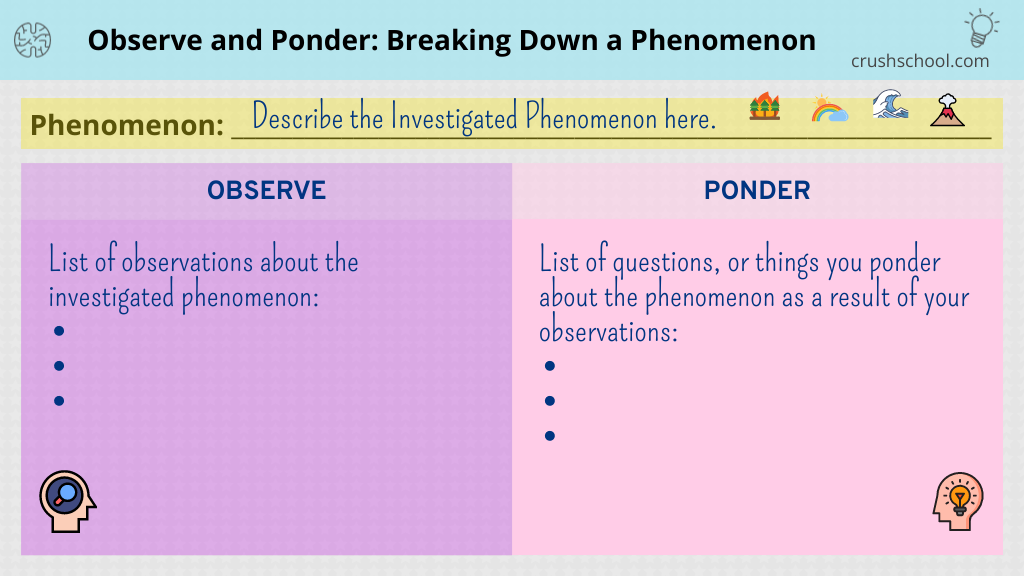
Observe and Ponder Chart is so oP y’all

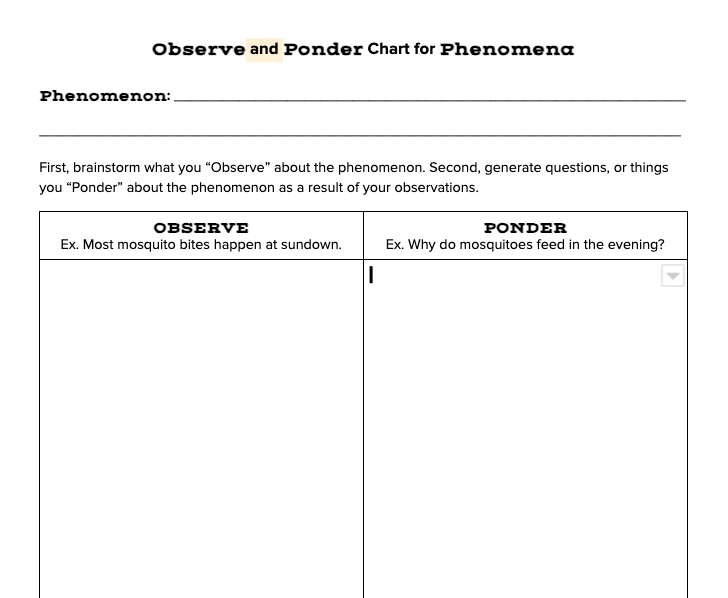
Click on the Image for a FREE Google Doc COPY of the Observe and Ponder Chart you can use in your classroom.

I use the Observe and Ponder (OP) chart to help students break down a phenomenon. In small groups, they compile the two lists. First, they brainstorm and write down all of the the observations they have collected about the phenomenon. I always make the phenomenon image/video available to students in the LMS (learning management system ex. Google Classroom, Schoology etc.) our school uses, so they can review it as they complete the activity.

In the second column, students write down any questions that come to mind about the phenomenon and the observations they’ve made. These questions help direct student investigations.

The goal of the Observe and Ponder activity is to teach students a strategic way of looking at different phenomena and ultimately to help them become better at investigating and solving problems.

Taking it further: Looking at Phenomena as a class

At this point, you may allow students to start their investigations, or, if you feel they’d benefit from peer and teacher feedback, you may want to facilitate a class discussion during which students share their observations and questions they’ve generated. This provides an additional scaffold - especially useful at the beginning of the school year - that allows students to see if they are on track.

Creating a class OP chart allows you to compile and combine observations

SHD (Subtle Hint Dropping) is an additional tool you can use to aid the phenomenon breakdown process. It is extra helpful when you find glaring omissions in the Ponder column or when working with younger students who experience more difficulty in converting observations into questions to investigate. Basically, point to the specific observation in the class OP chart and ask students if anything else comes to mind that may be important to look into. You may also ask them to make an inference, or guess the reason for this observation.

And if all fails, do a think-aloud during which you tell them what you’re looking for but you don’t just give them the answer - you demonstrate your thinking process step by step that got you to it.

Why Your Phenomenon-Based Learning Future is Bright

As students participate in PhenBL activities throughout the school year and become more comfortable with Phenomenon-Based Learning and gain more confidence in their ability to deconstruct phenomena (aka becoming more OP at school and life), you can remove the scaffolds and let students guide themselves and collaborate with others.

Handing control over to the students will require that you “be in the space” with them so you can scrutinize and support their work. Just make sure you’re kind in your guidance, you have fun, and you occasionally strike up a random conversation, because they’ll appreciate the small brain breaks this provides and they’ll find out that you’re human after all. They will also enjoy having you around.

Play your cards right and you’ll become the OG who’s pretty OP. And that’s a dub and a wrap.


Sign up for my Teaching Tips, Resources, & Ideas Newsletter to get the next PhenBL post when it drops. It’ll be about Creating a Common Learning Experience for Difficult Phenomena and is free.

BOOKS & TOOLS

Phenomena Poster
$1.50
Mistakes Are... Poster
$3.00
Back 2 School Classroom Bundle of 8 Posters
Sale Price: $5.00 Original Price: $8.00
Because... Chemistry Unisex T-Shirt
from $15.00

Phenomenon-Based Learning Lessons: Choosing and Using Phenomena

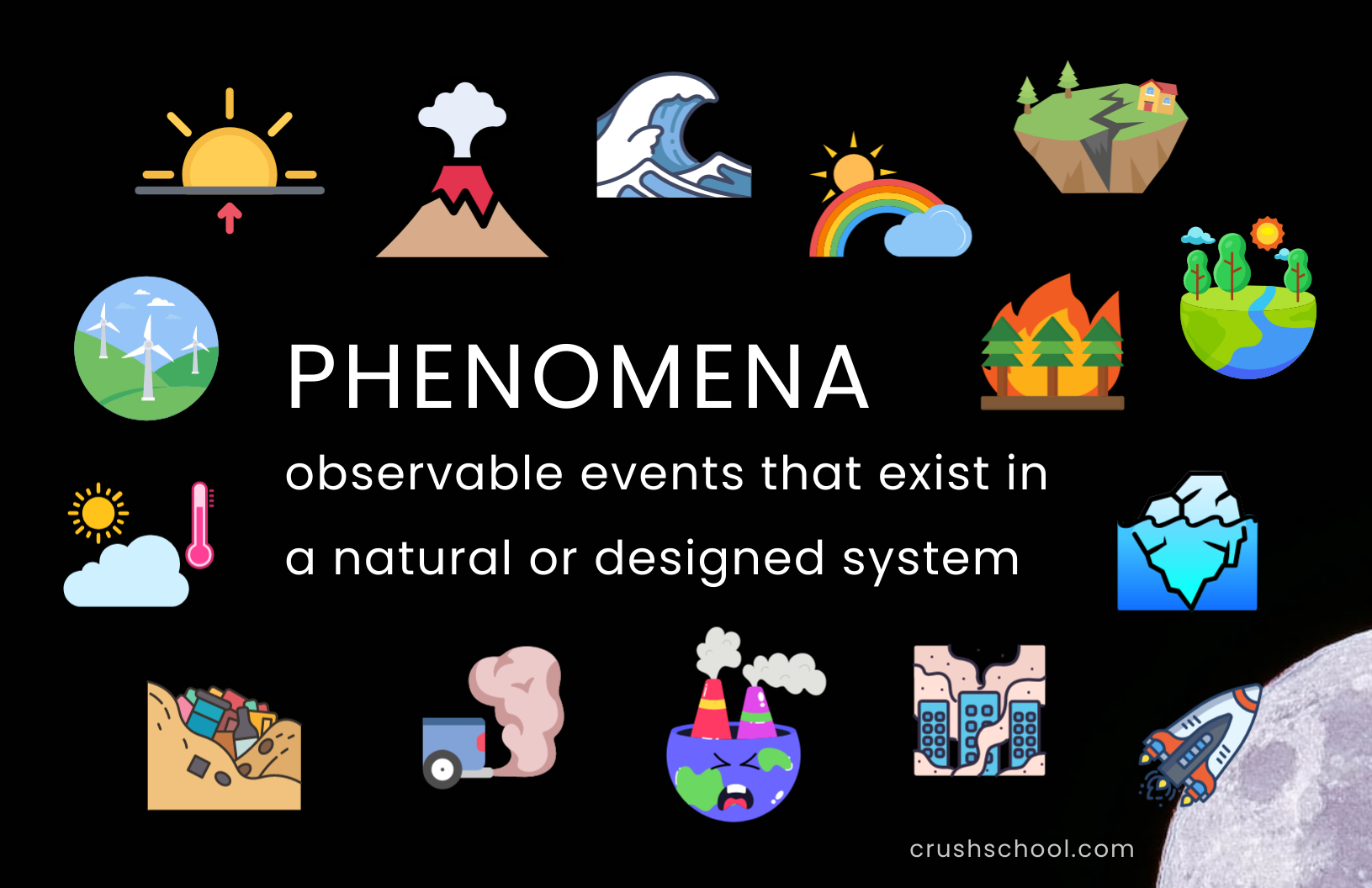
This poster shows and explains what phenomena are and gives many examples of natural and human made phenomena.

Phenomena are everywhere and can be natural or designed by humans.

Explained and exemplified, let’s talk about how to use phenomena in the classroom.

Before you Choose a Phenomenon

Use backwards design to plan for what you (and the state you teach in) want your students to learn. This involves using the main (core) idea (or ideas if more than one) of the lesson/unit and creating a concept map or an outline of the ideas that connect to it - ideas that help create and explain the whole picture. Check out my previous post: Where and How to Begin with Phenomenon-Based Learning if you’d like some help on this. Laying out the major content you want to focus on will lead you to the right phenomenon.

Choosing a Phenomenon: Part 1

Good phenomena address the content to be learned and are relevant and/or interesting to your students. This doesn’t mean that every phenomenon has to blow students’ minds (though mind blowing helps) but it is important to pick an event students can relate to somehow (you can create a common experience for your class to help with some difficult phenomena).

So, when choosing a phenomenon, consider (1) the content to be learned, (2) the diversity of your students, (3) the scope: does the phenomenon anchor the entire unit, or represents a part of one unit, or is used for a single lesson?, and (4) how you will present it to the students: video, image(s), school grounds stroll, field trip etc.

Beginning with a phenomenon

Beginning the lesson by showing students a phenomenon should stimulate student interest and get them thinking about the smaller (but important) concepts that ultimately tie into the core idea of the lesson. Most of the time, I use images or a video that may contain a prompt but do not give my students much background information. Rather, I aim to ignite the process of students investigating on their own while I guide them - ask leading questions, look for misconceptions, and ask them to dig deeper and revise their thinking if it strays. Initially, the hardest part was trusting in the process - that student-led exploration can lead to them discovering and understanding the core idea. This is why the teacher guidance is so important.

Let’s start exploring this process by examining the two phenomena examples below:

Social Studies (HS): Show students the Omaha Beach D-Day Landing movie clip from Saving Private Ryan and ask a question such as: 2,400 US soldiers died storming Omaha Beach on D-Day. Why was the US willing to enter WWII and sacrifice so many lives in mid-1944 after staying out of the war for nearly 5 years? You could use EdPuzzle to trim the video if you wish and add the question you want at the end, so students can view it and make some claims to answer the question in small groups before you discuss as a class.

Earth and Space Science (MS / HS): Show students the Diamond vs. Graphite image and pose this question: Each made of carbon; a diamond is forever, but graphite not so much. Why?

Each phenomenon is tied to the core idea. The Omaha Beach landing phenomenon does not beat around the bush - it is presented in a way that directly ties the event to the core idea of US entering WWII. 11th graders working in small groups can likely tackle this lesson in one day. The science example is more indirect - I am looking for my students to connect the differences between two forms of carbon and how different minerals form on Earth. Depending on the ensuing storyline I create, student might spend several days first investigating and then modeling the different mineral-forming processes.

Both phenomena cannot be answered with one sentence and require digging deeper. As students investigate, they find themselves asking new questions that require further investigation. Additionally, each phenomenon is either interesting or easy to relate to.

Choosing a Phenomenon: Part 2

Choosing an appropriate phenomenon can be challenging and may require some heavy thinking. The best way to get better at picking phenomena is picking phenomena. The more you create, the better you get at creating. Here’s the phenomenon recipe I use:

  1. Break down the core idea.

  2. List different things, events etc. the core idea makes you think of.

  3. Consider student age, interests, backgrounds, experiences etc.

  4. Pick items from #2 that are relevant or interesting, question provoking, not easy to explain, and not super frustrating.

  5. Use the list from #4 and find/create a phenomenon to represent it. You can Google: events related to ___________ or examples of _____________ - just be careful not to pick something that’s too simple.

And then there are times when it just appears to me. With practice, I am confident it will happen to you too. Or maybe you already are a phenomenon ninja and don’t yet know it. Dive into Phenomenon-Based Learning and find out.


My next post will explain How to Guide Student Investigations of Phenomena. Sign up for my Teaching Tips, Resources, & Ideas Newsletter to get it when it drops. It’s totally free.

BOOKS & TOOLS

Phenomena Poster
$1.50
Back 2 School Classroom Bundle of 8 Posters
Sale Price: $5.00 Original Price: $8.00

2024 Crush School