CRUSH SCHOOL

I blog on Brain-Based Learning, Metacognition, EdTech, and Social-Emotional Learning. I am the author of the Crush School Series of Books, which help students understand how their brains process information and learn. I also wrote The Power of Three: How to Simplify Your Life to Amplify Your Personal and Professional Success, but be warned that it's meant for adults who want to thrive and are comfortable with four letter words.

Filtering by Category: Earth Science

The pH of Panic: Why Chemistry Class Deserves a Low Key, Low-Stress Start
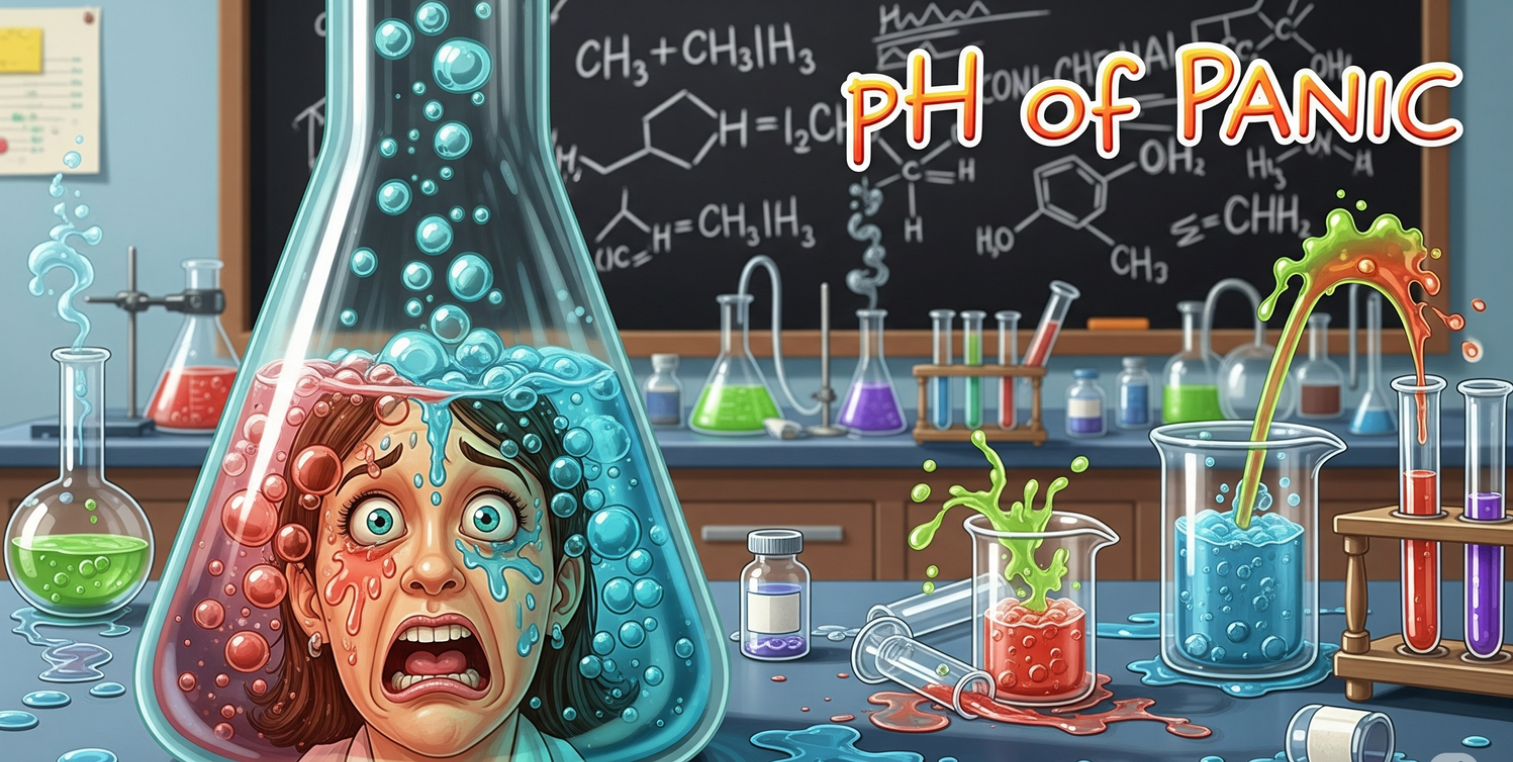
Ah, chemistry. Just the word itself conjures up images of wide-eyed wonder, boundless curiosity, and… let’s be honest, the faint aroma of impending doom for roughly 90% of the student population. One mention of stoichiometry and suddenly, perfectly capable teenagers develop a fascinating neurological condition where their eyes glaze over and their limbs appear to fuse to their desks. It's a miracle they manage to locate their phones, let alone the periodic table.

And us, the noble purveyors of scientific enlightenment? We’re just thrilled to be back, aren’t we? After months of rigorous research into optimal hammock sag and the subtle art of not thinking about work, our own cerebral matter has perhaps atrophied slightly. I, for one, tried to balance a chemical equation happening on my grill using only a spatula. The results were... hard to swallow.

So, when these hallowed halls beckon once more, and our still somewhat awkward-balanced learners stumble in, what's the first thing we do? Slam them with a pop quiz on orbital hybridization? Demand they perfectly balance combustion reactions? I mean, that would be efficient, but we simply cannot have that. No, we must embrace the Soft Start – a pedagogical concept so revolutionary, it's practically common sense wrapped in academic jargon. Because, apparently, easing them into a subject that makes reminiscing grown ass adults weep is now best practice.

The Acid Test: Why Chemistry Is A Special Kind of Hell

Let's dissect, with surgical precision, why chemistry holds such a coveted spot in the pantheon of subjects designed to induce existential dread:

  1. The Invisible Friend Problem: We ask them to visualize atoms. Atoms. Tiny, invisible particles that allegedly dance and swap partners in a quantum ballet. Meanwhile, their primary visual experience for three months has been 4K resolution on a 6-inch screen. Asking them to imagine electrons whizzing around a nucleus is like asking them to knit a sweater using only positive thoughts. It's profoundly abstract, and their brains, bless their underdeveloped frontal lobes, simply aren't wired for such profound imaginative leaps right out of the gates.

  2. Math? In My Science Class?! It’s Practically Child Abuse! You’d Think: Just when they thought they’d escaped the tyranny of numbers in math, chemistry rears its ugly, quantitative head. Moles, grams, liters, and sig figs – it’s a numerical onslaught. For students whose mathematical prowess peaked at calculating the percentage of battery life left on their devices, this is a full-scale assault. And the tears? They're practically stoichiometric.

  3. The Secret Language of the Illuminati: We’re not just teaching them science; we’re teaching them a new dialect. "Enthalpy," "entropy," "kinetics," "equilibrium" – these aren’t just words; they’re incantations. And woe betide the poor soul who confuses a "covalent bond" with a "covalent blonde" (though, admittedly, one is arguably more appealing). It's like Rosetta Stone, but with more potential for accidental explosions.

  4. Lab Work: The Perilous Dance: Ah, the lab. Where the theoretical nightmares become terrifyingly tangible. Here, they must not only understand the invisible, but also precisely measure the unmeasurable, pour the unpourable, and then, God forbid, clean up after themselves. Safety protocols are paramount, of course, because the last thing anyone needs on day two is a spontaneously generated black hole from mixing the wrong cleaning agents. The pressure to perform flawlessly, lest they accidentally create a new element or, worse, annoy the teacher, is palpable.

  5. The Jenga Tower of Doom: Chemistry is cumulative. One missed concept is not just a hiccup; it's the foundation cracking on a meticulously built Jenga tower of misery. If you don't grasp atomic structure, then bonding is a mystery. If bonding is a mystery, chemical reactions are witchcraft. And before you know it, you’ve got a student staring blankly at a titration curve, convinced they should have gone into interpretive dance.

  6. The Prophecy of Failure: Every year, they shuffle in, burdened by the dire warnings of older siblings and the collective schoolyard mythos: "Chemistry is IMPOSSIBLE." This pre-programmed anxiety is a delightful addition to their already overstimulated little brains. It's like starting a marathon convinced you've already lost. Bravo, educational system, bravo.

The Gentle Touch: Why We Must Handle Them With Hot Gloves

So, instead of detonating their fragile, summer-addled minds on day one, we engage in the grand performance of the "soft start." And why? Because, apparently, overwhelming them instantly isn't conducive to optimal learning. Who knew?

  1. De-escalating the Meltdown: When students are stressed, their tiny brains (and our not-so-tiny ones, let's be fair) go into fight, flight, or freeze mode. The part that handles "balancing equations" is summarily unplugged. A soft start is a deliberate act of cerebral détente. It whispers, "It's okay, little one. The world isn't ending. Just… look at this pretty picture of a nebula." It allows their overtaxed amygdalas to chill out, freeing up precious cognitive bandwidth for, you know, actual cognition.

  2. Forced Friendship and Group Hugs: The first few days are all about "community building," which, in teacher-speak, means forcing children who'd rather stare at their shoes to interact with each other. Low-stakes, collaborative activities are key here. When they realize that their classmates are equally clueless about last summer's solar eclipse, a fragile bond of shared incompetence can form. And that, my friends, is the bedrock of future group projects.

  3. The Grand Delusion of Prior Knowledge: Instead of launching into the periodic table as if it's universal law (which, scientifically, it is, but don't tell them that), we gently prod. "What do you think you know about elements? No wrong answers! Just… thoughts!" This isn't about assessment; it's about giving them the comforting illusion that they might actually know something before you inevitably blow their minds with quantum mechanics.

  4. The Safety Dance (But Make It Fun): Lab safety. Oh, the joy. Instead of a monotone lecture that induces instant narcolepsy, we turn it into a thrilling scavenger hunt! "Find the eyewash station! Win a high-five!" It’s utterly absurd, but it gets the job done without the usual eye-rolls and existential dread. Plus, it teaches them where the actual eyewash is, which might come in handy when they inevitably try to distill Mountain Dew.

  5. A Confidence Trick (For Their Own Good): Successes, even tiny, meaningless successes, breed confidence. Give them an activity where they simply cannot fail. A "wonder wall" about stars. A drawing of their favorite element (even if it's just a stick figure with "O" for oxygen). These are not academically rigorous, but they are confidence-building exercises. They walk away thinking, "Huh. Maybe chemistry isn't literally going to kill me."

The Glorious, Exhausting Aftermath

So, what’s the grand payoff for this elaborate charade of "easing in"?

  • Less Whining: A subtle decrease in the audible groans emanating from their general direction.

  • Marginal Engagement: They might actually participate, rather than simply existing in a state of suspended animation.

  • The Illusion of Comprehension: They might even think they're understanding things, which is often half the battle.

  • A Slightly Less Frazzled Teacher: Because if they’re less stressed, you’re less stressed. And that, my friends, is the most crucial chemical reaction of all.

In conclusion, dear science colleagues, as the relentless march of the academic calendar propels us forward, let us not forget the delicate, fragile state of our students' minds. Let us approach chemistry, not with the abruptness of a chemical explosion, but with the gentle, reassuring grace of a perfectly buffered solution. Because while their brains may still be frying from summer sun, ours are equally crispy. And the first rule of chemistry is, of course, "Don't ignite the children." Or the teacher. Especially not the teacher.


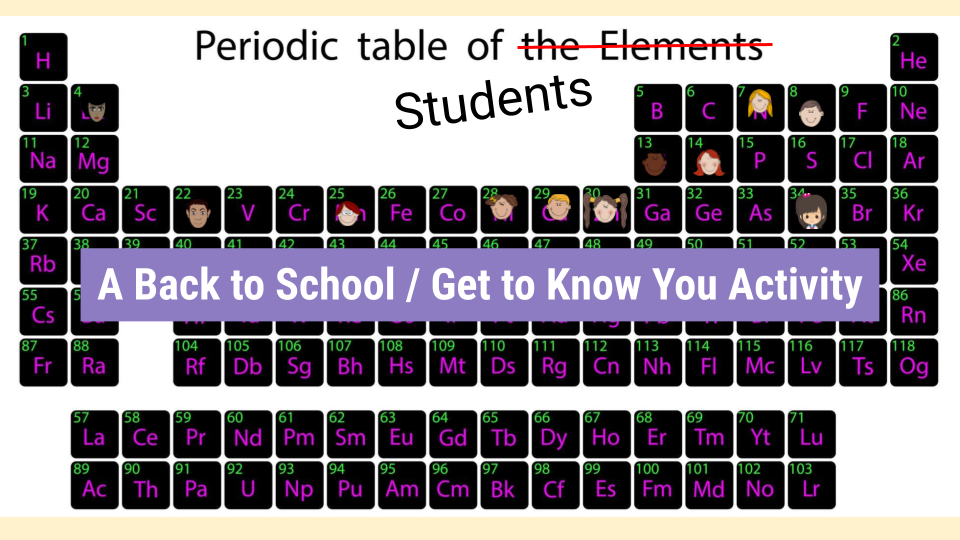
Thanks for reading my thoughts! I hope they help you in being more ready for the impending doom of the new school year. Check out my Periodic Table of Students Lesson if you need a low key back to school chemistry lesson. And if you cannot spare the $, please email me and I’ll give it to you for free.

BOOKS & TOOLS

EQUITY Poster
$1.50

Equity-Promoting Classroom Poster. What does EQUITY in the classroom look like?

  • Everyone has a different start and finish line

  • Quality is more important that quantity

  • Understanding that diversity makes us stronger

  • Inclusion despite beliefs, appearances, and circumstances

  • Thoughtfulness lowers barriers and reduces biases

  • Yesterday's mistakes are today's learning agenda

You can teach your students about equity and make it a daily classroom practice using this inspirational poster, which also includes images that accompany the equity description. You can discuss each letter characteristic with your students as a way of introducing your inclusive classroom and display it prominently as a reminder that diversity makes the classroom community stronger.

Introduction to Earth and Space Science - 5 Phenomenon-Based Projects
Sale Price: $10.00 Original Price: $15.00

Save 2 - 3 weeks of planning time and start your Earth and Space Science school year off right using NGSS and Phenomenon Based Learning with this “Introduction to Earth and Space Science” Unit that contains 5 relevant and engaging multi-day projects.

Back 2 School Classroom Bundle of 8 Posters
Sale Price: $5.00 Original Price: $8.00

8 digital, printable, size 11 x 17 classroom posters:

  1. “Welcome” in multiple languages

  2. “Hi” in multiple languages

  3. Three Equity posters

  4. Classroom Rules: Be Open, Be Kind, Have Fun

  5. “Classroom of Champs”

  6. “Kindness”

ON SALE until August 30th.

Anthropogenic Phenomenon Investigation
$3.00

Save planning time with this 3 to 4-day Earth and Space Science NGSS-aligned introductory lesson during which students learn about the Systems Approach to studying science and analyzing real world phenomena.

The lesson involves investigating an anthropogenic phenomenon and examining human influence on the four spheres (biosphere, hydrosphere, atmosphere, and geosphere).

During the investigation, students create models and use them to explain how each of the four spheres is affected in a video that educates viewers on the consequences of human actions and the interconnectedness of the Earth’s systems.

Includes 9 detailed slides (PDF and Google Slides link for editing) + detailed teacher directions (2 slides).

The project follows the guidelines set by the Next Generation Science Standards (NGSS) and guides students in using Science and Engineering Practices (SEPs), Crosscutting Concepts (CCCs), and Disciplinary Core Ideas (DCIs).

Student Learning Objectives:

  1. Describe what a Phenomenon is and give examples of Natural and Anthropogenic Phenomena.

  2. Explain how phenomena can be used to study scientific concepts.

  3. Describe the four spheres: atmosphere, hydrosphere, geosphere, and biosphere, and give examples of different matter interactions between them.

  4. Understand, explain, and apply the Systems Approach when investigating Earth and Space Science Phenomena. 

  5. Break down how a Specific Anthropogenic Phenomenon affects each of the four spheres.

Earth Science: Create a Computer Simulation of an ESS Concept
Sale Price: $2.00 Original Price: $3.00

Save planning time with this introductory, 3-4 day Earth and Space Science engineering challenge in which students create a computer simulation of an Earth Science topic.

Includes 12 detailed slides (PDF and Google Slides link for editing) + detailed teacher directions (last slide) + a BONUS resource: Animation Guide for Google Slides.

The project follows the guidelines set by the Next Generation Science Standards (NGSS) and guides students in using Science and Engineering Practices (SEPs).

Student Performance and Learning Objectives:

  1. Design and create an informative computer simulation.

  2. Use computer animation to simulate a key ESS concept.

  3. Explain the key ideas of an ESS concept of your choice.

Periodic Table of Students: A Fun Back to School Chemistry Classroom Activity
$3.00

Can teachers make Chemistry less stressful for students?

I am not sure about this one. After all, chemistry gets the bad rep for being hard and a lot of work. But while this may be true, teachers can help make the beginning of the school year less stressful for their students by easing into chemistry using a low pressure, high bang for their buck activity.

In this one- to two- day Back to School activity, designed for a high school Chemistry classroom, students visually share and learn various facts about each other which helps in building a supportive classroom community and, along the way, learn some chemistry lingo and facts that will come in handy later. But, psssst! Don't tell them they are unconsciously learning chemistry. Just let them have fun getting to know each other and their teacher.

Why and how does this learning strategy work?

The main idea is to begin the new school year and your chemistry class low-stress. This benefits both students and teachers as we often find getting back to doing something we are rusty on rough (translation for non-teachers: we are barely holding it together and are ten seconds from crashing out, because we are only about 50% sure we still know how to participate in society at large, let alone teach). So rather than continuously wondering about the 10,000 things that can go wrong (but never will) in the first few days of the new school year, we can combine chemistry, social-emotional learning, and classroom community-building and get to know our students a little bit before we hit them with atoms, bonding, stoichiometry, and Le Chatelier's Principle.

Student Learning and Performance Objectives:

  1. Put together a periodic table of chemistry students in our class.

  2. Create an element box for each student with their characteristics, likes, dislikes etc.

  3. Start building a classroom community.

  4. Allow students to familiarize themselves with each other by learning a few things about their classmates.

What's included:

  1. 10 slides that introduce, explain, and guide the teacher and students through this 2-day activity

  2. An element box/card template for either digital or old school use (you choose)

  3. Teacher notes explaining the purpose, teacher participation, possible extensions, and the side benefits of the activity

  4. Student Learning and Performance Objectives

  5. Materials list

  6. Detailed directions for what information students should include on their card

  7. Directions on how to assemble the classroom periodic table

  8. Follow up discussion questions

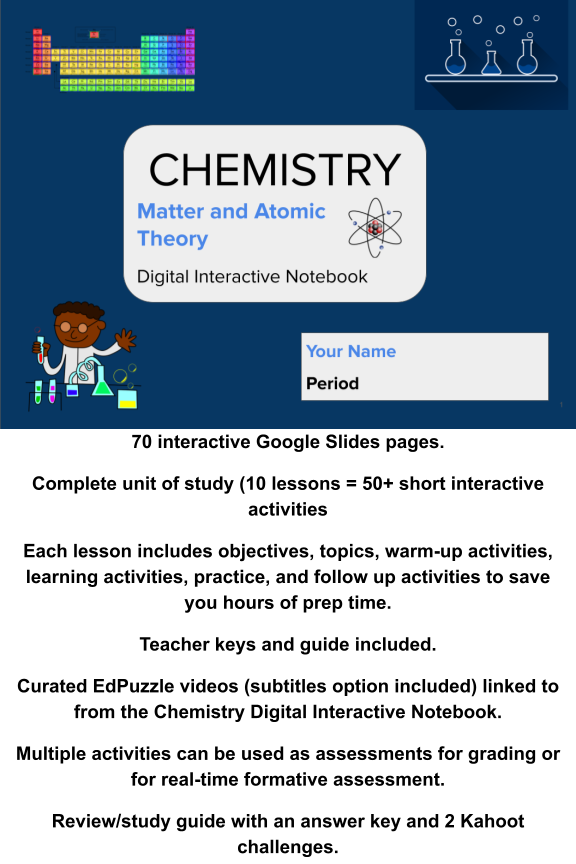
Chemistry Digital Interactive Notebook: Matter and Atomic Theory (PDF & Google Slides)
Sale Price: $15.00 Original Price: $20.00

Help students learn about matter and atomic theory in an active way. Every Crush School Digital Interactive Notebook unit of study is made up of several lessons and can be used as a whole, or each lesson can be used individually, or you may choose to use specific digital activities from certain lessons with your students when and where you see fit.

UPON PAYMENT, YOU WILL RECEIVE A PDF COPY OF THE NOTEBOOK AND ONCE YOUR PAYMENT CLEARS, YOU WILL BE GIVEN ACCESS TO THE ORIGINAL NOTEBOOK IN THE GOOGLE SLIDES FORMAT VIA EMAIL YOU USE WHEN MAKING YOUR PURCHASE.

Unit Topics:

  1. Chemistry and matter

  2. Elements, compounds, and mixtures

  3. Properties of matter

  4. The atom (nucleus, electron cloud, subatomic particles, protons, neutrons, electrons, atomic number)

  5. Periodic table (element types, groups, periods, families)

  6. Isotopes, mass number, and average atomic mass

  7. Atomic mass calculations

  8. Quantum mechanical model and electron configurations

Questions? Email me at oskar@crushschool.com. I’m happy to answer your questions.

Fair Use Feel free to share and use the Digital Chemistry Notebook with your students. Please do not share it with other parties or use for profit.

Why We All Need (and Science Backs) a Chill Back-to-School Start

Why We All Need (and Science Backs) a Chill Back-to-School Start

The early wake up. The unwelcome sound of the first school bell. For students, its dreadful wail signals the end of way too much screen time and questionable snack choices. For teachers, it’s like suddenly remembering you signed up for a marathon after spending three months perfecting not running, but… napping.

My summer, for example, involved rigorous scientific study of optimal hammock recline angles and the fascinating hydrodynamics of ice melting in a cold beverage. My brain, once a finely tuned machine for dissecting plate tectonics and explaining the intricacies of stellar nucleosynthesis, is currently operating at the speed of continental drift. Seriously, I tried to calculate the tip on a coffee and bagel this morning and nearly summoned a black hole.

And then, just when I’ve finally convinced my internal clock that 9 AM is not the middle of the night, bam! It's Back to School season. The fluorescent lights hum, the smell of freshly waxed floors (and nervous sweat) fills the air, and suddenly, I’m expected to facilitate critical thinking about astronomical units when my own unit of measure for time is before coffee and after nap.

But here's the thing: I'm not alone in this post-summer brain fog. My students are probably equally discombobulated. Their synapses are still firing about TikTok dances and the optimal strategy for conquering level 73 of whatever video game is currently taking over their lives. Asking them to immediately dive into the Coriolis Effect or the nuances of atmospheric layers is, frankly, an act of abuse-bordering pedagogical cruelty.

This is why, as a 22-year veteran of the Summer-to-School Transition, I firmly believe in the Low-Stress, High-SEL Back-to-School Approach I describe below. So let’s make the first few days of Earth and Space Science, a subject inherently full of wonder, less about "memorize these facts" and more about "let's all remember how to human in the classroom."

Think about it. We’ve all been through it. That first day back, the locker combination feels like a riddle, finding your class is an epic, Indiana Jones-like quest, and the sheer volume of new information feels like a tornado aimed directly at your brain. Students are battling anxiety, social jitters, and the sudden shock of having to wear actual clothes. In the meantime, we, the teachers, are simultaneously trying to remember how to teach, decipher admin memos, and resist the urge to fight or flight.

But how do we shift our brains back into academic gear and not cause a mass exodus to the bathroom, the nurse’s office, or the conveniently-located office of the already swamped and stressed by schedule changes, parent demands, and student complaints counselors?

The Gentle Re-Entry: Why "Chill" is a Scientific Strategy

It might sound counterintuitive, but a relaxed start isn't just about being nice (though being nice is always nice). It's backed by some solid scientific stuff.

  1. The Brain Needs to Boot Up, Not Crash: Our brains have spent weeks in a low-demand, high-novelty environment. Suddenly transitioning to a highly structured, cognitively demanding setting can lead to cognitive overload. Imagine trying to run a marathon after only walking to the fridge for three months. SCREAMING muscles. Your students’ brains are screaming too. Easing in allows neural pathways to gradually reactivate for academic tasks.

    • Supporting Science: While specific studies on "easing into school" and cognitive load are integrated into broader educational psychology, the concept of cognitive load theory (Sweller, 1988) broadly explains how our working memory has limited capacity. Overwhelming it too quickly can hinder learning. A sudden influx of complex information after a break can exceed this capacity, leading to frustration and reduced retention.

  2. Anxiety is the Archenemy of Learning: Back-to-school anxiety is real, for both students and teachers. Students worry about new teachers, new classmates, new expectations, and whether their summer growth spurt will make their old clothes fit weird. Teachers worry about classroom management, covering the curriculum, and that one student who always asks if aliens are real (the answer is still "probably, but we don't know for sure ‘cause Transformers are not a thing, so sit down and shut up"). High anxiety activates the fight or flight response, making it incredibly difficult for the brain to focus on complex tasks like learning about the water cycle.

  3. SEL: The Secret Sauce for Success (and Sanity): Social-Emotional Learning (SEL) isn't just a buzzword; it's the foundation upon which effective learning is built. Those first few days are prime time for building relationships, establishing a safe classroom culture, and helping students (and teachers!) feel seen and understood. When students feel a sense of belonging and know their emotions are acknowledged, they are far more receptive to academic content.

My Anti-Burnout, Pro-Curiosity First-Day Strategy

For my Earth and Space Science classroom, a perfect low-stress, high-SEL opening activity is the "The Earth and You" Gallery Walk. It's simple, requires minimal direct instruction, and gets everyone moving and thinking without the pressure of “getting it right.”

The Setup (Minimal Effort, Maximum Impact):

  1. Gather Visuals/Prompts: I scatter 10 captivating Earth and Space Science images or thought-provoking prompts around the room. Think: a dazzling nebula, a satellite image of Earth at night, a question like "If you could visit any planet, why?" or "If you could ask the earth any question, what would it be?"

  2. Sticky Notes & Pens: Each student gets a few sticky notes and a pen. Their mission, should they choose to accept it (and they always do, because who doesn't love sticky notes?), is to wander, observe, wonder, and jot down any thought, feeling, or question that pops into their head at each station.

  3. Calm Vibes: Optional, but highly recommended: soft, instrumental background music. Think "Emancipator Earth vibes," not "heavy metal geology."

The Execution (Freedom to Explore):

  1. The "Welcome Back, Brains" Speech (5 minutes): I keep it light. "Alright peeps, welcome back! Your brains have been on vacation, and so has mine. So, instead of diving straight into quantum mechanics of black holes (yet!), we're going on a low-stress journey of discovery." I explain the sticky note concept, emphasizing that there are no wrong answers, only curious minds.

  2. The Wander (25-30 minutes): Students move freely. They look at the stunning image of Jupiter, scrawl "Whoa, that's huge!" on a sticky note, and stick it to the wall. They read a quote about the interconnectedness of Earth's systems and write "Everything's connected, like my hand to my phone!" (Hey, it’s a connection!). The room fills with quiet movement, the soft scratching of pens, and the occasional murmur of "Cool!"

  3. The Share & Connect (10-15 minutes): We come back together. I might pick a few stations and ask, "What were some common thoughts or feelings at this station?" or "Did anyone write something that really resonated with you?" This isn't a pop quiz; it's a chance to see that others share similar curiosities, anxieties, or awe. Often, I just walk around between groups of students and chat them up about what they observed and their hopes and reams for the school year. I keep it fun and low key.

The Payoff, No Textbook Required

This low-key start pays dividends beyond just reducing stress.

  • It builds community: Students see their peers' thoughts, realizing they're not alone in their initial anxieties or their deep-seated curiosities. It opens doors for future discussions.

  • It reactivates curiosity: Instead of being told what to learn, they're prompted to think about what they wonder. This is the ignition for true scientific inquiry.

  • It models self-awareness: By asking them to reflect on their feelings, even fleetingly, they practice identifying and acknowledging their emotional state – a key SEL skill.

  • It gives me data (the sneaky kind): Without formal assessments, I get a snapshot of their prior knowledge, misconceptions, and areas of genuine interest. This informs my future lesson planning, ensuring I'm teaching them, not just the curriculum.

  • It reminds me I'm human too: Honestly, it's a nice way for me to ease back in. No intense lecturing or too much talking on day one. Just facilitating wonder and reconnecting with why I love teaching Earth and Space Science in the first place. Because let's be real, after months of hammock research, my own brain needs a gentle re-entry as well.

So, as we stare down the barrel of another loaded school year, let’s embrace the power of the chill. Let's give our brains, and our students' brains, the time to wake up, smell the Celsius, and remember the joy of discovery before we hit them with the full force of the cosmos. The universe can wait. Our well-being cannot.


Thanks for reading my thoughts! I hope they help you in being more you. Check out my ready-to-go version of the Earth and You Gallery Walk, but if you cannot spare the $3 fee, please email me, and I’ll give it to you for free.

Supporting Scientific Articles and Resources for Your Inner Nerd (and Mine!):

  • Cognitive Load Theory:

  • Anxiety and Learning:

    • Johns Hopkins Medicine. "5 Tips to Ease Back-to-School Anxiety." (Accessible article discussing the prevalence and impact of back-to-school anxiety on children, and strategies to mitigate it). [No direct peer-reviewed link, but a reputable source summarizing common knowledge].

  • Social-Emotional Learning (SEL) Benefits:


BOOKS & TOOLS

EQUITY Poster
$1.50

Equity-Promoting Classroom Poster. What does EQUITY in the classroom look like?

  • Everyone has a different start and finish line

  • Quality is more important that quantity

  • Understanding that diversity makes us stronger

  • Inclusion despite beliefs, appearances, and circumstances

  • Thoughtfulness lowers barriers and reduces biases

  • Yesterday's mistakes are today's learning agenda

You can teach your students about equity and make it a daily classroom practice using this inspirational poster, which also includes images that accompany the equity description. You can discuss each letter characteristic with your students as a way of introducing your inclusive classroom and display it prominently as a reminder that diversity makes the classroom community stronger.

Introduction to Earth and Space Science - 5 Phenomenon-Based Projects
Sale Price: $10.00 Original Price: $15.00

Save 2 - 3 weeks of planning time and start your Earth and Space Science school year off right using NGSS and Phenomenon Based Learning with this “Introduction to Earth and Space Science” Unit that contains 5 relevant and engaging multi-day projects.

Back 2 School Classroom Bundle of 8 Posters
Sale Price: $5.00 Original Price: $8.00

8 digital, printable, size 11 x 17 classroom posters:

  1. “Welcome” in multiple languages

  2. “Hi” in multiple languages

  3. Three Equity posters

  4. Classroom Rules: Be Open, Be Kind, Have Fun

  5. “Classroom of Champs”

  6. “Kindness”

ON SALE until August 30th.

Anthropogenic Phenomenon Investigation
$3.00

Save planning time with this 3 to 4-day Earth and Space Science NGSS-aligned introductory lesson during which students learn about the Systems Approach to studying science and analyzing real world phenomena.

The lesson involves investigating an anthropogenic phenomenon and examining human influence on the four spheres (biosphere, hydrosphere, atmosphere, and geosphere).

During the investigation, students create models and use them to explain how each of the four spheres is affected in a video that educates viewers on the consequences of human actions and the interconnectedness of the Earth’s systems.

Includes 9 detailed slides (PDF and Google Slides link for editing) + detailed teacher directions (2 slides).

The project follows the guidelines set by the Next Generation Science Standards (NGSS) and guides students in using Science and Engineering Practices (SEPs), Crosscutting Concepts (CCCs), and Disciplinary Core Ideas (DCIs).

Student Learning Objectives:

  1. Describe what a Phenomenon is and give examples of Natural and Anthropogenic Phenomena.

  2. Explain how phenomena can be used to study scientific concepts.

  3. Describe the four spheres: atmosphere, hydrosphere, geosphere, and biosphere, and give examples of different matter interactions between them.

  4. Understand, explain, and apply the Systems Approach when investigating Earth and Space Science Phenomena. 

  5. Break down how a Specific Anthropogenic Phenomenon affects each of the four spheres.

Earth Science: Create a Computer Simulation of an ESS Concept
Sale Price: $2.00 Original Price: $3.00

Save planning time with this introductory, 3-4 day Earth and Space Science engineering challenge in which students create a computer simulation of an Earth Science topic.

Includes 12 detailed slides (PDF and Google Slides link for editing) + detailed teacher directions (last slide) + a BONUS resource: Animation Guide for Google Slides.

The project follows the guidelines set by the Next Generation Science Standards (NGSS) and guides students in using Science and Engineering Practices (SEPs).

Student Performance and Learning Objectives:

  1. Design and create an informative computer simulation.

  2. Use computer animation to simulate a key ESS concept.

  3. Explain the key ideas of an ESS concept of your choice.

The Earth & You Gallery Walk: A Low Stress Back to School Earth and Space Science Lesson
$3.00

While hitting the ground running is often important, having a less stressful beginning to the new school year is key for both teachers and students to setting themselves up for a more collaborative and successful school year.

While we cannot completely eliminate the stress of doing something we all have not done for 3 months (!!!) easing into science by using a low pressure, but meaningful activity is just what the psychologist ordered.

In this one- to two- day Back to School activity, designed for a high school Earth and Space Science classroom, students share their own thoughts and feelings about the world around them. which helps in building a supportive classroom community while they are observing and reflecting on the natural and human-caused phenomena around them.

Why and how does this learning strategy work?

The main idea is to begin the new school year and your Earth science class low-stress. This benefits both students and teachers as we often find getting back to doing something we are rusty on rough (translation for non-teachers: we are barely holding it together and are ten seconds from crashing out, because we are only about 50% sure we still know how to participate in society at large, let alone teach). So rather than continuously wondering about the 10,000 things that can go wrong (but never will) in the first few days of the new school year, we can combine chemistry, social-emotional learning, and classroom community-building and get to know our students a little bit before we hit them with climate change, seismic waves, and continental drift.

Student Learning and Performance Objectives:

  1. Share your own thoughts and feelings about the world around you.

  2. Observe, reflect, and share what comes to mind at each station.

What's included:

  1. 11 slides that introduce, explain, and guide the teacher and students.

  2. Detailed teacher notes on prep, main lesson, and follow up activities.

  3. Detailed student directions.

  4. 10 station ideas, along with a link to a document that contains the printouts for each station.

  5. Student Learning and Performance Objectives

  6. Materials list

  7. Follow up discussion questions

  8. SEL connections

Periodic Table of Students: A Fun Back to School Chemistry Classroom Activity
$3.00

Can teachers make Chemistry less stressful for students?

I am not sure about this one. After all, chemistry gets the bad rep for being hard and a lot of work. But while this may be true, teachers can help make the beginning of the school year less stressful for their students by easing into chemistry using a low pressure, high bang for their buck activity.

In this one- to two- day Back to School activity, designed for a high school Chemistry classroom, students visually share and learn various facts about each other which helps in building a supportive classroom community and, along the way, learn some chemistry lingo and facts that will come in handy later. But, psssst! Don't tell them they are unconsciously learning chemistry. Just let them have fun getting to know each other and their teacher.

Why and how does this learning strategy work?

The main idea is to begin the new school year and your chemistry class low-stress. This benefits both students and teachers as we often find getting back to doing something we are rusty on rough (translation for non-teachers: we are barely holding it together and are ten seconds from crashing out, because we are only about 50% sure we still know how to participate in society at large, let alone teach). So rather than continuously wondering about the 10,000 things that can go wrong (but never will) in the first few days of the new school year, we can combine chemistry, social-emotional learning, and classroom community-building and get to know our students a little bit before we hit them with atoms, bonding, stoichiometry, and Le Chatelier's Principle.

Student Learning and Performance Objectives:

  1. Put together a periodic table of chemistry students in our class.

  2. Create an element box for each student with their characteristics, likes, dislikes etc.

  3. Start building a classroom community.

  4. Allow students to familiarize themselves with each other by learning a few things about their classmates.

What's included:

  1. 10 slides that introduce, explain, and guide the teacher and students through this 2-day activity

  2. An element box/card template for either digital or old school use (you choose)

  3. Teacher notes explaining the purpose, teacher participation, possible extensions, and the side benefits of the activity

  4. Student Learning and Performance Objectives

  5. Materials list

  6. Detailed directions for what information students should include on their card

  7. Directions on how to assemble the classroom periodic table

  8. Follow up discussion questions

Making Lessons Fun: Gamifying Learning with Classroom Escape Rooms

Study guide packets, yeah buddy! ‘Cause nothing screams "engaging learning experience" quite like flipping through 20 pages of blank-filling, vocab matching, defining, and short answer question… answering.

It's truly a marvel how these magnificent documents manage to extract every last ounce of life from a unit, transforming vibrant concepts into a monotonous exercise in hand cramps and existential dread.

Who needs active recall or critical thinking when you can simply transcribe information directly from the textbook, barely registering its meaning?

And the thrill of flipping to the next page, realizing you've successfully completed another utterly mind-numbing task – it's almost enough to make you forget you haven't actually learned anything. So, for unparalleled boredom and guaranteed ineffectiveness in content review, look no further than the humble study guide packet.

Or, you inject some excitement into those old review sessions instead. Yeah, Gimkit, Kahoot!, Quizziz etc. are cool review tools, but they can get repetitive.

Escape, or breakout rooms, are a cool, engaging, and effective way to review content and further develop student problem-solving and collaboration.

Escape Rooms in the Classroom?

Inspired by popular escape room games, classroom escape rooms challenge students to "break out" of a hypothetical scenario (or a locked classroom) by solving a series of puzzles and challenges. Each puzzle requires them to apply their knowledge of previously learned content. When they solve a puzzle, it often reveals a clue or a part of the solution to the next puzzle, ultimately leading them to the "key" to escape or unlock the final prize.

Escape Rooms for Content Review?

Let’s look at some benefits of content review breakout rooms.

  1. Engaging & Motivating: The inherent challenge and problem-solving aspect of an escape room naturally hooks students. The pressure of a time limit (optional, but often effective) adds to the excitement.

  2. Active Learning: Students aren't passively listening or filling out blanks. They're actively recalling, analyzing, and applying information to solve real problems.

  3. Collaborative Skills: Most escape rooms are designed for small groups, forcing students to communicate, divide tasks, and work together to achieve a common goal. This builds teamwork skills.

  4. Differentiated Learning: Puzzles and problems can be designed in a variety if ways and to accommodate various levels of understanding.

  5. Immediate Feedback: Students know almost immediately if their solution is correct, providing instant reinforcement or prompting them to re-evaluate, rethink, and revise their understanding.

  6. Fun! Learning should be enjoyable, because we like doing what we like. Escape rooms transform review into exciting, thus memorable experiences.

Classroom Escape Room How to

Creating an effective classroom escape room doesn't require a Hollywood budget. Here's a step-by-step guide.

  1. Identify Your Learning Objectives: What specific content do you want students to review? This is your starting point for all puzzles. For example, if you're reviewing fractions, every puzzle should involve fraction questions and problems.

  2. Brainstorm Puzzle Ideas Tied to Content: This is where you get creative. Think about different ways to present your content as a challenge.

    • Math: Cipher wheels with math problems as the key, order of operations leading to a lock combination, word problems solved to reveal a code.

    • ELA: Unscrambling vocabulary words, identifying literary devices in short passages, putting events of a story in chronological order to form a phrase.

    • Science: Matching elements to their symbols to unlock a box, solving a scientific riddle, identifying parts of a cell based on descriptions.

    • History: Sequencing historical events, matching key figures to their achievements, decoding a message based on historical facts.

  3. Choose Your "Locks" and "Keys":

    • Physical Locks: Directional locks, 3 or 4-digit number locks, word locks (often used with a hasp on a box). You can purchase these relatively inexpensively.

    • Digital Locks: Google Forms can be set up to require a specific answer to proceed to the next section, effectively acting as a digital lock. Websites like Breakout EDU also offer digital lockbox options.

    • "Keys": The solution to one puzzle should lead to the "key" for the next lock. This could be a number, a word, a direction, a symbol, or a clue leading to a physical object.

  4. Design the Flow and Narrative (Optional but Recommended):

    • Linear vs. Non-Linear: Will students solve puzzles in a specific order (linear), or can they tackle them simultaneously (non-linear)? Linear is often easier for a first-time escape room.

    • Theme: A simple theme can add to the immersion. Are they "escaping the classroom," "rescuing a lost artifact," or "cracking a secret code?"

    • The Story: A brief narrative at the beginning sets the stage and explains the "why" behind the escape.

  5. Gather Your Materials:

    • Boxes/Containers: Use shoeboxes, plastic tubs, or even just envelopes. A dedicated "breakout box" is ideal if you plan to do this often.

    • Puzzles: Printouts, laminated cards, objects.

    • Clues: Written clues, images, riddles.

    • Locks: As mentioned above.

    • Props: Anything that adds to your theme (e.g., "secret agent" files, "ancient" maps).

  6. Set Up and Test:

    • Arrange the Puzzles: Place puzzles logically around the room or in designated areas for each group.

    • Test, Test, Test! Play through the entire escape room yourself, or have a colleague or a small group of students test it out. This will help you identify any confusing clues, dead ends, or overly difficult puzzles.

  7. Facilitate the Game:

    • Introduce the Rules: Explain the objective, time limit, and how to ask for hints.

    • Group Students: Assign students to small, collaborative groups (3-5 ideal).

    • Monitor and Guide: Circulate around the room, offering subtle hints if groups get stuck. Resist the urge to give them the answer and encourage them to work together to get to it.

    • Debrief: After the game, discuss the content reviewed, the strategies used, and what students enjoyed or found challenging.

Tips for Successful Breakout Review Sessions

  • Start Simple: Your first escape room doesn't need to be overly complex. Focus on 3-5 well-designed puzzles.

  • Clear Instructions: Ensure all puzzle instructions are unambiguous.

  • Scaffold Hints: Have a tiered hint system ready (e.g., first hint is vague, second hint is more specific).

  • Time Management: Decide on a time limit (e.g., 30-45 minutes).

  • Celebrate Success: Whether they "escape" or not, acknowledge effort and learning.

  • Reuse and Recycle: Once you have a set of materials, you can often adapt them for different content or themes. You can reuse digital templates and modify them for different content.

More than just a game, classroom escape rooms are a powerful way to transform content review into an exciting, memorable, and highly effective learning experience.

Maybe it’s time to ditch the dull drills and unlock a few… locks and break into a world of engaging education with your first classroom escape room?

They’ll have fun. You’ll have fun. It’ll be fun.


Thanks for reading my thoughts! I hope they help you have more fun in the classroom.

If you’d like a digital breakout template to use, check out my Gas Law Chemistry Breakout. It’ll set you back $3.50, but you can copy and modify every template and the Google Form to use for your own content.

Also, check out my shop for thoughtful, engaging, project-based and phenomena-based Earth and Space Science or Chemistry lessons.

BOOKS & TOOLS

EQUITY Poster
$1.50

Equity-Promoting Classroom Poster. What does EQUITY in the classroom look like?

  • Everyone has a different start and finish line

  • Quality is more important that quantity

  • Understanding that diversity makes us stronger

  • Inclusion despite beliefs, appearances, and circumstances

  • Thoughtfulness lowers barriers and reduces biases

  • Yesterday's mistakes are today's learning agenda

You can teach your students about equity and make it a daily classroom practice using this inspirational poster, which also includes images that accompany the equity description. You can discuss each letter characteristic with your students as a way of introducing your inclusive classroom and display it prominently as a reminder that diversity makes the classroom community stronger.

Introduction to Earth and Space Science - 5 Phenomenon-Based Projects
Sale Price: $10.00 Original Price: $15.00

Save 2 - 3 weeks of planning time and start your Earth and Space Science school year off right using NGSS and Phenomenon Based Learning with this “Introduction to Earth and Space Science” Unit that contains 5 relevant and engaging multi-day projects.

Back 2 School Classroom Bundle of 8 Posters
Sale Price: $5.00 Original Price: $8.00

8 digital, printable, size 11 x 17 classroom posters:

  1. “Welcome” in multiple languages

  2. “Hi” in multiple languages

  3. Three Equity posters

  4. Classroom Rules: Be Open, Be Kind, Have Fun

  5. “Classroom of Champs”

  6. “Kindness”

ON SALE until August 30th.

Anthropogenic Phenomenon Investigation
$3.00

Save planning time with this 3 to 4-day Earth and Space Science NGSS-aligned introductory lesson during which students learn about the Systems Approach to studying science and analyzing real world phenomena.

The lesson involves investigating an anthropogenic phenomenon and examining human influence on the four spheres (biosphere, hydrosphere, atmosphere, and geosphere).

During the investigation, students create models and use them to explain how each of the four spheres is affected in a video that educates viewers on the consequences of human actions and the interconnectedness of the Earth’s systems.

Includes 9 detailed slides (PDF and Google Slides link for editing) + detailed teacher directions (2 slides).

The project follows the guidelines set by the Next Generation Science Standards (NGSS) and guides students in using Science and Engineering Practices (SEPs), Crosscutting Concepts (CCCs), and Disciplinary Core Ideas (DCIs).

Student Learning Objectives:

  1. Describe what a Phenomenon is and give examples of Natural and Anthropogenic Phenomena.

  2. Explain how phenomena can be used to study scientific concepts.

  3. Describe the four spheres: atmosphere, hydrosphere, geosphere, and biosphere, and give examples of different matter interactions between them.

  4. Understand, explain, and apply the Systems Approach when investigating Earth and Space Science Phenomena. 

  5. Break down how a Specific Anthropogenic Phenomenon affects each of the four spheres.

Earth Science: Create a Computer Simulation of an ESS Concept
Sale Price: $2.00 Original Price: $3.00

Save planning time with this introductory, 3-4 day Earth and Space Science engineering challenge in which students create a computer simulation of an Earth Science topic.

Includes 12 detailed slides (PDF and Google Slides link for editing) + detailed teacher directions (last slide) + a BONUS resource: Animation Guide for Google Slides.

The project follows the guidelines set by the Next Generation Science Standards (NGSS) and guides students in using Science and Engineering Practices (SEPs).

Student Performance and Learning Objectives:

  1. Design and create an informative computer simulation.

  2. Use computer animation to simulate a key ESS concept.

  3. Explain the key ideas of an ESS concept of your choice.

[Earth Science] Terraforming Mars: The Red Planet "Shark Tank" Innovation Challenge
$4.00

Are your students tired of just reading about Earth? Do they gaze longingly at the night sky, dreaming of a future beyond textbook pages? Excellent! Because today, we're not just learning about science; we're making science. We're launching them into the ultimate entrepreneurial challenge: Terraforming Mars: The Red Planet "Shark Tank" Innovation Challenge!

Forget your quaint little recycling programs. We're talking about taking a dusty, desolate rock and turning it into a vacation spot for humanity.

This isn't just a project; it's a desperate plea from the future (and a cunning way to keep them engaged). Your students will become "Terraforming Tech Startups," armed with nothing but their wits, some internet access, and a burgeoning understanding of how Earth actually works. Because, let's be honest, trying to make Mars habitable without understanding our own planet's life support systems is like trying to bake a cake without knowing what flour is.

Prepare for an explosion of creativity (hopefully not literal, on Mars or in your classroom) as they grapple with the fundamental cycles that make life possible. The competitive drive to secure that "virtual investment" (and bragging rights) will channel all their boundless energy into productive, scientific output. Just try to keep the "mad scientist" cackles to a minimum.

Student Learning and Performance Objectives:

  1. Demonstrate understanding of the Carbon, Water, Nitrogen, and Oxygen cycles.

  2. Apply your knowledge of the principles of these cycles to design an ecosystem on a different planet (e.g. Mars).

  3. Illustrate how biogeochemical cycles support life in a closed system (Earth, Mars colony, dome ecosystem etc.).

  4. Pitch your solutions to practice collaboration, critical thinking, and creative problem-solving/design.

What's included:

  1. 20 slides that introduce, explain, and guide the teacher and students

  2. Introductory popcorn reading activity

  3. Research Guide (G-doc link): Includes Note-taking space and links to reputable websites for students to use.

  4. Project timeline and detailed tasks for each day

  5. Group Roles explained in detail

  6. Detailed teacher notes on prep, main lesson, and best practices

  7. List of materials

  8. Student Learning and Performance Objectives

  9. Grading Rubric and Peer Evaluation Form

Chemistry Breakout: Gas Laws & Properties Escape Room Review Lesson
$3.50

In this one-day review activity, designed for a high school Chemistry classroom, students work in small teams to “escape” their chemistry room by answering questions and solving Gas Laws Unit problems.

Basic Idea:

  1. Student answer questions at each level to figure out the breakout code.

  2. They type the breakout code in the Google form (link provided) to progress through the different levels.

  3. Upon unlocking the last level, students are be given a numeric breakout code that will grant them safe passage out of the classroom.

Why and how does this learning strategy work?

Escape room-style lessons are fun, engaging, and motivating. They involve friendly competition between teams as each group wants to be the first to escape, but the students’ main competition is time. Each breakout room level is designed to be progressively more difficult and calls on more advanced content knowledge and skills. While designed as a review lesson, I find that many students (inadvertently) use the Gas Laws and Properties Breakout as the opportunity to learn and understand the gas unit content and calculations better. In addition to learning subject knowledge, students improve their teamwork-related skills, such as communication, role distribution, and time management as they collaborate toward reaching a common goal.

Student Learning and Performance Objectives:

  1. Put together a periodic table of chemistry students in our class.

  2. Create an element box for each student with their characteristics, likes, dislikes etc.

  3. Start building a classroom community.

  4. Allow students to familiarize themselves with each other by learning a few things about their classmates.

What's included:

  1. 13 pages that introduce, explain, and guide the teacher and students through the activity.

  2. Google Form students use to input their answers to progress through the levels (They can only progress by inputting correct answers)

  3. Printable escape room levels (4 pages)

  4. Teacher notes including the set-up, introduction to students, and frequently asked teacher questions

  5. Materials needed

  6. Teacher Answer Keys for each Breakout Level

2024 Crush School