CRUSH SCHOOL

I blog on Brain-Based Learning, Metacognition, EdTech, and Social-Emotional Learning. I am the author of the Crush School Series of Books, which help students understand how their brains process information and learn. I also wrote The Power of Three: How to Simplify Your Life to Amplify Your Personal and Professional Success, but be warned that it's meant for adults who want to thrive and are comfortable with four letter words.

AI for Teachers: 3 Simple Ways to Use Artificial Intelligence in Lesson Planning
The Artificial Intelligence driven transformation of education can be scary if we consider the possibility of us teachers being replaced by machines. It’s one thing watching RoboCop patrol the hood and keep crime in check, but it’s quite another to envision a RoboTeacher leading a class of young humans in their quest for self-betterment, or better yet, self-preservation.

My mama always said “you have to know the language of your enemy” whenever I’d complain about being forced to study Russian in elementary school. I still don’t know Russian, at least not well enough to put Putin in his place, but I think the lesson my mother was trying to convey was that I’d be better prepared to survive and thrive in an uncertain world if I learn and adapt to the conditions this ever-changing world presents.

And while I don’t believe a thinking computer system will replace me anytime soon, the fact that AI is rapidly transforming many industries, education included, gives me a pause and I can’t help but reflect on how I and others who ply the teaching trade might learn and adapt not just to it, but it, in the pursuit of education for all.

And so my journey of leveraging AI to enhance my teaching and my students’ learning has begun. As I learn, I adopt, and I share. Below are a few things I’ve discovered thus far.

Getting Started with AI-Aided Lesson Planning

Start small. Identify your specific needs. What are your biggest challenges with lesson planning? What could AI help you with?

Next, experiment with different AI tools. There are a variety of AI tools available, each with its own strengths and weaknesses. I recommend experimenting with Google’s Bard and OpenAI’s ChatGPT. Just type in a prompt and see what the chatbot does. Ask for a lesson plan on Amelia Earhart. Then, make the prompt more specific. Then, specify some more, ask for examples, and see what happens.

Don't rely on AI entirely. AI can be a valuable tool, but it is important to remember that it is not a replacement for teacher judgment. Use AI to generate ideas and suggestions, but use your own expertise to create and implement lesson plans that are best suited for your students.

Easier and Enhanced Lesson Planning

AI-powered tools can save teachers time by creating engaging, differentiated lessons in seconds. Here are some specific examples of how AI can be used to enhance lesson planning:

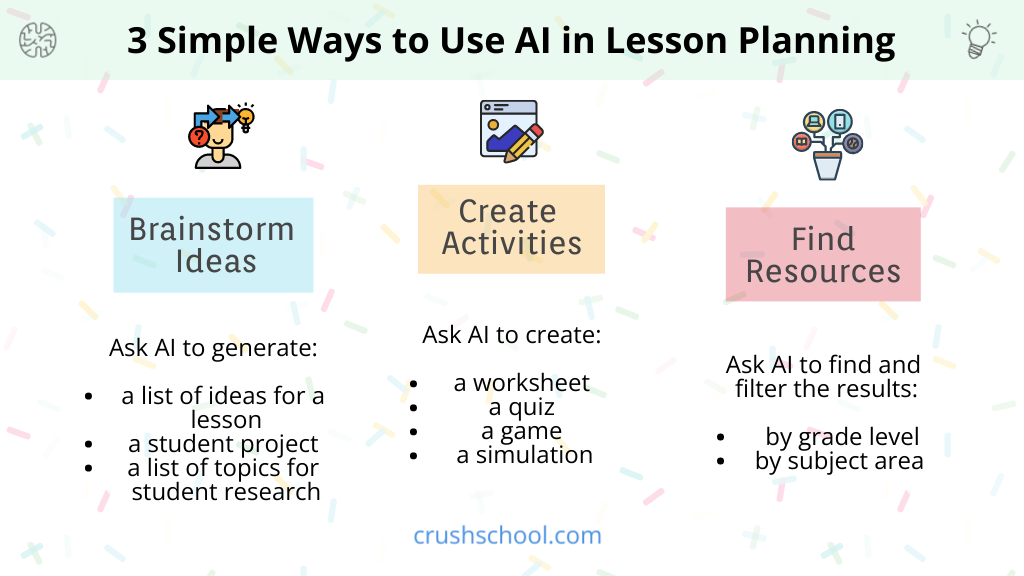
  1. Brainstorming ideas: AI can help teachers come up with new and innovative ideas for their lessons. Ask Bard or ChatGPT to generate a list of ideas for a lesson or a student project or a list of topics for student research. AI can also help refine and develop these ideas based on additional prompts you put in.

  2. Finding resources: AI can help teachers find high-quality resources for their lessons. Search the web for resources on a specific topic, and ask the AI to filter the results to find resources that are appropriate for your grade level and subject area. The trick is to include this information in the prompt.

  3. Creating activities: AI can help teachers create interactive activities for their lessons. Ask the AI to create a worksheet, a quiz, a game, or a simulation and see what happens. Even if the product is a little rough around the edges, it will give you something you can use after a little polishing.

So What?

Artificial Intelligence can save teachers hours of time by automating the process of creating lesson plans. AI can take into account the teacher's subject area, grade level, and learning objectives to generate comprehensive and engaging lesson plans. As AI continues to develop, so will more innovative ways to use it to enhance lesson planning.


If you found this post helpful, sign up for my Teaching Tips, Resources, & Ideas Newsletter to get the next article when it drops. It’s totally free.

BOOKS & TOOLS

Phenomena Poster
$1.50
Mistakes Are... Poster
$3.00
Back 2 School Classroom Bundle of 8 Posters
Sale Price: $5.00 Original Price: $8.00
Because... Chemistry Unisex T-Shirt
from $15.00

AI for Teachers: Using Artificial Intelligence to Enhance Learning

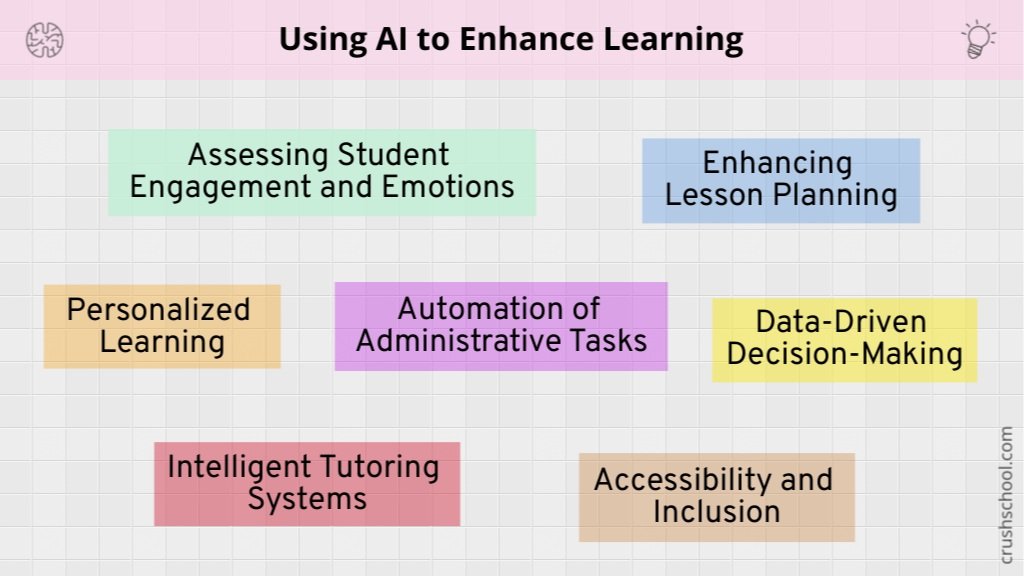
Whether we like it or hate it, want it or resist it, embrace it or repress it, Artificial Intelligence is here to stay. On one hand, the uncertainty AI brings with it is scary. On the other, AI has the potential to transform traditional education - it can make learning more personalized, efficient, and engaging for our students. But to harness its full potential, educators and institutions must carefully consider how to best integrate AI into the classroom. This article is an exploration of the key ways in which AI can (and already is being used to) enhance learning.

Personalized Learning

One of the most promising aspects of AI in education is its ability to create personalized learning paths for each student. AI algorithms can analyze students' strengths, weaknesses, and learning styles based on their performance and adapt the curriculum accordingly. AI driven personalization enables educators to both challenge and support their students, which ultimately leads to improved learning outcomes for all.

You may already know and use such platforms in your teaching.

Khan Academy is a well-known online learning platform that uses adaptive learning technology and offers personalized math and science instruction to students of all ages, adjusting the difficulty of exercises based on individual performance.

DreamBox and Carnegie Learning are adaptive math programs for students that use AI to adapt to each student's skill level and learning style, providing a customized learning path.

Duolingo is a language-learning app that incorporates AI to personalize language instruction. It adapts lessons based on a student's progress and adjusts difficulty levels to optimize learning.

Intelligent Tutoring Systems

Intelligent Tutoring Systems (ITS) powered by AI are like having a virtual tutor available 24/7. These systems can provide students with immediate feedback, answer their questions, and offer additional resources for further learning. ITS can be particularly useful in subjects where students may require extra help, such as mathematics or language learning. You may already know and use such platforms in your teaching.

Besides the aforementioned Khan Academy et. al., the platforms such as SMART Learning Suite (customized lessons and assessments), ScribeSense (grading and providing feedback on handwritten assignments), and Pearson MyLab (adaptive assessments and feedback) are other examples of AI-driven Intelligent Tutoring Systems. As AI technology continues to advance, we can expect even more innovative and personalized learning solutions to emerge.

Automation of Administrative Tasks

Grading assignments and communicating with students and parents is time consuming. AI can automate these routine tasks, freeing up teachers' valuable time for more critical activities, like lesson planning, engaging with students, and professional development. Many private sector companies already use AI for such tasks. Why should education be different?

Enhancing Lesson Planning

By analyzing the Internet database of educational materials, AI algorithms can recommend relevant content, teaching strategies, and activities tailored to the learning objectives and the specific needs of the students in the classroom. This can help teachers deliver more engaging and effective lessons. Artificial Intelligence can also be used to provide examples for key concepts studied, real-life phenomena for research, and topics for student projects.

Data-Driven Decision-Making

AI can provide educators with valuable insights through data analytics. By tracking students' progress, engagement, and performance, AI can help teachers identify areas where students may be struggling and adapt their teaching strategies accordingly. Moreover, it can assist schools in making data-driven decisions regarding curriculum improvements and resource allocation.

Assessing Student Engagement and Emotions

Understanding how students are feeling and engaging during lessons is crucial for effective teaching. AI can analyze facial expressions, behavior, and sentiment to gauge students' emotional states and level of engagement. Teachers can use this information to adjust their teaching methods, provide additional support, or introduce more engaging activities. If this sounds too sci-fi for you sit down, take a deep breath, and accept the weird outrageousness of it all.

Accessibility and Inclusion

AI can play a significant role in creating an inclusive learning environment. For example, it can provide real-time language translation to assist ELL students, offer accessibility features for students with disabilities, and even adapt content for students with varying learning styles and abilities.

So What Does it all mean?

Artificial Intelligence is changing education. Teachers can focus on preventing students from using AI to cheat or harness its power to create more personalized and effective learning experiences for students. It’s important to remember that successful AI integration requires careful planning, training, and consideration of ethics. When used thoughtfully, AI has the potential to revolutionize education - to make it more accessible, engaging, and tailored to the needs of individual learners. AI is not coming - it’s already here and embracing it in the classroom helps us prepare students for the challenges and opportunities the future brings.


If you found this post helpful, sign up for my Teaching Tips, Resources, & Ideas Newsletter to get the next article when it drops. It’s totally free.

BOOKS & TOOLS

Phenomena Poster
$1.50
Mistakes Are... Poster
$3.00
Back 2 School Classroom Bundle of 8 Posters
Sale Price: $5.00 Original Price: $8.00
Because... Chemistry Unisex T-Shirt
from $15.00

The Systems Approach in Education: Nurturing Holistic Learning

In a world of rapid change and increasing complexity, traditional education often falls short in adequately preparing students for the challenges we are currently facing. Population growth, resource demands and exploitation, climate change, disease, sustainability, poverty, peace and security, human rights… are all interconnected. One affects another no matter how hard we try to separate them and deal with each issue one by one, and perhaps this is why it is time to give up the status quo way of educating in favor of the systems approach.

Understanding the Systems Approach

The systems approach finds any system as not just a collection of individual parts, but an integrated whole where the interactions between these parts create emergent behaviors (behaviors that emerge from the interactions of various parts of the system).

In traditional education, we often compartmentalize subjects and treat their topics in isolation. In contrast, the systems approach encourages an interdisciplinary perspective. It emphasizes the interconnectedness of subjects, encouraging students to understand how knowledge and skills from various domains can be used to solve real-world problems. This approach mirrors the complexity of real-life situations, where challenges rarely fit into a single academic field.

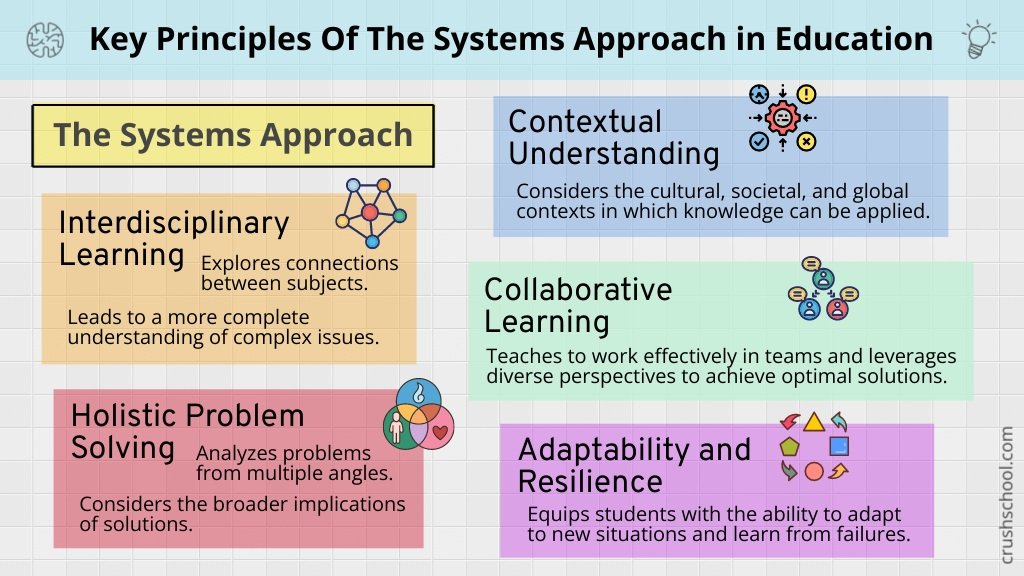
Key Principles of the Systems Approach in Education

  1. Interdisciplinary Learning: The systems approach promotes learning that transcends disciplines. By encouraging students to explore connections between subjects, it equips them with a more comprehensive understanding of complex issues.

  2. Holistic Problem Solving: In the real world, challenges are multifaceted. The systems approach teaches students to analyze problems from multiple angles and consider the broader implications of their solutions.

  3. Contextual Understanding: Education should not occur in a vacuum. The systems approach encourages students to consider the cultural, societal, and global contexts in which their knowledge can be applied.

  4. Adaptability and Resilience: Complex systems are adaptable and resilient. The systems approach equips students with the ability to adapt to new situations and learn from failures.

  5. Collaborative Learning: Systems thinking involves understanding of relationships and interactions, which encourages collaborative learning. Students learn to work effectively in teams, leveraging diverse perspectives to achieve optimal solutions.

Effective Implementation of the Systems Approach

  1. Curriculum Design: A systems-focused curriculum incorporates Phenomenon-Based Learning (PhenBL), which promotes case studies, real-world simulations, and interdisciplinary projects. Investigating multifaceted phenomena exposes students to the complex connections between topics associated with seemingly disparate subjects and how a more holistic understanding can be used to create more meaningful solutions.

  2. Assessment Methods: Traditional exams cannot correctly evaluate systems thinking skills. Performance assessments, such as designing and performing investigations, creating multimedia products, and solving real-world problems can better measure a student's ability to connect various subjects and issues.

  3. Teacher Training: Teachers are key to promoting the systems approach. Adequate PD should focus on enhancing teachers' ability to design more holistic lesson plans, facilitate collaborative learning, and guide students in applying systems thinking.

  4. Technology: Technology can facilitate the systems approach by providing tools for visualizing and simulating complex systems and connecting with experts from various fields, transcending geographical limitations.

Benefits of The Systems Approach

Embracing the systems approach in education offers numerous benefits. Students develop critical thinking skills, a deeper understanding of real-world complexity, and an enhanced ability to innovate. By fostering collaboration and adaptability, this approach prepares students for careers in a rapidly changing job market.

Future Implications of The Systems Approach

However, transitioning to a systems approach requires a paradigm shift in education. Curricula need to be replaced by approaches such as Phenomenon- or Project-Based Learning. The evaluation metrics for student success need to evolve in kind to gauge the complex, multifaceted, and transferable skills developed through using the systems approach.

The systems approach aims to bridge the gap between the classroom and the real-world. By cultivating holistic thinking, interdisciplinary learning, collaboration, and learning from mistakes, the systems approach equips students with the skills necessary to navigate the complexities of the modern era. The world of education must continue to embrace and improve holistic learning models such as the systems approach to move the society closer to a future in which students learn how to solve (and solve) global challenges in the classroom.


If you found this post helpful, sign up for my Teaching Tips, Resources, & Ideas Newsletter to get the next article when it drops. It’s totally free.

BOOKS & TOOLS

Phenomena Poster
$1.50
Mistakes Are... Poster
$3.00
Back 2 School Classroom Bundle of 8 Posters
Sale Price: $5.00 Original Price: $8.00
Because... Chemistry Unisex T-Shirt
from $15.00

2024 Crush School