CRUSH SCHOOL

I blog on Brain-Based Learning, Metacognition, EdTech, and Social-Emotional Learning. I am the author of the Crush School Series of Books, which help students understand how their brains process information and learn. I also wrote The Power of Three: How to Simplify Your Life to Amplify Your Personal and Professional Success, but be warned that it's meant for adults who want to thrive and are comfortable with four letter words.

Filtering by Category: Science

Making Lessons Fun: Gamifying Learning with Classroom Escape Rooms

Study guide packets, yeah buddy! ‘Cause nothing screams "engaging learning experience" quite like flipping through 20 pages of blank-filling, vocab matching, defining, and short answer question… answering.

It's truly a marvel how these magnificent documents manage to extract every last ounce of life from a unit, transforming vibrant concepts into a monotonous exercise in hand cramps and existential dread.

Who needs active recall or critical thinking when you can simply transcribe information directly from the textbook, barely registering its meaning?

And the thrill of flipping to the next page, realizing you've successfully completed another utterly mind-numbing task – it's almost enough to make you forget you haven't actually learned anything. So, for unparalleled boredom and guaranteed ineffectiveness in content review, look no further than the humble study guide packet.

Or, you inject some excitement into those old review sessions instead. Yeah, Gimkit, Kahoot!, Quizziz etc. are cool review tools, but they can get repetitive.

Escape, or breakout rooms, are a cool, engaging, and effective way to review content and further develop student problem-solving and collaboration.

Escape Rooms in the Classroom?

Inspired by popular escape room games, classroom escape rooms challenge students to "break out" of a hypothetical scenario (or a locked classroom) by solving a series of puzzles and challenges. Each puzzle requires them to apply their knowledge of previously learned content. When they solve a puzzle, it often reveals a clue or a part of the solution to the next puzzle, ultimately leading them to the "key" to escape or unlock the final prize.

Escape Rooms for Content Review?

Let’s look at some benefits of content review breakout rooms.

  1. Engaging & Motivating: The inherent challenge and problem-solving aspect of an escape room naturally hooks students. The pressure of a time limit (optional, but often effective) adds to the excitement.

  2. Active Learning: Students aren't passively listening or filling out blanks. They're actively recalling, analyzing, and applying information to solve real problems.

  3. Collaborative Skills: Most escape rooms are designed for small groups, forcing students to communicate, divide tasks, and work together to achieve a common goal. This builds teamwork skills.

  4. Differentiated Learning: Puzzles and problems can be designed in a variety if ways and to accommodate various levels of understanding.

  5. Immediate Feedback: Students know almost immediately if their solution is correct, providing instant reinforcement or prompting them to re-evaluate, rethink, and revise their understanding.

  6. Fun! Learning should be enjoyable, because we like doing what we like. Escape rooms transform review into exciting, thus memorable experiences.

Classroom Escape Room How to

Creating an effective classroom escape room doesn't require a Hollywood budget. Here's a step-by-step guide.

  1. Identify Your Learning Objectives: What specific content do you want students to review? This is your starting point for all puzzles. For example, if you're reviewing fractions, every puzzle should involve fraction questions and problems.

  2. Brainstorm Puzzle Ideas Tied to Content: This is where you get creative. Think about different ways to present your content as a challenge.

    • Math: Cipher wheels with math problems as the key, order of operations leading to a lock combination, word problems solved to reveal a code.

    • ELA: Unscrambling vocabulary words, identifying literary devices in short passages, putting events of a story in chronological order to form a phrase.

    • Science: Matching elements to their symbols to unlock a box, solving a scientific riddle, identifying parts of a cell based on descriptions.

    • History: Sequencing historical events, matching key figures to their achievements, decoding a message based on historical facts.

  3. Choose Your "Locks" and "Keys":

    • Physical Locks: Directional locks, 3 or 4-digit number locks, word locks (often used with a hasp on a box). You can purchase these relatively inexpensively.

    • Digital Locks: Google Forms can be set up to require a specific answer to proceed to the next section, effectively acting as a digital lock. Websites like Breakout EDU also offer digital lockbox options.

    • "Keys": The solution to one puzzle should lead to the "key" for the next lock. This could be a number, a word, a direction, a symbol, or a clue leading to a physical object.

  4. Design the Flow and Narrative (Optional but Recommended):

    • Linear vs. Non-Linear: Will students solve puzzles in a specific order (linear), or can they tackle them simultaneously (non-linear)? Linear is often easier for a first-time escape room.

    • Theme: A simple theme can add to the immersion. Are they "escaping the classroom," "rescuing a lost artifact," or "cracking a secret code?"

    • The Story: A brief narrative at the beginning sets the stage and explains the "why" behind the escape.

  5. Gather Your Materials:

    • Boxes/Containers: Use shoeboxes, plastic tubs, or even just envelopes. A dedicated "breakout box" is ideal if you plan to do this often.

    • Puzzles: Printouts, laminated cards, objects.

    • Clues: Written clues, images, riddles.

    • Locks: As mentioned above.

    • Props: Anything that adds to your theme (e.g., "secret agent" files, "ancient" maps).

  6. Set Up and Test:

    • Arrange the Puzzles: Place puzzles logically around the room or in designated areas for each group.

    • Test, Test, Test! Play through the entire escape room yourself, or have a colleague or a small group of students test it out. This will help you identify any confusing clues, dead ends, or overly difficult puzzles.

  7. Facilitate the Game:

    • Introduce the Rules: Explain the objective, time limit, and how to ask for hints.

    • Group Students: Assign students to small, collaborative groups (3-5 ideal).

    • Monitor and Guide: Circulate around the room, offering subtle hints if groups get stuck. Resist the urge to give them the answer and encourage them to work together to get to it.

    • Debrief: After the game, discuss the content reviewed, the strategies used, and what students enjoyed or found challenging.

Tips for Successful Breakout Review Sessions

  • Start Simple: Your first escape room doesn't need to be overly complex. Focus on 3-5 well-designed puzzles.

  • Clear Instructions: Ensure all puzzle instructions are unambiguous.

  • Scaffold Hints: Have a tiered hint system ready (e.g., first hint is vague, second hint is more specific).

  • Time Management: Decide on a time limit (e.g., 30-45 minutes).

  • Celebrate Success: Whether they "escape" or not, acknowledge effort and learning.

  • Reuse and Recycle: Once you have a set of materials, you can often adapt them for different content or themes. You can reuse digital templates and modify them for different content.

More than just a game, classroom escape rooms are a powerful way to transform content review into an exciting, memorable, and highly effective learning experience.

Maybe it’s time to ditch the dull drills and unlock a few… locks and break into a world of engaging education with your first classroom escape room?

They’ll have fun. You’ll have fun. It’ll be fun.


Thanks for reading my thoughts! I hope they help you have more fun in the classroom.

If you’d like a digital breakout template to use, check out my Gas Law Chemistry Breakout. It’ll set you back $3.50, but you can copy and modify every template and the Google Form to use for your own content.

Also, check out my shop for thoughtful, engaging, project-based and phenomena-based Earth and Space Science or Chemistry lessons.

BOOKS & TOOLS

EQUITY Poster
$1.50

Equity-Promoting Classroom Poster. What does EQUITY in the classroom look like?

  • Everyone has a different start and finish line

  • Quality is more important that quantity

  • Understanding that diversity makes us stronger

  • Inclusion despite beliefs, appearances, and circumstances

  • Thoughtfulness lowers barriers and reduces biases

  • Yesterday's mistakes are today's learning agenda

You can teach your students about equity and make it a daily classroom practice using this inspirational poster, which also includes images that accompany the equity description. You can discuss each letter characteristic with your students as a way of introducing your inclusive classroom and display it prominently as a reminder that diversity makes the classroom community stronger.
Introduction to Earth and Space Science - 5 Phenomenon-Based Projects
Sale Price: $10.00 Original Price: $15.00

Save 2 - 3 weeks of planning time and start your Earth and Space Science school year off right using NGSS and Phenomenon Based Learning with this “Introduction to Earth and Space Science” Unit that contains 5 relevant and engaging multi-day projects.
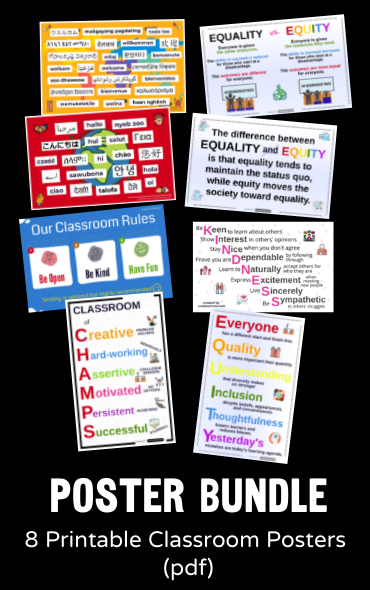
Back 2 School Classroom Bundle of 8 Posters
Sale Price: $5.00 Original Price: $8.00

8 digital, printable, size 11 x 17 classroom posters:

  1. “Welcome” in multiple languages

  2. “Hi” in multiple languages

  3. Three Equity posters

  4. Classroom Rules: Be Open, Be Kind, Have Fun

  5. “Classroom of Champs”

  6. “Kindness”

ON SALE until August 30th.

Anthropogenic Phenomenon Investigation
$3.00

Save planning time with this 3 to 4-day Earth and Space Science NGSS-aligned introductory lesson during which students learn about the Systems Approach to studying science and analyzing real world phenomena.

The lesson involves investigating an anthropogenic phenomenon and examining human influence on the four spheres (biosphere, hydrosphere, atmosphere, and geosphere).

During the investigation, students create models and use them to explain how each of the four spheres is affected in a video that educates viewers on the consequences of human actions and the interconnectedness of the Earth’s systems.

Includes 9 detailed slides (PDF and Google Slides link for editing) + detailed teacher directions (2 slides).

The project follows the guidelines set by the Next Generation Science Standards (NGSS) and guides students in using Science and Engineering Practices (SEPs), Crosscutting Concepts (CCCs), and Disciplinary Core Ideas (DCIs).

Student Learning Objectives:

  1. Describe what a Phenomenon is and give examples of Natural and Anthropogenic Phenomena.

  2. Explain how phenomena can be used to study scientific concepts.

  3. Describe the four spheres: atmosphere, hydrosphere, geosphere, and biosphere, and give examples of different matter interactions between them.

  4. Understand, explain, and apply the Systems Approach when investigating Earth and Space Science Phenomena. 

  5. Break down how a Specific Anthropogenic Phenomenon affects each of the four spheres.

Earth Science: Create a Computer Simulation of an ESS Concept
Sale Price: $2.00 Original Price: $3.00

Save planning time with this introductory, 3-4 day Earth and Space Science engineering challenge in which students create a computer simulation of an Earth Science topic.

Includes 12 detailed slides (PDF and Google Slides link for editing) + detailed teacher directions (last slide) + a BONUS resource: Animation Guide for Google Slides.

The project follows the guidelines set by the Next Generation Science Standards (NGSS) and guides students in using Science and Engineering Practices (SEPs).

Student Performance and Learning Objectives:

  1. Design and create an informative computer simulation.

  2. Use computer animation to simulate a key ESS concept.

  3. Explain the key ideas of an ESS concept of your choice.

[Earth Science] Terraforming Mars: The Red Planet "Shark Tank" Innovation Challenge
$4.00

Are your students tired of just reading about Earth? Do they gaze longingly at the night sky, dreaming of a future beyond textbook pages? Excellent! Because today, we're not just learning about science; we're making science. We're launching them into the ultimate entrepreneurial challenge: Terraforming Mars: The Red Planet "Shark Tank" Innovation Challenge!

Forget your quaint little recycling programs. We're talking about taking a dusty, desolate rock and turning it into a vacation spot for humanity.

This isn't just a project; it's a desperate plea from the future (and a cunning way to keep them engaged). Your students will become "Terraforming Tech Startups," armed with nothing but their wits, some internet access, and a burgeoning understanding of how Earth actually works. Because, let's be honest, trying to make Mars habitable without understanding our own planet's life support systems is like trying to bake a cake without knowing what flour is.

Prepare for an explosion of creativity (hopefully not literal, on Mars or in your classroom) as they grapple with the fundamental cycles that make life possible. The competitive drive to secure that "virtual investment" (and bragging rights) will channel all their boundless energy into productive, scientific output. Just try to keep the "mad scientist" cackles to a minimum.

Student Learning and Performance Objectives:

  1. Demonstrate understanding of the Carbon, Water, Nitrogen, and Oxygen cycles.

  2. Apply your knowledge of the principles of these cycles to design an ecosystem on a different planet (e.g. Mars).

  3. Illustrate how biogeochemical cycles support life in a closed system (Earth, Mars colony, dome ecosystem etc.).

  4. Pitch your solutions to practice collaboration, critical thinking, and creative problem-solving/design.

What's included:

  1. 20 slides that introduce, explain, and guide the teacher and students

  2. Introductory popcorn reading activity

  3. Research Guide (G-doc link): Includes Note-taking space and links to reputable websites for students to use.

  4. Project timeline and detailed tasks for each day

  5. Group Roles explained in detail

  6. Detailed teacher notes on prep, main lesson, and best practices

  7. List of materials

  8. Student Learning and Performance Objectives

  9. Grading Rubric and Peer Evaluation Form

Chemistry Breakout: Gas Laws & Properties Escape Room Review Lesson
$3.50

In this one-day review activity, designed for a high school Chemistry classroom, students work in small teams to “escape” their chemistry room by answering questions and solving Gas Laws Unit problems.

Basic Idea:

  1. Student answer questions at each level to figure out the breakout code.

  2. They type the breakout code in the Google form (link provided) to progress through the different levels.

  3. Upon unlocking the last level, students are be given a numeric breakout code that will grant them safe passage out of the classroom.

Why and how does this learning strategy work?

Escape room-style lessons are fun, engaging, and motivating. They involve friendly competition between teams as each group wants to be the first to escape, but the students’ main competition is time. Each breakout room level is designed to be progressively more difficult and calls on more advanced content knowledge and skills. While designed as a review lesson, I find that many students (inadvertently) use the Gas Laws and Properties Breakout as the opportunity to learn and understand the gas unit content and calculations better. In addition to learning subject knowledge, students improve their teamwork-related skills, such as communication, role distribution, and time management as they collaborate toward reaching a common goal.

Student Learning and Performance Objectives:

  1. Put together a periodic table of chemistry students in our class.

  2. Create an element box for each student with their characteristics, likes, dislikes etc.

  3. Start building a classroom community.

  4. Allow students to familiarize themselves with each other by learning a few things about their classmates.

What's included:

  1. 13 pages that introduce, explain, and guide the teacher and students through the activity.

  2. Google Form students use to input their answers to progress through the levels (They can only progress by inputting correct answers)

  3. Printable escape room levels (4 pages)

  4. Teacher notes including the set-up, introduction to students, and frequently asked teacher questions

  5. Materials needed

  6. Teacher Answer Keys for each Breakout Level

Making Lessons Fun: Shark Tank Innovation Challenges

Let's be real, getting my students genuinely excited about research or problem-solving can sometimes feel like trying to convince my cat, Tola to like the vet. Two hours later and two tranquilizers in her, Tola is fully alert ready to rip anyone’s head off should they try to touch any part of her twelve-pound body.

But what if I told you there's a magical potion – okay, a lesson design strategy – that channels the boundless, chaotic teenage energy into productive and competitive brilliance? All you have to do is throw them into a tank full of sharks!

Close your eyes and envision teams of teens frantically designing, debating, and then boldly pitching their groundbreaking ideas to a panel of pretend billionaires. This isn't just a project. It's a high-stakes (ish), low-risk “my thing is better than your thing” battle that leaves students engaged in actual learning.

Here's how to set up the engagement goldmine that is the Shark Tank Innovation Challenge.

Day 1: The Plunge - Identifying the Problem

Day one is all about throwing them into the deep end... of a real-world problem, that is.

The Problem Pitch (10-15 mins): Start with a bang! Present a compelling, relatable, real-world issue that needs a solution. Think local water pollution, designing a truly sustainable community, or inventing a wild new recycling method. Make it feel urgent and important, like the fate of the world (or at least their grade) depends on their ingenuity. "Alright, innovators! Today, we're tackling a problem so big, it makes your Pre-Calc homework look like a chihuahua barking at a grizzly bear.”

Introduce the "Tank" Rules: Explain the "Shark Tank" premise. Students will work in teams, research a problem, design a solution, and then "pitch" it to a panel of "investors" (that's you, maybe a brave colleague, or if you're feeling really adventurous, actual community members). Emphasize that the goal is not just a good idea, but a viable, well-researched, and convincingly pitched one.

Form the Companies (Teams): Divide students into small groups (3-4 per "company"). Give them a few minutes to pick a catchy company name. This tiny act of ownership always boosts engagement. Then, assign or let them choose which specific problem they want to tackle within your broader topic.

Initial Brainstorm & Research Kick-off: Give teams time to brainstorm initial ideas. Crucially, provide a curated list of reputable online resources. "No, TikTok is not a valid research source for global water scarcity. Shocking, I know." This initial research will likely spill into homework, or you could make this a four-day thing.

Day 2: The Deep Dive - Research, Design, and Pitch Prep

This is where the magic aka the organized chaos of genuine innovation happens.

Research Fortification: Students dive deeper into understanding their chosen problem and researching existing solutions (and why they're not good enough). They need data, statistics, and maybe even a few compelling anecdotes. This is where their "Lead Researcher" steps up.

Solution Conception & Design: Teams then brainstorm and design their own unique, innovative solution. Encourage creativity, but stress that it must be grounded in reality (or at least, plausible science). Whether it's a new app, a physical device, or a policy proposal, they need to flesh it out. This is the "Product Development" phase.

Crafting the Killer Pitch: Now comes the salesmanship! Teams need to plan their presentation. Who says what? How will they convey their idea's brilliance in a limited time? They should practice their opening hook, explain the problem, present their solution, justify its viability, and outline its impact. "Remember, investors don't have all day. Get to the point, make it shine, and do not insult the investors' intelligence."

Visual Aids & Prototypes (Conceptual, Usually): Encourage them to think about simple visual aids – a basic diagram, a conceptual drawing, or even a brief flow chart. No need for a working model that sprays glitter, but a clear visual helps!

Day 3: The Feeding Frenzy - Pitch Day!

The moment of truth! Prepare for a flurry of nervous energy, impressive pitches, and surprisingly insightful questions.

Final Touches (5-10 mins): Give teams a brief period for last-minute practice and deep breathing. Remind them of time limits and the "no throwing chairs" rule during the Q&A.

The Pitches Commence: Gather your "investor" panel. Have each team present their solution. Encourage genuine curiosity and critical questioning from the investors and hand them a few starter questions such as “What is the evidence your solution design could work?” or "What makes your solution different or better than what's out there right now?"

Investor Q&A: After each pitch, open it up for questions from the "investors." This is where their research and quick thinking are truly tested. Don't know the answer? Pivot, innovate, or gracefully admit you'll 'get back to them' after more research (a common entrepreneurial strategy).

Debrief & Reflection: After all pitches are done, take a moment to discuss. What made a pitch compelling? What challenges did they face? What did they learn about real-world problem-solving? You can even do a "virtual investment" where students anonymously "invest" imaginary money into the ideas they found most compelling, with extra credit for the "most funded" project. And just like that, the world is (potentially) saved, and you somehow managed the class for three to four straight days with minimal effort. Go you!

The "Shark Tank" Challenge isn't just about designing cool things; it's about making students own their learning, collaborate under pressure, and channel their boundless teenage energy into something genuinely productive. Plus, it's hilarious to watch them try to sell you on something groundbreaking like a self-cleaning grass-powered backyard dog poop scooper.

So take the plunge. Students will dive deep and feast on the required content knowledge without realizing it. Not a bad trick for someone with no formal Jedi training. May the force be with you always.


Thanks for reading my thoughts! I hope they help you in being more you. Check out my shop (see top) if you need thoughtful (not busy work), engaging (fun), project-based and phenomena-based (the whole NGSS thing) Earth and Space Science lessons. I try to keep the prices decent, but if you cannot spare the $, please email me and I’ll give you whatever you need for free.

BOOKS & TOOLS

EQUITY Poster
$1.50

Equity-Promoting Classroom Poster. What does EQUITY in the classroom look like?

  • Everyone has a different start and finish line

  • Quality is more important that quantity

  • Understanding that diversity makes us stronger

  • Inclusion despite beliefs, appearances, and circumstances

  • Thoughtfulness lowers barriers and reduces biases

  • Yesterday's mistakes are today's learning agenda

You can teach your students about equity and make it a daily classroom practice using this inspirational poster, which also includes images that accompany the equity description. You can discuss each letter characteristic with your students as a way of introducing your inclusive classroom and display it prominently as a reminder that diversity makes the classroom community stronger.

Introduction to Earth and Space Science - 5 Phenomenon-Based Projects
Sale Price: $10.00 Original Price: $15.00

Save 2 - 3 weeks of planning time and start your Earth and Space Science school year off right using NGSS and Phenomenon Based Learning with this “Introduction to Earth and Space Science” Unit that contains 5 relevant and engaging multi-day projects.

Back 2 School Classroom Bundle of 8 Posters
Sale Price: $5.00 Original Price: $8.00

8 digital, printable, size 11 x 17 classroom posters:

  1. “Welcome” in multiple languages

  2. “Hi” in multiple languages

  3. Three Equity posters

  4. Classroom Rules: Be Open, Be Kind, Have Fun

  5. “Classroom of Champs”

  6. “Kindness”

ON SALE until August 30th.

Anthropogenic Phenomenon Investigation
$3.00

Save planning time with this 3 to 4-day Earth and Space Science NGSS-aligned introductory lesson during which students learn about the Systems Approach to studying science and analyzing real world phenomena.

The lesson involves investigating an anthropogenic phenomenon and examining human influence on the four spheres (biosphere, hydrosphere, atmosphere, and geosphere).

During the investigation, students create models and use them to explain how each of the four spheres is affected in a video that educates viewers on the consequences of human actions and the interconnectedness of the Earth’s systems.

Includes 9 detailed slides (PDF and Google Slides link for editing) + detailed teacher directions (2 slides).

The project follows the guidelines set by the Next Generation Science Standards (NGSS) and guides students in using Science and Engineering Practices (SEPs), Crosscutting Concepts (CCCs), and Disciplinary Core Ideas (DCIs).

Student Learning Objectives:

  1. Describe what a Phenomenon is and give examples of Natural and Anthropogenic Phenomena.

  2. Explain how phenomena can be used to study scientific concepts.

  3. Describe the four spheres: atmosphere, hydrosphere, geosphere, and biosphere, and give examples of different matter interactions between them.

  4. Understand, explain, and apply the Systems Approach when investigating Earth and Space Science Phenomena. 

  5. Break down how a Specific Anthropogenic Phenomenon affects each of the four spheres.

Earth Science: Create a Computer Simulation of an ESS Concept
Sale Price: $2.00 Original Price: $3.00

Save planning time with this introductory, 3-4 day Earth and Space Science engineering challenge in which students create a computer simulation of an Earth Science topic.

Includes 12 detailed slides (PDF and Google Slides link for editing) + detailed teacher directions (last slide) + a BONUS resource: Animation Guide for Google Slides.

The project follows the guidelines set by the Next Generation Science Standards (NGSS) and guides students in using Science and Engineering Practices (SEPs).

Student Performance and Learning Objectives:

  1. Design and create an informative computer simulation.

  2. Use computer animation to simulate a key ESS concept.

  3. Explain the key ideas of an ESS concept of your choice.

[Earth Science] Terraforming Mars: The Red Planet "Shark Tank" Innovation Challenge
$4.00

Are your students tired of just reading about Earth? Do they gaze longingly at the night sky, dreaming of a future beyond textbook pages? Excellent! Because today, we're not just learning about science; we're making science. We're launching them into the ultimate entrepreneurial challenge: Terraforming Mars: The Red Planet "Shark Tank" Innovation Challenge!

Forget your quaint little recycling programs. We're talking about taking a dusty, desolate rock and turning it into a vacation spot for humanity.

This isn't just a project; it's a desperate plea from the future (and a cunning way to keep them engaged). Your students will become "Terraforming Tech Startups," armed with nothing but their wits, some internet access, and a burgeoning understanding of how Earth actually works. Because, let's be honest, trying to make Mars habitable without understanding our own planet's life support systems is like trying to bake a cake without knowing what flour is.

Prepare for an explosion of creativity (hopefully not literal, on Mars or in your classroom) as they grapple with the fundamental cycles that make life possible. The competitive drive to secure that "virtual investment" (and bragging rights) will channel all their boundless energy into productive, scientific output. Just try to keep the "mad scientist" cackles to a minimum.

Student Learning and Performance Objectives:

  1. Demonstrate understanding of the Carbon, Water, Nitrogen, and Oxygen cycles.

  2. Apply your knowledge of the principles of these cycles to design an ecosystem on a different planet (e.g. Mars).

  3. Illustrate how biogeochemical cycles support life in a closed system (Earth, Mars colony, dome ecosystem etc.).

  4. Pitch your solutions to practice collaboration, critical thinking, and creative problem-solving/design.

What's included:

  1. 20 slides that introduce, explain, and guide the teacher and students

  2. Introductory popcorn reading activity

  3. Research Guide (G-doc link): Includes Note-taking space and links to reputable websites for students to use.

  4. Project timeline and detailed tasks for each day

  5. Group Roles explained in detail

  6. Detailed teacher notes on prep, main lesson, and best practices

  7. List of materials

  8. Student Learning and Performance Objectives

  9. Grading Rubric and Peer Evaluation Form

Making Lessons Fun: Classroom Debates on Controversial Topics

Classroom Debates are Fun, engaging, and packed with student learning

Let's own it, my teacher brethren. There are times during the school year when we’re less than one-hundred percent and we just want our students to sit down, shut up, and listen. But while this elusive dream sounds serene and exactly what the migraine doctor ordered, the engaged classroom is where students are so thoroughly locked in, they behave like dogs with new squeaky toys. They're so captivated by the learning that they forget they possess opposable thumbs and the dopamine-driven urge to use them to Clash or Brawl.

And while lecturing might achieve our coveted silence, actual engagement often requires letting them talk; argue even. Yes, I'm talking about debates, the intellectual sparring sessions not just for the nerd at heart, but your secret weapon against the dreaded "blank stare" and the even more annoying "I'm done, can I be on my phone now?" questions.

If setting up a successful, intellectually stimulating debate conjures images of trying to lead a herd of hyper baboons through a laser maze, check out this surprisingly simple 3-day structure you can use to transform your classroom into an "Intellectual Thunderdome" without the fear of flying objects (unless you’re debating history of hot air ballooning).

Picture critical thinking, communication, research skills, public speaking, and evidence-supported persuasion all happening while students are too busy trying to "win" to realize they're actually learning. So Jedi of you….

Day 1: Lay the Foundation & Unleash the Research Beasts

Drop a controversial topic into their laps and watch them scramble for facts, like desperate squirrels for the last acorn before ice age buries all.

1. Introduce the Hot Topic

Pick a subject so inherently divisive, it practically begs for arguments. For instance, "What is the absolute best, most perfect, no-other-solution-compares answer for climate change?" is pure gold. Frame it as a grand, global challenge that only they can solve with superior intellect.

2. Explain the "Thunderdome" Rules (Gently, at First!)

Briefly outline that this isn't about whose feelings are hurt, but about whose facts are bigger and better. Emphasize "respect" (which they'll try to adhere to, bless their hearts), "active listening" (a skill rarely seen outside of professional therapy sessions), and the thrilling, primal urge to intellectually dominate their peers (it’s evolutionary! Darwin).

3. Assign Teams & Roles

Divide your class into teams (4-8 per side, depending on your school district’s ineptitude in lowering classroom sizes). Give each team a distinct "stance" or "solution" to champion – even if it's one you know they secretly despise. Assign roles within each team, individual or in pairs (e.g., Lead Investigator, Argument Architect, Rebuttal Assassin – yes, actual titles!). This way everyone has a job and no one can hide in the shadow of their phone.

4. Kick Off Research (and the Long Sighs)

Provide a "Research Starter Pack" – a curated list of reputable sources (think academic institutions, government agencies, established scientific bodies – not just random TikToks or Uncle Drew's Facebook rants). Give them clear guidelines on what kind of evidence they need: cold, hard data, expert opinions, feasibility studies, pros/cons. This will likely consume the remainder of Day 1 and either some homework or next day time. Prepare for the inevitable questions like, "Do I have to read all of it?"

Day 2: Forge Arguments & Sharpen the Swords of Truth

Now that your intellectual squirrels have gathered some acorns, Day 2 is dedicated to turning those scattered nuts (or facts) into a well-oiled, argument-spewing machine.

1. Team Collaboration Power Hour (or Two)

Give teams dedicated time to synthesize their research. This is where the Lead Investigator dumps their findings, and the Argument Architect tries to make sense of it all, structuring an opening statement that doesn't sound like a caffeine-fueled rave.

2. Crafting the Core Arguments (and Avoiding Logical Fallacies)

Guide teams to develop 2-3 main arguments that powerfully support their assigned stance. For each, they need strong, evidence-based points. Encourage them to think about why their solution is the undisputed champion of all solutions.

3. Anticipate the Blows (Rebuttal Prep - The Fun Part!)

This is where the real competition happens. Have each team brainstorm what the other teams might argue. What are the gaping holes in their own brilliant solution? What unexpected strengths might the opposition possess? This foresight allows the Rebuttal Assassin to prepare devastating counter-arguments that have opponents whimper for mercy…. or at least blush.

4. Practice, Practice, Practice (Because Winging It Rarely Works)

If time allows (and you have the patience), encourage teams to practice their opening statements and initial rebuttals. Running through it helps them refine their language, identify awkward pauses, and get comfortable speaking under the terrifying gaze of their peers. Plus, it's a great way to use up that extra class time.

Day 3: Unleash The Thunderdome

The moment of truth has arrived! May their arguments be strong and their Google slides minimally embarrassing!

1. Quick Rules Review (Just in Case)

Before the first gavel (or ruler) falls, quickly remind everyone of the debate decorum: no personal attacks (you know who you are), stick to facts (it's hard, I know), respect time limits (or face my wrath), and listen actively (what the frick is that?).

2. Run the Debate

Follow a structured debate format (e.g., opening statements, alternating rebuttals/cross-examinations, closing statements). You'll serve as the stern, impartial moderator, keeping time and ensuring fair play. Witness the magic as students passionately (and hopefully factually) defend their positions. You'll be amazed at the sophisticated arguments they can construct when their pride is on the line.

3. Debrief & Reflect (The "Learning" Part)

After the intellectual dust settles, bring everyone back together. Ask:

  • What did you learn about the complexity of the topic?

  • Did your understanding of any solution actually change? (Don't worry, I won't tell anyone you admitted to being swayed by logic.)

  • What was challenging about defending a position you might not personally agree with?"

This is where the true learning solidifies, as they move from competitive yelling to actual comprehension. Venisti. Vidisti. Vicisti. Yes, you did.

Implementing a 3-day debate lesson might require a bit more upfront planning and a stronger than usual cup of coffee, but the payoff in student engagement, critical thinking, and genuine (and performative) learning is immense. So, choose your topic, assign your teams, and prepare to be impressed by the intellectual prowess and competitive spirit of your students. They might just surprise themselves and you! Especially you.


Thanks for reading my thoughts! I hope they help you make learning more fun for you and your students. Check out my shop if you need fun science teaching lessons or classroom swag. I try to keep the prices decent, but if you cannot spare the $, please email me and I’ll give you whatever you need for free.

BOOKS & TOOLS

EQUITY Poster
$1.50

Equity-Promoting Classroom Poster. What does EQUITY in the classroom look like?

  • Everyone has a different start and finish line

  • Quality is more important that quantity

  • Understanding that diversity makes us stronger

  • Inclusion despite beliefs, appearances, and circumstances

  • Thoughtfulness lowers barriers and reduces biases

  • Yesterday's mistakes are today's learning agenda

You can teach your students about equity and make it a daily classroom practice using this inspirational poster, which also includes images that accompany the equity description. You can discuss each letter characteristic with your students as a way of introducing your inclusive classroom and display it prominently as a reminder that diversity makes the classroom community stronger.

Introduction to Earth and Space Science - 5 Phenomenon-Based Projects
Sale Price: $10.00 Original Price: $15.00

Save 2 - 3 weeks of planning time and start your Earth and Space Science school year off right using NGSS and Phenomenon Based Learning with this “Introduction to Earth and Space Science” Unit that contains 5 relevant and engaging multi-day projects.

Back 2 School Classroom Bundle of 8 Posters
Sale Price: $5.00 Original Price: $8.00

8 digital, printable, size 11 x 17 classroom posters:

  1. “Welcome” in multiple languages

  2. “Hi” in multiple languages

  3. Three Equity posters

  4. Classroom Rules: Be Open, Be Kind, Have Fun

  5. “Classroom of Champs”

  6. “Kindness”

ON SALE until August 30th.

Climate Change Debate: The Earth Science Intellectual Thunderdome
$4.00

In this 3- to 4-day lesson, designed for a high school Earth and Space Science classroom, student groups are assigned and investigate 4 leading solutions to the climate change crisis our planet is experiencing. Then, they are called upon to debate against each other to try to convince others that their solution is the most viable and provide counterarguments against other solutions. It’s an intellectual thunderdome in which students are encouraged to use science to attacks each others points of view on climate change but not character.

Why and how does this learning strategy work?

Rote memorization out; seeking answers and deeper learning in.

The debate-style approach to learning is engaging and motivating for learners, because they are challenged to use real evidence and their wits to outmaneuver their opposition.

Not only do they act as investigators, developing communication, collaboration, and argumentation skills but they learn about viable solutions to the climate change conundrum we all find ourselves in. They learn Earth and Space Science content while investigating and debating solutions to a real-world phenomenon, which is what the Next Generation Science Standards (NGSS) call for.

Student Learning and Performance Objectives:

  1. Research multiple, complex climate change solutions to discover that the world is more complicated than a single TikTok trend.

  2. Articulate scientific arguments with actual evidence.

  3. Listen to opposing viewpoints, to hone "social awareness" skills.

  4. Realize that climate change solutions are multi-faceted, messy, and require more than just good vibes.

  5. Describe and support with, not mere belief but actual evidence, the leading climate solutions proposed by, not the coven of online witches but the scientific community.

What's included:

  1. 24 slides that introduce, explain, and guide the teacher and students

  2. Detailed teacher notes on prep, main lesson, and follow up activities

  3. General Lesson flow for teacher to follow to make it all seamless

  4. A short and funny “hook” to increase student buy in

  5. Detailed student directions

  6. A list (research starter pack) of links to legit, scientific websites for students to use.

  7. Group roles (team jobs) with descriptions of what each entails.

  8. 4 climate change solutions to assign to 4 different student groups

  9. Student Learning and Performance Objectives

  10. Detailed Grading Rubric to guide students and make assessment easy

  11. Debate Day introduction and format description

  12. Follow up discussion questions (reflection and debrief)

Anthropogenic Phenomenon Investigation
$3.00

Save planning time with this 3 to 4-day Earth and Space Science NGSS-aligned introductory lesson during which students learn about the Systems Approach to studying science and analyzing real world phenomena.

The lesson involves investigating an anthropogenic phenomenon and examining human influence on the four spheres (biosphere, hydrosphere, atmosphere, and geosphere).

During the investigation, students create models and use them to explain how each of the four spheres is affected in a video that educates viewers on the consequences of human actions and the interconnectedness of the Earth’s systems.

Includes 9 detailed slides (PDF and Google Slides link for editing) + detailed teacher directions (2 slides).

The project follows the guidelines set by the Next Generation Science Standards (NGSS) and guides students in using Science and Engineering Practices (SEPs), Crosscutting Concepts (CCCs), and Disciplinary Core Ideas (DCIs).

Student Learning Objectives:

  1. Describe what a Phenomenon is and give examples of Natural and Anthropogenic Phenomena.

  2. Explain how phenomena can be used to study scientific concepts.

  3. Describe the four spheres: atmosphere, hydrosphere, geosphere, and biosphere, and give examples of different matter interactions between them.

  4. Understand, explain, and apply the Systems Approach when investigating Earth and Space Science Phenomena. 

  5. Break down how a Specific Anthropogenic Phenomenon affects each of the four spheres.
Earth Science: Create a Computer Simulation of an ESS Concept
Sale Price: $2.00 Original Price: $3.00

Save planning time with this introductory, 3-4 day Earth and Space Science engineering challenge in which students create a computer simulation of an Earth Science topic.

Includes 12 detailed slides (PDF and Google Slides link for editing) + detailed teacher directions (last slide) + a BONUS resource: Animation Guide for Google Slides.

The project follows the guidelines set by the Next Generation Science Standards (NGSS) and guides students in using Science and Engineering Practices (SEPs).

Student Performance and Learning Objectives:

  1. Design and create an informative computer simulation.

  2. Use computer animation to simulate a key ESS concept.

  3. Explain the key ideas of an ESS concept of your choice.

[Earth & Space Science] Cosmic Scene Investigation: A Case of the Kilonova
$4.00

In this 50 - 70 minute, CSI-style investigation, designed for a high school Earth and Space Science classroom, students investigate a space phenomenon of kilonova. The investigation is set up so students do not know a kilonova occurred. Rather, they are given five case files on a major phenomenon that occurred in a fictional galaxy V57-1. The case files contain information they will have to interpret and research online to first understand the clues each file contains to later be able to arrive at the correct conclusion that a kilonova, caused by a collision and merging of two neutron stars has taken place.

Why and how does this learning strategy work?

Rote memorization out; seeking answers and deeper learning in.

The CSI-style approach to learning is fun, engaging, and motivating for learners, because they are called upon, thus challenged to find answers based on evidence rather than given a list of facts to study about a topic; space in this case.

When students are allowed to act as investigators, they develop skills such as analyzing evidence from various sources to understand the world and how it works. They not only hone and apply Science and Engineering Practices (SEPs), but also learn Earth and Space Science content while investigating a real-world (or real-space) phenomenon, which is what the Next Generation Science Standards (NGSS) call for.

Student Learning and Performance Objectives:

  1. Analyze scientific evidence to arrive at a correct conclusion about the cosmic event that occurred in a distant galaxy. Synthesize multi-messenger astronomical evidence to draw conclusions about complex cosmic phenomena.

  2. Understand the role of various astronomical instruments in space exploration.

  3. Describe different types of data collected by these instruments.

  4. Explain how element emission spectra are used to identify space objects and phenomena.

What's included:

  1. 13 slides that introduce, explain, and guide the teacher and students

  2. Detailed teacher notes on prep, main lesson, and follow up activities

  3. A link to a student-only slideshow.

  4. Detailed student directions.

  5. 5 case files that contain data collected about the event for students to investigate

  6. Teacher answer key describing what conclusions students should make from each case file.

  7. Report File - guided Google Doc for students to fill out as they take note on each case file. data and generate their conclusions

  8. Student Learning and Performance Objectives

  9. Debriefing activity and key talking points

  10. Follow up discussion questions and a next day bell ringer

2024 Crush School