CRUSH SCHOOL

I blog on Brain-Based Learning, Metacognition, EdTech, and Social-Emotional Learning. I am the author of the Crush School Series of Books, which help students understand how their brains process information and learn. I also wrote The Power of Three: How to Simplify Your Life to Amplify Your Personal and Professional Success, but be warned that it's meant for adults who want to thrive and are comfortable with four letter words.

Filtering by Category: Teaching

10 Ideas For Increasing Your Creativity

A bowl of cereal with gummy bears in it is creative twist on traditional breakfast. Being open to playing with your food or, on a bigger scale, playing with the traditional ways of doing things helps us become more creative

Photo courtesy of Gratisography

To be creative means to be in love with life.
— Osho

I learned today that velociraptors were turkey-sized and T-Rex topped out at ten miles per hour, which means you don’t have to be Usain Bolt to outrun one. Damn you Hollywood, Jurassic Park, and Steven Spielberg for having me think they were cool.

But my dino disillusionment aside, learning these facts while watching Weird But True with my son gave me a creative way to start this article after over a year of blog silence.

Creativity awakens imagination, spurs innovation, and provides inspiration. But for me, creativity makes work fun. It allows me to see things in new ways and create new ways to teach and help my students learn.

In my twenty years of teaching, I learned that everyone is creative and everyone can take deliberate action to increase their creativity.

Here’s a list of 10 things anyone can do every day to up their creativity.

Learn Something New

It doesn’t matter what you learn. Just learn something you did not know before. Even if the new information you put in your brain is unrelated to the work you do, your brain will find a way to use it. 3 days, or 3 months, or 3 years from now, perhaps in a form of a sudden spark of genius or a slow methodical approach - you will apply this learning to something. Consciously or without you knowing, the info you learn today will make something you’re creating in the future a bit more creative; a bit better.

Learn something new every day and you will increase your chances of coming up with new and innovative ways of doing things and creating more impactful and fulfilling work.

Listen To A Podcast

This should be easy if you commute to work. Connect your phone to your car’s stereo or use the phone/headphones combo on your public trans ride to work and voila - instant mobile university! Of course, shock-jock garbage doesn’t count, because garbage in - garbage out.

Good podcasts are not hard to find. Some of my faves are Hidden Brain, Akimbo, The Knowledge Project, Inquiring Minds, TED Radio Hour, and The James Altucher Show. Be ready to pause a podcast, so you can start writing down ideas. You can just use your phone’s note app or carry a small notebook. If driving, dictate the epiphanies and ideas your mind generates while listening into your phone’s note app.

Read

As a kid growing up in Poland, I was great at devouring books. Now, I suck at reading books. I wish I was better, but I’m really bad at books. I own a lot of them. I still buy books and promise myself I will read them. I still may, but for now, I am happy reading bits and pieces of whole books. A chapter here and a chapter there is my usual fare that helps me prepare and keeps me away from brain numbing solitaire.

The books I frequently keep coming back to and extract information from are Brain Rules, Atomic Habits, Ultralearning, and Make It Stick.

I still read though. Every day. It’s just that I mostly read from illuminated screens. And it’s illuminating. It gives me ideas on how to learn faster, teach better, tweak lessons, come up with topics for articles I might write, potential side hustles, and other unexpected things. I read on my phone and laptop. I use Feedly to aggregate new education, teaching, and science blogs and articles. My go tos are NPR, TED Blog, TED Education, John Spencer, The Cult of Pedagogy, and Getting Smart.

If you have close to zero time to read, use Blinkist. The app creators pull the meat out of the best books out there, summarize the gists, and provide the takeaways in less-than-ten-minute text or audio (you choose) packages, designed for the busiest of the busy bees of the world so they can keep learning and get better at creating.

Write

Listen, read, learn, and then write about it. Write it for an audience of one (you) or one hundred - it doesn’t matter. The best thing about writing about what you’re learning is not the passing of what you learned on to others, which is very gratifying, but the slowing down of your thought stream , which in turn allows for deeper reflection and the forming of new understandings. Writing then, is a way to reprocess that which you’re learning, is creative by default, and stimulates new creativity.

Flip The Script

Take a perspective you disagree with and find arguments for it. Look for things or people you disagree with and come up with positive qualities they have. Maybe you hate mosquitos. I mean they suck. Literally… But maybe they are necessary, because geckos eat them. And geckos are cool. Remember the one from the commercials? It’s one cool gecko.

Think of a recent argument you had with someone. Perhaps it did not come to blows, but you vehemently disagreed. Think back to some of the arguments your counterpart had and try to find a few pros for the views you so passionately disagreed with. I’m not telling you to start agreeing. I’m telling you to see what you have not been able to before. Flipping the script and doing it often is the essence of creativity.

Converse

Talk to the woman standing behind you in the insanely long REI line.

Ask the kid next to you if he knows what happened to all the missing Jersey Mike’s sandwich numbers. I mean, how the hell do you go from three to eighty three? Does big Mike have a love-hate relationship with middle numbers?

Ask the guy browsing the same Trader Joe’s beer aisle if he also wanted an instant refund after buying and trying that awful seasonal pumpkin gourd ale beer impostor thingy. I bought six. Big mistake. It’s Halloween special suckiness still haunts me.

But do not talk about the weather. Fuck weather. There’s too much weather talk. Just don’t. Pick a different topic and go.

Create

I love John Spencer’s creativity. But I hate him for this intro:

My goal is simple. I want to make something each day. Sometimes I make things. Sometimes I make a difference. On a good day, I get to do both. - John Spencer

I hate how perfect it is. I know, I know - perfect is the enemy of good, but still… This should be my bio and I hate that I did not come up with it before he did. I guess I just hate myself. Wait… I don’t! I’m inspired.

Seriously, to be creative, one must create. To become more creative, one must keep creating. Creating something every day, will continue increasing your creativity.

You hate that popcorn ceiling in your basement? Watch some YouTube and remove that shit yourself.

Your kid is bored? Find a PBS Kids project and do it with them.

Create an infographic flyer using Google Draw/Slides or Piktochart for that b-day, holiday, or grad party. It is easier than you think and helluva lot more satisfying than Evite.

Write a poem or rap to explain something to someone. Start small. A few lines, that’s all. If it rhymes, cool. If it don’t, you’re no fool. School others or get schooled.

Or, make up a story.

Make Up Stories

Huh? Am I asking you to lie? You damn straight I am. But it will not make you a bad person. It will make you a more creative one. Just hear me out.

People love stories. From very little, we have been learning how to be good and kind and not assholes from stories. Why stop now? Why not use storytelling to teach our coworkers or help older kids (even the forty-something ones like me) learn?

I recently told my chemistry students that I spent one college summer hitchhiking through Europe performing magic tricks dressed as a clown. Then, I poured water into a clear plastic cup, put an index card over it, and flipped it. Boom! The magic (or pressure) of the underlying air kept the card stuck to the mouth of the cup, which kept the water in the cup and not pouring on the victim’s, I mean student volunteer’s head.

Johnny’s head was about two inches below the card. A few students were sad the magic trick didn’t fail…

Then, we talked briefly about gases and gas pressure before proceeding to students performing a bunch of simple experiments that involve gases. There was energy in the room. It was fun telling the story and seeing the students engaged in the activity.

Of course, I hitchhiked through Europe at 19 years old, but I never owned a clown costume or performed street tricks. To spice up the story and the learning build up, I also claimed I made money making balloon animals. Total lie. Clowns scare the crap out of me and I’m too much of an anxious freak to be a street performer. Still, I was glad to muster enough courage to create this learning experience for my students.

Making up stories to represent a concept or to prove a point is far from evil. It’s creative and fun and necessary.

Do Something New

“Do something that scares you every day” has become a cliche line promoted by self help gurus and leadership experts. It’s true that stepping out of your comfort zone can help you level up, but you need not to subject yourself to PTSD inducing experiences to become more creative. You can do simple stuff like ordering a different-than-usual Starbucks drink or taking an alternative route back from work tomorrow - something to change things up.

If you typically eat lunch at your work desk, check out the cafeteria on Monday. If you always take the elevator, take the stairs on Tuesday. Wake up 10 minutes earlier on Wednesday and enjoy the view from your kitchen window while paying attention to every detail you have failed to see before. Wear two different socks to work on Thursday and see if anyone notices and points it out, because if they do, you can explain why and ask what they think about it. If they don’t, smirk every time your mind reminds you of your dirty little secret. And on Friday? Friday’s all you, but you get the idea. Keep it creative.

Do this sort of thing frequently to create many new experiences, because no matter how small, new experiences will lead to new outlooks and these in turn will lead to newfound creativity. It’ll sneak up on you out of nowhere; rattlesnake-in-a-desert-like.

Reinvent The Wheel, But…

Don’t take a wheel and use it as a wheel. Use it as something else. Create a new game in which players roll a wheel down the hill to kill Bill (the human-shaped wooden tower). But make sure Quentin T. is cool with it before you name it that or else you might get sued.

Take an idea from one field and use it in yours. Maybe you saw someone from a different department in your school or place of work use a neat strategy to do something? Could you repurpose it and use in yours? Could you reinvent it?

Whenever you see something neat, something seemingly unrelated, think How can I use it?

Then, use it.

Reflect and remake

Failures increase creativity if you reflect on them, learn from them, apply this learning to improve upon the original ideas, and try again. Mr. Dennis, the most epic teacher ever who happened to be my 10th grade history teacher, always talked about the first Toyota coming off the boat in the 70s, not making it up the first hill it encountered, and going right back to Japan with that whole first shipment of US-bound Toyotas.

I did zero fact checking on this and maybe Mr. D was straight up lying, but the moral of the story was that when the Toyota came back much improved the next year, it proceeded to grab a major share of the US market it still holds today. So while failure may be embarrassing, it forces new solutions, which require creativity and lead to success.

So fail, because mistakes is what it takes. Then, reflect and remake your failures.

Up your creativity through this iterative process.

Move Toward Creativity

If sitting seems wrong to you sometimes, you’re right. The insidious act of sitting restricts blood circulation and reduces the flow of the beautiful, beneficial, and creativity-inducing oxygen to your brain.

So take fluffy for a longer walk. Opt for the stairs not the mall escalator. Get an adjustable standing desk and alternate between sitting and standing while working. Take your kid to the park and swing on the swings or kick/throw/hit a ball. If you despise exercise, biking is easier. Don’t drive to the nearby grocery store. Put on a backpack and walk.

Body movement increases blood movement, which increases oxygen movement, which increases the movement of creative out-of-the-blue thoughts in your noggin. This is called divergent thinking and science proves divergent creativity is where it’s at.

Oops… This was 12. Oh well. Hope you found them swell.

Key Takeaways

  1. Creativity is a skill we can continue getting better at.

  2. Becoming more creative involves deliberate daily practice. Learning, reflecting, and remaking are a few ways to stimulate creativity.

  3. Being open to new experiences, forcing yourself to look at things from multiple view points, incorporating more physical movement, and creating new things will make you more creative faster.


If you enjoyed this post or found it helpful consider signing up for my newsletter below.

Hi! I'm Oskar.

I teach, write, and create to make teaching easier and learning simpler.

BOOKS

How to Create Effective Interactive Digital Lessons

effective interactive digital lessons
A good teacher offers practice, a bad one offers theories.
— Anthony De Mello

I could just end this post there but I won’t.

Attention Span Studies and Myths and Claims

You might have heard the reason TED Talks are limited to 18 minutes is because neuroscientists suggest that a human adult subjected to such presentations can stay attentive for about that long.

Some studies claim student attentions wane 10-15 minutes into presentations while one academic claims these studies are unreliable due to flawed methodologies and subjective data collection.

Then there’s the Microsoft study that claims our 8-second attention span is shorter than that of a goldfish as this bowl-inhabiting creature can out-attention us by an entire second!

Scientists cannot agree. Marketers measure vanity metrics. Let’s call BS on them and focus on what we, the teachers can do to capture our students’ attentions long enough to educate them. To do this, we need to design lessons they want to participate in because partly dull with a chance of boring just don’t cut it.

How Students Want to Learn

Why should we care about what students want from teachers and how they want to learn?

If you’re in a relationship with someone you care about and they ask you for help and tell you what they want from you, do you just go ahead and disregard them and instead decide what they need and want? I mean, if your partner is reasonable and their requests are not harmful to the world or self-destructive do you listen? Or, do you ignore them and use some patronizing logic to convince them of what’s best for them?

While it’s accurate to say teachers are in a different kind of a relationship with their students, it’s not fair for teachers to assume students are incapable of deciding what they want. In fact, validating reasonable and innocuous student preferences goes a long way in establishing teacher-student relationships in which students feel valued and teachers fulfilled.

Better yet - take the initiative and ask how your students want to learn and they will tell you honestly. Check out this lesson plan I use to get off to a good school year start. In the article, I give away the 14-slide show to go with the lesson that helps me design effective, student-centered lessons and teaches students to use design thinking.

Using the approach above in finding out how students prefer to learn is better suited to a physical classroom setting so teachers must tweak the best face-to-face strategies to fit the COVID-19 models. It’s also important to look into the best hybrid and distance learning practices.

According to this 2019 survey both teachers and students envision a more personalized online learning experience with a high degree of social interaction within the learning community. This 2020 case study recommends faculty training on using online methods and creating interactive lessons that reduce cognitive load. Socially or with learning material - students want to interact.

Effective Interactive Digital Lessons

Taking students to the computer lab so they can type their English essay or read a science article online is not “infusing” or “enhancing” class with technology. Uploading presentations and worksheets into the school’s learning management system (LMS) as primary means of learning is a misuse of resources too, because while lessons become digitized, the learning process remains too passive to be effective and students are left to their own devices to learn the concepts and skills required.

Interactivity is the Key to Creating Effective Digital Lessons

The ultimate goal of any lesson should be to create activities that promote understanding and increase memory of the lesson topics during the lesson, and not leaving those for “later” as homework. This is not to say students will learn and remember everything after “doing” the lesson once. They will not. However, by upping the lesson interactivity, teachers will increase student alertness, escalating their initial understanding and memory of the concepts. The best way to do this is to plan activities that allow real-time processing of concepts and practice of skills.

Effective Interactive Digital Lesson Example

The best digital lessons retain most of the most important parts of effective lesson design - the best practices all teachers should use regardless of how techie or old school the methods they use are.

Starting with lesson design, each digital lesson should include the learning objectives (“I can” statements etc.), an opening activity that promotes review of a previous or engagement in a new topic, front-loading or learning activity which introduces and explains the content to be learned, followed with in-class practice, and concluded with some kind of a summarizing task. All of these need to be supported with clear and concise instructions and transparency in how students will be assessed.

Take a look at the following digital interactive notebook lesson (Google Slides).

Lesson Opening Slide

Effective Digital Lesson Objectives

Warm Up Activity

Effective Digital Lesson Warm Up Activity

Shared Digital Board

What is chemistry interactive warm up activity

Front-Loading Activity #1

Effective Digital Lesson Introductory Front-loading activity

Front-Loading Activity #2

Effective Digital Lesson Discovey Activity (front-loading)

Practice Activity #1

Effective Digital Lesson deeper processing activity

Practice Activity #2

Effective Digital Lesson quick practice activity

Practice Activity #3

Effective Digital Lesson challenging practice activity

Quick Summarizing Activity

Effective Digital Lesson Exit Ticket

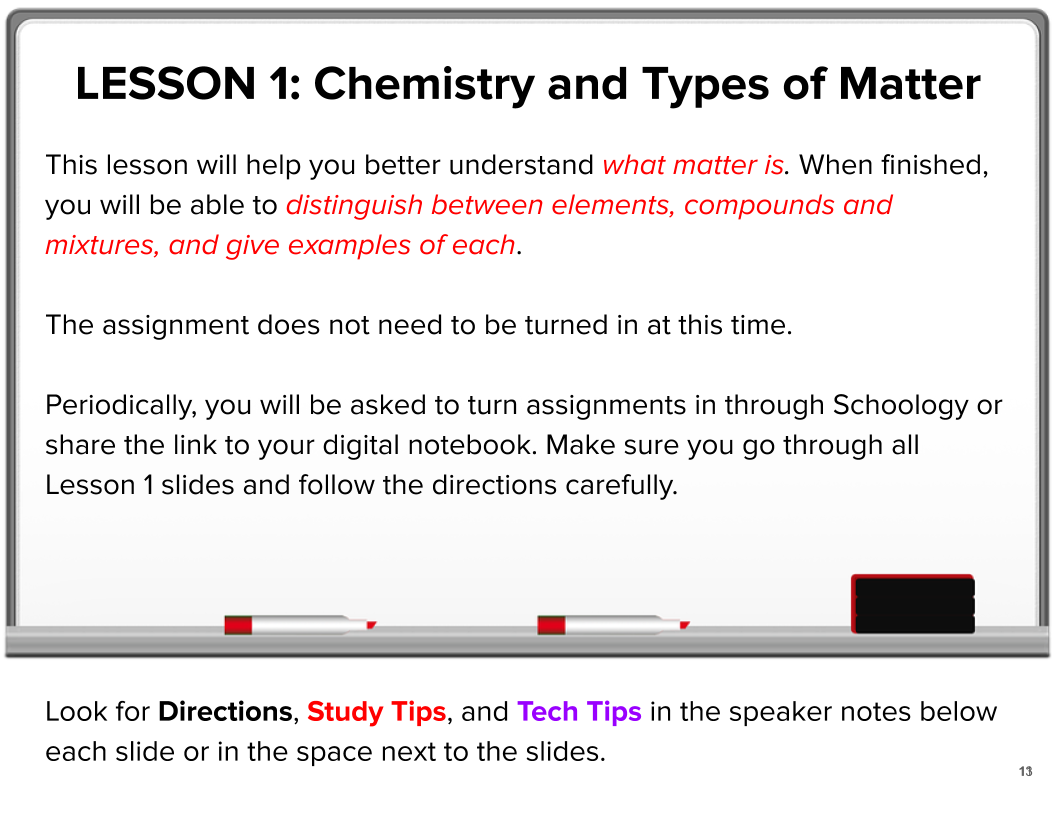
The first lesson slide includes:

  1. Lesson Title and Objectives

  2. Whether anything will be graded

  3. Other useful information

The second slide contains a Warm Up Activity designed to engage students in thinking about what chemistry is, how it’s used etc. The directions are given to the left to leave the slide available for student use. After clicking on the link, the students are taken to the slide below. It has sticky notes they can use.

The “What is Chemistry? - Brainstorm it!” is an interactive activity designed for small groups or the whole class. The slide serves as a digital board students “stick” their answers to. They type their answers on a few stickies and drag each onto the slide. Click HERE to grab this slide to modify and use in your class.

Instead of being given the information by the teacher, the students are prompted to find it in the textbook or online. They replace the text on the slide with the information they find following directions given to the left.

Here, students dig deeper into the 3 categories (types of matter) from the slide above. The speaker notes section is used to provide a tech tip on how to insert pictures. This activity works well in comparing/contrasting three different concepts from the same category.

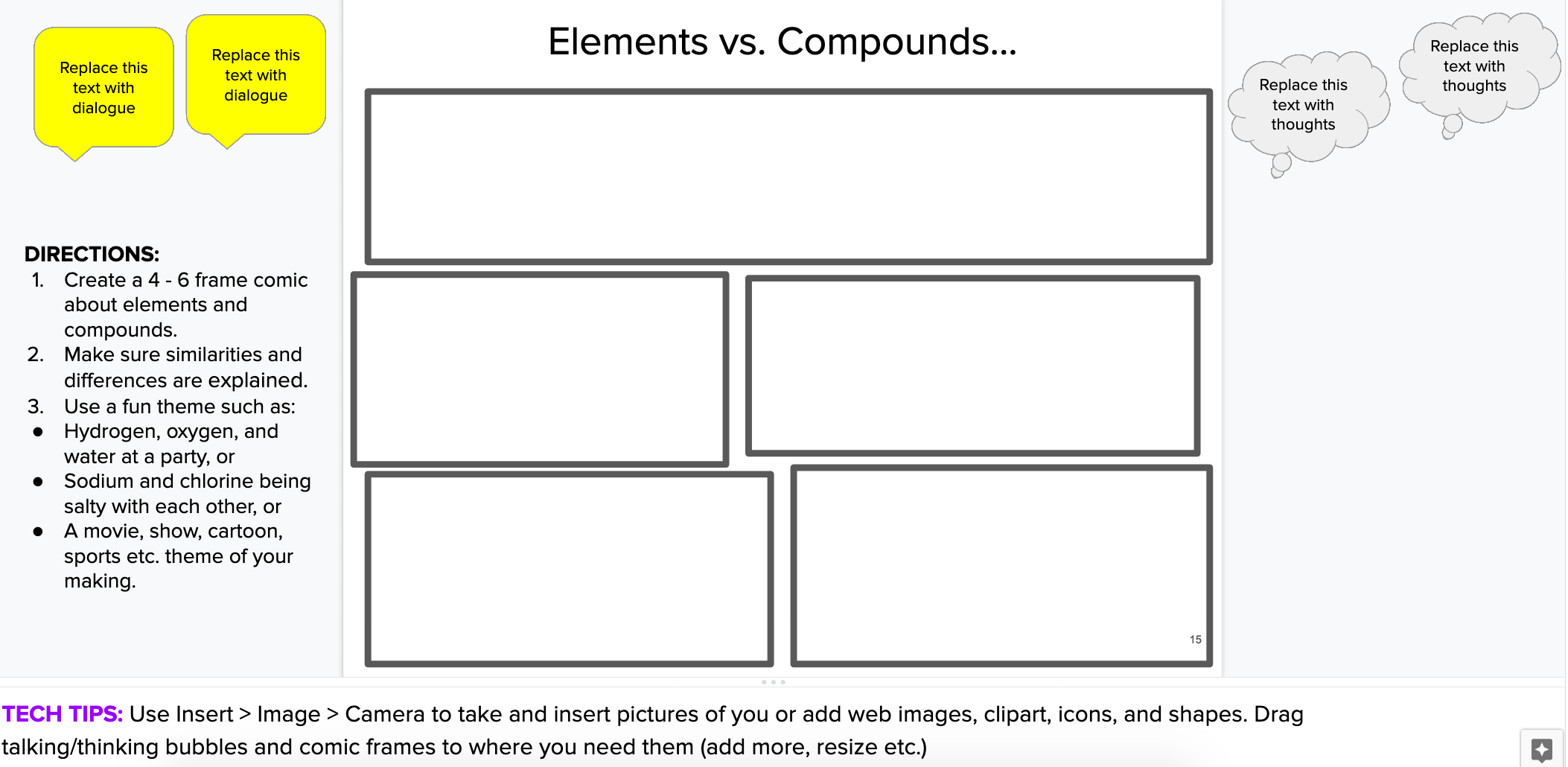
The comic activity stimulates deeper thinking about newly learned concepts as students are asked to apply information in a novel way. They are not just restating the facts but creating a story that uses these facts. Click HERE to grab a copy you can modify and use.

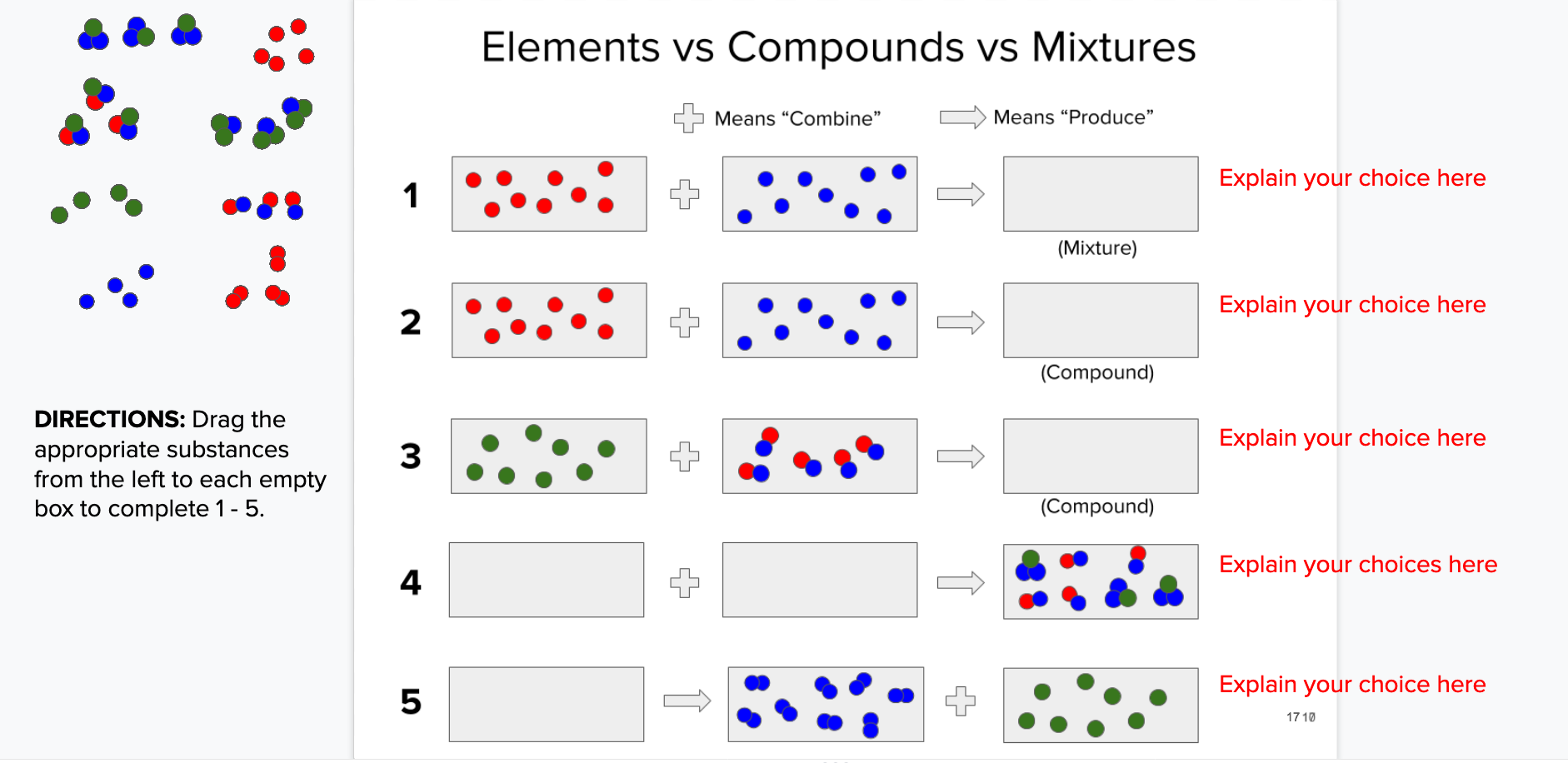
This is a simple and quick sorting activity for student self-assessment or one the teacher can use as formative assessment. Students drag the arrows to identify which category each image represents.

This, more challenging practice activity is designed to have students process and apply newly-acquired information in a new way. First, students drag the objects from the left to complete each problem. Then, they are asked to provide a rationale for their answers.

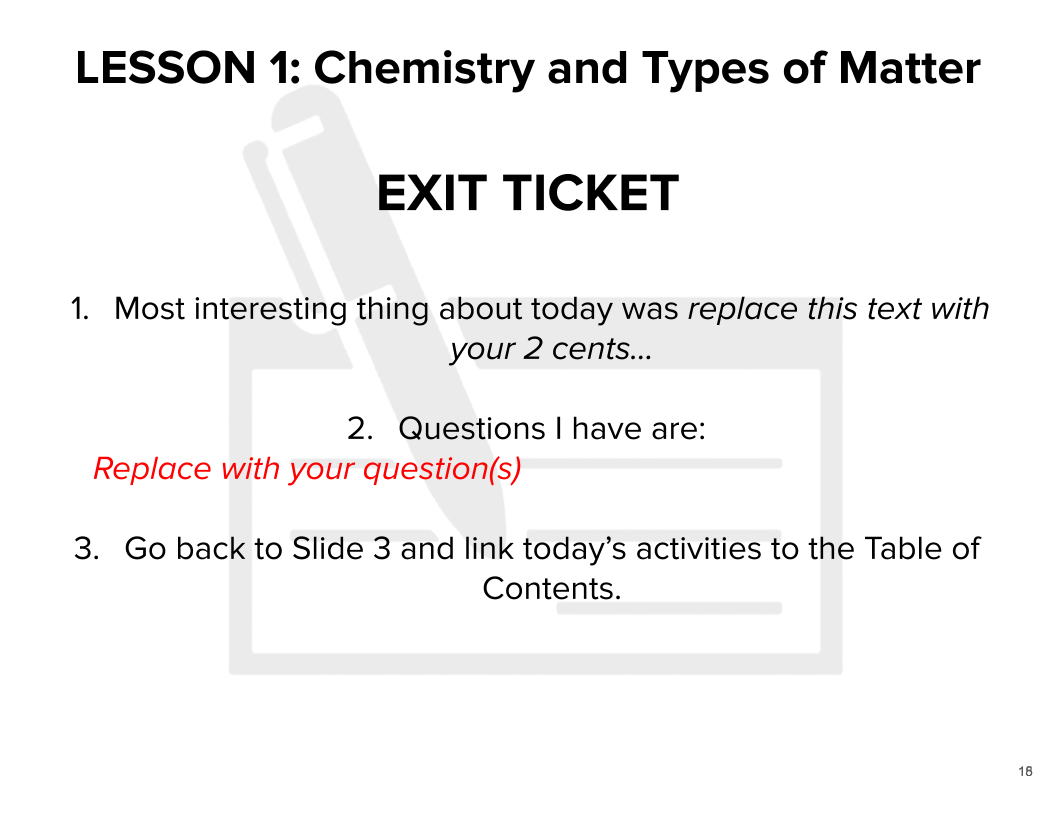
An exit ticket is a tried and true lesson review strategy. In this one, students do a little bit of retrieval practice by identifying what they found most interesting and identifying concepts they need explained further or clarified more.

Making the Learning Last Long Past the Test

By creating introductory lessons students can actively participate in, teachers can lay a foundation for further deeper learning. However, it’s important to note that students must keep practicing by applying the information several times after the initial lesson and it is up to the teacher to make time for classroom-based, not just by-yourself-at-home enrichment activities. Doing so and seeing the results can help teachers become more mindful about achieving deeper learning and less worried about “covering everything,” because the time spent on practice toward achieving mastery is time well-spent.

It’s always more advantageous to focus on learning a few topics/skills really well than to skim only the surface of or cognitively-overload with many concepts. The former way helps the knowledge and skills last, while the latter becomes yet another part of student’s forgotten academic past shortly after the unit test is crammed for and passed.

Key Points

  1. While attention span studies and claims seem unreliable, we can increase student engagement by teaching the way they want to learn and creating effective digital lessons.

  2. To create effective digital lessons, the goal of the teacher should be creating lesson activities that allow students to interact with the class material and/or each other.

  3. Digital media are misused when used solely to “give students the material.” Interactive digital lessons allow students to construct their own understanding.

  4. Providing multiple opportunities for students to process information and practice skills in class improves memory and understanding of concepts.


Sources:

Bradbury, N. A. (2016) Attention span during lectures: 8 seconds, 10 minutes, or more? Advances in Physiology Education, 40:4(509-513).

Mukhtar, K., Javed, K., Arooj, M., & Sethi, A. (2020). Advantages, Limitations and Recommendations for online learning during COVID-19 pandemic era. Pakistan Journal of Medical Sciences, 36(COVID19-S4).

Rick L. Shearer, Tugce Aldemir, Jana Hitchcock, Jessie Resig, Jessica Driver & Megan Kohler (2020) What Students Want: A Vision of a Future Online Learning Experience Grounded in Distance Education Theory, American Journal of Distance Education, 34:1, 36-52.

Time Article: You Now Have a Shorter Attention Span Than a Goldfish (May 14, 2015).


If you enjoyed this post or found it helpful consider signing up for my newsletter below.

oc pro.png

Hi! I'm Oskar.

I teach, write, and create to make teaching easier and learning simpler.

BOOKS
The Most Important Quality of an Online Teacher

how to be a better online teacher

I recently came across Excellent Online Teaching: Effective Strategies For A Successful Semester Online - a short book written by Aaron Johnson that inspired me to write this post and improve my online teaching.

To be honest I was not looking for help with online teaching. I thought I was doing well. I still think I am but after reading the book I see that my limited experience with online teaching has led to me overlooking some things and not emphasizing other important aspects of online instruction. I realized there’s no getting around the fact that while I’ve been doing blended learning for about 4 years now I’m still pretty fresh to this distance learning thing.

The author of the book has been doing it for fifteen years. First as an online high school teacher and now as the technical advisor and faculty developer at the Denver Seminary helping instructors create better online classes and become better online teachers. I suppose this is a pretty vague job description…

What appealed to me in Excellent Online Teaching was the apparent lack of flashy digital activity how tos. Instead of calls and rationales for the use of cutting edge edtech, Johnson focuses on building structures that lead to successful online experiences for teachers and their students.

He starts his book with the recognition that with the transition to online instruction teachers lose the framework they are used to and are now tasked with building a new one. The most important parts of this new framework are connection, communication, demonstrating compassion (or empathy), and developing the discipline of prompt feedback. Moreover, the author claims that developing a routine that allows one to consistently perform all parts of this online teaching framework is what separates excellent online teachers from the “just okay” ones.

And so, this essay is an honest examination of my online teaching so far - the successes, the shortcomings, and the work I must still do to get better at it. I hope you find some of my insights helpful in walking your own online teaching journey.

Compassion or Empathy?

I really believe the author said “compassion” but was going for “empathy” on this one. In the book, he admits to developing a very negative perception of his students because he failed to try to understand who they were and where they were coming from. He expected them to fit into his schedule and understand and adapt his procedures right away. He also failed to accept that students will reach out with (often the same and previously answered) questions for a variety of reasons and at various times throughout the day.

Class Lists

Over time Johnson discovered that printing out class lists with student pictures and contact information was a great first step to getting to know his students. Doing so might seem unnecessary at first glance as the rosters are always available in the learning management system the school uses. However, having well-organized hard copies of his or her classes gives the teacher quick access to phone numbers and emails making communication more likely. It allows the teacher to quickly send “checking-in” emails that show students the instructor cares and help make the relationships more personal.

Check-in Emails

In his book, Johnson gives the template below and encourages teachers to copy/paste it and send to all of their students as often as their busy schedules will allow. Just don’t be that guy/gal who forgets to change the name :o) - (he also encourages the use of emoticons such as this one).

Brian, I just wanted to check in with you and see how your semester is going. I’d also like to know if there is anything I can do to make your learning experience a better one. Glad to have you in class this semester.

I must admit that I have not printed my rosters (I will pronto) and did not think about regular check in emails. I realize they are time-consuming but well worth it because they build solid relationships with students which will undoubtedly make them feel welcome and motivate them to learn. Another benefit of keeping hard copies of class lists is the ease with which the instructor can make a note regarding a student’s needs, modifications, or life situation right next to his name and face.

Walking In Their Shoes

Another strategy that helps an online instructor build empathy for her students is to put herself in their shoes by clicking through all the links for each week and estimating the amount of time and mental effort someone who has no online learning experience and zero knowledge of the class content might put into not just completing, but also navigating the online environments she set up for them and understanding the topics and skills they are asked to master. Then, after she multiplies the above times the number of classes the student is taking and adds the feeling of uncertainty associated with the novelty of it all she begins to feel how overwhelmed and anxious they may be. All kids are different but undoubtedly some are plain freaking out.

Focusing On What’s Most Important

As a result of feedback on how overwhelming distance learning has been for many students I decided to stick to only one daily activity or assignment. I focus on one major topic per lesson (it might include a few subtopics), starting with a front-loading activity on day one that has formative feedback built in. The next day, students complete a relatively small (30 minutes or less) summative assignment that serves as the follow up to the learning activity. Some weeks contain two back-to-back formative activities while others might involve completing a three- to five-day graded project but, in general, I try to have 2 graded activities per week.

Here’s what my students will see during the week of May 11th (minus the arrows and descriptions I added for my readers):

Example Online Week in My Chemistry Class

Example Online Week in My Chemistry Class

It is important to note that for the learning (front-loading and formative) activities I choose online applications that are interactive - they allow me to create structures that promote processing of the content and make giving immediate feedback easy. Maximizing each activity in this way becomes important when one considers the amount of content we will never get to. And I just can’t let go of this belief that maybe focusing on fewer topics and investing time into diving deeper will lead to higher quality learning.

What’s Going On?

Excellent Online Teaching woke me up to the fact that no matter how clear my directions seem to me and how easy my structures appear, they will be confusing to some students and provoke anxiety in others. Johnson advises online teachers to assume our students “start each week lost, treading in a sea of links and documents” and it’s our job to “throw them a lifeline and get them oriented.” He suggests building a habit of sending out a weekly email to students every Monday morning to keep them afloat.

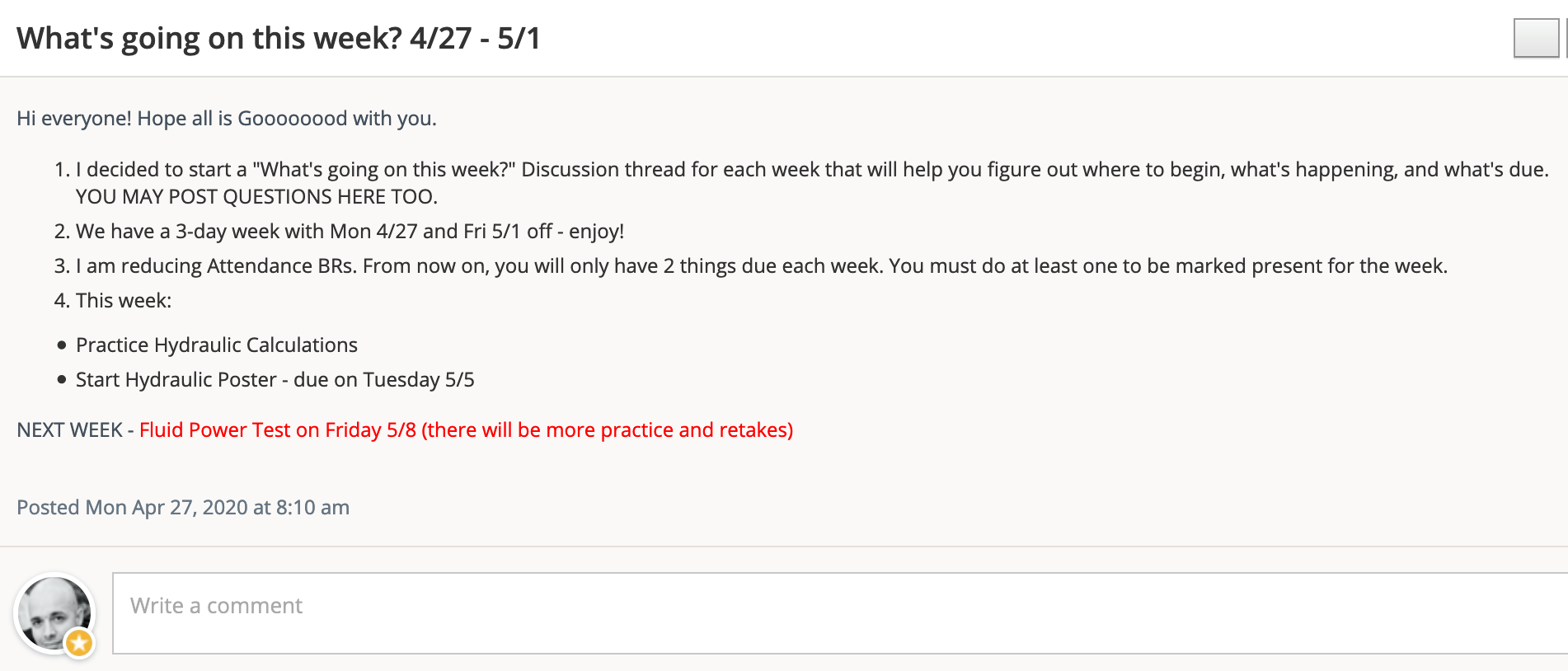
Following the author’s suggestion of getting students oriented each week but knowing that many high schoolers don’t check email regularly I added a “What’s Going On This Week?” discussion thread to the beginning of each week in my learning management system.

Treading the Sea of Links and Documents

Treading the Sea of Links and Documents

This is what my students will see in Schoology next week when they log into Chemistry. Being the one who set it up I could easily dismiss the image to the left as “easy to follow,” but considering the fact that every teacher does it differently I can imagine students have a lot of deciphering of what’s going on to do. I can help, it takes little effort and time, and pays off big.

Check out my first “What’s Going On This Week” discussion thread in principles of engineering.

What's Going On This Week Discussion Thread

What's Going On This Week Discussion Thread

The nice thing about a discussion is that students can ask and read each other’s questions as well as the answers I post. It’s likely students will ask questions that have already been answered in the thread. It’ll be important for me to not get annoyed or condescend but rather show empathy and answer with patience and compassion. After all, I do not know what other responsibilities and stresses they are dealing with at home and how much time they have to read every single thread post. All that matters is that they get their concerns addressed and that they are doing well.

Key Points

  1. Being a better online teacher is not about the tech you use. Tools are important but people always come first.

  2. Don’t just be empathetic. Demonstrate empathy by putting yourself in your students’ shoes every day and creating structures that help alleviate confusion and anxiety.

  3. Print out class lists for easier communication.

  4. Build a habit of writing regular quick check-in emails.

  5. The start is the hardest part. Get your students going with a weekly “What’s Going On This Week?” communication (discussion, email, message etc.)

Resources

Excellent Online Teaching: Effective Strategies For A Successful Semester Online by Aaron Johnson


If you enjoyed this post or found it helpful consider signing up for my newsletter below.

Hi! I'm Oskar. I teach, write, and create to make teaching easier and learning simpler.

oc pro.png

BOOKS

2026 Crush School