CRUSH SCHOOL

I blog on Brain-Based Learning, Metacognition, EdTech, and Social-Emotional Learning. I am the author of the Crush School Series of Books, which help students understand how their brains process information and learn. I also wrote The Power of Three: How to Simplify Your Life to Amplify Your Personal and Professional Success, but be warned that it's meant for adults who want to thrive and are comfortable with four letter words.

Filtering by Category: Teaching

AI for Teachers: Step into the Past; Converse with Marie Curie, then Malcolm X

Using Artificial Intelligence in the Classroom. AI for learning about famous individuals and historical figures.

Or Napoleon Bonaparte if you wish. Dude just told me he was often too busy with military campaigns and dreams of domination to eat fancy meals, so chicken with potatoes was his go to.

Boring, I know.

Still, it is not every day you get to chat it up with the French emperor who lived some two hundred years ago.

Okay, okay - I admit - I am full of it. The dream of conversing with historical figures may remain confined to the realm of fiction or witchcraft, but the wonders of technology have brought us a step closer to this trippy idea. Thanks to Artificial Intelligence, we get to pick Marie Curie’s radioactive brain and Malcolm X’s explosive mind. Thanks to AI, we can now simulate conversations with historical figures and engage in dialogues that transcend time.

Let’s explore how to create such captivating experiences for our students using ChatGPT.

Choose Your Historical Figure

Deciding which historical figure you'd like your students to converse with depends on your subject matter, the era you are studying, and what you want your students to get out of such activity. Do you want them to get a feel for what life was like back then or look at the achievements of a certain individual? Do you want your students to learn some facts from a ground-breaking scientist or understand the motivations an important politician had for taking the path they took to push progress? The Internet database is the limit.

Gather Data or Just Get into it

To make your AI conversation as authentic as possible, you might ask your students to gather historical data about the chosen figure. This may include looking at their writings, speeches, biographies, and other relevant materials. Going at it this way, allows you to help your pupils to act as media reporters and build background knowledge on the individual they are about to simulate an interaction with to ask more thoughtful questions.

But don’t worry. AI is not easily offended and does not judge. Yet. This means you can opt to let your students just dive straight in and ask any smart or dumbass question they can conjure up.

Scaffold the Questions

To spark a meaningful dialogue with the AI DaVincis, Curies, and Crazy Horses, ignore that last sentence and give your students guidelines specifying what it is they need to learn from their famous interviewees. Specify what you want them to learn or what insights you hope they gain from these conversations. This way, they can focus on asking relevant questions and not get too involved in the love lives of AIs. Hint: They got none, ‘cause no game means no play.

Engage in the Conversation

Tell your students to “send a message” in chatGPT that says something like: Pretend to be Malcolm X and I will ask you interview questions and the AI will happily (-ish) oblige. And in case you’re wondering - yes, chatGPT will act in line with the character and expertise of the individual it’s faking basing it all off of the information available online up to year 2021.

Allow Students to Explore and Learn

As the conversation unfolds, students will have the opportunity to explore the historical figure's thoughts and perspectives. They can delve into their achievements, personal experiences, and the challenges they faced in their time.

Reflect and Share

After the simulated conversations, ask students to reflect on what they've discovered and learned. Have them share their experiences with other students. The AI-generated conversations can serve as educational tools, sparking interest in science, history, and other subjects, as well as the lives of remarkable individuals.

Ethical Considerations

Be clear in communicating to your students that they are using AI to generate the conversations and acknowledge the limitations of AI when it comes to capturing the complexity of the human mind.

So What?

AI can unlock the virtual doors to the minds of historical figures, helping students gain insights and knowledge that bridge the gap between centuries. As technology advances, the opportunity to converse with the past becomes increasingly accessible, opening new horizons for exploration and education. And, it’s kind of fun. Try it and you’ll see. Then, let your students try.


If you found this post helpful, sign up for my Teaching Tips, Resources, & Ideas Newsletter to get the next article when it drops. It’s totally free.

BOOKS & TOOLS

Mistakes Are... Poster
$3.00

In this classroom Mistakes are Expected, Respected, Inspected, Corrected!

Learned helplessness is a result of years of conditioning that mistakes are bad for learning. Nothing is further from the truth - some of the most powerful life lessons come from making mistakes, reflecting on them, and growing as a result.

This is a PNG Poster you can print and display in your classroom to encourage a culture of risk-taking and learning from mistakes.

Equity: Bundle of 3 Posters - SAVE 25%
$4.00

3 Equity Promoting Posters.

(1) Equity (11 x17):

  • Everyone has a different start and finish line

  • Quality is more important that quantity

  • Understanding that diversity makes us stronger

  • Inclusion despite beliefs, appearances, and circumstances

  • Thoughtfulness lowers barriers and reduces biases

  • Yesterday's mistakes are today's learning agenda

(2) Equality vs Equity (11 x 17 side-by-side comparison)

(3) Equality vs Equity (11 x 17 the difference Quote)

Every poster contains accompanying images.
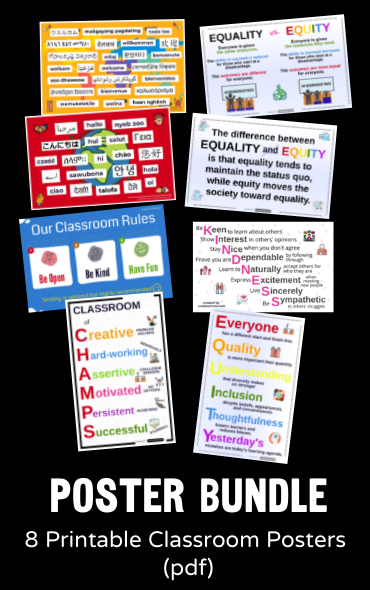
8 Classroom Posters
Sale Price: $5.00 Original Price: $8.00

8 digital, printable, size 11 x 17 classroom posters:

  1. “Welcome” in multiple languages

  2. “Hi” in multiple languages

  3. Three Equity posters

  4. Classroom Rules: Be Open, Be Kind, Have Fun

  5. “Classroom of Champs”

  6. “Kindness”

ON SALE until August 30th.
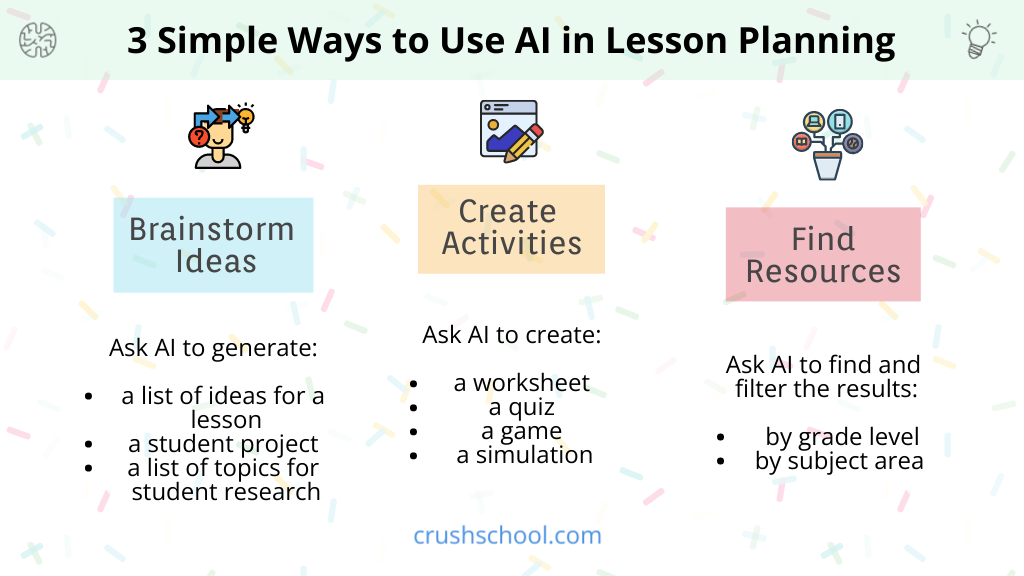
AI for Teachers: 3 Simple Ways to Use Artificial Intelligence in Lesson Planning

The Artificial Intelligence driven transformation of education can be scary if we consider the possibility of us teachers being replaced by machines. It’s one thing watching RoboCop patrol the hood and keep crime in check, but it’s quite another to envision a RoboTeacher leading a class of young humans in their quest for self-betterment, or better yet, self-preservation.

My mama always said “you have to know the language of your enemy” whenever I’d complain about being forced to study Russian in elementary school. I still don’t know Russian, at least not well enough to put Putin in his place, but I think the lesson my mother was trying to convey was that I’d be better prepared to survive and thrive in an uncertain world if I learn and adapt to the conditions this ever-changing world presents.

And while I don’t believe a thinking computer system will replace me anytime soon, the fact that AI is rapidly transforming many industries, education included, gives me a pause and I can’t help but reflect on how I and others who ply the teaching trade might learn and adapt not just to it, but it, in the pursuit of education for all.

And so my journey of leveraging AI to enhance my teaching and my students’ learning has begun. As I learn, I adopt, and I share. Below are a few things I’ve discovered thus far.

Getting Started with AI-Aided Lesson Planning

Start small. Identify your specific needs. What are your biggest challenges with lesson planning? What could AI help you with?

Next, experiment with different AI tools. There are a variety of AI tools available, each with its own strengths and weaknesses. I recommend experimenting with Google’s Bard and OpenAI’s ChatGPT. Just type in a prompt and see what the chatbot does. Ask for a lesson plan on Amelia Earhart. Then, make the prompt more specific. Then, specify some more, ask for examples, and see what happens.

Don't rely on AI entirely. AI can be a valuable tool, but it is important to remember that it is not a replacement for teacher judgment. Use AI to generate ideas and suggestions, but use your own expertise to create and implement lesson plans that are best suited for your students.

Easier and Enhanced Lesson Planning

AI-powered tools can save teachers time by creating engaging, differentiated lessons in seconds. Here are some specific examples of how AI can be used to enhance lesson planning:

  1. Brainstorming ideas: AI can help teachers come up with new and innovative ideas for their lessons. Ask Bard or ChatGPT to generate a list of ideas for a lesson or a student project or a list of topics for student research. AI can also help refine and develop these ideas based on additional prompts you put in.

  2. Finding resources: AI can help teachers find high-quality resources for their lessons. Search the web for resources on a specific topic, and ask the AI to filter the results to find resources that are appropriate for your grade level and subject area. The trick is to include this information in the prompt.

  3. Creating activities: AI can help teachers create interactive activities for their lessons. Ask the AI to create a worksheet, a quiz, a game, or a simulation and see what happens. Even if the product is a little rough around the edges, it will give you something you can use after a little polishing.

So What?

Artificial Intelligence can save teachers hours of time by automating the process of creating lesson plans. AI can take into account the teacher's subject area, grade level, and learning objectives to generate comprehensive and engaging lesson plans. As AI continues to develop, so will more innovative ways to use it to enhance lesson planning.


If you found this post helpful, sign up for my Teaching Tips, Resources, & Ideas Newsletter to get the next article when it drops. It’s totally free.

BOOKS & TOOLS

Mistakes Are... Poster
$3.00

In this classroom Mistakes are Expected, Respected, Inspected, Corrected!

Learned helplessness is a result of years of conditioning that mistakes are bad for learning. Nothing is further from the truth - some of the most powerful life lessons come from making mistakes, reflecting on them, and growing as a result.

This is a PNG Poster you can print and display in your classroom to encourage a culture of risk-taking and learning from mistakes.

Equity: Bundle of 3 Posters - SAVE 25%
$4.00

3 Equity Promoting Posters.

(1) Equity (11 x17):

  • Everyone has a different start and finish line

  • Quality is more important that quantity

  • Understanding that diversity makes us stronger

  • Inclusion despite beliefs, appearances, and circumstances

  • Thoughtfulness lowers barriers and reduces biases

  • Yesterday's mistakes are today's learning agenda

(2) Equality vs Equity (11 x 17 side-by-side comparison)

(3) Equality vs Equity (11 x 17 the difference Quote)

Every poster contains accompanying images.

8 Classroom Posters
Sale Price: $5.00 Original Price: $8.00

8 digital, printable, size 11 x 17 classroom posters:

  1. “Welcome” in multiple languages

  2. “Hi” in multiple languages

  3. Three Equity posters

  4. Classroom Rules: Be Open, Be Kind, Have Fun

  5. “Classroom of Champs”

  6. “Kindness”

ON SALE until August 30th.

Hollowed Be Thy... Equity?

My music interests shifted drastically in seventh grade. One minute I’m listening to Cheri Cheri Lady by Modern Talking and the next it’s Metallica’s Master of Puppets. I was even quizzed by a bigger eighth-grader on the names of all the band members when I wore a Metallica T-shirt to school. I passed, thus avoiding an ass-kicking, but I remember the long-haired kid I wanted to be like correcting me on the first name of the bass player (Jason, not John as I thought).

Fear of the Dark by Iron Maiden was the first music album I ever bought. It was the summer of 1992 and I just finished eighth grade. I remember it well because I was about to leave my childhood friends and country of birth forever and no audio cassette has ever sounded better.

I grew up Catholic, which meant being sent to church every Sunday while my parents stayed home. My younger brother and I stood in the small wooded area outside of the church gates, part by choice, and part because the church was too small. I didn’t care for church but I went, because this is what the rest of the Polish tribe did.

Poland of my youth presented as a picture of homogeneity - everyone was white and Catholic, except for one Jehovah’s Witness family that lived in the communist-style apartment buildings for the masses all of us were sardined into. Parents told my friends and I these folks were not to be trusted. No one knew much about them, but everyone believed they were the wrong kind of people and needed to be excluded by default.

The aforementioned homogeneity was broken by the music subcultures present in the 80s and 90s - the poppers, the punk rockers, the metal-heads, and the skinheads. The pop listeners were made fun of. The punks and the metals got along, but we hated the skinheads. I don’t know if they were Neo-nazis but I was supposed to hate them, because they shaved their heads and hated us, or so we thought.

I was also taught to hate the Germans because of fascism and World War II, spit on everything Russian because of communism and the iron curtain, and ridicule the Jews because they were the sneaky, somehow better-off-than-us Jews. I laughed at and repeated the popular-at-the-time Jew jokes despite the fact my paternal grandfather and my last name are both Jewish. Being accused of being Jewish was horror, so I hid this part of my heritage.

And then eighth grade ended and I came to America to my mother and a racist stepfather. He said Black people were criminals, Mexicans cockroaches, and gays the devil. I believed him. I believed he had the right to use racial and other derogatory slurs because he was right. That summer, I used the Polish version of the n-word in a letter to my best friend I left behind in Poland thinking I was being cool and American and better.

It’s hard to admit, because I’m ashamed, but I believe my journey to understanding, though unfinished, is not unlike many others’ journeys. Many of us grew up in homes where discrimination figured prominently on the conversation menu. Wokeness did not exist as a word then and certainly wasn’t practiced around us. I did not grow up in a thoughtful, progressive, and accepting home. Instead, first in Poland and then in the USA, I was fed unfounded hate at a high rate.

But it did not become my fate.

The one single defining moment that changed me… didn’t happen. But I remember moments throughout my high school years that helped shape me through the messages they carried; some with obvious, many with unconscious, only to be understood later meanings.

In many ways, high school was a blur, but I do recall many small, happy, life defining moments, like this African American kid giving the horns up to my Megadeth: Countdown to Extinction T-shirt. He said Rust In Peace is better and I beg to differ, but all metal fans unite; four-minute passing times be damned.

I remember Nick, a Black kid I sat next to in French, who said my eyebrows go straight across. I have a subtle unibrow, unlike the Brow, but I just had to laugh. Nick was funny and we had many conversations and laughs in that class. The dopamine hits were enough to make up for the fact I speak less than a little French today.

Another time, I was blown away by this long-haired Mexican kid’s geography class presentation about his indigenous heritage. It’s the only presentation I remember; I was so in awe of what he said and the Aztec artifacts he brought to class. I even bought a leather bracelet with Quetzalcoatl artwork on it while in Mexico a few years later, because it was so “heavy metal.”

Nearly every day, I played basketball at Archer Park with Tino, Nino, and other Filipinos. Tino was short and funny. Nino about my height and wore his hat turned backwards. Both talked smack and backed it up with their play.

One time, the cops rolled up onto the court and searched all of us. I had a joint hidden in between the cigarettes and gave the pack to the frisking Five-O to check, but he didn’t bother. I was white, just associating with the wrong kind I guess. I didn’t understand it then, but know now how white privilege saved my ass. Tino and Nino were clean, so we went back to playing like nothing happened, but what happened felt wrong. That was my introduction to racial profiling.

And then there’s the senior year AP European History class… Eduardo, a preppy-looking Mexican kid with an accent as thick as mine was the hardest worker. He was kind and always said hi in the hallway. Jamila, a Muslim girl, who told me that her female cousins often hit her at their family gatherings for not wearing the hijab, was one of the kindest people I have ever met. Vanessa, the Jew with red paint in her hair was possibly the coolest high schooler I knew and not a nerd at all (and I might have had a crush on her). And then there was Arasally, the self-proclaimed Polo-Rican - Polish dad and Puerto Rican mom if I recall this right - who was just a walking party during the day; not sure about night. I loved that class and appreciated my classmates. I miss listening to their stories and the emotion they brought to my world. I miss them now and wonder where they’re at.

Enough can’t be said about the positive people I had all around me then and the messages I received that reinforced the fact that the diversity I was taught to hate at home is precisely what makes the world better, fun, and worth wandering.

The messages I received were enough to set me on a different path. Luck struck and I ended up in a Chicago public school where BIPOC students outnumbered their white peers and I could learn about and from them. High school changed my one dimensional, Polish worldview. It changed me.

It pains me to say this, but my country of birth is as it was back then, just more undercover on the European Union stage. It seems like every time I look at news from Poland, I see continued hatred of the LGBTQ+ community, prevalent unacceptance of people of different skin color and religion, and continued war on women’s rights.

The Philando Castile, George Floyd, Daunte Wright, and other killings show my adopted country still has a long way to go. And while we can rage against the machine that perpetuates discrimination all we want, I think we need to do more. We have to take the power back, and the best way to do that is by helping our students understand what white privilege is, the difference between equality and equity, and why standing up for and creating more equitable conditions for individuals and communities that start out at a disadvantage is advantageous for the society as a whole, not just at the local, but also at the global level.

While there are still government officials in multiple states and on the big hill who pretend they don’t get it or are blatant threats to democracy and human rights, the change must start with we the people. We elect these stooges after all.

And let’s be real - most adults will not change. Research shows the brain’s ability to change in response to experiences is highest when we’re young. In fact, it is in our mid- to late- twenties when the amount of cognitive, emotional, and social effort required to fundamentally change our way of thinking outweighs our capacity to change, and we tend to hold onto our beliefs, no matter how many counterarguments to the contrary we face or how much logic that shows how illogical our ways are we encounter.

Children, on the other hand, are constantly challenged by their environment to “revise” their theories. When they acquire new information in the classroom or on the playground, their limited, home-learned views can change radically. The less a child knows, the fewer biases he has, and the more likely he is to be open to ideas that contradict his early understanding of a concept. In addition, the consequences for being “wrong” are less severe for children than they are for adults who are part of the same community.

While now more familiar than Poland - I’ve lived in the US for more than a quarter century after all - it’s still strange in many ways. We are a confusing nation full of contradictions. In the land of opportunity, most of those who strive cannot acquire the power the few have. It makes no sense how those few can get away with the despicable things they do to hold onto the power they feel entitled to. It makes no sense that six, or 1.2% of Fortune 500 CEOs are Black, while the 2021 Census shows 13.6 % of US residents are African American. It makes no sense that there are only six pro sports teams majority owners of color, with Michael Jordan as the only Black owner, while most athletes are minorities.

Or maybe it makes all the sense in the world we live in, because change on paper and de facto change are not the same thing. Because, equity is something we aspire to but don’t quite understand.

The messages we expose our kids to matter. This messaging starts at home. Many homes offer hope. Others feed hate. Luckily, at five to six years old, the kids start spending more time at school than at home. They are exposed to new ways of looking at the same concepts in different contexts and environments. They kids are ready to change and the teachers must have the courage to show these students a way that is full of regard and compassion for individuals who may be different, but who are just as valuable.

I don’t have all the answers. But I’m choosing to learn and change.


Did you like this post? Click HERE -> Teaching Tips, Resources, & Ideas Newsletter for more.

Also, I created a few classroom posters on equity. They’re inexpensive and help me pay for this website and an occasional IPA. Check them out here.

Hi! I'm Oskar. I teach, write, and speak to make learning better.

oc pro.png

BOOKS & TOOLS

2026 Crush School