CRUSH SCHOOL

I blog on Brain-Based Learning, Metacognition, EdTech, and Social-Emotional Learning. I am the author of the Crush School Series of Books, which help students understand how their brains process information and learn. I also wrote The Power of Three: How to Simplify Your Life to Amplify Your Personal and Professional Success, but be warned that it's meant for adults who want to thrive and are comfortable with four letter words.

How to Create Effective Interactive Digital Lessons
effective interactive digital lessons
A good teacher offers practice, a bad one offers theories.
— Anthony De Mello

I could just end this post there but I won’t.

Attention Span Studies and Myths and Claims

You might have heard the reason TED Talks are limited to 18 minutes is because neuroscientists suggest that a human adult subjected to such presentations can stay attentive for about that long.

Some studies claim student attentions wane 10-15 minutes into presentations while one academic claims these studies are unreliable due to flawed methodologies and subjective data collection.

Then there’s the Microsoft study that claims our 8-second attention span is shorter than that of a goldfish as this bowl-inhabiting creature can out-attention us by an entire second!

Scientists cannot agree. Marketers measure vanity metrics. Let’s call BS on them and focus on what we, the teachers can do to capture our students’ attentions long enough to educate them. To do this, we need to design lessons they want to participate in because partly dull with a chance of boring just don’t cut it.

How Students Want to Learn

Why should we care about what students want from teachers and how they want to learn?

If you’re in a relationship with someone you care about and they ask you for help and tell you what they want from you, do you just go ahead and disregard them and instead decide what they need and want? I mean, if your partner is reasonable and their requests are not harmful to the world or self-destructive do you listen? Or, do you ignore them and use some patronizing logic to convince them of what’s best for them?

While it’s accurate to say teachers are in a different kind of a relationship with their students, it’s not fair for teachers to assume students are incapable of deciding what they want. In fact, validating reasonable and innocuous student preferences goes a long way in establishing teacher-student relationships in which students feel valued and teachers fulfilled.

Better yet - take the initiative and ask how your students want to learn and they will tell you honestly. Check out this lesson plan I use to get off to a good school year start. In the article, I give away the 14-slide show to go with the lesson that helps me design effective, student-centered lessons and teaches students to use design thinking.

Using the approach above in finding out how students prefer to learn is better suited to a physical classroom setting so teachers must tweak the best face-to-face strategies to fit the COVID-19 models. It’s also important to look into the best hybrid and distance learning practices.

According to this 2019 survey both teachers and students envision a more personalized online learning experience with a high degree of social interaction within the learning community. This 2020 case study recommends faculty training on using online methods and creating interactive lessons that reduce cognitive load. Socially or with learning material - students want to interact.

Effective Interactive Digital Lessons

Taking students to the computer lab so they can type their English essay or read a science article online is not “infusing” or “enhancing” class with technology. Uploading presentations and worksheets into the school’s learning management system (LMS) as primary means of learning is a misuse of resources too, because while lessons become digitized, the learning process remains too passive to be effective and students are left to their own devices to learn the concepts and skills required.

Interactivity is the Key to Creating Effective Digital Lessons

The ultimate goal of any lesson should be to create activities that promote understanding and increase memory of the lesson topics during the lesson, and not leaving those for “later” as homework. This is not to say students will learn and remember everything after “doing” the lesson once. They will not. However, by upping the lesson interactivity, teachers will increase student alertness, escalating their initial understanding and memory of the concepts. The best way to do this is to plan activities that allow real-time processing of concepts and practice of skills.

Effective Interactive Digital Lesson Example

The best digital lessons retain most of the most important parts of effective lesson design - the best practices all teachers should use regardless of how techie or old school the methods they use are.

Starting with lesson design, each digital lesson should include the learning objectives (“I can” statements etc.), an opening activity that promotes review of a previous or engagement in a new topic, front-loading or learning activity which introduces and explains the content to be learned, followed with in-class practice, and concluded with some kind of a summarizing task. All of these need to be supported with clear and concise instructions and transparency in how students will be assessed.

Take a look at the following digital interactive notebook lesson (Google Slides).

Lesson Opening Slide
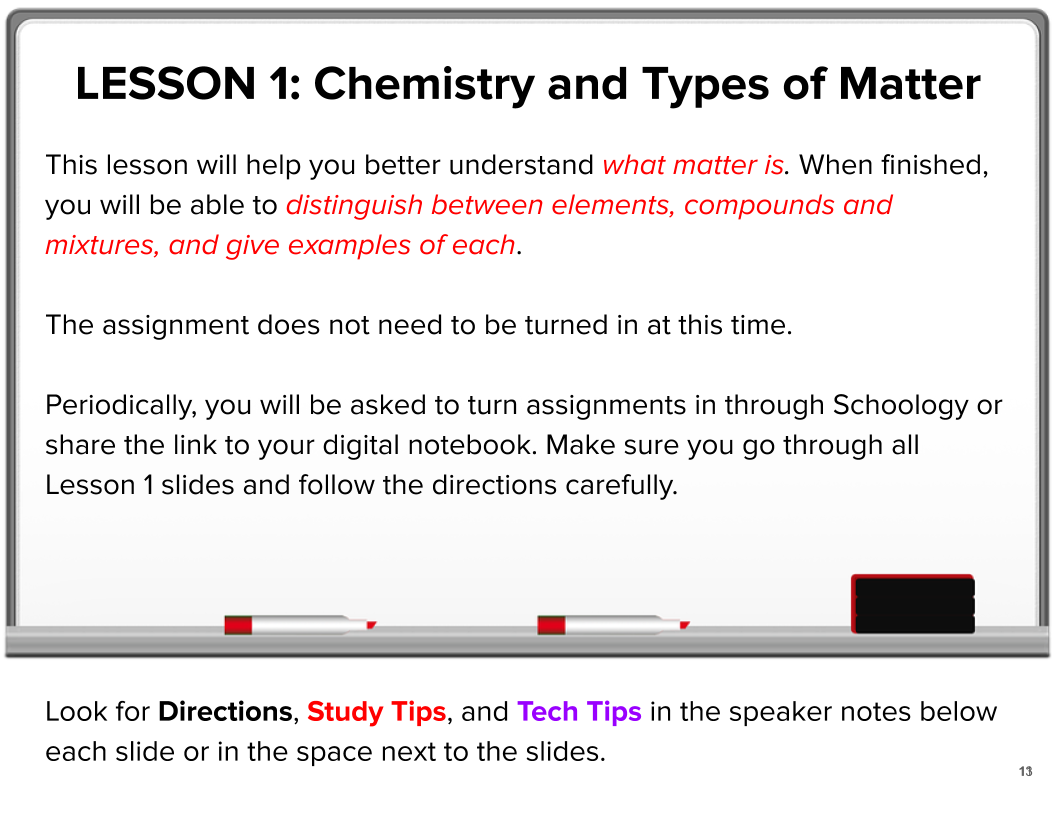
Effective Digital Lesson Objectives

Warm Up Activity

Effective Digital Lesson Warm Up Activity

Shared Digital Board

What is chemistry interactive warm up activity

Front-Loading Activity #1

Effective Digital Lesson Introductory Front-loading activity

Front-Loading Activity #2

Effective Digital Lesson Discovey Activity (front-loading)

Practice Activity #1

Effective Digital Lesson deeper processing activity

Practice Activity #2

Effective Digital Lesson quick practice activity

Practice Activity #3

Effective Digital Lesson challenging practice activity

Quick Summarizing Activity

Effective Digital Lesson Exit Ticket

The first lesson slide includes:

  1. Lesson Title and Objectives

  2. Whether anything will be graded

  3. Other useful information

The second slide contains a Warm Up Activity designed to engage students in thinking about what chemistry is, how it’s used etc. The directions are given to the left to leave the slide available for student use. After clicking on the link, the students are taken to the slide below. It has sticky notes they can use.

The “What is Chemistry? - Brainstorm it!” is an interactive activity designed for small groups or the whole class. The slide serves as a digital board students “stick” their answers to. They type their answers on a few stickies and drag each onto the slide. Click HERE to grab this slide to modify and use in your class.

Instead of being given the information by the teacher, the students are prompted to find it in the textbook or online. They replace the text on the slide with the information they find following directions given to the left.

Here, students dig deeper into the 3 categories (types of matter) from the slide above. The speaker notes section is used to provide a tech tip on how to insert pictures. This activity works well in comparing/contrasting three different concepts from the same category.

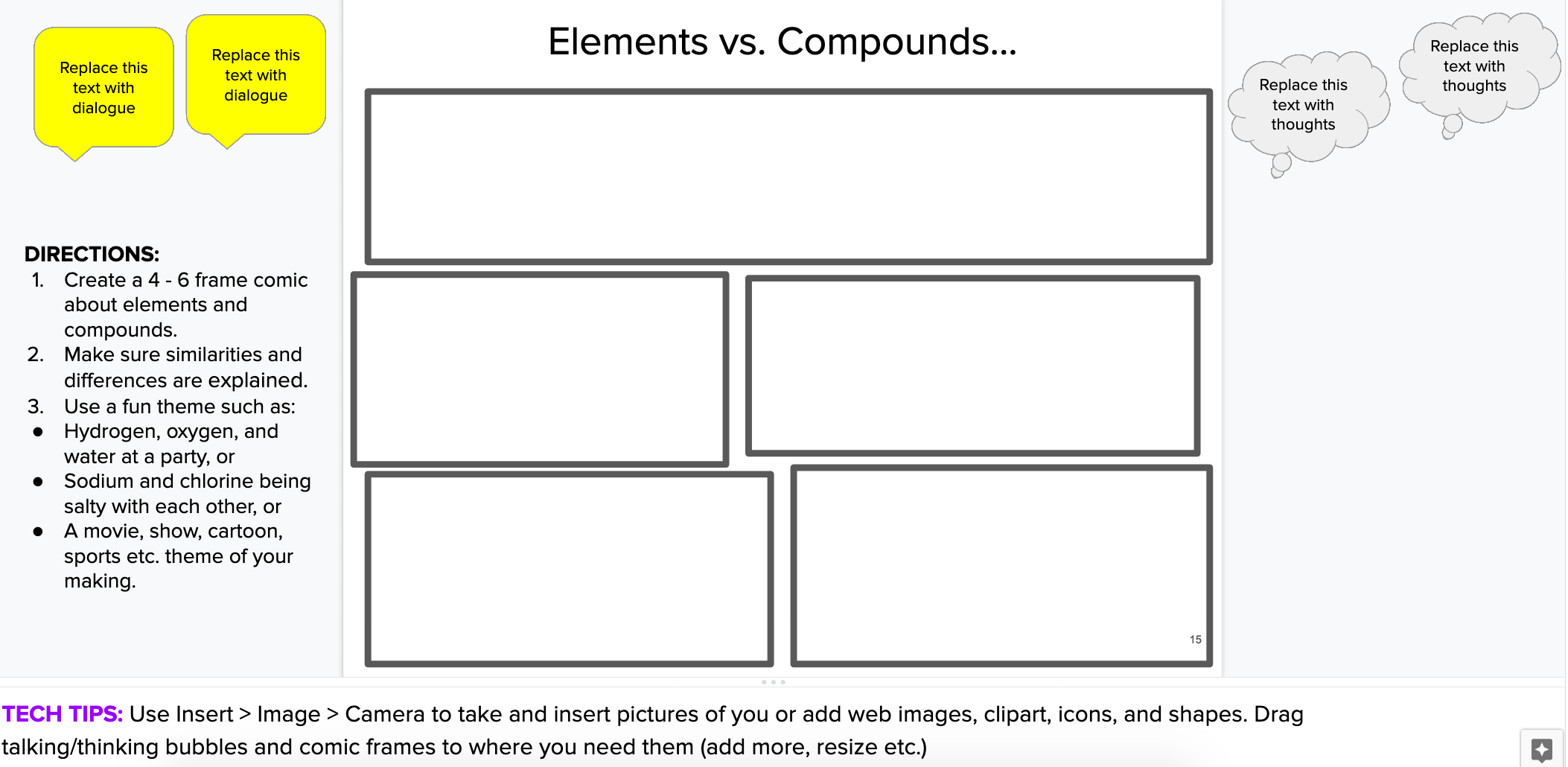
The comic activity stimulates deeper thinking about newly learned concepts as students are asked to apply information in a novel way. They are not just restating the facts but creating a story that uses these facts. Click HERE to grab a copy you can modify and use.

This is a simple and quick sorting activity for student self-assessment or one the teacher can use as formative assessment. Students drag the arrows to identify which category each image represents.

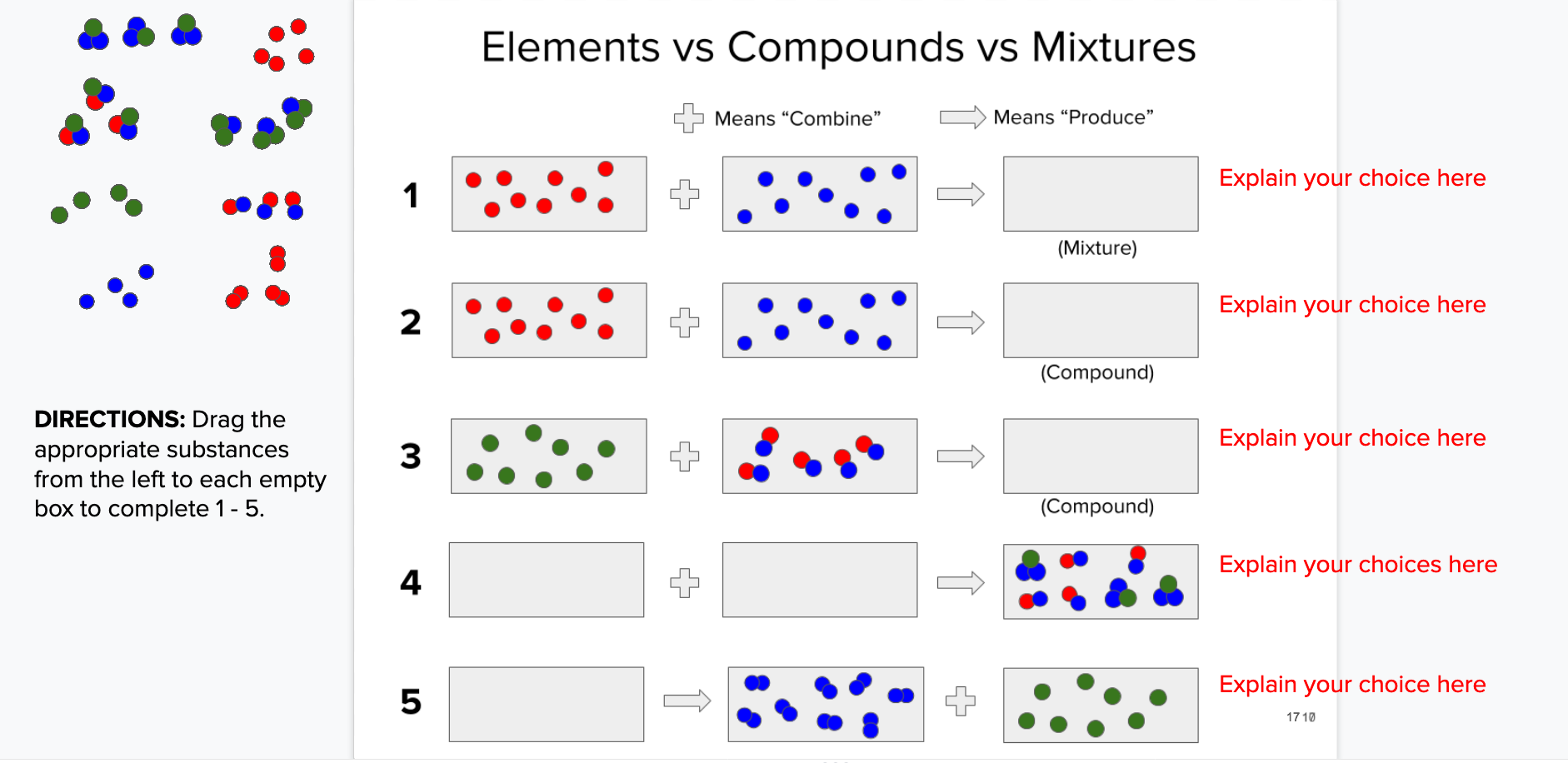
This, more challenging practice activity is designed to have students process and apply newly-acquired information in a new way. First, students drag the objects from the left to complete each problem. Then, they are asked to provide a rationale for their answers.

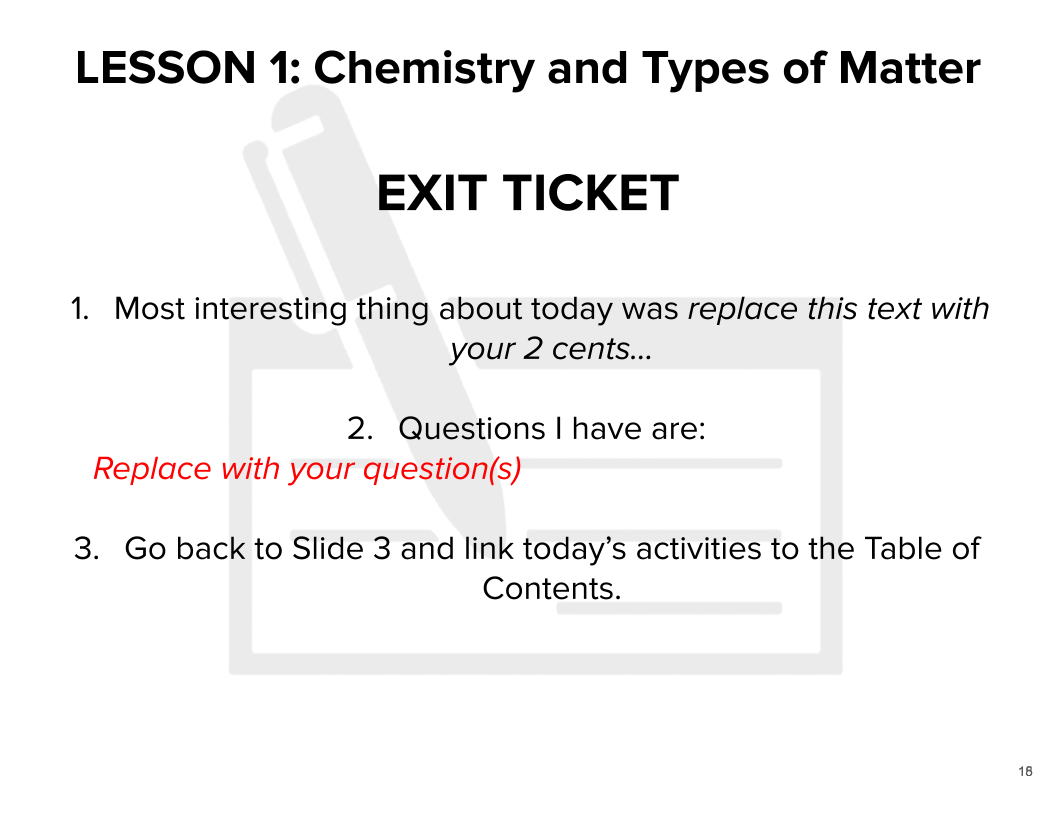
An exit ticket is a tried and true lesson review strategy. In this one, students do a little bit of retrieval practice by identifying what they found most interesting and identifying concepts they need explained further or clarified more.

Making the Learning Last Long Past the Test

By creating introductory lessons students can actively participate in, teachers can lay a foundation for further deeper learning. However, it’s important to note that students must keep practicing by applying the information several times after the initial lesson and it is up to the teacher to make time for classroom-based, not just by-yourself-at-home enrichment activities. Doing so and seeing the results can help teachers become more mindful about achieving deeper learning and less worried about “covering everything,” because the time spent on practice toward achieving mastery is time well-spent.

It’s always more advantageous to focus on learning a few topics/skills really well than to skim only the surface of or cognitively-overload with many concepts. The former way helps the knowledge and skills last, while the latter becomes yet another part of student’s forgotten academic past shortly after the unit test is crammed for and passed.

Key Points

  1. While attention span studies and claims seem unreliable, we can increase student engagement by teaching the way they want to learn and creating effective digital lessons.

  2. To create effective digital lessons, the goal of the teacher should be creating lesson activities that allow students to interact with the class material and/or each other.

  3. Digital media are misused when used solely to “give students the material.” Interactive digital lessons allow students to construct their own understanding.

  4. Providing multiple opportunities for students to process information and practice skills in class improves memory and understanding of concepts.


Sources:

Bradbury, N. A. (2016) Attention span during lectures: 8 seconds, 10 minutes, or more? Advances in Physiology Education, 40:4(509-513).

Mukhtar, K., Javed, K., Arooj, M., & Sethi, A. (2020). Advantages, Limitations and Recommendations for online learning during COVID-19 pandemic era. Pakistan Journal of Medical Sciences, 36(COVID19-S4).

Rick L. Shearer, Tugce Aldemir, Jana Hitchcock, Jessie Resig, Jessica Driver & Megan Kohler (2020) What Students Want: A Vision of a Future Online Learning Experience Grounded in Distance Education Theory, American Journal of Distance Education, 34:1, 36-52.

Time Article: You Now Have a Shorter Attention Span Than a Goldfish (May 14, 2015).


If you enjoyed this post or found it helpful consider signing up for my newsletter below.

Why I Want To Crush School And You Should Too

Kill Teaching and Students Will Crush School

This post contains a few f-bombs. I am human and I do not apologize for it. I am including a bunch of free digital resources teachers can use in an in-person, hybrid, or distance learning classroom at the end of the post so you can just scroll down to find them if cussin’ ain’t your thing.

What is this Crushing School all about?

I recently came across two Twitter posts.

In the first, a brand new teacher from England asked “how unprofessional is it to cry in front of your mentor” about how bad her first lesson went. She must have thought that showing such strong emotions is not okay for a teacher (which by the way shows how much she cared about being a good teacher on her first day).

In the other, much more disturbing post, another new teacher described her experience of being shamed by a more seasoned colleague for doing something wrong and how awful she felt afterward.

The response of other educators on Twitter was overwhelmingly supportive and encouraging in both cases. But I felt disheartened to see the culture of perfectionism and the lack of empathy being still alive and well in education. Students and teachers are often held to impossible standards. This is something we need to change.

crush school: mistakes-are-poster

Crushing school is about changing outdated pedagogy. It’s about embracing teacher and student mistakes and using them as powerful learning devices. This poster I made shows you how I feel about mistakes. (I’ll tell you how to get one free later).

But, I didn’t always feel this way.

Change Yourself And Things Will Change

Some 7 years ago, which followed 10 years of teaching high school and middle school students, I came to to the realization that I sucked as a teacher. For a decade, I spent too much time worrying about maintaining control and telling my students what to do and not enough time being a human being willing to change myself and my methods to help them change their academic outcomes. In my self-righteousness I forced my way of doing everything on my students no matter the pain I caused or the price I paid because I thought the way I was taught was the way I needed to teach.

It was wrong and I was wrong.

It was bad. I was bad. If school was Hogwarts I’d be a joy-sucking dementor. I was a control freak. I thought I was practicing tough love but I was just tough to love. I kept doing things that frustrated both students and myself. I was going through the motions. I was stressing and I was stressed. Instead of thriving I was barely surviving.

I fucked up my opportunity to change lives. But you see, fucking shit up is a human condition and it’s what we do after we realize we fucked up that defines us.

I made a lot of mistakes but my light bulb came on just before I burned out. My son’s birth changed everything. I wanted to be a good father and I realized that what I do and how I do it in other realms of life impact me as a whole. I needed to get better as a husband, teacher, friend, and human.

Crushing Teaching So They Can Crush School

First therapy. Then empathy. Now, I share a flexible learning space and find happiness being among my students. I ask them how they are and what they need and want. They often don’t know what they want but if I look closely and listen intently I can make out what they need. I learn from them. I get schooled by them which prompts me to seek answers in the Cybersphere. I read. I listen. I watch. I create something new. I try it. I fail or I succeed. I reflect. If I failed, I try again and do it better. I keep trying and improving. I keep progressing. I keep creating. I don’t mind the work because creating things is my jam and it keeps me moving forward.

I come here to write articles on what I discover about the art of teaching and learning from various (some less traditional) sources. I find teaching and learning stuff others swear by, I try it, and break it down into what works and what needs work. I like to consume content only loosely related to education so I tweak it and implement it in my classroom. I talk about it honestly on this blog.

If you let me, I’ll share my experiences - mistakes, successes, and epiphanies. I’m betting on mistakes to be of greatest value as we can learn from them the most. Major mistakes can be painful and I hope by sharing mine you can avoid a few yourself. But I also hope you will allow yourself to take some chances and make mistakes. Doing so will help you grow when you reflect and course-correct.

But this blog is just a partial answer.

So How Do We Crush School?

It’s up to each teacher to get better to make learning better and still keep it real for his or her students. My rough start taught me we all can choose to change. And on occasion, if we pay attention and try hard enough we can change the world for a student who really needs it changing. That’s crushing school.

This is why I try new things, look to create unique learning experiences, and always tell my students why I do these things - things others don’t do and things my students are not yet accustomed to. I hope to help them understand that I am trying different ways for them to learn the skills they’ll need in the best way possible.

Sometimes I fail, I figure out why, and I share insights and alternatives. When I strike teaching gold I get super excited and I share it with anyone willing to listen.

In my writing, I aim to be theoretical and practical… and human, because I’ve learned that’s the most important play in the teaching game. I explain the what, the why, and the how and usually give resources teachers can use in their courses.

Simply put, I am making up for my decade of darkness by coming up with ways for teachers to kill it so students can crush it.

Because teachers have the power to change lives. We just need a reminder and some encouragement to use it often.


Thanks for reading! You can grab the Mistakes Are… poster and other digital posters as well as learning to learn books and lessons here after you sign up for my weekly newsletter in which I give away teaching and learning strategies and resources.

The Most Important Quality of an Online Teacher

how to be a better online teacher

I recently came across Excellent Online Teaching: Effective Strategies For A Successful Semester Online - a short book written by Aaron Johnson that inspired me to write this post and improve my online teaching.

To be honest I was not looking for help with online teaching. I thought I was doing well. I still think I am but after reading the book I see that my limited experience with online teaching has led to me overlooking some things and not emphasizing other important aspects of online instruction. I realized there’s no getting around the fact that while I’ve been doing blended learning for about 4 years now I’m still pretty fresh to this distance learning thing.

The author of the book has been doing it for fifteen years. First as an online high school teacher and now as the technical advisor and faculty developer at the Denver Seminary helping instructors create better online classes and become better online teachers. I suppose this is a pretty vague job description…

What appealed to me in Excellent Online Teaching was the apparent lack of flashy digital activity how tos. Instead of calls and rationales for the use of cutting edge edtech, Johnson focuses on building structures that lead to successful online experiences for teachers and their students.

He starts his book with the recognition that with the transition to online instruction teachers lose the framework they are used to and are now tasked with building a new one. The most important parts of this new framework are connection, communication, demonstrating compassion (or empathy), and developing the discipline of prompt feedback. Moreover, the author claims that developing a routine that allows one to consistently perform all parts of this online teaching framework is what separates excellent online teachers from the “just okay” ones.

And so, this essay is an honest examination of my online teaching so far - the successes, the shortcomings, and the work I must still do to get better at it. I hope you find some of my insights helpful in walking your own online teaching journey.

Compassion or Empathy?

I really believe the author said “compassion” but was going for “empathy” on this one. In the book, he admits to developing a very negative perception of his students because he failed to try to understand who they were and where they were coming from. He expected them to fit into his schedule and understand and adapt his procedures right away. He also failed to accept that students will reach out with (often the same and previously answered) questions for a variety of reasons and at various times throughout the day.

Class Lists

Over time Johnson discovered that printing out class lists with student pictures and contact information was a great first step to getting to know his students. Doing so might seem unnecessary at first glance as the rosters are always available in the learning management system the school uses. However, having well-organized hard copies of his or her classes gives the teacher quick access to phone numbers and emails making communication more likely. It allows the teacher to quickly send “checking-in” emails that show students the instructor cares and help make the relationships more personal.

Check-in Emails

In his book, Johnson gives the template below and encourages teachers to copy/paste it and send to all of their students as often as their busy schedules will allow. Just don’t be that guy/gal who forgets to change the name :o) - (he also encourages the use of emoticons such as this one).

Brian, I just wanted to check in with you and see how your semester is going. I’d also like to know if there is anything I can do to make your learning experience a better one. Glad to have you in class this semester.

I must admit that I have not printed my rosters (I will pronto) and did not think about regular check in emails. I realize they are time-consuming but well worth it because they build solid relationships with students which will undoubtedly make them feel welcome and motivate them to learn. Another benefit of keeping hard copies of class lists is the ease with which the instructor can make a note regarding a student’s needs, modifications, or life situation right next to his name and face.

Walking In Their Shoes

Another strategy that helps an online instructor build empathy for her students is to put herself in their shoes by clicking through all the links for each week and estimating the amount of time and mental effort someone who has no online learning experience and zero knowledge of the class content might put into not just completing, but also navigating the online environments she set up for them and understanding the topics and skills they are asked to master. Then, after she multiplies the above times the number of classes the student is taking and adds the feeling of uncertainty associated with the novelty of it all she begins to feel how overwhelmed and anxious they may be. All kids are different but undoubtedly some are plain freaking out.

Focusing On What’s Most Important

As a result of feedback on how overwhelming distance learning has been for many students I decided to stick to only one daily activity or assignment. I focus on one major topic per lesson (it might include a few subtopics), starting with a front-loading activity on day one that has formative feedback built in. The next day, students complete a relatively small (30 minutes or less) summative assignment that serves as the follow up to the learning activity. Some weeks contain two back-to-back formative activities while others might involve completing a three- to five-day graded project but, in general, I try to have 2 graded activities per week.

Here’s what my students will see during the week of May 11th (minus the arrows and descriptions I added for my readers):

Example Online Week in My Chemistry Class

Example Online Week in My Chemistry Class

It is important to note that for the learning (front-loading and formative) activities I choose online applications that are interactive - they allow me to create structures that promote processing of the content and make giving immediate feedback easy. Maximizing each activity in this way becomes important when one considers the amount of content we will never get to. And I just can’t let go of this belief that maybe focusing on fewer topics and investing time into diving deeper will lead to higher quality learning.

What’s Going On?

Excellent Online Teaching woke me up to the fact that no matter how clear my directions seem to me and how easy my structures appear, they will be confusing to some students and provoke anxiety in others. Johnson advises online teachers to assume our students “start each week lost, treading in a sea of links and documents” and it’s our job to “throw them a lifeline and get them oriented.” He suggests building a habit of sending out a weekly email to students every Monday morning to keep them afloat.

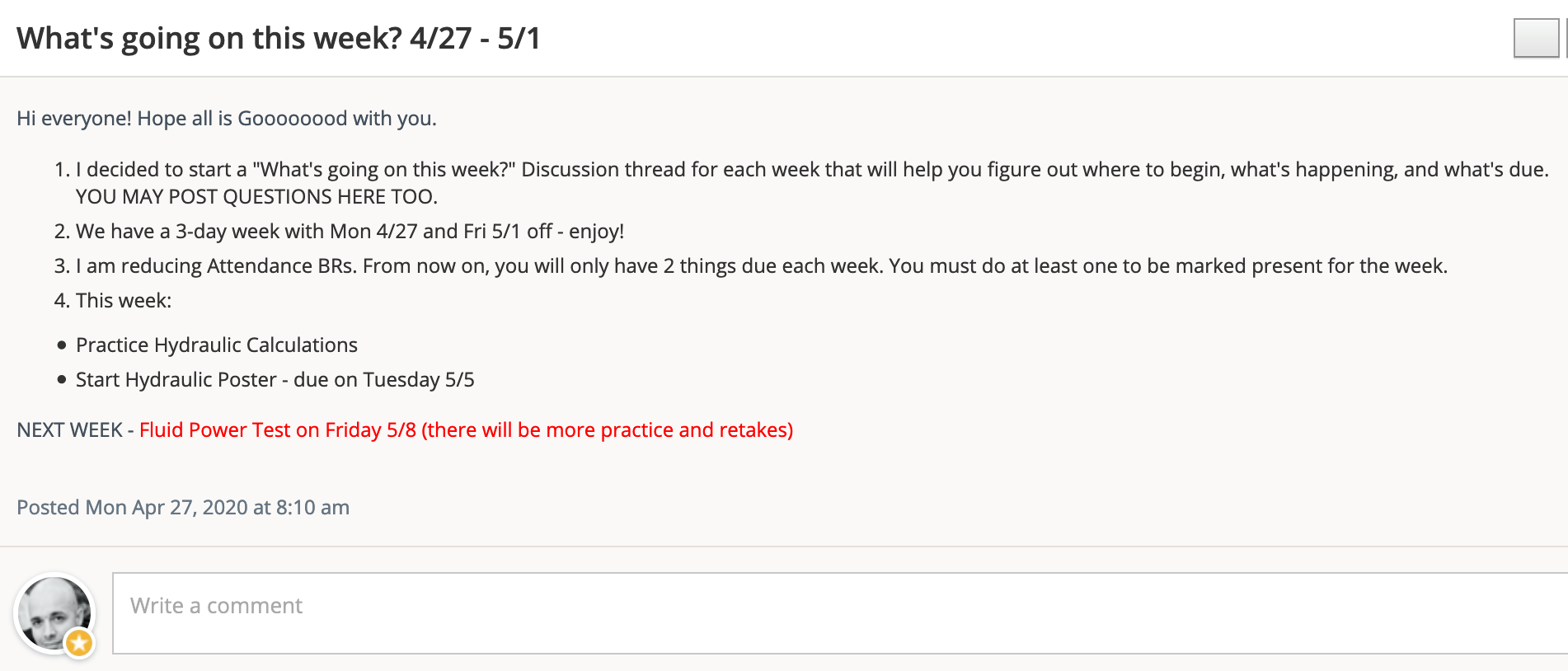
Following the author’s suggestion of getting students oriented each week but knowing that many high schoolers don’t check email regularly I added a “What’s Going On This Week?” discussion thread to the beginning of each week in my learning management system.

Treading the Sea of Links and Documents

Treading the Sea of Links and Documents

This is what my students will see in Schoology next week when they log into Chemistry. Being the one who set it up I could easily dismiss the image to the left as “easy to follow,” but considering the fact that every teacher does it differently I can imagine students have a lot of deciphering of what’s going on to do. I can help, it takes little effort and time, and pays off big.

Check out my first “What’s Going On This Week” discussion thread in principles of engineering.

What's Going On This Week Discussion Thread

What's Going On This Week Discussion Thread

The nice thing about a discussion is that students can ask and read each other’s questions as well as the answers I post. It’s likely students will ask questions that have already been answered in the thread. It’ll be important for me to not get annoyed or condescend but rather show empathy and answer with patience and compassion. After all, I do not know what other responsibilities and stresses they are dealing with at home and how much time they have to read every single thread post. All that matters is that they get their concerns addressed and that they are doing well.

Key Points

  1. Being a better online teacher is not about the tech you use. Tools are important but people always come first.

  2. Don’t just be empathetic. Demonstrate empathy by putting yourself in your students’ shoes every day and creating structures that help alleviate confusion and anxiety.

  3. Print out class lists for easier communication.

  4. Build a habit of writing regular quick check-in emails.

  5. The start is the hardest part. Get your students going with a weekly “What’s Going On This Week?” communication (discussion, email, message etc.)

Resources

Excellent Online Teaching: Effective Strategies For A Successful Semester Online by Aaron Johnson


If you enjoyed this post or found it helpful consider signing up for my newsletter below.

2024 Crush School