
Resistance to Change and the Teaching Struggle Is Real

I’ve been thinking a lot about this school year lately. More than usual, I have been reflecting on the school year that’s in the books now. It wasn’t easy. Honestly, it was one of the hardest years I’ve had in a while. Not because of behavior issues, which I had to some extent (though most of my students are pretty chill), or grading, which I hate with a passion (I much prefer creating learning experiences), or administrative stuff, which is what it is, but because I felt like I regressed.
Like I forgot, after 22 years of doing it, how to be a teacher.
I found myself questioning things I thought I had long figured out—especially when it comes to my understanding of students. And after 12+ years of of teaching chemistry in my current school, it was jarring to feel that way. But change, especially top-down forced change, has a way of doing that.
Last year, I transitioned from teaching upperclassmen in Chemistry—a subject I know like the back of my hand—to teaching Earth and Space Science to freshmen. That’s right. Fourteen-year-olds. Ninth graders. A totally different beast.
And wow, was I not ready.
Let’s start with the students themselves. Juniors in chemistry have a level of maturity (usually), a sense of structure and responsibility (again, usually), and at the very least, they have a clearer picture of the expectations of high school life (read: they know what not to do better than the youngins). Freshmen, on the other hand, are in the process of figuring it out. They’re bouncing between middle school habits and high school demands, trying to find their footing socially, emotionally, and academically. And I’ll admit—I struggled to meet them where they are.
Some of the struggle was internal. I resisted the change. I didn’t want to leave chemistry. It’s a subject I love and have spent years crafting lessons for, refining labs, and building strong connections with older students I taught. I even liked writing college and scholarship recommendation letters, even if I procrastinated with finishing all of them.
And being asked to teach Earth Science—a subject I hadn’t taught since the dark ages (aka my middle school days)—felt like an earthquake constantly shifting the ground beneath me.
But what really caught me off guard was how it affected my confidence in the classroom. Not on the subject matter—I have an Earth and Environmental Sciences degree and have always liked how relevant the content is—but on being a better pedagogue and mentor.
I found myself questioning my instincts. Am I being too hard on them? Not hard enough? Do they even know how to learn? Why aren’t they getting what I’m giving? Is critical thinking not very critical at this age and am I too critical of it? Too demanding? I felt myself slipping into frustration more often than I’d like to admit. And worse, I caught myself forgetting what I’ve always known: students aren’t finished products. They are works in progress, just like I am.
The last two years reminded me of something I hadn’t felt in years: the sharp learning curve new teachers climb. The feeling that you’re constantly behind, that you’re not doing right by your students, that you should know more, do more, be more. And while it was uncomfortable, in the end it proved illuminating.
I’ve come to realize struggling isn’t failing. It’s growing.
Regression first. Struggle next. In the end, recalibration. The three stages of teacher death and rebirth. Leo T. is rolling his eyes while rolling in his grave right now.
Teaching freshmen science forced me to listen more intently, observe more closely, and adapt more quickly. It challenged me to remember that good teaching isn’t just about mastery of content—it’s about connection, patience, and flexibility. But most of all, humility.
First trimester was tough, because I was failing at something I was supposed to be good at.
But then—something shifted.
In second trimester, I began to settle. I got to know the students better, and more importantly, I let them get to know me—not the perfect version of a teacher I had in my head, but the real one. I started to communicate the expectations better. In fact, I adjusted my expectations, both of students and of myself. I leaned into the chaos instead of constantly trying to control it, because I accepted that freshmen are a mess, make a mess, and, in their wake, leave a mess.
I started finding joy in small wins: when an autistic student who is always on the edge ready to jump off a one-thousand foot high cliff had a freakout free day, or when a class that used to feel like giving a TED Talk to caffeinated squirrels actually was able to hold their side conversations, shut up, and listen to the directions that did, by the way, help them be more successful in their learning, and by that I mean get a better grade of course. I stopped comparing this year to past years. I stopped wishing I was teaching something else and started teaching the kids in front of me. It made all the difference.
By third trimester, I wasn’t just surviving—I was enjoying it. I felt more relaxed, more responsive, and more in tune with what these freshmen needed. I started to see the progress they’d made—not just academically, but emotionally. I could see how they had grown, and I realized that I had too. And, we started to like each other.
I ate my humble pie, gave up trying to control what I cannot control, and grew as a result.
So if you’re a teacher who’s had a tough year or who may be shifting grade levels, changing subjects, or just going through a rough patch in the future: I see you. Change is hard. Regression happens. But so does growth. We don’t always get to choose our challenges, but we can choose how we show up for them.
Teaching is never truly mastered. Every class, every group of students, every subject comes with its own learning curve. And while it’s uncomfortable to feel like a beginner again, it’s also a powerful reminder of why we do this in the first place.
To learn and grow as human beings first, and teachers second.
We learn every year, because we choose to stay when every fiber of our being tells us to run away. We stick it out. We keep the faith.
And next year? We’ll be better—not because we go back to what was, but because we stayed in the struggle long enough to realize that while we cannot always win, we can always learn.
Here’s to the teachers who are still learning.
Thanks for reading my thoughts! I hope they help you in being more you. Check out my shop (see top) if you need thoughtful (not busy work), engaging (fun), project-based and phenomena-based (the whole NGSS thing) Earth and Space Science lessons. I try to keep the prices decent, but if you cannot spare the $, please email me and I’ll give you whatever you need for free.
BOOKS & TOOLS

Equity-Promoting Classroom Poster. What does EQUITY in the classroom look like?
Everyone has a different start and finish line
Quality is more important that quantity
Understanding that diversity makes us stronger
Inclusion despite beliefs, appearances, and circumstances
Thoughtfulness lowers barriers and reduces biases
Yesterday's mistakes are today's learning agenda
You can teach your students about equity and make it a daily classroom practice using this inspirational poster, which also includes images that accompany the equity description. You can discuss each letter characteristic with your students as a way of introducing your inclusive classroom and display it prominently as a reminder that diversity makes the classroom community stronger.
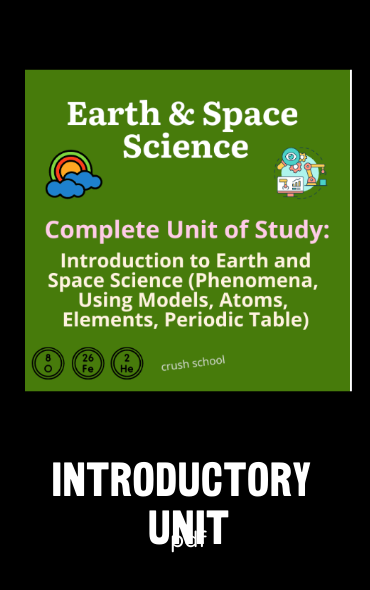
Save 2 - 3 weeks of planning time and start your Earth and Space Science school year off right using NGSS and Phenomenon Based Learning with this “Introduction to Earth and Space Science” Unit that contains 5 relevant and engaging multi-day projects.
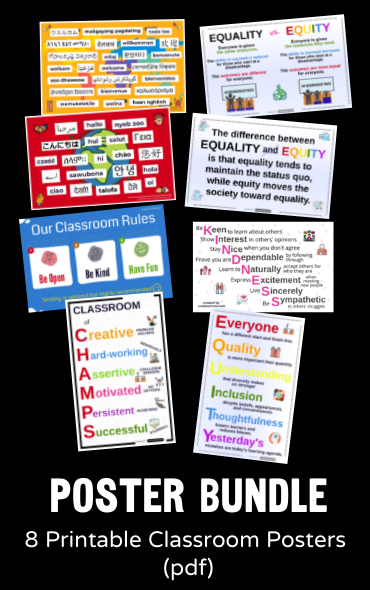
8 digital, printable, size 11 x 17 classroom posters:
“Welcome” in multiple languages
“Hi” in multiple languages
Three Equity posters
Classroom Rules: Be Open, Be Kind, Have Fun
“Classroom of Champs”
“Kindness”
ON SALE until August 30th.
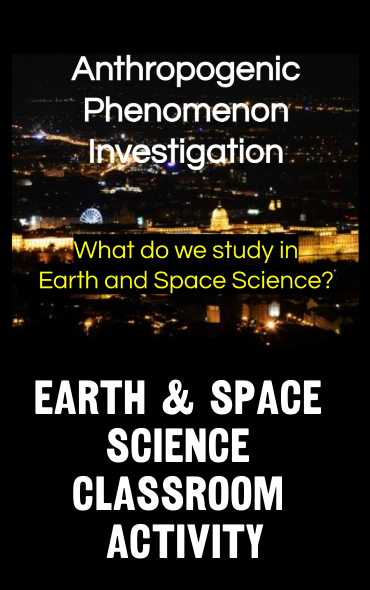
Save planning time with this 3 to 4-day Earth and Space Science NGSS-aligned introductory lesson during which students learn about the Systems Approach to studying science and analyzing real world phenomena.
The lesson involves investigating an anthropogenic phenomenon and examining human influence on the four spheres (biosphere, hydrosphere, atmosphere, and geosphere).
During the investigation, students create models and use them to explain how each of the four spheres is affected in a video that educates viewers on the consequences of human actions and the interconnectedness of the Earth’s systems.
Includes 9 detailed slides (PDF and Google Slides link for editing) + detailed teacher directions (2 slides).
The project follows the guidelines set by the Next Generation Science Standards (NGSS) and guides students in using Science and Engineering Practices (SEPs), Crosscutting Concepts (CCCs), and Disciplinary Core Ideas (DCIs).
Student Learning Objectives:
Describe what a Phenomenon is and give examples of Natural and Anthropogenic Phenomena.
Explain how phenomena can be used to study scientific concepts.
Describe the four spheres: atmosphere, hydrosphere, geosphere, and biosphere, and give examples of different matter interactions between them.
Understand, explain, and apply the Systems Approach when investigating Earth and Space Science Phenomena.
Break down how a Specific Anthropogenic Phenomenon affects each of the four spheres.


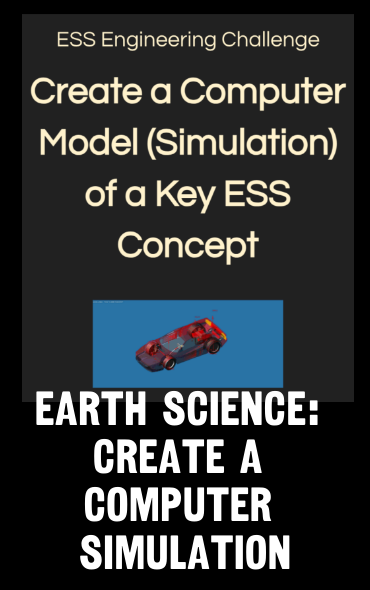
Save planning time with this introductory, 3-4 day Earth and Space Science engineering challenge in which students create a computer simulation of an Earth Science topic.
Includes 12 detailed slides (PDF and Google Slides link for editing) + detailed teacher directions (last slide) + a BONUS resource: Animation Guide for Google Slides.
The project follows the guidelines set by the Next Generation Science Standards (NGSS) and guides students in using Science and Engineering Practices (SEPs).
Student Performance and Learning Objectives:
Design and create an informative computer simulation.
Use computer animation to simulate a key ESS concept.
Explain the key ideas of an ESS concept of your choice.
- October 2026 2
- September 2026 6
- August 2026 9
- July 2026 7
- June 2026 9
- May 2026 9
- April 2026 7
- March 2026 1
- December 2025 1
- September 2025 2
- August 2025 5
- July 2025 4
- June 2025 2
- August 2024 2
- July 2024 2
- June 2024 1
- October 2023 1
- September 2023 3
- August 2023 6
- July 2023 6
- July 2022 2
- June 2022 1
- November 2020 3
- October 2020 3
- April 2020 1
- March 2020 5
- July 2019 1
- June 2019 1
- April 2019 1
- January 2019 1
- November 2018 3
- October 2018 2
- September 2018 1
- August 2018 7
- July 2018 11
- June 2018 4
- May 2018 5
- April 2018 2
- March 2018 4
- February 2018 5
- January 2018 3
- December 2017 1
- November 2017 5
- October 2017 7
- September 2017 6
- August 2017 5
- July 2017 3
- June 2017 10
- May 2017 7
- April 2017 7
- March 2017 15
- February 2017 12
- January 2017 13
- December 2016 15
- November 2016 8
- October 2016 7
- September 2016 12
- August 2016 14
- July 2016 10
- June 2016 13
- May 2016 10
- April 2016 8
- March 2016 5
- February 2016 7
- January 2016 6
- December 2015 5
- November 2015 8
- October 2015 2