CRUSH SCHOOL

I blog on Brain-Based Learning, Metacognition, EdTech, and Social-Emotional Learning. I am the author of the Crush School Series of Books, which help students understand how their brains process information and learn. I also wrote The Power of Three: How to Simplify Your Life to Amplify Your Personal and Professional Success, but be warned that it's meant for adults who want to thrive and are comfortable with four letter words.

Learn Faster, Study Smarter, and Remember More

"Learning is a marathon not a race," they say but is this statement true? On one hand, cramming is a "rushed" method that doesn't work. On the other, learning things quickly and applying them effectively is highly sought after by employers.

We live in a world full of paradoxes. And, education isn't immune to them. Because schools emphasize tests and grades not learning, and by learning I mean deep understanding, effective application, and long-term memory of concepts, the best students cram, get good grades, and forget. They did it quickly, but what is it? Can you call it learning if it's quickly forgotten? If you can't use it in the future, are you learning or merely wasting time?

While grades are important and get students into good colleges, they don't guarantee college or future job success. In fact, the latest college completion data shows only 54.8% of students graduate with a 4-year degree in 6 years or fewer. But if they're able to get into colleges, then why do over 45% of students fail and end up with exorbitant tuition bills with nothing to show for them?

We all know the answer to this. While some students cannot afford to continue, many simply don't have the skills to perform well at the university level and it's not their fault!

They wanted to go to college!

They wanted to succeed! 

They didn't...

But they could have if they had the skills. If only they knew and could use effective learning strategies.

Check out the one below. Look how common sense it is!

Yet, most students don't use it. They don't know it.
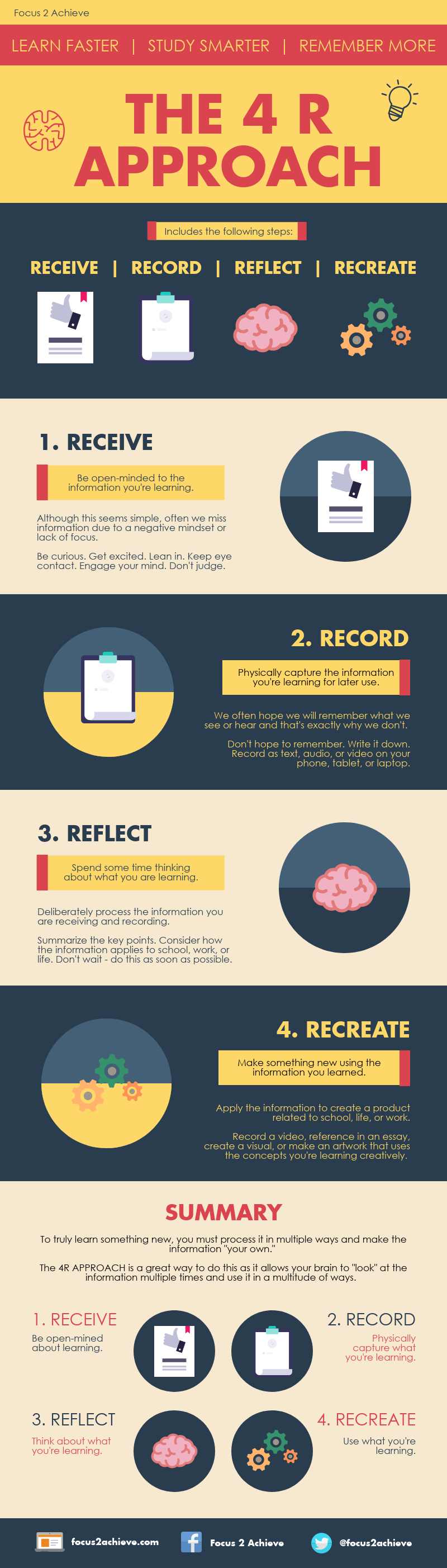
Learn Faster, Study Smarter, and Remember More with The 4R Approach

While steps 1 and 2 (Receive and Record) happen in the classroom, students are frequently left to their own devices when it comes to memory consolidation, which steps 3 and 4 (Reflect and Recreate) lead to. A student who has the understanding, the time, and the discipline to these things at home is likely to learn (understand, remember, and be able to apply) the information.

Problem is, even at the high school level many students do not realize they should review and use the information immediately after they receive it. They don't know because classes are built and teachers trained to deliver information not to help students learn it.

Of course every teacher wants all their students to learn! But, school curricula are written to deliver massive amounts of content, leaving little room for teaching skills and learning how to learn.

However, any student who understands how her brain learns can make strategic decisions about her learning. If she has skills and knows effective learning strategies, she can use them to learn faster and smarter. She can improve her working and long-term memory. But chances are, she must acquire many of these skills on her own. Or, she might get lucky...

But if you're like me, you don't want to leave your kids' success up to luck or school alone. I want my son to do well in school and life but as schools are now, they mostly focus on teaching subjects not transferable skills.

The good news is the neuroscience developments of the last decade have allowed scientists to identify how the brain learns best, and all you have to do is apply these realizations and methods that support them to learning. But again, schools teach only a few of these skills. 

There are many books on the market on learning how to learn, accelerated learning, memory training, and doing better at school.

Many contain useful information but I have not found one that isn't descriptive.

Most, just tell you what to do to get better.

The better books give you examples.

None of them have students practice what they preach in the book.

They don't contain exercises that have students apply the information, which is ironically how we learn best and that is why most of the information the students read is forgotten and never used.

A perfect example of this is to think about a book you read, say... 1 month ago. How much do you remember from it? How much can you use right now?

If you don't open it back up, chances are you remember a few things well and only vaguely remember a few others. The rest of the information, which is most of it, never made it into your long-term memory. This is because your brain did not evolve to remember it in such a way...

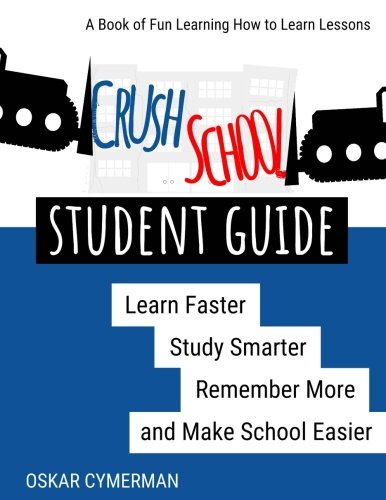
And this is why I created my new book Crush School Student Guide: Learn Faster, Study Smarter, Remember More, and Make School Easier, to be a workbook that contains a series of short, fun, and easy to follow lessons designed to incrementally turn a mediocre or good student into an advanced learner ready to crush the challenges of high school, college, and the world of work.

It is now available on Amazon for pre-order. Just click here.

Before you make your mind up, consider this:

  1. The book contains well over 60 strategies and tips anyone can use to learn faster and smarter and train their memory

  2. In the book, I don't just tell students to "read and apply." Rather, I built the book to be a Learning How to Learn Course.

  3. Any student can use the Crush School Student Guide at home or the book can be used by teachers as a series of lessons done in class

But don't worry, if you're not ready to spend $29.95 on the paperback, you can check out the Kindle version at low risk for $3.45 only. It's easy as 1,2,3 by clicking here.

You have the power to change lives. Use it often so they can change the world.

Oskar

To Focus on What Truly Matters You Must Fight Predators and Choose the Right Opportunities

Fight Predators and Choose the Right Opportunities

The modern Homo Sapiens is in the fight of his life. The never-ending struggle occurs in his brain. As the modern brain battles the ancient part of it, the struggle manifests itself as a series of contradictory behaviors. On one hand, the Sapiens has the ability to learn an indefinable amount of information. On the other, he's often too distracted to learn much of anything.

Evolution has both allowed him and robbed him of the ability to carefully process information - to rethink, to reflect, and to reapply. As a result of this paradox, he often skims the learning surface. While the cerebrum (modern "rational" brain) has skyrocketed his potential, his progress is hindered by the amygdala (ancient "emotional" brain). His knowledge stalls. He's mired in mediocrity. No longer in tangible danger, he's escaping the conditioned anxieties. The distractions today's world affords him make it easy. And they are everywhere. 

Why do so many people become part-time zombies, the classroom students and the everywhere adults, who upon leaving their dull desks and constraining cubicles glue their eyes to screens and allow their minds to be trapped in virtual, dopamine-inducing worlds that serve as fire escapes from the boring, painful, and otherwise unpleasant daily reality but keep them stuck in it long term? 

The ancient brain has evolved to respond to two things: threats and rewards. The mere perception of a threat releases cortisol and adrenaline and we freeze, fight, or flight. When the brain detects reward possibilities or we're rewarded, it produces dopamine, oxytocin, and serotonin. This motivates us to keep doing what we're doing because we want to keep feeling the good feeling.

Back in the day, the rewards were food and the opportunity to procreate. The threats were the predators that tried to eat us and the natural we tried to hide from.

Enter the modern times - the technology and the entertainment. Our ancient brain responds to them as opportunities and they often are but the rewards they offer can be tricky. 

While technology is cool, the entertainment industry is insidious, and our awareness rare. Fires are few and far in-between and most other prehistoric dangers the Sapiens faced have long been extinguished. Yet our split attention remains and make no mistake, the industry knows it and fights for it. And we succumb by continually allowing ourselves to be convinced we must keep running away.

The insidious, profit-mongering, and brilliant marketing campaigns and products of television producers, social media providers, app and game developers, and others work to keep us convinced they offer something much better than life itself. Consequently, we often let time pass unforgivably "taking the load off" from our busy work or school lives instead of spending it doing more meaningful things that improve our lives. Mediocrity perpetuated with the belief "this is all life is supposed to be."

And this is how the industry players want us. They want us coming back to them. The more automatic our behaviors the better, because if they lose our attention they lose. They can't profit.

While many online activities are worthwhile, we rarely think about how much time we spend participating in things that keep us stuck in the status quo we might otherwise work on changing. While there's nothing wrong with taking a mental break, as we should do things that relax our minds, we are being conditioned to identify work as the necessary evil to grind through from 9-5, so that we can have fun as a reward afterward.

We become dabblers. We just dabble in things. We're too distracted to commit. The predators changed and so did the opportunities but they're ever-present. They keep our minds occupied. If we don't pay attention we end up doing a lot of things that entertain us in the moment but add little lasting value to our lives.

We can spend our lives sitting on a couch looking at a screen doing little more than nothing or we can spend that time interacting with the world we live in, learning about it and ourselves, and filling our lives with meaning. The only way to flip that switch is by becoming aware and taking action. 

Our kids are the most vulnerable ones. But zero tolerance electronics policies are not the way because the brain wants what it cannot have even more. The forbidden fruit tastes sweeter.

So we don't take away but educate. We lead by example. We show our kids that there's a better way. We limit our use and their use of the devices and actively participate in their lives. We do stuff with them because we love them. Then, we cross our fingers and hope they see the way for themselves.

On the places they'll go.

I think they will. I believe they can. 

You have the power to change lives. Use if often so they can change the world.

Oskar


Sign up below to receive more articles and graphics on effective learning and building skills. It's completely free and with no strings attached.

And if you're looking for some success tools check out my books on Amazon.


More Open-Minded in 3 Steps: Examine, Exercise, Experience

Doesn't it drive you nuts when someone just gets stuck in their way of doing something and wants nothing to do with a new, often better approach?

A child who refuses to try that healthy meal defaulting to chicken nuggets and french fries. A partner who won't take you up on your offer to go to the theater, because he says he hates musicals. A coworker who will not give the new faster approach a chance because she has been doing it the old way for 12 years and she's content. The list goes on.

You could call it being conservative or narrow-minded or close-minded but there's a reason ALL OF US are (at least sometimes) this way. I will get more into Why We Resist Change in a future post but it's important to mention that it's natural. 

We are wired to resist change because our brain has evolved to protect itself and our body. Because conscious thought requires more energy, our basal ganglia, the part of the brain that controls habits and routines, creates neural networks that automate certain behaviors so they can be done unconsciously, freeing up mental capacity to perform the actions we're aware of. 

We can develop new habits but it's hard. And once we do, unlearning and replacing existing habits is difficult as well. In a way, each time we try to change routines we are fighting our own nature. 

However, natural isn't always beneficial. If we always stay as we are now and never take risks, opportunities to learn and improve our lives and impact those of others will pass us by. Thus, it is important to develop and practice our open-mindedness. 

I recently watched the TEDxHaarlem Talk by Ricardo Lieuw On How to triple your memory by using this trick, which inspired me to think about my own open-mindedness and how I can help my son and my students practice it.

Turns out, we all can help our kids practice being more open-minded. If we treat it as a skill, we can become more open-minded ourselves. 

It's important to mention that all of us are quite open to trying new things in some personal and professional arenas and not so receptive to trying new approaches in other realms of life.

No one is always close-minded or always open-minded but all of us can benefit from becoming more open to new experiences, approaches, and possibilities. 

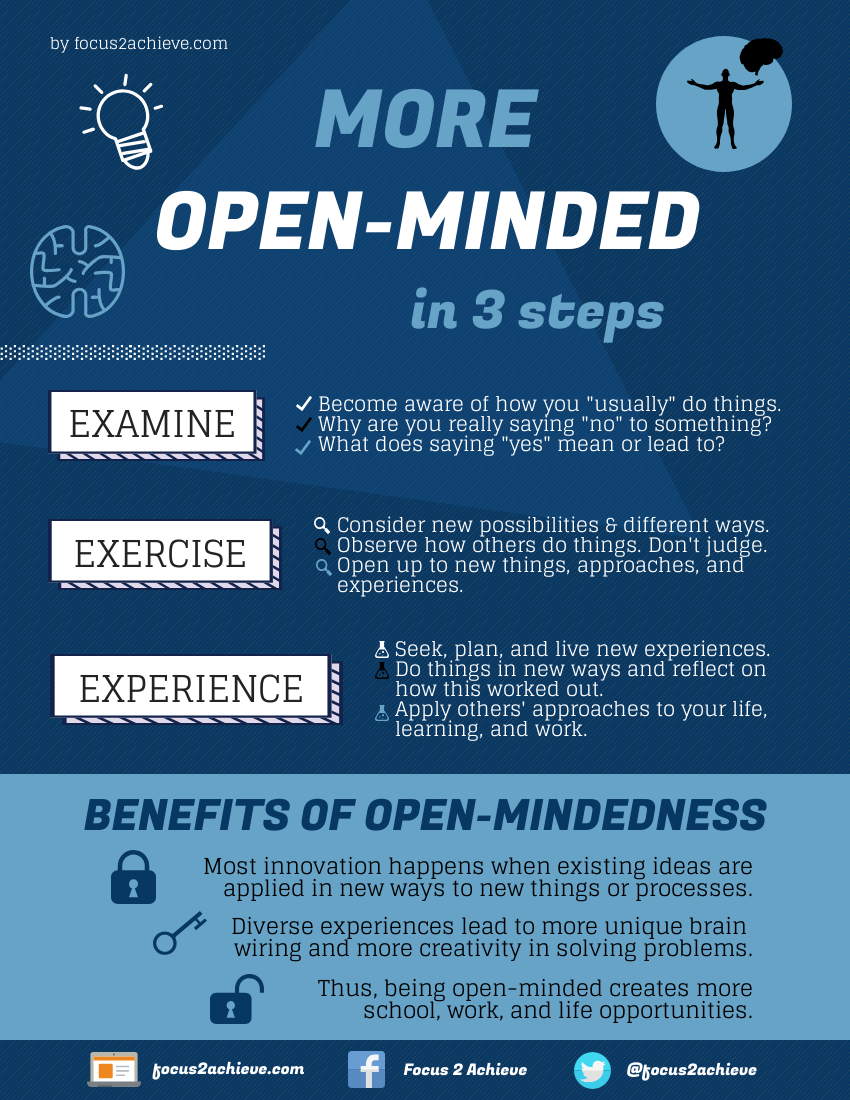
I created the infographic below for my new book Crush School Student Guide: Your Fun, Fast, and Easy Journey to Becoming a Smarter Student which is a series of lessons and activities designed for teens to learn how to learn more effectively scheduled to be published on Amazon on July 27th. The graphic uses a 3-step approach to practicing open-mindedness in any situation.

It entails consciously Examining our thoughts, behaviors, routines, and habits.

It calls for Exercising our minds in observing and considering new ways and approaches.

It requires Experiencing new things and applying new methods to our situations.

More Open-Minded in 3 Steps: Examine, Exercise, Experience

You can grab a printable PDF poster of the above infographic here if you'd like to use it in your home, office, or classroom as a reminder to practice open-mindedness.

Though dictionaries and thesauruses might say otherwise, creativity and narrow-mindedness are antonyms. You can't innovate without an open mind.

Luckily, practicing being more open-minded is possible with awareness - bringing the unconscious to the conscious - and then taking action. It's a skill we can teach our kids. And then they can... who knows?

You have the power to change lives. Use it often so they can change the world.


Sign up below to receive more articles and graphics on effective learning and building skills. It's completely free and with no strings attached.

And if you're looking for some success tools check out my books on Amazon.


2026 Crush School