
Candy Crush vs. Chemistry: What Will the Brain Remember?
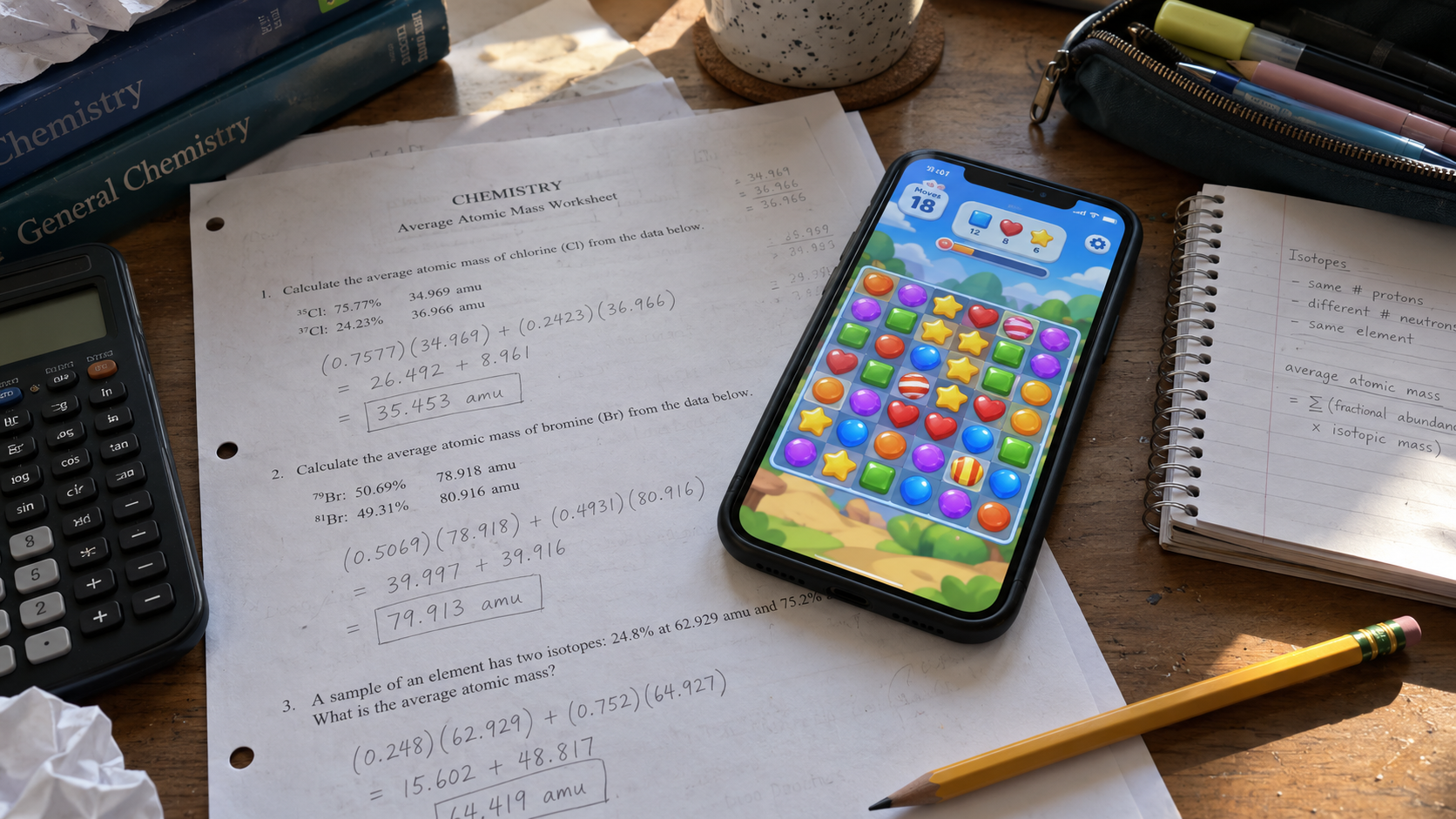
Candy Crush vs. Chemistry: When students switch between learning and entertainment, what happens to attention, memory, and understanding?
A high school junior picks up her phone and plays a few Candy Crush moves in between average atomic mass calculations in chemistry. I walk up frowning.
“But I’m done with the problem and I want to play my video game while I wait for everyone else to finish,” she says.
She thinks she has a point and it might sound valid to a random eavesdropper, but she doesn’t know.
She doesn’t know that she’s going against her biology.
“But I finished it, so what’s the big deal?,” she insists.
“Well done, but this is not about you slacking off,” I reply.
Finally, annoyance in his voice, a kid sitting at her table says: “He wants you to put your phone away!”
It’s that damn Digital Delusion book I’ve been listening to on my rides to and back from work. And though the title suggests the author’s main goal is to sway educators away from educational technology, to me, his book is a cognitive science one—a discourse on how learning does and doesn’t work.
Fractured focus is real in today’s classroom. So is loss of information.
The Big Cognitive Deal
The brain consolidates memories while we sleep. It replays the “important” memories at night while at rest. The human hippocampus serves as a review machine of sorts—first encoding and strengthening memories, and later working with the cortex to recall that information.
But what makes memories important?
How does the human brain choose what to replay and remember?
I wish there was an easy answer that would allow every teacher to extract and implement its wisdoms in the classroom to maximize memory formation and minimize forgetting. There isn’t.
But while this eureka-sized brain discovery still eludes us, there are a few straightforward things we think we know. Studies involving human memory show that what we pay attention to and how meaningfully we process information have a major influence on how well we encode and later remember it.
So I wonder this about my chemistry junior: How much of the chemistry-related information is she actually encoding while switching from class content to her phone and how much of what will get replayed in her hippocampus at night has to do with the saga of the Candy Crush variety?
After all, she’s switching between these two tasks. Moreover, my interaction with her leads me to believe her conscious mind is prioritizing the video game while treating the atomic mass as necessary evil.
How does her hippocampus weigh the importance of these two experiences at night?, I consider. What does it deem worth saving?, I wonder.
Taking On Our Own Biology And Losing
The conscious human brain can’t multitask, so when a student attempts to do two things at once, task switching is what they’re really doing.
The phone distraction vs. human memory game has concluded. There are many studies that tell the same tale. Memory lost. It didn’t stand a chance.
Switching between learning and phone interrupts encoding, which leads to often incomplete or inaccurrate processing of information. Phone 1, Memory 0.
Working memory and processing of information are less effective when class content is competing against phone entertainment, draining our brain’s cognitive resources all at the same time. Phone 2, Memory 0.
Returning from one task to another requires the brain to repeatedly reset attention and goals to the new task, making learning less efficient and producing more errors. Phone 3, Memory 0.
The human brain is simply not built to give two cognitively demanding tasks its full attention simultaneously. What we often call multitasking is actually rapid task-switching between activities that use the same attention and compete for the same limited working-memory.
When I so-harshly demanded that my chemistry student put her phone away I couldn’t help but think: How deep is her processing and understanding of this concept? She seems to be able to plug in the numbers into the formula and get the right answer, but is she truly understanding what she’s actually doing, given the presence of competing information and the entertainment her phone provides? Will she be able to recall how to do this next week?
The answer is probably more shallow than I’d like, but time will tell.
No Rest For The (Phone-Wielding) Wicked
Recent studies show that memory consolidation also occurs during rest periods while we’re awake. In a classroom setting, teachers can help activate their students’ hippocampal memory replay process with a short, cognitively-undemanding break from the active task they’re undertaking.
Perhaps we can let them stand up and walk a little or talk to a friend about this Friday’s football game for five minutes; encoding and consolidation happening in the background.
But when my junior kept picking up her phone in between the calculations, I kept thinking: Is she giving her brain a fair chance to encode and consolidate what she’s learning? Or, Is the swiping of colorful candy pieces and the problem-solving required for it too demanding for her brain to be at the rest level required for the background memory replay to take place?
I am not convinced that we know exactly what is happening in young brains in those moments, but multiple research studies point to excessive screen usage causing thinning of the brain’s cerebral cortex and reduction in its grey matter in adults, both responsible for processing memory and other brain functions.
The brain of a sixteen year old cannot be that much different from 18-25 year olds in those studies, which points to their cognitive processing and memory making being weakened by the ubiquity of smartphones.
And now I worry: How is my junior’s knowledge of all these things? Does she go through life switching between phone and this, then that task? Does she know how it affects her brain and learning? Would she care if she did?
And she’s just one of many in the Generation Scroll and Swipe.
Screenagers are here. Loss of information imminent?
The Quality of Encoding Matters
Imagine two students performing the same chemical reaction.
Student A watches the reaction, even enjoys the bubbling and the color change, but then goes back to scrolling while his partner does the rest of the lab.
Student B predicts what will happen, observes the process, looks for evidence, compares the results to her prediction, and discusses with her partner the potential products of the reaction.
Both students are encoding information, but are they encoding the same things?
Student A might remember the visual spectacle and even talk about it at the dinner table, but student B is more likely to develop a meaningful memory of the scientific concepts behind the processes she witnessed because she engaged in deeper processing and made connections to her prior knowledge.
Student minds being fully present for the learning experience matter because the quality of encoding matters.
The Big Learning Deal
There are things every classroom educator can do to help their students learn and retain more.
Some involve addition and some subtraction.
I used to be for teaching students how to use their smartphones for learning. Unfortunately, after a decade of experience and experimentation with phones in my classroom I learned they are almost never necessary and almost always a distraction. If we can subtract them from the classroom, we should.
If we can do the same thing without the laptop or the tablet, we should. Digitizing a worksheet is not the way to learn, but a shortcut to task switching through tab switching. Subtract.
Brain breaks without devices, but movement and small-talk instead. Add.
More 1:1 human interaction: teacher-student, student-student. Add. Add.
More meaningful learning. Prediction before explanation. Retrieval over repetition. Application instead of consumption. Add. Add. Add.
For 100+ ready-to-use activities that improve student memory of class content and help them engage in deeper processing, check out my book Spark. Wire. Fire. on Amazon.
BOOKS & TOOLS
Flashcards are okay but there's a better way. The Memory (or Mind) Palace Method is a powerful learning and memorization technique that when mastered allows a student to remember 10, 20, or even 30 vocabulary words or concepts (definitions included) with ease.
And, they actually remember what they learned using memory palaces! This series of lessons (which can be used as classroom handouts) walks students through creating their first memory palace, filling it with information they need to learn, and using it to train their memories. It also contains short readings, a video lesson, memory palace examples, and practice drills.
Fair Use
Feel free to use with your students. Please do not share it with other parties or use for profit. All rights by crushschool.com.
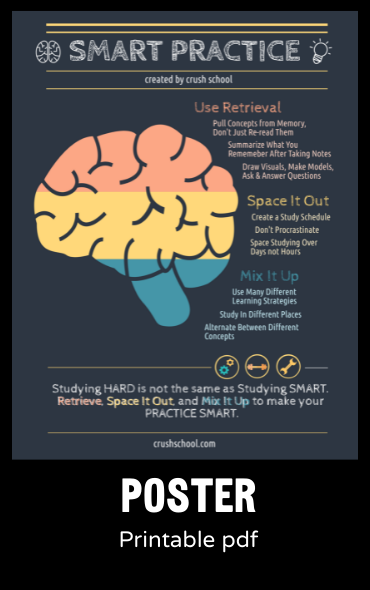
Retrieval Practice, Spaced Practice, and Mixed Practice (Interleaving).
Studying Hard is not the same as Studying Smart. This High Quality printable, digital (PNG) poster is a constant classroom reminder of best practices for teachers and learning the smart way for students.

In this classroom Mistakes are Expected, Respected, Inspected, Corrected!
Learned helplessness is a result of years of conditioning that mistakes are bad for learning. Nothing is further from the truth - some of the most powerful life lessons come from making mistakes, reflecting on them, and growing as a result.
This is a PNG Poster you can print and display in your classroom to encourage a culture of risk-taking and learning from mistakes.
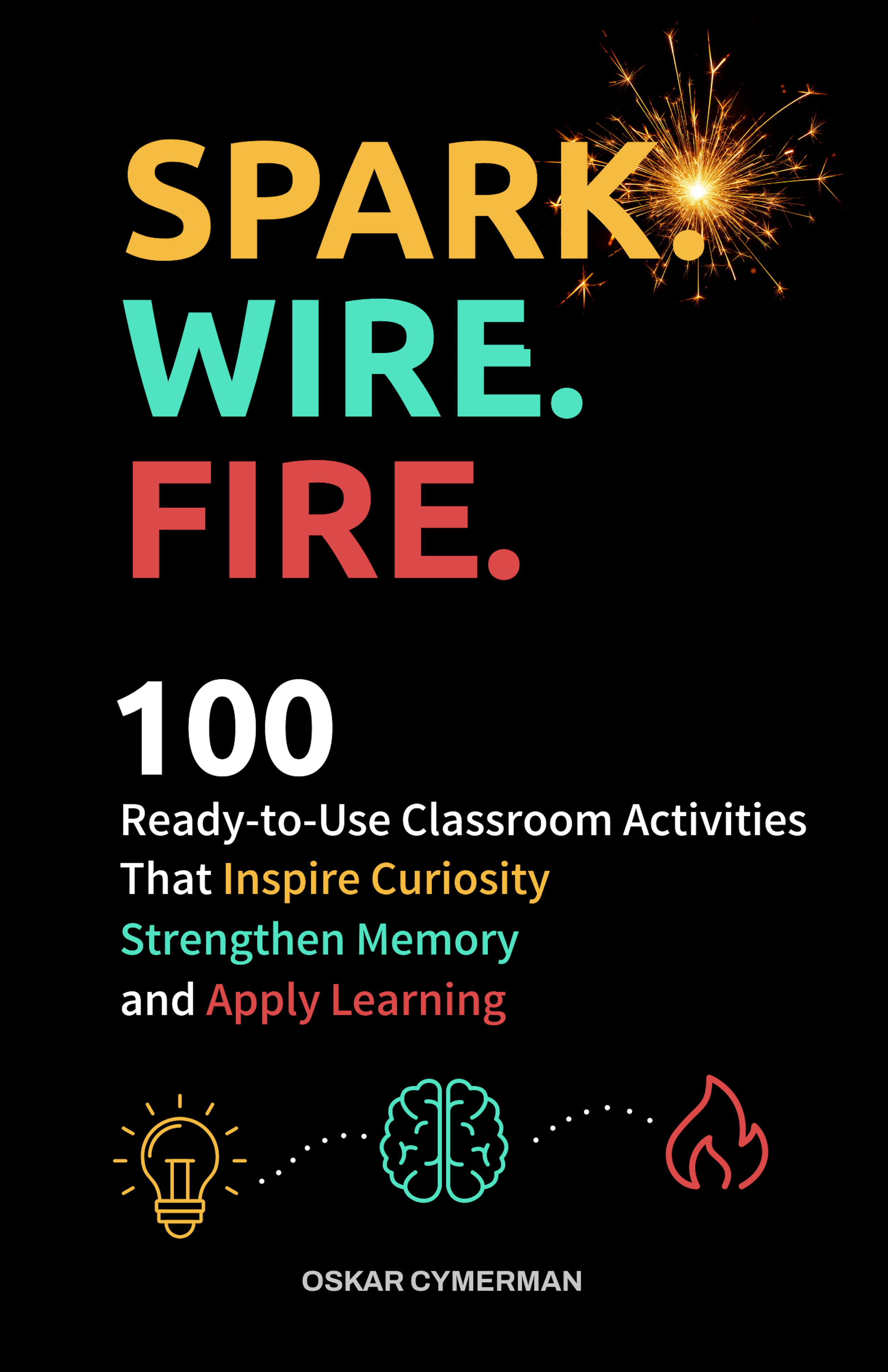
NEW BOOK
100+ practical, brain-based activities teachers can use right away with or without technology.