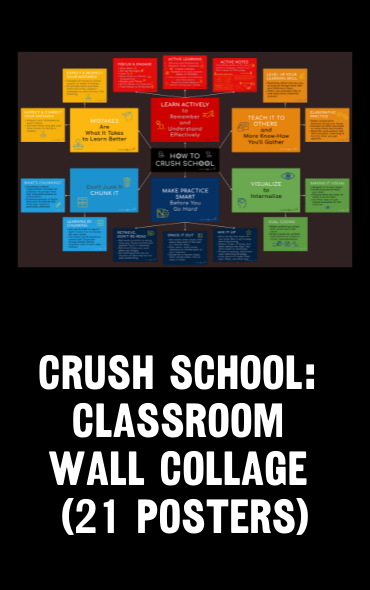
CRUSH SCHOOL

I blog on Brain-Based Learning, Metacognition, EdTech, and Social-Emotional Learning. I am the author of the Crush School Series of Books, which help students understand how their brains process information and learn. I also wrote The Power of Three: How to Simplify Your Life to Amplify Your Personal and Professional Success, but be warned that it's meant for adults who want to thrive and are comfortable with four letter words.

Filtering by Category: BRAIN-BASED

5-Minute Classroom Strategies That Motivate and Promote Learning

Colorful classroom infographic titled “Keeping the Learning Active & Alive,” showing three short classroom strategies: Example Challenge, 90-Second Teacher, and Concept Block Party, with a Spark, Wire, Fire banner at the bottom.

Short classroom strategies like Example Challenge, 90-Second Teacher, and Concept Block Party help students stay engaged before, during, and after longer learning activities.

Long classroom activities can be great.

Labs, projects, discussions, simulations, stations, writing tasks, problem-solving days, and group work all have a place in the classroom and are sometimes exactly what is needed.

But even the best of such activities can lose steam if teachers use them too frequently and students start drifting, rushing, waiting, zoning out, or pretending to work while their brains check out.

That’s where short classroom strategies save the day.

Not cute little activities we toss in when we have time, but intentionally-placed, short classroom engagement strategies that help students start strong, refocus in the middle, or end class with learning still active in their minds.

A quick spark before instruction begins.

A short reset between longer tasks.

A fast retrieval check that solidifies learning before students bounce.

It is precisely such small moves that keep the energy, attention, and thinking from taking a hike—bathroom requests notwithstanding—during a full class period.

Keeping the Learning Active and Alive

Keeping the learning alive is one of the main themes of Spark. Wire. Fire.

The book organizes activities into three big categories:

Spark activities help student brains get ready and motivated for the learning—bell ringers, lesson hooks, curiosity prompts, prediction activities, and quick challenges that grab attention and activate prior knowledge.

Wire activities wire learning into memory through retrieval practice activities, drawing tasks, partner explanations, concept connections, and review moves that help students remember, organize, and explain what they’re learning.

Fire activities push students to apply learning by asking students to use ideas, defend thinking, solve problems, make decisions, create artifacts, or transfer learning to new situations.

The framework works because student engagement is about helping students do something meaningful with the learning, not about just keeping them busy.

A good 5-minute strategy can work extremely well at the beginning of class, between longer classroom activities, or at the end of the period.

At the beginning, it can wake up curiosity.

In the middle, it can bring students back before attention completely disappears.

At the end, it can help students retrieve, summarize, connect, or apply what they learned.

Here are three examples from Spark. Wire. Fire.

1. Example Challenge

This is a great way to start class and review a previously-learned topic.

Instead of giving students an age-old “What is…” question, put them in small groups and give them a concept, process, vocabulary term, or skill to review.

Ask groups to list as many accurate examples of the concept as possible in 2-3 minutes. When the time is up, groups count their examples, compare totals, and brag who got the most because it’s fun. Then, ask each group to share and explain one example they generated.

This works because students like (read: are actually motivated by) such low-stakes competitions, they have to retrieve what they know, and they have to use it—apply through example-making. They are not just copying the right answer Google or Chat gave them. They are collaborating, generating, comparing, analyzing, and explaining.

And that, my friends, beats “take out your notes and get your pencils ready” one-hundred percent of the time.

2. 90-Second Teacher

This is a perfect “show me what you got” in the middle of a longer activity when students need a quick energy shift.

Give students a concept, process, example, vocabulary term, or problem. They get 90 seconds to prepare a quick explanation for a partner. They can sketch, label, or create a simple example, but they cannot just copy a definition.

They have to teach it in their own words and drawings.

Explaining something forces students to organize their thinking. If they cannot explain the idea in their own words, they probably do not understand it as well as they thought.

It also gives every student a job. Nobody gets to disappear into the furniture for twenty minutes while one student does all the thinking.

3. Concept Block Party

This is a strong way to end class.

Students are given a concept to come up with four "block partiers" for: (1) Best Friend = most closely connected concept, (2) Neighbor = frequently associated concept, (3) Cousin = related but less directly connected concept, and (4) Stranger = Concept that does not belong.

To make it more powerful, have them rationalize their associations. Then they can compare with a partner and discuss disagreements and alternative answers.

This turns the end of class into retrieval practice and application of learning instead of a chaotic countdown to the bell.

Students have to pull information from memory, decide what matters, connect ideas, and notice what they still do not understand. Teachers also get a quick look at what stuck and what needs more attention the next day.

Learning that Works 5 Minutes at a Time

The real power of 5-minute strategies is that they make student thinking visible without taking over the whole lesson. You do not need to redesign your entire class. You just need small moments where students stop passively receiving information and start actively using it.

Start with a spark.

Pause to wire the learning into memory.

End with a fire that pushes students to apply, explain, or connect what they learned.

That is how short activities can support longer classroom activities instead of interrupting them.

Because the goal is not to fill five minutes, but to use them well.


If you want simple ways to turn quiet work into deeper thinking, Spark. Wire. Fire. available on Amazon includes 100+ ready-to-use activities for curiosity, memory, and application. Paperback regular price: $19.95.

The Master Teacher Toolkit app gives you classroom activities you can launch and display instantly when you need something better than “finish this quietly.”


BOOKS & TOOLS

 
3 Memory Palace Lessons
$3.00

Flashcards are okay but there's a better way. The Memory (or Mind) Palace Method is a powerful learning and memorization technique that when mastered allows a student to remember 10, 20, or even 30 vocabulary words or concepts (definitions included) with ease.

And, they actually remember what they learned using memory palaces! This series of lessons (which can be used as classroom handouts) walks students through creating their first memory palace, filling it with information they need to learn, and using it to train their memories. It also contains short readings, a video lesson, memory palace examples, and practice drills.

Fair Use

Feel free to use with your students. Please do not share it with other parties or use for profit. All rights by crushschool.com.

 
EQUITY Poster
$1.50

Equity-Promoting Classroom Poster. What does EQUITY in the classroom look like?

  • Everyone has a different start and finish line

  • Quality is more important that quantity

  • Understanding that diversity makes us stronger

  • Inclusion despite beliefs, appearances, and circumstances

  • Thoughtfulness lowers barriers and reduces biases

  • Yesterday's mistakes are today's learning agenda

You can teach your students about equity and make it a daily classroom practice using this inspirational poster, which also includes images that accompany the equity description. You can discuss each letter characteristic with your students as a way of introducing your inclusive classroom and display it prominently as a reminder that diversity makes the classroom community stronger.

 
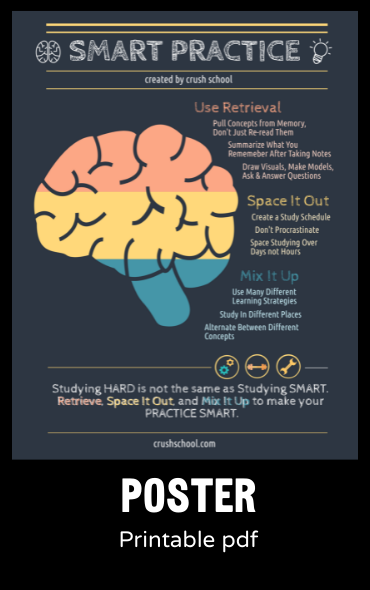
Smart Practice Digital Poster
Sale Price: $2.00 Original Price: $3.00

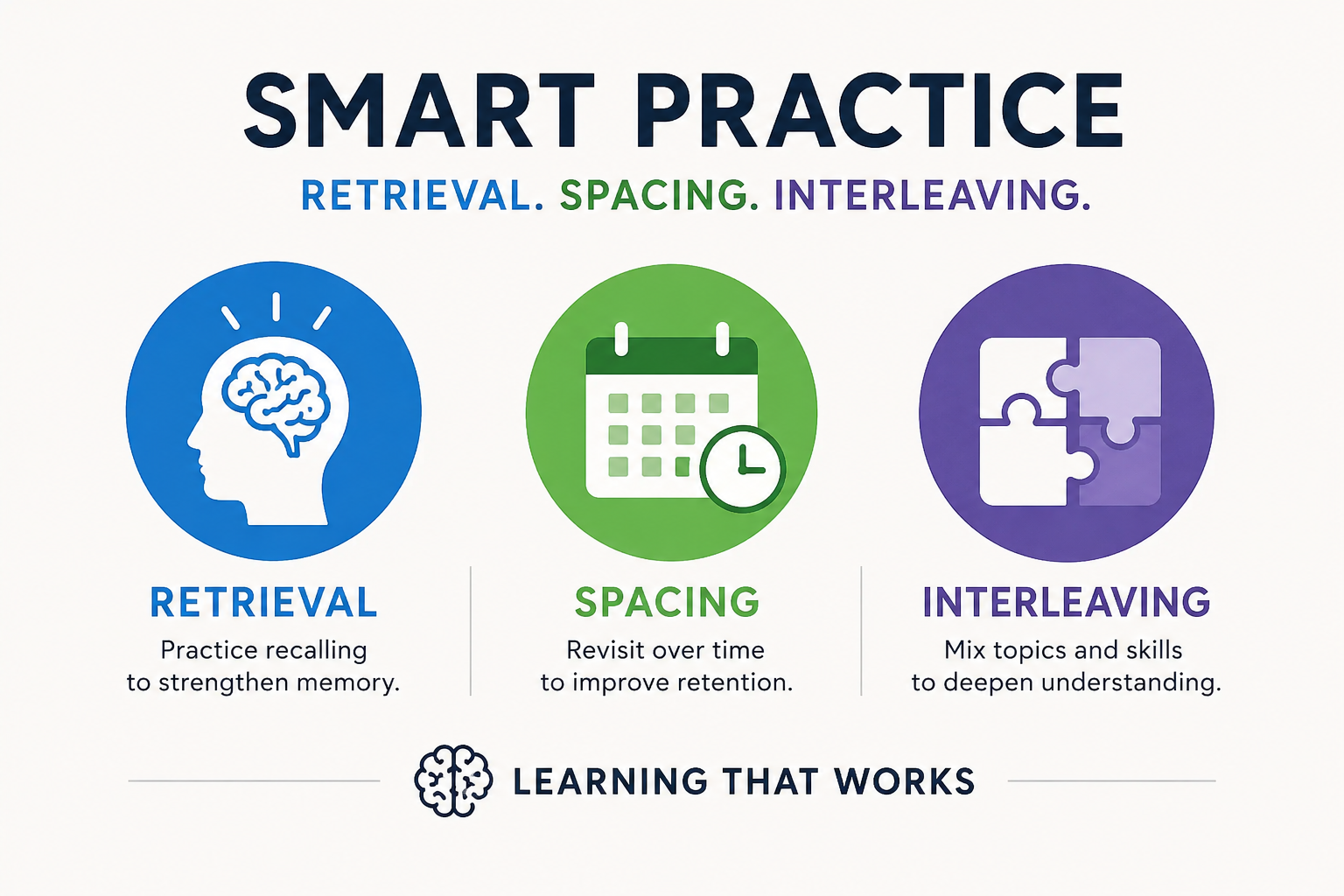
Retrieval Practice, Spaced Practice, and Mixed Practice (Interleaving).

Studying Hard is not the same as Studying Smart. This High Quality printable, digital (PNG) poster is a constant classroom reminder of best practices for teachers and learning the smart way for students.

 
Mistakes Are... Poster
$3.00

In this classroom Mistakes are Expected, Respected, Inspected, Corrected!

Learned helplessness is a result of years of conditioning that mistakes are bad for learning. Nothing is further from the truth - some of the most powerful life lessons come from making mistakes, reflecting on them, and growing as a result.

This is a PNG Poster you can print and display in your classroom to encourage a culture of risk-taking and learning from mistakes.
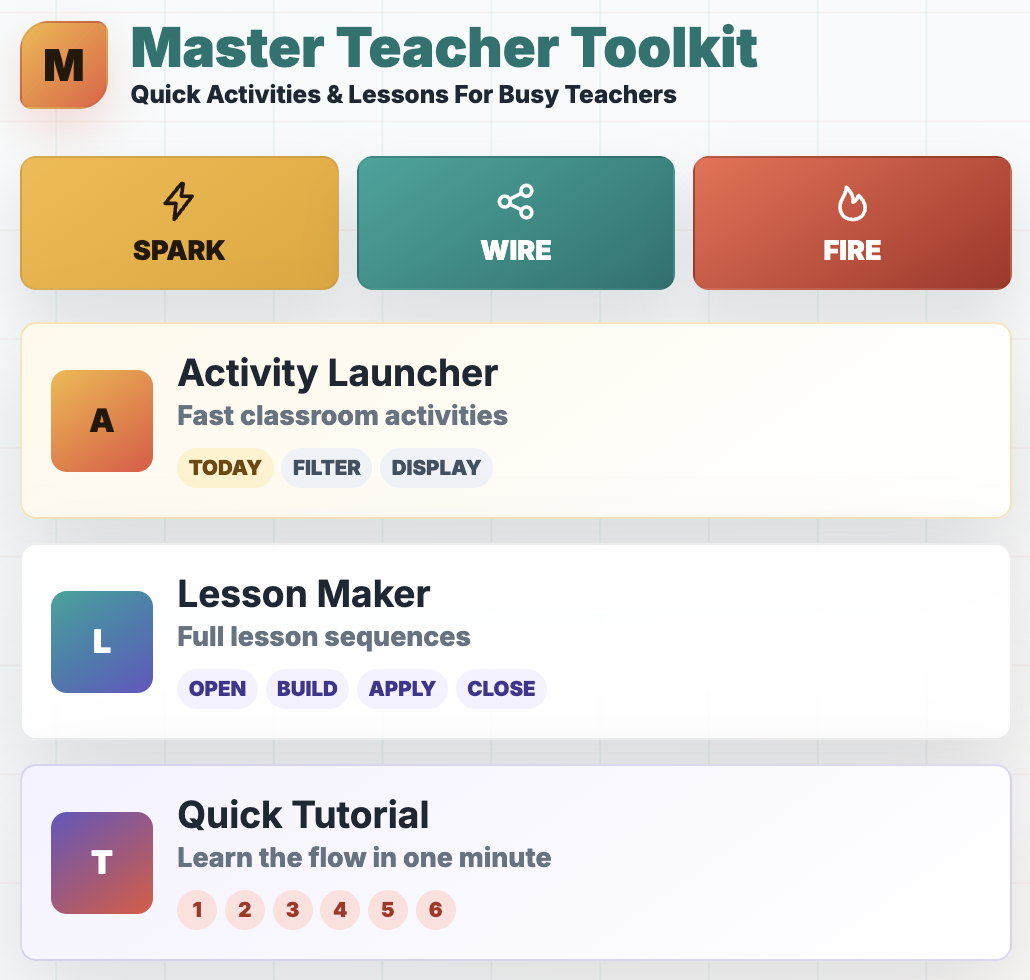
 
Master Teacher Toolkit home screen featuring the Activity Launcher for quick classroom activities and Lesson Maker for building structured 45-, 60-, or 90-minute lesson sequences

Teaching App

Launch engaging, deeper learning activities and lessons in seconds. Then, launch and display them to students instantly.
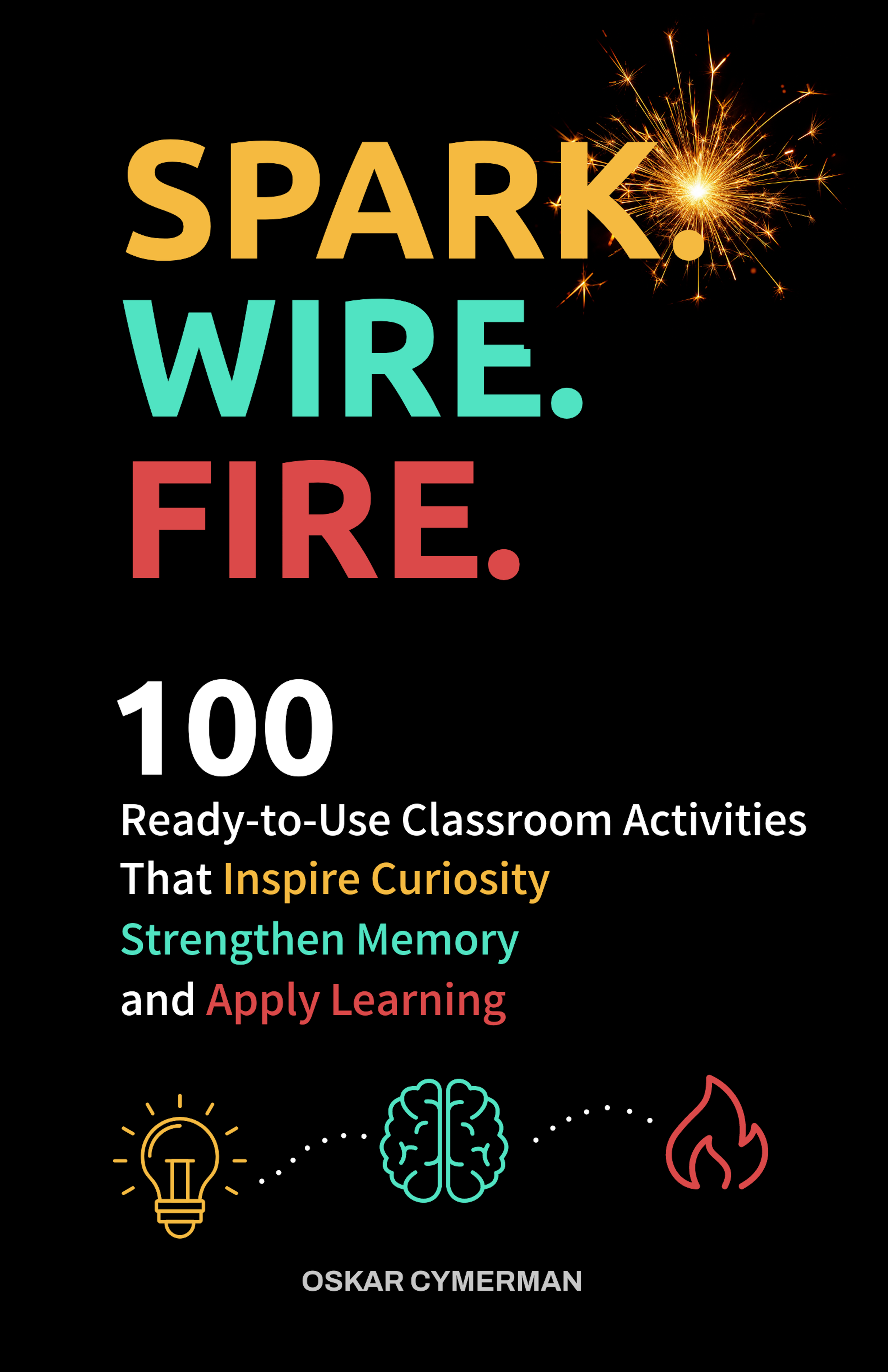
 
Book cover for Spark. Wire. Fire.: 100 Ready-to-Use Classroom Activities That Inspire Curiosity, Strengthen Memory, and Apply Learning, a teacher resource focused on classroom engagement, memory, and active learning strategies.

NEW BOOK

100+ practical activities teachers can use right away with little or no prep.
Learning That Works: Science-Backed, High-Impact Teaching Strategies

Infographic explaining four key principles of learning: attention, memory, cognitive load, and retrieval, showing how science-backed teaching strategies improve student engagement, retention, and learning.

The science of learning is surprisingly simple: attention gets information in, memory stores it, cognitive load determines whether students can process it, and retrieval makes learning stick.

Every teacher has experienced it.

You spend twenty minutes explaining a concept. Students pay attention, nod with approval, and take notes.

But a few days later you ask a seemingly-easy question and are met with: Huh?

What happened?

Most of us were taught how to manage a classroom, write lesson plans, and assess learning. Very few of us left teacher-prep school with a solid grasp on how learning actually works. I know I didn’t.

That's a big status quo bummer because every teaching decision we make either works with our students’ brains or against them.

The good news is that learning that works isn't nearly as mysterious as it used to be. While cognitive science is a massive field, much of what works in a classroom can be explained with four simple ideas: attention, memory, cognitive load, and retrieval.

These ideas are the foundation behind the strategies in my HITS (High Impact Teaching Strategies) collection. They are not activities designed to keep students busy. They are designed to help them learn.

In other words, they are built around learning that works.

Learning Begins With Attention

No matter how brilliant a lesson is, learning cannot happen if students are not paying attention.

The challenge is that attention isn't something teachers can control. Attention is something the brain gives selectively.

The human brain evolved to notice what is new, uncertain, surprising, or rewarding. Predictable experiences quickly fade into the background. This helps explain why students sometimes seem bored before a lesson even starts. Their brains have already recognized the routine.

The slideshow, the worksheet, the teacher talk—the format became so familiar, the brain opts to conserve energy.

This is why some of the most effective classroom engagement strategies begin with curiosity rather than content. A prediction challenge. A strange image. A surprising statement. A quick puzzle.

Activities like Prediction Mystery, Two Truths and a Lie, and Word Unscramble work because they create a small amount of uncertainty. Students suddenly have something they want to figure out.

The goal isn't confusion. It’s curiosity because curiosity opens the door the learning walks through.

Learning Lives in Memory

Many people think learning happens when students encounter information.

But in reality, learning happens when information changes memory.

Thus, if a student cannot remember something, the learning never happened.

The brain doesn't store knowledge like files in a cabinet. New learning must connect to something that’s already there. Hence, prior knowledge. Without it, new information feels disconnected and overwhelming.

Think about trying to assemble furniture without instructions. Every piece feels random. But when you can see and understand how the pieces fit together, the process becomes much easier.

Learning works the same way.

This is why effective teachers spend time helping students activate what they already know before introducing something new. Whether students are sorting ideas, making predictions, building concept maps, or discussing examples, they are preparing mental pathways for new learning to travel along.

Strong learners aren't individuals who know the most facts, but ones who understand how ideas connect and can use them in new situations.

Sometimes Students Aren't Bored

One of the biggest misconceptions in education is that disengagement means students don't care.

Sometimes they might not. Sometimes they care and are overloaded.

Working memory can only handle so much information at once. When too much information arrives too quickly, the brain starts protecting itself. Processing slows down. Attention drifts. Students appear to check out.

From the teacher's perspective, it looks like a motivation problem.

From the brain's perspective, it's a capacity problem.

This is one reason many active learning strategies are so effective. Instead of asking students to sit through long stretches of information, they alternate between receiving information and doing something with it.

Students explain, sketch, discuss, connect, collaborate, and teach each other.

Activities like Dual Coding Blitz, Look Up + Teach, and Silent Switch, Add and Connect are effective not because they're entertaining but because they give working memory a chance to breathe.

Learning becomes manageable.

Manageable learning is far more likely to become lasting learning.

Retrieval Changes Memory

If there is one principle that appears again and again throughout cognitive science, it is retrieval.

Students do not learn best by repeatedly looking at information. They learn best by repeatedly trying to remember it.

Rereading notes feels productive because everything looks familiar. But while recognition might create confidence, it is often mistaken for understanding—the so-called “illusion of learning.”

The real test is: Can students pull the information out of their brain only?

Recall, or retrieval, strengthens memory. Every successful retrieval acts like a rep in the gym. The neural pathway in the brain is used more frequently and thus becomes stronger. As a result, information is accessed more efficiently and learning becomes more durable.

This is why so many strategies I use focus on retrieval. Students answer questions without notes. They explain concepts from memory. They sketch diagrams. They teach partners. They debate ideas. They play review games.

Activities like 3-2-1 Recall, Last Team Standing, and No Notes, Just Brain work because they force students to do the one thing that strengthens memory more than almost anything else: they force themselves; struggle to remember.

The “trying to remember” struggle is real because both failure and success to remember now helps students remember better in the future.

This struggle is both method and evidence that learning is happening.

Why These Strategies Work

Why would students be more engaged during HIT activities than during traditional review?

Though some are very entertaining, entertainment is why they enjoy them, but not why they learn from them. The learning results from the design—the activities are built to align with how the brain learns best.

They capture attention through curiosity. They strengthen memory by activating prior knowledge. They reduce cognitive overload by breaking learning into manageable chunks. And they use retrieval to strengthen long-term retention.

The result is not just higher engagement. It’s better learning.

That is why such strategies consistently show up among the most effective science-backed teaching strategies, brain-based teaching strategies, and student-centered learning strategies used by teachers.

They work because they were built around the learner rather than the lesson.

Learning That Works For The Learner

The best teachers don’t “present” information, but create opportunities for students to use it.

They ask students to predict, connect, explain, retrieve, discuss, sketch, organize, and teach.

Because learning isn't something students get, but something they do.

And when instruction aligns with how the brain actually learns, students remember more, understand better, and become increasingly capable of teaching themselves.

Because self-determination is the ultimate goal of learning.

This is what the Spark-Wire-Fire Framework is designed to do.

Not to just drive engagement, but to create learning that works for the learner.


Want More Learning That Works?

If you enjoyed the ideas in this article, you'll find 100 more inside Spark. Wire. Fire.: 100 Ready-to-Use Classroom Activities that Inspire Curiosity, Strengthen Memory, and Apply Learning.

This practical guide is packed with simple, classroom-tested activities designed to increase engagement, strengthen memory, improve retrieval, and help students become more independent learners. Every strategy is grounded in cognitive science and can be implemented with minimal preparation.

Whether you're looking for new bell ringers, review activities, discussion starters, retrieval practice activities, or effective strategies for distracted students, you'll find ready-to-use ideas that help transform passive classrooms into active learning environments.

Check it out on Amazon and discover more learning that works.


BOOKS & TOOLS

 
Book cover for Spark. Wire. Fire.: 100 Ready-to-Use Classroom Activities That Inspire Curiosity, Strengthen Memory, and Apply Learning, a teacher resource focused on classroom engagement, memory, and active learning strategies.

NEW BOOK

100+ practical activities teachers can use right away with little or no prep..

 
3 Memory Palace Lessons
$3.00

Flashcards are okay but there's a better way. The Memory (or Mind) Palace Method is a powerful learning and memorization technique that when mastered allows a student to remember 10, 20, or even 30 vocabulary words or concepts (definitions included) with ease.

And, they actually remember what they learned using memory palaces! This series of lessons (which can be used as classroom handouts) walks students through creating their first memory palace, filling it with information they need to learn, and using it to train their memories. It also contains short readings, a video lesson, memory palace examples, and practice drills.

Fair Use

Feel free to use with your students. Please do not share it with other parties or use for profit. All rights by crushschool.com.

 
EQUITY Poster
$1.50

Equity-Promoting Classroom Poster. What does EQUITY in the classroom look like?

  • Everyone has a different start and finish line

  • Quality is more important that quantity

  • Understanding that diversity makes us stronger

  • Inclusion despite beliefs, appearances, and circumstances

  • Thoughtfulness lowers barriers and reduces biases

  • Yesterday's mistakes are today's learning agenda

You can teach your students about equity and make it a daily classroom practice using this inspirational poster, which also includes images that accompany the equity description. You can discuss each letter characteristic with your students as a way of introducing your inclusive classroom and display it prominently as a reminder that diversity makes the classroom community stronger.

 
Mistakes Are... Poster
$3.00

In this classroom Mistakes are Expected, Respected, Inspected, Corrected!

Learned helplessness is a result of years of conditioning that mistakes are bad for learning. Nothing is further from the truth - some of the most powerful life lessons come from making mistakes, reflecting on them, and growing as a result.

This is a PNG Poster you can print and display in your classroom to encourage a culture of risk-taking and learning from mistakes.

 
Climate Change Project
$4.00

In this 3- to 4-day lesson, designed for a high school Earth and Space Science classroom, student groups are assigned and investigate 4 leading solutions to the climate change crisis our planet is experiencing. Then, they are called upon to debate against each other to try to convince others that their solution is the most viable and provide counterarguments against other solutions. It’s an intellectual thunderdome in which students are encouraged to use science to attacks each others points of view on climate change but not character.

Why and how does this learning strategy work?

Rote memorization out; seeking answers and deeper learning in.

The debate-style approach to learning is engaging and motivating for learners, because they are challenged to use real evidence and their wits to outmaneuver their opposition.

Not only do they act as investigators, developing communication, collaboration, and argumentation skills but they learn about viable solutions to the climate change conundrum we all find ourselves in. They learn Earth and Space Science content while investigating and debating solutions to a real-world phenomenon, which is what the Next Generation Science Standards (NGSS) call for.

Student Learning and Performance Objectives:

  1. Research multiple, complex climate change solutions to discover that the world is more complicated than a single TikTok trend.

  2. Articulate scientific arguments with actual evidence.

  3. Listen to opposing viewpoints, to hone "social awareness" skills.

  4. Realize that climate change solutions are multi-faceted, messy, and require more than just good vibes.

  5. Describe and support with, not mere belief but actual evidence, the leading climate solutions proposed by, not the coven of online witches but the scientific community.

What's included:

  1. 24 slides that introduce, explain, and guide the teacher and students

  2. Detailed teacher notes on prep, main lesson, and follow up activities

  3. General Lesson flow for teacher to follow to make it all seamless

  4. A short and funny “hook” to increase student buy in

  5. Detailed student directions

  6. A list (research starter pack) of links to legit, scientific websites for students to use.

  7. Group roles (team jobs) with descriptions of what each entails.

  8. 4 climate change solutions to assign to 4 different student groups

  9. Student Learning and Performance Objectives

  10. Detailed Grading Rubric to guide students and make assessment easy

  11. Debate Day introduction and format description

  12. Follow up discussion questions (reflection and debrief)


Teaching App

Build engaging lessons in seconds. Then, launch and display them to students instantly.

Quiet Class Work Time Looks Good, But Is It?

High school classroom infographic contrasting quiet students completing work with the question of whether they are actually learning, showing icons for retrieval, explanation, connection, application, and deeper learning.

Quiet work can look productive, but stronger learning happens when students retrieve, explain, connect, and apply what they know.

Quiet work time looks amazing from the doorway.

This is especially true when a team of admins is doing a walkthrough.

Students? Seated. Chromebooks? Open. Pencils? Moving.

The room feels calm. Nobody is throwing stuff, arguing about who hid whose NeeDoh, or asking to go to the bathroom.

It looks like learning.

One of those admins might even crack a smile and compliment you on having “a model classroom.”

But silence does not automatically mean learning is happening.

How Quiet Class Work Is Often the Enemy of Learning

Quiet work time can be useful, but it can also fool us.

A quiet room may be full of students who are copying, guessing, waiting, avoiding, clicking, pretending, or silently stuck. Compliance abounds, but what about processing?

I am not against quiet work. Students need independent practice—time to write, solve, read, reflect, and think without constant noise. The issue arises when quiet work becomes the status quo; the default answer to every classroom problem.

Tired students? Give them quiet work.

Lesson finished too early? Quiet work.

Need to catch up on grading? Quiet work.

Teacher headache? Quiet work.

The room gets quieter, but learning does not always get stronger.

The question is not “Are the students quiet so they can focus?” The real question is “What kind of thinking are they doing during this task?”

If students are copying definitions, filling in blanks, or completing worksheet questions, then quiet work creates the appearance of productivity all the while little learning happens in reality. Students call this busy work.

They answer every question, but can’t explain any of them. Busy work.

They copy a bunch of definitions, but don’t know what they mean. Busy work.

They read the chapter, but can’t summarize the main idea. Busy work.

They complete the assignment, but forget it by tomorrow. Busy work.

They finish the review packet, but still bomb the test. Busy work.

Learning requires more than completion. A lot more.

Retrieval. Explanation. Feedback. Making connections. Comparing ideas. Correcting errors. Defending answers. Applying what they know.

Quiet work can support all that, but only when the task is designed to make students think and do instead of just comply and complete.

Making Quiet Class Work Meaningful

Instead of asking students to copy vocabulary definitions, ask them to write what they remember first with no notes (quiet), then compare with a partner (talk it out), then revise (quiet or together).

Instead of having students answer ten isolated review questions, ask them to choose the three most important ideas (quiet) and explain how they connect (talk it out with a group).

Instead of giving students a worksheet full of practice problems, give them one wrong solution and ask them to find, explain, and fix the mistake (quiet). Afterward, aske them to compare their corrections with a partner (talk it out).

That is a very different kind of quiet.

It is not just silent completion. It is silent thinking intertwined with thinking aloud—practice and application.

Mix Quiet Class Work with Loud(-ish) Work

Quiet work time becomes more powerful when it is paired with short active learning strategies.

Let students work independently for a few minutes, then have them explain their reasoning to a partner.

Let them write first, then sort answers.

Let them solve first, then compare methods.

Let them retrieve first, then check notes.

That small shift moves students from producing answers to processing ideas.

Quiet work is not bad. It’s often overrated. this is especially true when we confuse silence with learning.

A quiet classroom looks beautiful. A thinking classroom is beautiful.

Because learning that works can be quiet, but it must involve actual thinking.


If you want simple ways to turn quiet work into deeper thinking, Spark. Wire. Fire. available on Amazon includes 100+ ready-to-use activities for curiosity, memory, and application. Paperback regular price: $21.95.

The Master Teacher Toolkit app gives you classroom activities you can launch and display instantly when you need something better than “finish this quietly.”


BOOKS & TOOLS

 
3 Memory Palace Lessons
$3.00

Flashcards are okay but there's a better way. The Memory (or Mind) Palace Method is a powerful learning and memorization technique that when mastered allows a student to remember 10, 20, or even 30 vocabulary words or concepts (definitions included) with ease.

And, they actually remember what they learned using memory palaces! This series of lessons (which can be used as classroom handouts) walks students through creating their first memory palace, filling it with information they need to learn, and using it to train their memories. It also contains short readings, a video lesson, memory palace examples, and practice drills.

Fair Use

Feel free to use with your students. Please do not share it with other parties or use for profit. All rights by crushschool.com.

 
EQUITY Poster
$1.50

Equity-Promoting Classroom Poster. What does EQUITY in the classroom look like?

  • Everyone has a different start and finish line

  • Quality is more important that quantity

  • Understanding that diversity makes us stronger

  • Inclusion despite beliefs, appearances, and circumstances

  • Thoughtfulness lowers barriers and reduces biases

  • Yesterday's mistakes are today's learning agenda

You can teach your students about equity and make it a daily classroom practice using this inspirational poster, which also includes images that accompany the equity description. You can discuss each letter characteristic with your students as a way of introducing your inclusive classroom and display it prominently as a reminder that diversity makes the classroom community stronger.

 
Smart Practice Digital Poster
Sale Price: $2.00 Original Price: $3.00

Retrieval Practice, Spaced Practice, and Mixed Practice (Interleaving).

Studying Hard is not the same as Studying Smart. This High Quality printable, digital (PNG) poster is a constant classroom reminder of best practices for teachers and learning the smart way for students.

 
Mistakes Are... Poster
$3.00

In this classroom Mistakes are Expected, Respected, Inspected, Corrected!

Learned helplessness is a result of years of conditioning that mistakes are bad for learning. Nothing is further from the truth - some of the most powerful life lessons come from making mistakes, reflecting on them, and growing as a result.

This is a PNG Poster you can print and display in your classroom to encourage a culture of risk-taking and learning from mistakes.

 
Master Teacher Toolkit home screen featuring the Activity Launcher for quick classroom activities and Lesson Maker for building structured 45-, 60-, or 90-minute lesson sequences

Teaching App

Launch engaging, deeper learning activities and lessons in seconds. Then, launch and display them to students instantly.

 
Book cover for Spark. Wire. Fire.: 100 Ready-to-Use Classroom Activities That Inspire Curiosity, Strengthen Memory, and Apply Learning, a teacher resource focused on classroom engagement, memory, and active learning strategies.

NEW BOOK

100+ practical activities teachers can use right away with little or no prep.