Connect It: A Quick Concept Mapping Strategy For Deeper Learning
A lot of studying looks productive.
Highlighting.
Re-reading.
Staring at notes, slowly accepting defeat.
Because the brain doesn’t retain information when it’s stored like a grocery list.
It remembers information when ideas are connected.
This is why the Memory Palace is such a powerful memory strategy.
This is also why students can sometimes memorize 17 vocabulary words for a Tuesday quiz and forget 16.5 of them by Thursday afternoon.
The brain wants structure. It seeks relationships and craves patterns.
That’s where Connect It comes in.
It’s quick, requires almost no prep, works in every subject, and covertly forces students to use three of the most effective learning strategies in cognitive science at the same time:
retrieval
organization
elaboration
Which is basically the educational version of the Avengers.
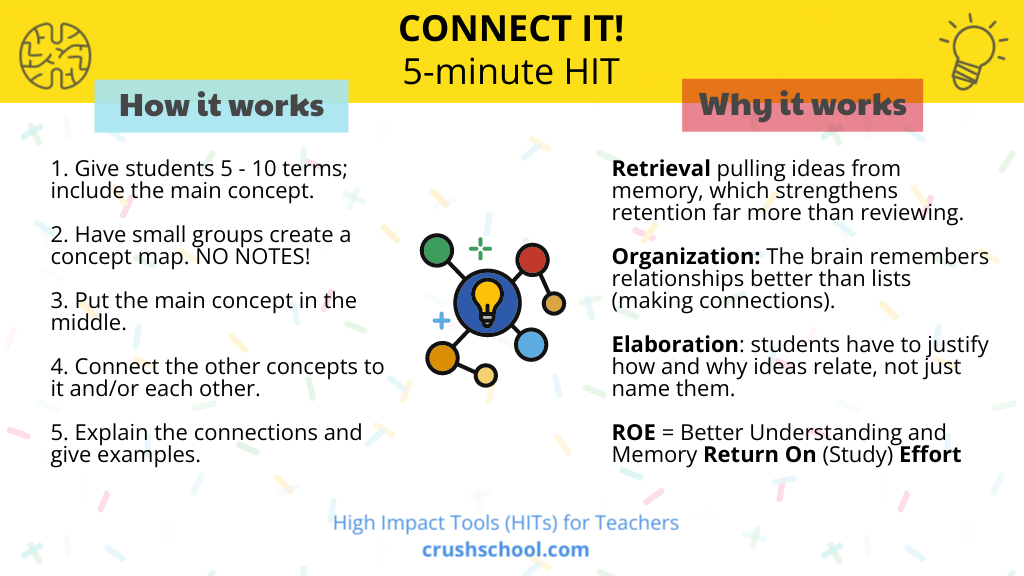
How Connect It Learning Strategy Activates The Brain
Students build a quick concept map from memory.
Not from notes.
Not from Google.
Not from that one kid in class who somehow remembers everything about everything and scares everyone in the process because he’s either an alien or a super-advanced cyborg.
From memory.
They connect terms, explain relationships, and give examples.
That is learning.
How Connect It Works
1. Give Students 5–10 Terms
Include the BIG concept and either or all of these:
vocab
processes
events
formulas
2. No Notes
Students must pull ideas from memory first.
Yes, they will groan dramatically like you just asked them to churn butter manually in the 1800s.
Stay mean. It’s for their own good.
3. Put the Main Concept in the Middle
Everything else connects back to it and/or each other with branches or arrows.
4. Connect the Concepts
Students look for relationships:
causes
effects
similarities
differences
sequences
Then they explain why these things are connected. Don’t just organize. Rationalize.
5. Give Examples
Examples force students to move from memorization to actual understanding.
Because knowing the word is not the same thing as understanding the idea.
Just ask anyone who has nodded through a meeting after hearing “synergize.”
Why Connect It Classroom Activity Improves Learning
1. Retrieval Strengthens Memory
Students pull ideas from memory instead of reviewing.
That struggle is not a system bug. It’s its necessary feature.
Every successful retrieval strengthens the path back (myelination) to that information later.
Staring at text is pretend learning. Recall of facts is memory forming.
2. Organization Builds Better Understanding
The brain remembers relationships better than isolated facts.
Concept maps help students organize knowledge into connected networks instead of random information blobs.
Which is how expertise works.
Experts don’t know more things. They can explain how things connect.
3. Elaboration Deepens Learning
Students must explain:
how concepts relate
why they relate
examples that prove the relationships
That forces more intense thinking instead of surficial memorization.
Translation: Deeper learning occurs when the brain is forced to process information in multiple ways.
Subject-Specific Examples
Science
Main Concept: Ecosystems
Terms:
producers
consumers
decomposers
energy flow
food web
Students connect:
producers → energy flow
decomposers → nutrient cycling
Then explain “Without decomposers, dead material would pile up and nutrients wouldn’t return to the soil.”
Boom. Understanding.
Math
Main Concept: Linear Functions
Terms:
slope
y-intercept
graph
rate of change
equation
Students explain “Slope and rate of change are connected because slope measures how fast something changes.”
Much better than memorizing random symbols and widespread confusion.
ELA
Main Concept: Theme
Terms:
conflict
character
symbolism
setting
evidence
Students connect:
character choices → theme
symbolism → deeper meaning
Then explain why.
Actual literary thinking appears. Yes. Miracles do happen.
Social Studies
Main Concept: Revolution
Terms:
taxes
inequality
protest
government
rights
Students connect:
inequality → protest
protest → revolution
Then explain historical examples.
Now history becomes an interesting story instead of a laundry list of dates.
Pro Tips For Maximum Student Engagement
1. Keep It Messy, not Classy
A concept map is not an art show entry.
If it looks like a clue board from a crime show, you’re probably doing it right.
2. Use Different Colors
Different colors help separate categories and relationships.
Also, students think markers give them superpowers.
3. Make Them Explain Out Loud
The explaining is where the real learning happens.
The map is the vehicle. The students have to hop behind the wheel and drive it.
4. Add One “Mystery Term”
Throw in one slightly unfamiliar or tricky concept.
This forces deeper discussion and problem-solving.
5. Compare Maps Between Groups
Students quickly realize “Ohhhh… you connected those ideas differently.”
That comparison strengthens understanding even more.
The Hidden Superpower: ROE
Return On (Study) Effort
Connect It gives students more learning for the same amount of effort because it combines:
As opposed to re-reading notes and hoping for divine intervention.
Connecting Facts Makes Learning Stick
Learning is stronger when ideas connect, not when students passively review disconnected facts.
Connect It works because students:
retrieve ideas
organize relationships
explain meaning
Which is exactly what the brain needs for learning to last.
Because understanding is not knowing more facts, but seeing how the facts fit together.
Thanks for reading!
Did you find “Connect It” helpful?
Sign up below and get 5 Active Learning Strategies You Can Use Today. It’s 5 Editable Activity Slides you can use in your classroom right away—any time, any subject, zero prep required + 5 Teacher Slides with pro tips and rationale.
BOOKS & TOOLS
Flashcards are okay but there's a better way. The Memory (or Mind) Palace Method is a powerful learning and memorization technique that when mastered allows a student to remember 10, 20, or even 30 vocabulary words or concepts (definitions included) with ease.
And, they actually remember what they learned using memory palaces! This series of lessons (which can be used as classroom handouts) walks students through creating their first memory palace, filling it with information they need to learn, and using it to train their memories. It also contains short readings, a video lesson, memory palace examples, and practice drills.
Fair Use
Feel free to use with your students. Please do not share it with other parties or use for profit. All rights by crushschool.com.

Equity-Promoting Classroom Poster. What does EQUITY in the classroom look like?
Everyone has a different start and finish line
Quality is more important that quantity
Understanding that diversity makes us stronger
Inclusion despite beliefs, appearances, and circumstances
Thoughtfulness lowers barriers and reduces biases
Yesterday's mistakes are today's learning agenda
You can teach your students about equity and make it a daily classroom practice using this inspirational poster, which also includes images that accompany the equity description. You can discuss each letter characteristic with your students as a way of introducing your inclusive classroom and display it prominently as a reminder that diversity makes the classroom community stronger.

In this classroom Mistakes are Expected, Respected, Inspected, Corrected!
Learned helplessness is a result of years of conditioning that mistakes are bad for learning. Nothing is further from the truth - some of the most powerful life lessons come from making mistakes, reflecting on them, and growing as a result.
This is a PNG Poster you can print and display in your classroom to encourage a culture of risk-taking and learning from mistakes.

In this 3- to 4-day lesson, designed for a high school Earth and Space Science classroom, student groups are assigned and investigate 4 leading solutions to the climate change crisis our planet is experiencing. Then, they are called upon to debate against each other to try to convince others that their solution is the most viable and provide counterarguments against other solutions. It’s an intellectual thunderdome in which students are encouraged to use science to attacks each others points of view on climate change but not character.
Why and how does this learning strategy work?
Rote memorization out; seeking answers and deeper learning in.
The debate-style approach to learning is engaging and motivating for learners, because they are challenged to use real evidence and their wits to outmaneuver their opposition.
Not only do they act as investigators, developing communication, collaboration, and argumentation skills but they learn about viable solutions to the climate change conundrum we all find ourselves in. They learn Earth and Space Science content while investigating and debating solutions to a real-world phenomenon, which is what the Next Generation Science Standards (NGSS) call for.
Student Learning and Performance Objectives:
Research multiple, complex climate change solutions to discover that the world is more complicated than a single TikTok trend.
Articulate scientific arguments with actual evidence.
Listen to opposing viewpoints, to hone "social awareness" skills.
Realize that climate change solutions are multi-faceted, messy, and require more than just good vibes.
Describe and support with, not mere belief but actual evidence, the leading climate solutions proposed by, not the coven of online witches but the scientific community.
What's included:
24 slides that introduce, explain, and guide the teacher and students
Detailed teacher notes on prep, main lesson, and follow up activities
General Lesson flow for teacher to follow to make it all seamless
A short and funny “hook” to increase student buy in
Detailed student directions
A list (research starter pack) of links to legit, scientific websites for students to use.
Group roles (team jobs) with descriptions of what each entails.
4 climate change solutions to assign to 4 different student groups
Student Learning and Performance Objectives
Detailed Grading Rubric to guide students and make assessment easy
Debate Day introduction and format description
Follow up discussion questions (reflection and debrief)
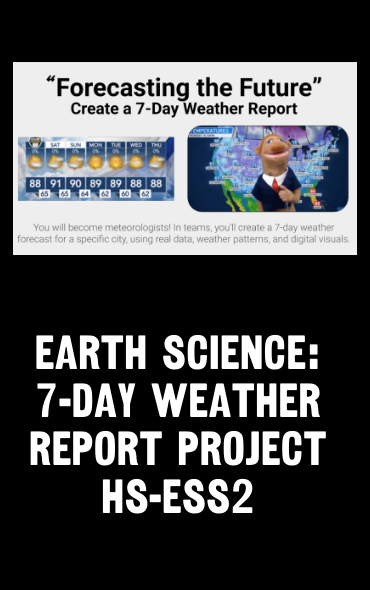
Save planning time with this Atmosphere Unit, 5-day Honors Earth and Space Science Project in which students research, design, create, and present a 7-day weather forecast for a specific city in the US or abroad.
Student Performance and Learning Objectives:
Explain how weather data is collected and interpreted.
Explain how weather patterns may be affected by geography (mountains, plains, valleys etc.).
Explain the atmospheric conditions (pressure, moisture etc.) necessary for different weather (sunny, windy, rainy etc.).
What's included:
16 slides (Google Slides link for easy use and editing to fit your purposes)
Learning Objectives
Group Roles / Jobs (up to 5 with detailed description of jobs)
Detailed Project Directions / Requirements
Materials/Web Resources List
Link to a "Wheel of Names" containing city names - students spin and receive their assigned city.
Link to a grading rubric for student and teacher use (printable doc).
The project follows the guidelines set by the Next Generation Science Standards (NGSS).
Questions?
Email me at oskar@crushschool.com. I’m happy to answer your questions.
Fair Use
Feel free to share and use this resource with your students.
Please do not share it with other parties or use for profit. All rights by crushschool.com.