
3–2–1 Recall: Turn Review Into Real Learning
Students forget things at an almost supernatural speed.
You teach something brilliantly on Monday.
On Wednesday, they stare at you blankly like the information was erased by secret government agents overnight.
And the real kicker? It’s normal.
The brain is not a hard drive, but a squirrel trying to remember where it buried nuts during a tornado.
Enter 3–2–1 Recall.
It’s fast. It works in every subject. It requires almost no prep.
And unlike a 42-slide PowerPoint that not only numbs survival instincts but slowly drains the will to live from everyone involved, students actually think when doing it.
Even better, it’s backed by the science of learning.
Check it out.
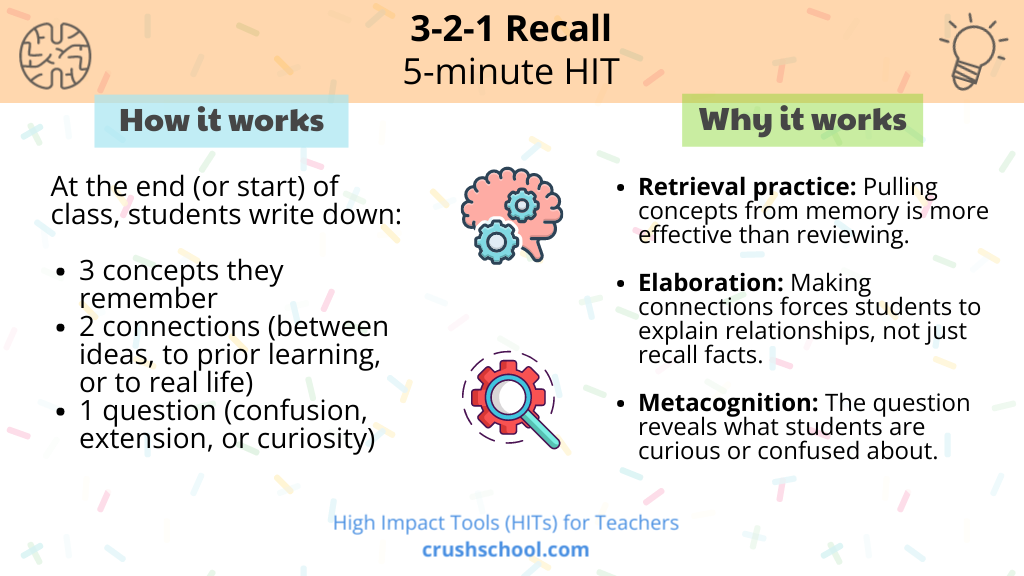
3-2-1 Recall Basics
It’s simple. Students write:
3 things they remember
2 connections
1 question
That’s it. No complicated setup. No color-coded laminated task cards forged in the fires of Pinterest.
Just a whole lotta brain power usage.
How the 3 Tasks Work Together
3 Things You Remember
Students recall 3 important ideas from memory only. No notes. No textbook. No “I’ll just peek real quick.” This is the non-negotiable retrieval part.
2 Connections
Students connect the learning to another topic, prior knowledge, real life (not the fake school one), or another subject.
This makes brains stop just storing information and start organizing it.
1 Question
Students write one thing they still don’t fully understand.
This does two things:
It helps students become aware of what they don’t know.
It prevents you from discovering the confusion three weeks later during the test.
Why 3-2-1 Recall Improves Learning and Retention
1. Retrieval Practice Strengthens Memory
Every time students pull information out of memory (retrieval practice), the memory becomes stronger and easier to access later. Think of it like carving a trail through the woods. The more you walk it, the clearer and more familiar the path becomes.
Reading notes only feels productive. Retrieving from memory actually is productive. Just sayin’.
2. Elaboration Deepens Understanding
The “2 connections” part forces students to explain relationships between ideas. That matters because the brain remembers connected knowledge better than isolated facts. Learning sticks when ideas are woven together instead of floating around separately like lonely little information islands.
3. Metacognition Helps Students Learn Better
The “1 question” forces students to think about their own thinking. Which sounds very philosophical and expensive, but really just means: Whoa… do I actually understand this? Wicked!”
Harnessed, metacognition is a powerful learning skill.
Subject-Specific 3-2-1 Recall Examples
Science
Topic: Weather
3 remember: evaporation, condensation, warm air rises
2 connections: clouds form like condensation on cold drinks; hurricanes need warm water
1 question: why do some clouds make storms and others don’t?
Math
Topic: Linear Equations
3 remember: slope = rate of change; y = mx + b; intercept crosses the y-axis
2 connections: slope relates to speed; graphs and tables show the same relationship
1 question: how do I find slope from two points again?
ELA
Topic: Theme
3 remember: theme is a message; themes need evidence; stories can have multiple themes
2 connections: character choices reveal theme; theme connects to conflict
1 question: can two readers interpret different themes?
Social Studies
Topic: Some Random Revolution (sorry, I’m a science teacher)
3 remember: taxes caused anger; Enlightenment ideas spread; power imbalance creates conflict
2 connections: similar to other revolutions; protests today also involve rights and power
1 question: why do some revolutions succeed while others fail?
Pro Tips For Maximum Engagement
1. Keep It No-Notes First
The struggle is the point. The “Wait… what was THAT called again?” …is your students’ brains getting stronger.
2. Make Students Compare Answers
After writing, pair them up and let them “steal” ideas they forgot. Students love discovering “Oh wow, you remembered THAT?”
3. Keep It Fast
3–5 minutes max. This is a brain sprint, not a hostage situation.
4. Use It More Than Once
The real superpower appears when students revisit old material days later. Spacing dramatically improves long-term retention.
5. Collect and Read the Questions
The “1 question” section is basically free teaching data. It tells you what students misunderstood, what didn’t stick, and what needs reteaching before the test destroys their grades and morale.
Why Quick Retrieval Activities Make Learning Stick
3–2–1 Recall works because it makes students retrieve, connect, and reflect.
It’s simple, fast, and works for every subject.
It turns passive review into active thinking.
And active is where learning is at.
Thanks for reading!
Did you found “3-2-1 Recall” helpful?
Sign up below and get 5 Active Learning Strategies You Can Use Today. It’s 5 Editable Activity Slides you can use in your classroom right away—any time, any subject, zero prep required + 5 Teacher Slides with pro tips and rationale.
BOOKS & TOOLS
Flashcards are okay but there's a better way. The Memory (or Mind) Palace Method is a powerful learning and memorization technique that when mastered allows a student to remember 10, 20, or even 30 vocabulary words or concepts (definitions included) with ease.
And, they actually remember what they learned using memory palaces! This series of lessons (which can be used as classroom handouts) walks students through creating their first memory palace, filling it with information they need to learn, and using it to train their memories. It also contains short readings, a video lesson, memory palace examples, and practice drills.
Fair Use
Feel free to use with your students. Please do not share it with other parties or use for profit. All rights by crushschool.com.
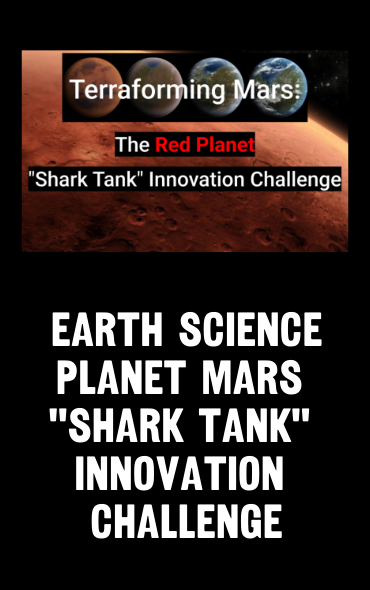
Are your students tired of just reading about Earth? Do they gaze longingly at the night sky, dreaming of a future beyond textbook pages? Excellent! Because today, we're not just learning about science; we're making science. We're launching them into the ultimate entrepreneurial challenge: Terraforming Mars: The Red Planet "Shark Tank" Innovation Challenge!
Forget your quaint little recycling programs. We're talking about taking a dusty, desolate rock and turning it into a vacation spot for humanity.
This isn't just a project; it's a desperate plea from the future (and a cunning way to keep them engaged). Your students will become "Terraforming Tech Startups," armed with nothing but their wits, some internet access, and a burgeoning understanding of how Earth actually works. Because, let's be honest, trying to make Mars habitable without understanding our own planet's life support systems is like trying to bake a cake without knowing what flour is.
Prepare for an explosion of creativity (hopefully not literal, on Mars or in your classroom) as they grapple with the fundamental cycles that make life possible. The competitive drive to secure that "virtual investment" (and bragging rights) will channel all their boundless energy into productive, scientific output. Just try to keep the "mad scientist" cackles to a minimum.
Student Learning and Performance Objectives:
Demonstrate understanding of the Carbon, Water, Nitrogen, and Oxygen cycles.
Apply your knowledge of the principles of these cycles to design an ecosystem on a different planet (e.g. Mars).
Illustrate how biogeochemical cycles support life in a closed system (Earth, Mars colony, dome ecosystem etc.).
Pitch your solutions to practice collaboration, critical thinking, and creative problem-solving/design.
What's included:
20 slides that introduce, explain, and guide the teacher and students
Introductory popcorn reading activity
Research Guide (G-doc link): Includes Note-taking space and links to reputable websites for students to use.
Project timeline and detailed tasks for each day
Group Roles explained in detail
Detailed teacher notes on prep, main lesson, and best practices
List of materials
Student Learning and Performance Objectives
Grading Rubric and Peer Evaluation Form

Equity-Promoting Classroom Poster. What does EQUITY in the classroom look like?
Everyone has a different start and finish line
Quality is more important that quantity
Understanding that diversity makes us stronger
Inclusion despite beliefs, appearances, and circumstances
Thoughtfulness lowers barriers and reduces biases
Yesterday's mistakes are today's learning agenda
You can teach your students about equity and make it a daily classroom practice using this inspirational poster, which also includes images that accompany the equity description. You can discuss each letter characteristic with your students as a way of introducing your inclusive classroom and display it prominently as a reminder that diversity makes the classroom community stronger.

In this 3- to 4-day lesson, designed for a high school Earth and Space Science classroom, student groups are assigned and investigate 4 leading solutions to the climate change crisis our planet is experiencing. Then, they are called upon to debate against each other to try to convince others that their solution is the most viable and provide counterarguments against other solutions. It’s an intellectual thunderdome in which students are encouraged to use science to attacks each others points of view on climate change but not character.
Why and how does this learning strategy work?
Rote memorization out; seeking answers and deeper learning in.
The debate-style approach to learning is engaging and motivating for learners, because they are challenged to use real evidence and their wits to outmaneuver their opposition.
Not only do they act as investigators, developing communication, collaboration, and argumentation skills but they learn about viable solutions to the climate change conundrum we all find ourselves in. They learn Earth and Space Science content while investigating and debating solutions to a real-world phenomenon, which is what the Next Generation Science Standards (NGSS) call for.
Student Learning and Performance Objectives:
Research multiple, complex climate change solutions to discover that the world is more complicated than a single TikTok trend.
Articulate scientific arguments with actual evidence.
Listen to opposing viewpoints, to hone "social awareness" skills.
Realize that climate change solutions are multi-faceted, messy, and require more than just good vibes.
Describe and support with, not mere belief but actual evidence, the leading climate solutions proposed by, not the coven of online witches but the scientific community.
What's included:
24 slides that introduce, explain, and guide the teacher and students
Detailed teacher notes on prep, main lesson, and follow up activities
General Lesson flow for teacher to follow to make it all seamless
A short and funny “hook” to increase student buy in
Detailed student directions
A list (research starter pack) of links to legit, scientific websites for students to use.
Group roles (team jobs) with descriptions of what each entails.
4 climate change solutions to assign to 4 different student groups
Student Learning and Performance Objectives
Detailed Grading Rubric to guide students and make assessment easy
Debate Day introduction and format description
Follow up discussion questions (reflection and debrief)
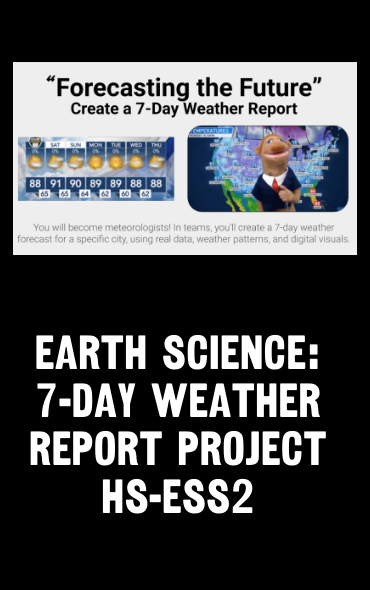
Save planning time with this Atmosphere Unit, 5-day Honors Earth and Space Science Project in which students research, design, create, and present a 7-day weather forecast for a specific city in the US or abroad.
Student Performance and Learning Objectives:
Explain how weather data is collected and interpreted.
Explain how weather patterns may be affected by geography (mountains, plains, valleys etc.).
Explain the atmospheric conditions (pressure, moisture etc.) necessary for different weather (sunny, windy, rainy etc.).
What's included:
16 slides (Google Slides link for easy use and editing to fit your purposes)
Learning Objectives
Group Roles / Jobs (up to 5 with detailed description of jobs)
Detailed Project Directions / Requirements
Materials/Web Resources List
Link to a "Wheel of Names" containing city names - students spin and receive their assigned city.
Link to a grading rubric for student and teacher use (printable doc).
The project follows the guidelines set by the Next Generation Science Standards (NGSS).
Questions?
Email me at oskar@crushschool.com. I’m happy to answer your questions.
Fair Use
Feel free to share and use this resource with your students.
Please do not share it with other parties or use for profit. All rights by crushschool.com.

In this classroom Mistakes are Expected, Respected, Inspected, Corrected!
Learned helplessness is a result of years of conditioning that mistakes are bad for learning. Nothing is further from the truth - some of the most powerful life lessons come from making mistakes, reflecting on them, and growing as a result.
This is a PNG Poster you can print and display in your classroom to encourage a culture of risk-taking and learning from mistakes.