
Classroom Strategy To Get Students To Pay Attention
One of the biggest problems in school is that students often start class cold. Mentally, I mean.
You begin the lesson, but their brains are still somewhere else: lunch, that hallway conversation, a star bball player making an insane play last night, their TikTok follower count… literally anything except class content.
What are we to do?
Talk louder? Maybe get mad a little and show them who’s boss?
That might work in the moment, but it’s stressful.
And sustained attention doesn’t work that way.
The brain is more drawn to uncertainty, novelty, and unanswered questions.
Enter the Prediction Mystery, one of the simplest and most effective classroom engagement strategies teachers can use to grab students’ attention and keep them focused long enough they forget they have smartphones.
The Prediction Mystery Classroom Activity
It takes only a minute, creates instant curiosity, and gets students mentally invested before the lesson even begins.
If that sounds like magic… well, it kind of is.
It’s one of those cool science supported teaching strategies that feels more like a puzzle to solve than schoolwork.
But underneath the mystery and suspense, it’s learning that works.
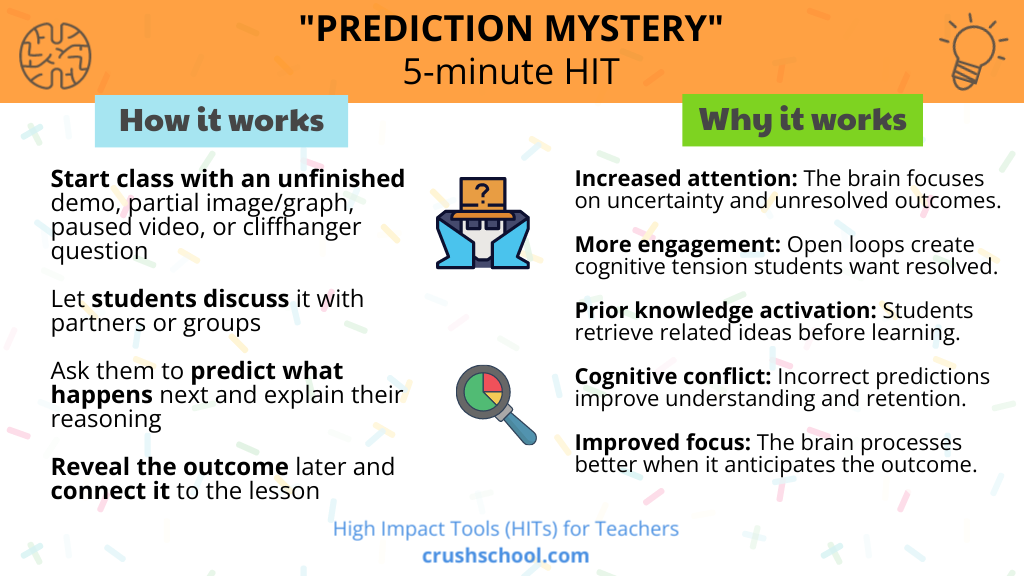
How Prediction Mystery Works
Start class with something unfinished or unresolved:
an unfinished demonstration
a partial graph
a paused video
half a story
a strange image
a cliffhanger question
Then ask:
“What do you think happens next?”
“Which outcome is most likely?”
“What strategy would work best here?”
Students:
make a prediction
explain their reasoning
discuss ideas with a partner or small group
Then, lead into the lesson. You can:
design the lesson so it leads to students uncovering the mystery
give student groups different paths to follow to find clues
or, reveal the outcome later and connect the explanation to the content being learned
That’s it. Simple setup. Huge attention boost.
It’s one of those easy high impact teaching strategies that immediately changes classroom energy.
Why Prediction Mystery Strengthens Learning
The Brain Is a Prediction Machine
The brain constantly tries to predict outcomes and close “open loops.” When something feels unfinished, our attention increases because we want closure.
That’s why cliffhangers work in movies and why Prediction Mystery works in classrooms.
Unanswered questions create cognitive tension the brain wants resolved.
Curiosity Increases Attention
Students struggle with attention when activities are passive.
Making them curios changes that. When students wonder “What will happen?” their brains become more alert and engaged.
This is one reason strong brain based teaching strategies often use novelty, uncertainty, suspense, and prediction.
The trick is to create anticipation before content is introduced, which is what Prediction Mystery does.
Prediction Activates Prior Knowledge
Before students learn something new, their brains search memory for related ideas and experiences.
Prediction makes this happen automatically. Students begin retrieving concepts, examples, past experiences, and misconceptions.
That matters because activating prior knowledge helps students connect new learning more effectively.
Wrong Predictions = More Effective Learning
One of the most powerful parts of this strategy happens when students are wrong. When predictions do not match reality, the brain experiences cognitive conflict “Man… I really thought this would work differently.”
The “belief-reality” mismatch forces the brain to update understanding.
This process strengthens memory and improves learning far more than simply being told the correct answer immediately.
That’s why prediction works very well as an engaging retrieval practice activity disguised as a mystery.
Why Students Keep Attention and Maintain Focus
Students naturally enjoy surprises, mysteries, suspense, predicting, and debating. The strategy creates instant mental investment because students want to know if they’re right.
Even reluctant learners tend to participate because there is no single obvious answer, discussion feels low-risk, they’re curious themselves, and they also want “the reveal.”
That’s what effective student centered learning strategies do: They pull students into the learning instead of pushing information on them.
Classroom Examples
Science
Hold up two beakers before mixing their contents and ask “What do you think will happen?”
Math
Display an unfinished graph and ask “How will it trend?”
ELA
Pause halfway through a story and ask “What do you think the character did?”
Social Studies
Present a historical dilemma and ask “What do you think happened next?”
Pro Tips
Don’t Reveal the Answer Too Fast
The tension is key. Let them sit in the uncertainty and work toward solving it.
Require Reasoning
Always ask “Why?”, because deeper thinking lives in its answers.
Use Partner Discussion
Quick discussion increases verbal processing and participation.
Make Predictions Safe
Wrong answers should feel normal—not embarrassing. Tell students the goal is thinking, not wizardry.
Bottom Line
Students pay attention when their brains have something unresolved to solve.
The Prediction Mystery works because it combines anticipation, curiosity, prediction, retrieval, cognitive conflict, and discussion into one simple classroom activity.
It’s fast. It’s engaging. It doesn’t just get students invested before the lesson—it is the best part of it.
That’s not just entertainment. That’s actual learning.
Sign Up below to get more high impact tools (HITs) like Prediction Mystery.
My new book High Impact Teaching Tools: 100 Brain-Based Strategies for Building Better Learners is set for release on August 1st and I plan to offer it at 50% off to the first 100 buyers, so sign up to get notified when it drops.
BOOKS & TOOLS
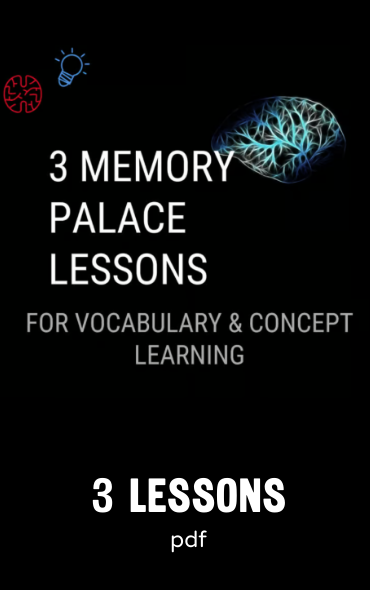
Flashcards are okay but there's a better way. The Memory (or Mind) Palace Method is a powerful learning and memorization technique that when mastered allows a student to remember 10, 20, or even 30 vocabulary words or concepts (definitions included) with ease.
And, they actually remember what they learned using memory palaces! This series of lessons (which can be used as classroom handouts) walks students through creating their first memory palace, filling it with information they need to learn, and using it to train their memories. It also contains short readings, a video lesson, memory palace examples, and practice drills.
Fair Use
Feel free to use with your students. Please do not share it with other parties or use for profit. All rights by crushschool.com.

Equity-Promoting Classroom Poster. What does EQUITY in the classroom look like?
Everyone has a different start and finish line
Quality is more important that quantity
Understanding that diversity makes us stronger
Inclusion despite beliefs, appearances, and circumstances
Thoughtfulness lowers barriers and reduces biases
Yesterday's mistakes are today's learning agenda
You can teach your students about equity and make it a daily classroom practice using this inspirational poster, which also includes images that accompany the equity description. You can discuss each letter characteristic with your students as a way of introducing your inclusive classroom and display it prominently as a reminder that diversity makes the classroom community stronger.

In this classroom Mistakes are Expected, Respected, Inspected, Corrected!
Learned helplessness is a result of years of conditioning that mistakes are bad for learning. Nothing is further from the truth - some of the most powerful life lessons come from making mistakes, reflecting on them, and growing as a result.
This is a PNG Poster you can print and display in your classroom to encourage a culture of risk-taking and learning from mistakes.

In this 3- to 4-day lesson, designed for a high school Earth and Space Science classroom, student groups are assigned and investigate 4 leading solutions to the climate change crisis our planet is experiencing. Then, they are called upon to debate against each other to try to convince others that their solution is the most viable and provide counterarguments against other solutions. It’s an intellectual thunderdome in which students are encouraged to use science to attacks each others points of view on climate change but not character.
Why and how does this learning strategy work?
Rote memorization out; seeking answers and deeper learning in.
The debate-style approach to learning is engaging and motivating for learners, because they are challenged to use real evidence and their wits to outmaneuver their opposition.
Not only do they act as investigators, developing communication, collaboration, and argumentation skills but they learn about viable solutions to the climate change conundrum we all find ourselves in. They learn Earth and Space Science content while investigating and debating solutions to a real-world phenomenon, which is what the Next Generation Science Standards (NGSS) call for.
Student Learning and Performance Objectives:
Research multiple, complex climate change solutions to discover that the world is more complicated than a single TikTok trend.
Articulate scientific arguments with actual evidence.
Listen to opposing viewpoints, to hone "social awareness" skills.
Realize that climate change solutions are multi-faceted, messy, and require more than just good vibes.
Describe and support with, not mere belief but actual evidence, the leading climate solutions proposed by, not the coven of online witches but the scientific community.
What's included:
24 slides that introduce, explain, and guide the teacher and students
Detailed teacher notes on prep, main lesson, and follow up activities
General Lesson flow for teacher to follow to make it all seamless
A short and funny “hook” to increase student buy in
Detailed student directions
A list (research starter pack) of links to legit, scientific websites for students to use.
Group roles (team jobs) with descriptions of what each entails.
4 climate change solutions to assign to 4 different student groups
Student Learning and Performance Objectives
Detailed Grading Rubric to guide students and make assessment easy
Debate Day introduction and format description
Follow up discussion questions (reflection and debrief)
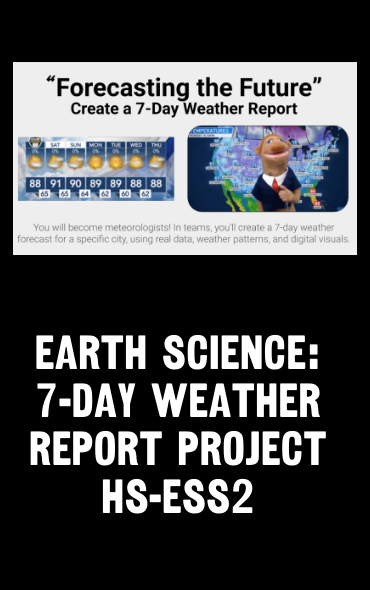
Save planning time with this Atmosphere Unit, 5-day Honors Earth and Space Science Project in which students research, design, create, and present a 7-day weather forecast for a specific city in the US or abroad.
Student Performance and Learning Objectives:
Explain how weather data is collected and interpreted.
Explain how weather patterns may be affected by geography (mountains, plains, valleys etc.).
Explain the atmospheric conditions (pressure, moisture etc.) necessary for different weather (sunny, windy, rainy etc.).
What's included:
16 slides (Google Slides link for easy use and editing to fit your purposes)
Learning Objectives
Group Roles / Jobs (up to 5 with detailed description of jobs)
Detailed Project Directions / Requirements
Materials/Web Resources List
Link to a "Wheel of Names" containing city names - students spin and receive their assigned city.
Link to a grading rubric for student and teacher use (printable doc).
The project follows the guidelines set by the Next Generation Science Standards (NGSS).
Questions?
Email me at oskar@crushschool.com. I’m happy to answer your questions.
Fair Use
Feel free to share and use this resource with your students.
Please do not share it with other parties or use for profit. All rights by crushschool.com.
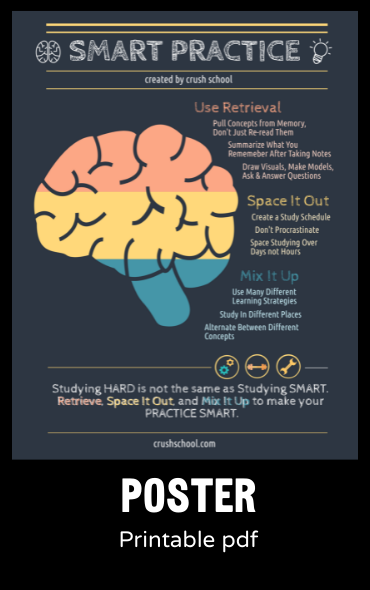
Retrieval Practice, Spaced Practice, and Mixed Practice (Interleaving).
Studying Hard is not the same as Studying Smart. This High Quality printable, digital (PNG) poster is a constant classroom reminder of best practices for teachers and learning the smart way for students.