
The Curse of Knowledge: What Teachers Forget About Learning

What feels simple and familiar to a teacher can be confusing and overwhelming to a student.
“I’m scared for this test,” says Nate, one of my chemistry students, on Wednesday.
The test is Friday.
“It’s too much stuff to learn for our little brains,” he continues.
I almost laugh. Instead, I smile.
Is he serious? I wonder. No way. He can't be.
“It’s a pretty short unit, Nate. We’ve only covered three things—the periodic table, electron configurations, and periodic trends. That’s it!” I say, as though naming just three things somehow makes them simple.
“Yeah, but it feels like a lot of stuff. And it's confusing.”
And he's not wrong.
“I hear you. This stuff is hard. That's why we practice. We've been practicing every day, but I'm not sure you've put in the time to really learn it.”
And there I go. Lecturing. Again. I didn't mean to, but somehow we've arrived here anyway.
…
It's Friday.
Nate failed the test. Badly.
Before the bell, I tried to prop him up, offer encouragement, maybe convince him that his doom was not yet written. But he'd already called himself cooked.
And, honestly, I suspected.
But what was I supposed to say?
“Go on, Nate. Take the test and take your F like a champ!”
Or perhaps serve him some motivational bullshit:
“You got this! Just believe and you’ll achieve!”
Nah.
I ninety-percent thought he was cooked as well.
And I’m also aware that I'm the chef serving up these harsh meals. More often than I'd like. But harsh is high school education.
So if you're reading this and thinking that's messed up, I'm right there with you. Chem tests aren't last meals, but there are days when I feel like the grim reaper of adolescent confidence, the inadvertent bringer of school despair.
It’s because I’m cursed.
The Curse of Knowledge
It's an affliction teachers often succumb to. The more we know, the harder it becomes to imagine what it's like not to.
We forget how difficult things were to learn because they're simple to us now. What once required major effort—focus, struggle, and multiple attempts—has become effortless. Automatic. Instinctive.
And then somewhere along the way, we start mistaking our concept familiarity with their perceived simplicity.
I know I do. More often than I realize.
Remember what I told Nate on Wednesday?
“We've only covered three things.”
Only. One little word. One big problem. Lurking, creeping, sneering.
The curse of knowledge.
So what are we to do? How do we break this hex?
We can't unlearn, demolish what we've spent years building, nor should we. Expertise is a good thing. It allows us to teach. But we need to become better at remembering what it was like before we knew. A little intellectual humility might just be the right countercurse. Not just to help students learn more, but to help us see what they're struggling to learn in the first place.
What We Teach Isn’t Always What Students Learn
I've explained electron configurations and periodic trends hundreds of times over the years. Give me a periodic table and I can do it all without much thinking.
But Nate? He's still trying to remember why there's 4s before 3d, what superscripts are for, and why electrons seem to follow rules invented by someone with too much time and not enough compassion.
To me, it’s all connected—one topic. To him, an unfamiliar scatter of ideas, symbols, patterns, rules. What my brain processes almost automatically, his is still struggling to piece together. And that takes a lot of attention, effort, and precious working memory.
That's the problem. The more automatic something becomes for us, the more likely we are to rush through or skip the steps that make it understandable to others. What looks like one small step to us might seem like six to students.
And there it is. The curse of knowledge rears its smug little head once more.
The lesson?
Next time I explain something challenging, I need to take more time. Slow down enough to see the steps invisible to me before. Break concepts into smaller chunks. Make thinking visible by showing students not just what to do, but how I got there and the reason for it.
Practice Doesn’t Always Equal Learning
I told Nate we'd been practicing every day. We had. But that's not the same as saying he'd been learning every day.
A student can complete a problem with notes open, examples on the board, and a peer whispering the next steps. They follow, fill in blanks, and finish; every answer correct. And yet, when Friday comes and the help disappears, so does the understanding.
It's not that they learned nothing, but they may not have learned enough. Not enough to retrieve and use the information by themselves.
Which makes me wonder… Is some practice I think successful just students following along?
That’s a distinction worth reflection.
I want to know whether my students are really learning. I need to see what they can do without me, not just recognize the right answer when it's in front of them. Can they produce it on their own? Can they explain and use it to solve something somewhat unfamiliar?
This means I need to give them chances to retrieve the info from their brains, explain their reasoning, and work through problems without leaning on their notes or my examples. Forget the time constraints and damn the “covering of everything.”
And when they struggle, I must get better at figuring out what the struggle is about rather than rescuing them with the answer.
Then comes the often tricky fix: knowing when to shut up and step back.
Show them, guide them, support them. Then gradually remove the training wheels and see if they can ride without you.
Get Better At Finding Out What Students Don't Understand
When Nate told me the material was confusing, I told him that we'd practiced it.
Chew on that for a few seconds.
He told me he was struggling. I told him what we’d done. Brilliant teaching it was not.
I should have asked him to show me. Give him a question, have him explain it and his thinking. Ask him to write an electron configuration on his own and see how far he’d get. Have him describe what happens to an atom’s size across a period, down a group, and why. Not to catch him being wrong, but to see where his knowing falls apart.
Maybe he knows the trend, but doesn't understand nuclear charge or shielding? Maybe he can write a configuration, but can’t explain what the notation shows? Maybe he's missing something small. Maybe the gap is fundamental.
Those are different problems that require different approaches.
“I don't get it” tells us little about what the student needs. Thinking communicates much more.
We need to ask better questions. Get students to show us what they know, what they don't, and where their understanding falls apart. Then model, guide, and scaffold accordingly.
Let’s make it visible while there's still time to act.
Remember That Understanding Is Built, Not Delivered
I can explain something beautifully, draw the perfect diagram, and create the most engaging activity imaginable, but none of that guarantees learning. Students still have to do the mental work of connecting new ideas to what they already know. This involves retrieving information, correcting mistakes, and applying what they've learned.
We can create the right conditions for this kind of work. We can design better practice, provide feedback, manage complexity, and make abstract ideas easier to understand.
But we can't do the learning for them.
Nate has a lot of responsibility here. He needs to participate, practice, and put in the effort. I can't crawl into his brain matter and arrange his neurons into a beautiful understanding of periodic trends.
And believe me, there are days I wish I could Antman that mofo.
But my responsibility is to make sure I'm not confusing my understanding with his. And maybe that's the lesson I needed from that Friday test.
In all truth I don't know if Nate would have passed had I approached Wednesday differently.
Maybe he needed to study. Maybe he needed more, better, smarter practice. Maybe he was missing some basic understanding and I had failed to notice it. It might have been a combination of all these things.
What I do know now is that he told me something wasn't working, and my first instinct was to preach—remind him what we had done and what he hadn’t.
The curse of knowledge at work. Not because I know chemistry too well, but because, for a moment, I dismissed how much he still had to learn.
It’s fortunate that the curse of knowledge is a problem of not knowledge but perspective. It’s not about knowing too much, but about forgetting what it's like to know too little.
Turn out, we both knew too little.
Nate needed to learn more chemistry. I needed to learn more about Nate.
For activities that help you teach more thoughtfully and students learn more effectively check out my book Spark. Wire. Fire. on Amazon.
BOOKS & TOOLS
Flashcards are okay but there's a better way. The Memory (or Mind) Palace Method is a powerful learning and memorization technique that when mastered allows a student to remember 10, 20, or even 30 vocabulary words or concepts (definitions included) with ease.
And, they actually remember what they learned using memory palaces! This series of lessons (which can be used as classroom handouts) walks students through creating their first memory palace, filling it with information they need to learn, and using it to train their memories. It also contains short readings, a video lesson, memory palace examples, and practice drills.
Fair Use
Feel free to use with your students. Please do not share it with other parties or use for profit. All rights by crushschool.com.

Equity-Promoting Classroom Poster. What does EQUITY in the classroom look like?
Everyone has a different start and finish line
Quality is more important that quantity
Understanding that diversity makes us stronger
Inclusion despite beliefs, appearances, and circumstances
Thoughtfulness lowers barriers and reduces biases
Yesterday's mistakes are today's learning agenda
You can teach your students about equity and make it a daily classroom practice using this inspirational poster, which also includes images that accompany the equity description. You can discuss each letter characteristic with your students as a way of introducing your inclusive classroom and display it prominently as a reminder that diversity makes the classroom community stronger.
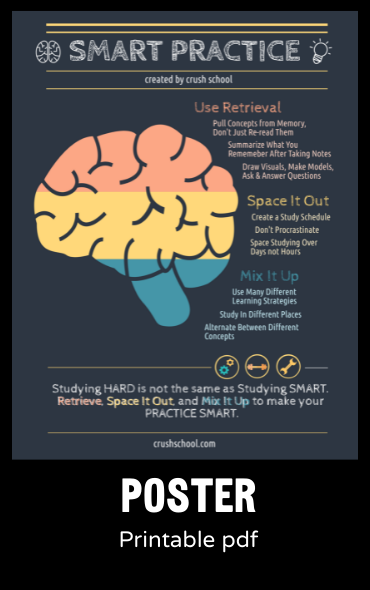
Retrieval Practice, Spaced Practice, and Mixed Practice (Interleaving).
Studying Hard is not the same as Studying Smart. This High Quality printable, digital (PNG) poster is a constant classroom reminder of best practices for teachers and learning the smart way for students.

In this classroom Mistakes are Expected, Respected, Inspected, Corrected!
Learned helplessness is a result of years of conditioning that mistakes are bad for learning. Nothing is further from the truth - some of the most powerful life lessons come from making mistakes, reflecting on them, and growing as a result.
This is a PNG Poster you can print and display in your classroom to encourage a culture of risk-taking and learning from mistakes.
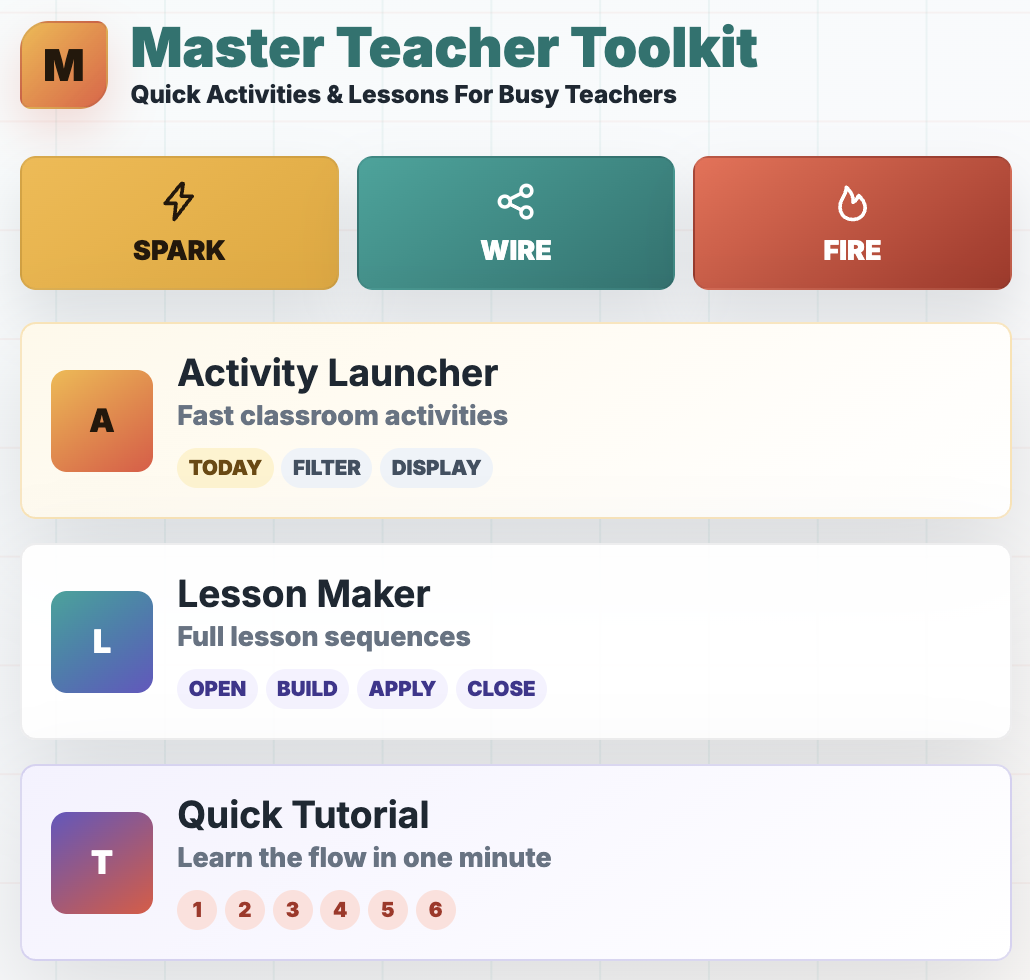
Teaching App
Launch engaging, deeper learning activities and lessons in seconds. Then, launch and display them to students instantly.
NEW BOOK
100+ practical activities teachers can use right away with little or no prep.