
The Best EdTech Tool I've Ever Used In My Classroom
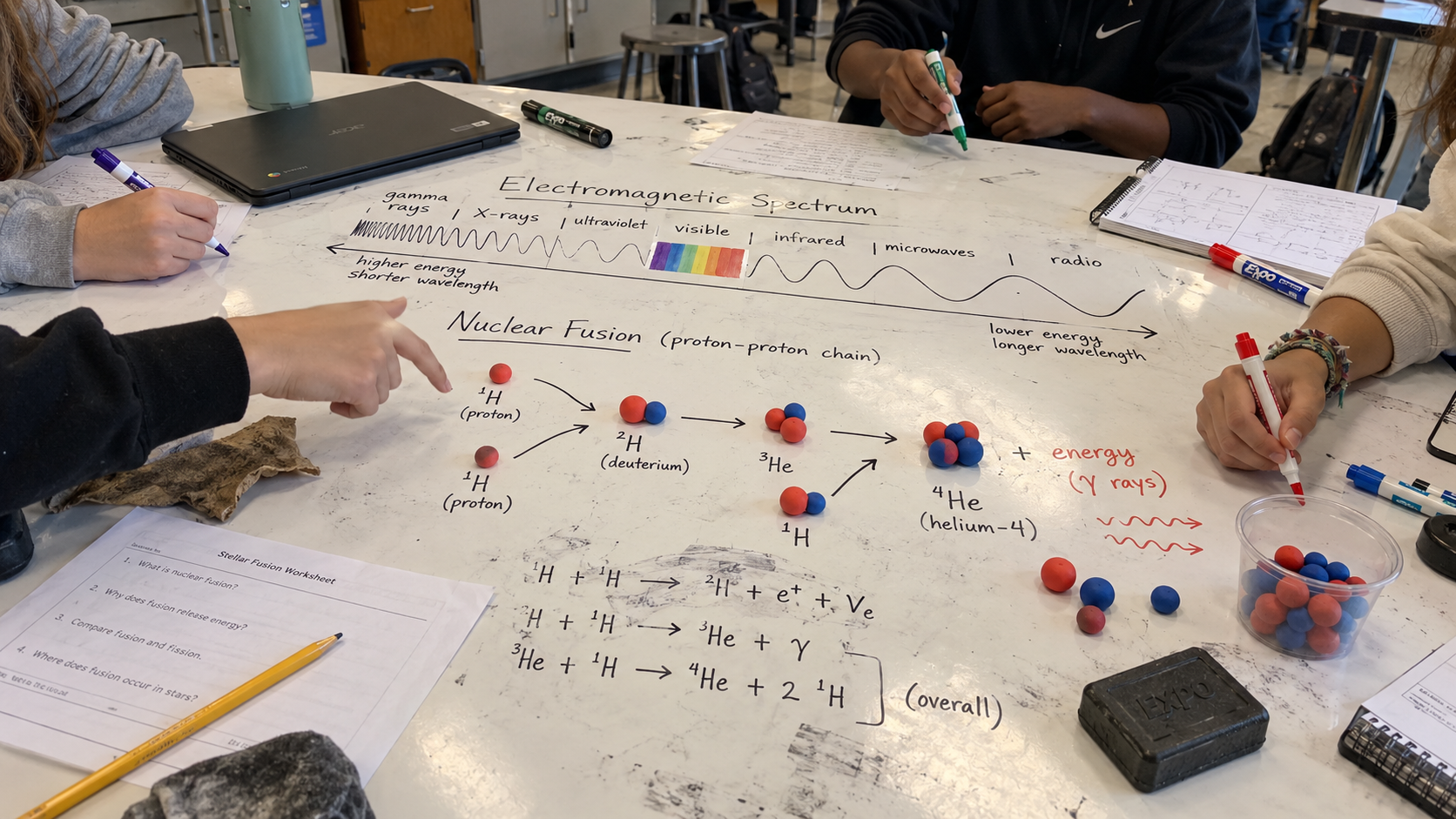
The best EdTech I've ever used doesn't need Wi-Fi, a password, or a software update. Just a marker, a whiteboard table, and a few brains willing to struggle.
I’ve been thinking a lot about technology, learning, and fractured focus lately.
And I don’t have to look very far to see what fractured focus looks like…
Barely a month into his high school career, a freshman is trying to finish his ranked Brawl Stars match while I’m trying to get everyone settled and start class. I suppose he’s boldly announcing to the world that “You gotta fight for your right to… to… phone?”
I take his phone and he lets me. He knows I’ll give it back at the end of class.
Keeping track of phones and the names they belong to, passing these artifacts up the chain of command, and dealing with the administrative circus that follows is not something I signed up for or have the time for.
And I'm not holding my breath for some schoolwide magic disappearing these distraction devices en masse.
But not in my classroom. Not today.
“No tech today,” I say, but I’m lying. Sort of.
“No phones. No laptops. No nothing.”
No notes either; I give them whiteboard markers and ask them to recall the waves of the electromagnetic spectrum in order. Then, I ask them to briefly elaborate on what each one is about with a partner.
“Raging monkeys invade Venus using X-ray guns,” I see some using the mnemonic I conjured with AI help just yesterday.
Underneath the silly monkey sentence, they write “Radio, microwave, infrared, visible, ultraviolet, x-ray, and gamma,” and they proceed to retrieve whatever memories their brains have stored of what transpired yesterday in earth science. Some put it down on their tables. Some retrieve it via conversation.
In retrospect, I should have asked my students to come up with their own memory devices yesterday. Make it tech-free and the struggle real. Yeah—it would take longer, but pay bigger dividends, I reckon now.
Because learning happens when the brain is allowed to struggle and so much of what tech has allowed—with AI clearly in the lead—is about making things easier.
But easy is the enemy of learning. I’d say “true learning,” but does any other kind exist?
But it’s not what this story is about.
We do the warm-up for a few minutes, then discuss it as a class.
Then, I give my students a one-page handout on the Sun’s nuclear fusion to continue the narrative of stars producing the energy that powers the universe. Yes, there are other processes than fusion involved in making all of the EM waves, but it all starts in stars’ cores so we soldier on.
I tell them to make a diagram of nuclear fusion from Hydrogen-1 through Helium-4 and to make sure that every person in the group understands each step of the “nuclear fusion story,” because I’ll be coming around later asking questions.
I also tell them each person must answer at least one question, but I’m targeting the weakest links. I’m coming for their lives! In the most academic sense possible though…
Protons? Neutrons? Clay balls of two different colors. Markers are used to draw arrows, label isotopes, and show release of particles and gamma rays.
Then, they practice—they point at objects and words they conjured on their tables as they talk each other through the process.
A PE teacher stops by because I forgot to email back with my Trimester 2 schedule and he can’t figure out when to yank my kids for embedded health three months from now.
“What class is this?” he asks as he looks at the table where I’m grilling the next group.
“Earth science,” I say and apologize for lack of speedy communication.
“You’re doing this with 9th graders? It’s some heavy stuff,” he adds.
“It’s Honors, and they can handle it,” I reply and confirm my Tri 2 schedule is the same as the one now.
Because they can handle it. The content is tougher to grasp for some students at first, but that’s okay—we’re stretching their brains. They help each other. Not all of them understand everything when I get to their table, but through a magical combination of peer explanation, my help, and what sometimes feels like divine intervention, we all arrive.
Whiteboard tables and markers—the best edtech I’ve ever used. Hands down and it’s not even close.
Visible thinking and learning.
Retrieval practice and dual coding.
Drawing out abstract concepts from the realms of science—physics, chemistry, earth, and environment.
Problem solving with me, together, and on their own.
I walk around and see what my students are doing. I never truly did see when they did stuff in their notebooks, and my myopia is only part to blame.
No hiding. Do or do not; there is no try, but if they do “do it wrong,” I can help and correct them. I can walk them through the problem mano a mano, then give them another one and come back and check. Rinse and repeat the grind of the mind kind.
Before school, after school, and during class.
I painted the tables when I went flex seating back in 2016. It was supposed to be a cool add-on, but became the biggest game changer for student learning and my teaching.
I had no idea of the impact it would have. It was a pure luck choice, but here I am glad it worked out like it did.
Yeah, it’s a pain in the ass to repaint them every year, but it’s worth it.
Yeah, whiteboard markers are somewhat pricey and I have to ask parents for donations and sometimes apply for grants, but it’s worth it.
Yeah, my school is being remodeled right now, and the prospect of new “nice” furniture is looming, and I wonder if my always-dirty, work-in-progress whiteboard tables fit the scheme, but I’ll think of something because it’s worth it.
I’m not going back because it’s the best edtech I’ve ever used.
For 100+ ready-to-use activities that help students think, retrieve, connect, and apply, check out my book Spark. Wire. Fire. on Amazon.
If you want faster access to bell ringers, exit tickets, mid-lesson checks, and other active learning strategies, check out my Teaching Apps.
BOOKS & TOOLS
Flashcards are okay but there's a better way. The Memory (or Mind) Palace Method is a powerful learning and memorization technique that when mastered allows a student to remember 10, 20, or even 30 vocabulary words or concepts (definitions included) with ease.
And, they actually remember what they learned using memory palaces! This series of lessons (which can be used as classroom handouts) walks students through creating their first memory palace, filling it with information they need to learn, and using it to train their memories. It also contains short readings, a video lesson, memory palace examples, and practice drills.
Fair Use
Feel free to use with your students. Please do not share it with other parties or use for profit. All rights by crushschool.com.

Equity-Promoting Classroom Poster. What does EQUITY in the classroom look like?
Everyone has a different start and finish line
Quality is more important that quantity
Understanding that diversity makes us stronger
Inclusion despite beliefs, appearances, and circumstances
Thoughtfulness lowers barriers and reduces biases
Yesterday's mistakes are today's learning agenda
You can teach your students about equity and make it a daily classroom practice using this inspirational poster, which also includes images that accompany the equity description. You can discuss each letter characteristic with your students as a way of introducing your inclusive classroom and display it prominently as a reminder that diversity makes the classroom community stronger.
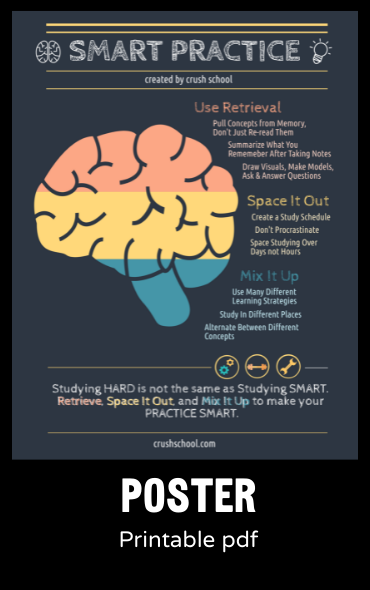
Retrieval Practice, Spaced Practice, and Mixed Practice (Interleaving).
Studying Hard is not the same as Studying Smart. This High Quality printable, digital (PNG) poster is a constant classroom reminder of best practices for teachers and learning the smart way for students.

In this classroom Mistakes are Expected, Respected, Inspected, Corrected!
Learned helplessness is a result of years of conditioning that mistakes are bad for learning. Nothing is further from the truth - some of the most powerful life lessons come from making mistakes, reflecting on them, and growing as a result.
This is a PNG Poster you can print and display in your classroom to encourage a culture of risk-taking and learning from mistakes.
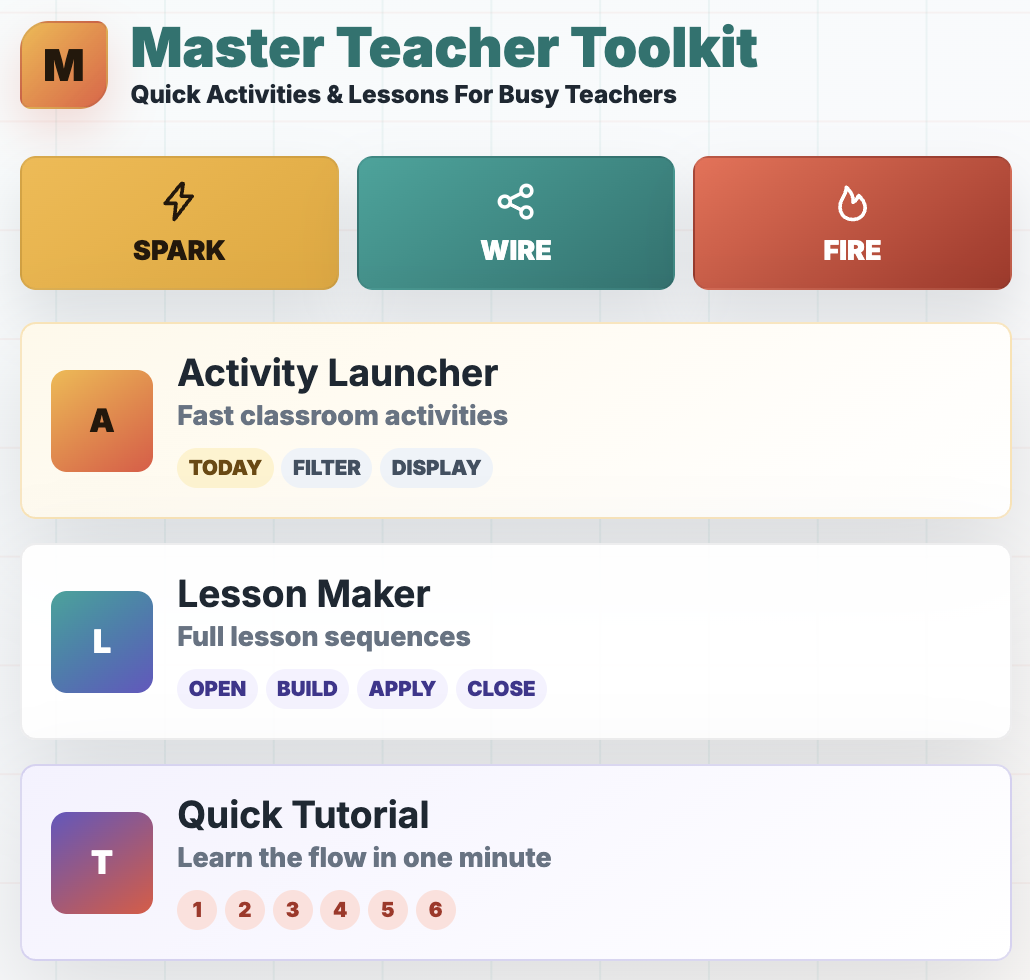
Teaching App
Launch engaging, deeper learning activities and lessons in seconds. Then, launch and display them to students instantly.
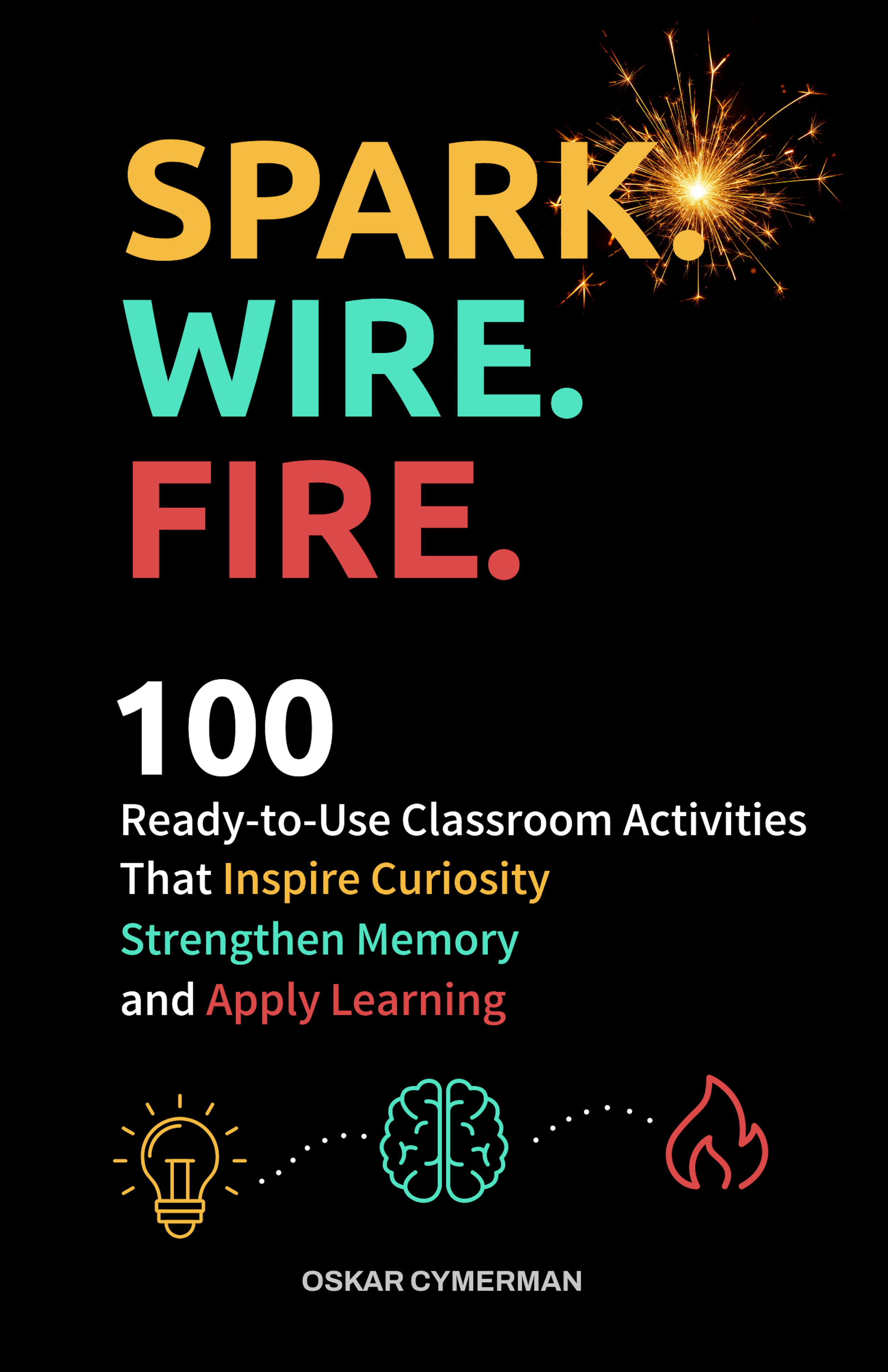
NEW BOOK
100+ practical activities teachers can use right away with little or no prep.