
The Biggest Mistake I Made This Year
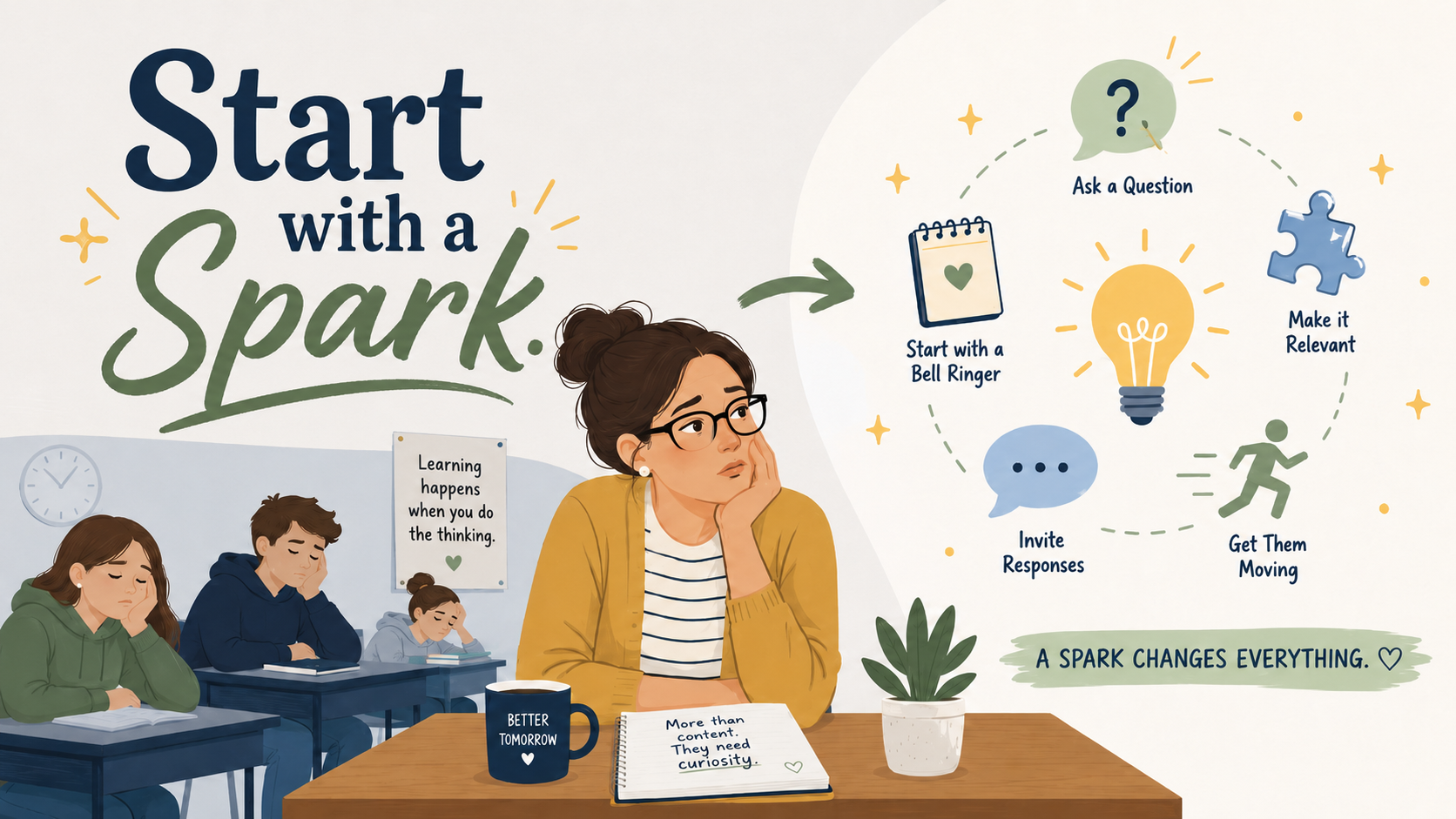
Sometimes the biggest teaching mistake is skipping the spark. A strong bell ringer or lesson hook helps students activate prior knowledge, focus attention, and enter the learning before the lesson begins.
The biggest mistake I made this year wasn’t a failed lesson, a bad lab setup, or one of those assignments that looked good in my head and then completely bombed in the classroom.
It was simpler than that.
Too often, I skipped the spark.
The truth is that I know better. I knew better…
I really did, but some days I was tired. Some days I felt lazy. Some days too much was going on in my brain or at school and I couldn’t summon enough energy to start class with something clever, active, or interesting.
So I did what many teachers do when we’re exhausted.
I’d start with something like:
“Homies, take out your Chromies.” - kind of clever but not the kind I’m going for. I’d follow with, “Here’s what we’re doing today.”
Class started, but learning didn’t always start the way I’d like.
My classes are very project-based. If you mix it up and provide a variety instead of “doing another poster,” students really enjoy and learn from these challenges. Most of the time, the projects I design—infographics explaining and giving examples of concepts visually, animations that show how processes work, educational videos that teach others various scientific ideas, engineering challenges that force students to brainstorm, collaborate, ideate, and apply what they’re learning, and others—last between two to five days. And, much of the time, I let students get right into them as soon as they get to class.
Nothing wrong with such agency—they wanted to “get to it” to get it done, but the part I kept noticing (and not correcting) was that on these projects days my students would really benefit from a quick bell ringer or hook—something connecting to the ideas they were learning during the course of the project.
Skipping the opening spark left some students “cold.” Their brains were still in the hallway, at lunch, on their phones, in yesterday’s drama, or already thinking about what they were doing after school.
I was ready to help and teach them, but they were not always ready to learn.
There was a gap I wasn’t noticing or doing anything about.
A good bell ringer, lesson hook, attention getter, or movement-based opener is not just a cute activity. It is not something we do because Pinterest said so.
It is the spark.
And the spark matters because the brain needs a reason to pay attention.
Before students can learn something new, they need to activate what they already know. They need a point of curiosity—a question, puzzle, prediction, image, mistake, or challenge that pulls their attention toward the learning.
That is what good lesson hooks do. They prime the brain for learning, activate prior knowledge, or create curiosity. Some of them accomplish all three.
But more importantly, they make students mentally available before we ask them to work with and process new information.
And when I skipped that step, I often paid for it later.
The lesson or project became harder. The explanations took longer. Students needed more redirection and reminders. The room felt flatter.
Not every time, of course, but often enough to realize when I reflected later.
The days I started with a strong spark were different.
A weird object on the front table. A wrong answer on the board. A prediction prompt before a demonstration I was about to do. A quick team challenge. A movement-based opinion question. A visual puzzle.
Suddenly, students were looking, talking, arguing, guessing, laughing, remembering, and asking questions.
It’s like magic, but that’s what attention and engagement can look like.
And attention is the gateway to learning.
This is one of the ideas behind my new book, Spark. Wire. Fire.: 100 Ready-to-Use Classroom Activities That Inspire Curiosity, Strengthen Memory, and Apply Learning.
The structure is simple:
Spark students’ interest.
Wire the learning into memory.
Fire it through application.
The Spark section includes 20 engaging priming, attention, movement, bell ringer, lesson hook, and attention-getter activities designed to help students enter the learning before the lesson really begins.
Here’s one I call Mystery Reveal:
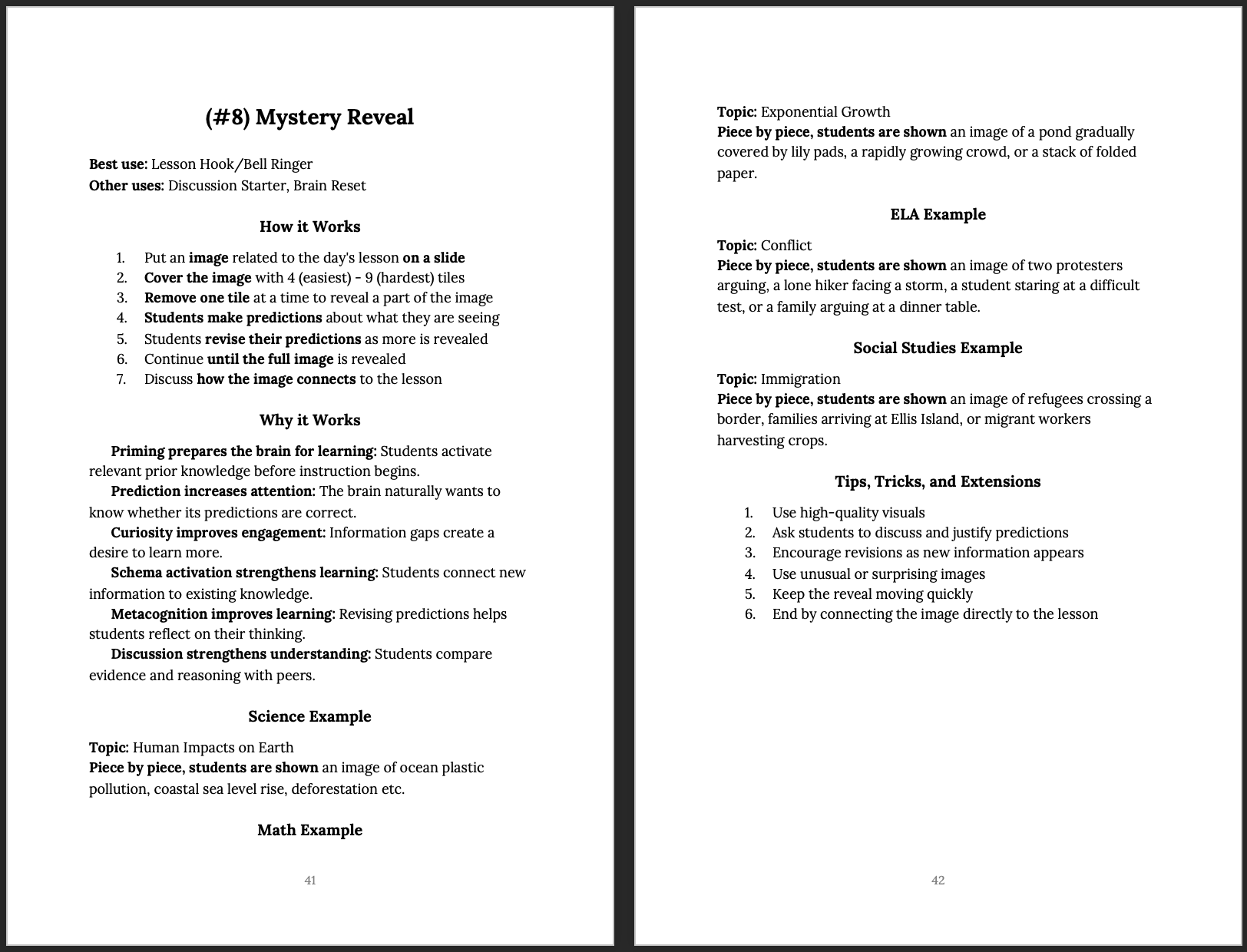
Mystery Reveal: A Spark Activity from Oskar Cymerman’s new book: Spark. Wire. Fire.: 100 Ready-to-Use Classroom Activities That Inspire Curiosity, Strengthen Memory, and Apply Learning.
Each activity in the book is intentional. I didn’t know it when I started writing it, but the book has become a vehicle for me to become a better teacher.
Reflecting on how I can do better, researching why certain strategies work while others don’t, and creating engaging and meaningful classroom activities brought about a renewed understanding of what learning is and what teaching can look like—impactful, rewarding, and, yes, fun.
The Spark. Wire. Fire. book is a way of telling myself: “Here are the tools. Use them. No more excuses.”
I’m planning on it because I’m not trying to repeat my mistakes.
For one, I will not assume students are ready just because class has started.
I need to help them get ready by sparking their attention and interest.
If you’re curious how I’ll do it, the Kindle version of Spark. Wire. Fire. is now out and available for free for the first 48 hours. I’d love for you to check it out and grab your copy on Amazon. The promotion expires at midnight on Thursday, July 2.
No pressure.
Beacause if you’ve ever skipped the spark because you were tired, overwhelmed, or just trying to survive the day, I get it.
I’ve done it too. I don’t feel bad or dwell on it. It is what it is, because teaching ain’t no cakewalk.
I’m just trying to do it less and do a little better each time I get out there.
My new book Spark. Wire. Fire.: 100 Ready-to-Use Classroom Activities That Inspire Curiosity, Strengthen Memory, and Apply Learning is about giving teachers ideas and practical examples you can use to make your lessons more engaging, memorable, and impactful.
The paperback is coming July 15th.
The kindle version in now out and available for free for the first 48 hours. If you’re curious, I’d love for you to check it out and grab your copy on Amazon. The promotion expires at midnight on Thursday, July 2nd.
BOOKS & TOOLS

Equity-Promoting Classroom Poster. What does EQUITY in the classroom look like?
Everyone has a different start and finish line
Quality is more important that quantity
Understanding that diversity makes us stronger
Inclusion despite beliefs, appearances, and circumstances
Thoughtfulness lowers barriers and reduces biases
Yesterday's mistakes are today's learning agenda
You can teach your students about equity and make it a daily classroom practice using this inspirational poster, which also includes images that accompany the equity description. You can discuss each letter characteristic with your students as a way of introducing your inclusive classroom and display it prominently as a reminder that diversity makes the classroom community stronger.

In this classroom Mistakes are Expected, Respected, Inspected, Corrected!
Learned helplessness is a result of years of conditioning that mistakes are bad for learning. Nothing is further from the truth - some of the most powerful life lessons come from making mistakes, reflecting on them, and growing as a result.
This is a PNG Poster you can print and display in your classroom to encourage a culture of risk-taking and learning from mistakes.
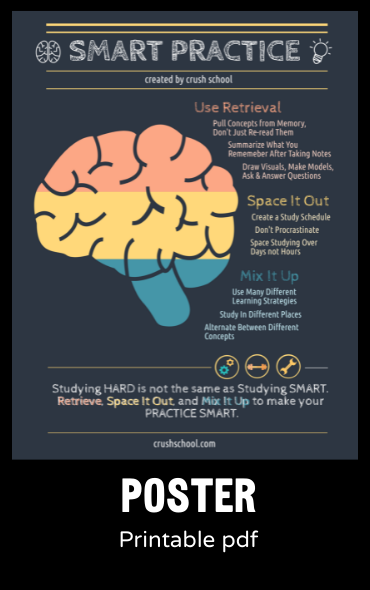
Retrieval Practice, Spaced Practice, and Mixed Practice (Interleaving).
Studying Hard is not the same as Studying Smart. This High Quality printable, digital (PNG) poster is a constant classroom reminder of best practices for teachers and learning the smart way for students.
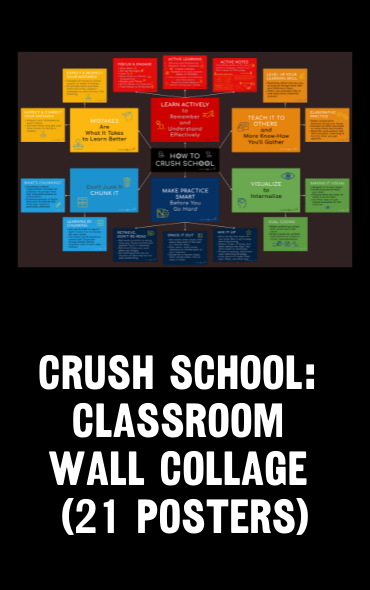
Classroom Wall Collage designed to promote effective, research-based, active learning strategies. Consists of 6 categories:
Learn Actively (Active Learning Strategies to avoid passive learning)
Mistakes Are What It Takes to Learn (Promoting a classroom culture of making and learning from mistakes and why such learning is effective)
Don’t Junk It, Chunk It (How to use the brain chunking technique)
Make Practice Smart (How to use smart and intentional study strategies instead of regurgitating and cramming information)
Visualize to Internalize (Dual Coding Strategy)
Teach It To Others (How to use what you learn to teach others to in turn learn it on a deeper level)
Each category includes 2 or 3 more specific descriptions of how it should be used. And, it rhymes for extra swag and student retention!
A total of 21 posters. Upon payment, you will be directed to a Google Drive link, which gives you 24 hours to copy the folder containing all 21 images to your Google Drive to use for educational purposes only.