
Word Unscramble: Fun and Engaging End-of-the-School-Year Activity Students Love
By mid-May, students are mentally cooked.
Their brains scrambled by the grind of the school year, even simple classroom tasks feel like a battle.
That’s why the end of the school year is not the time for long lectures, giant packets, or passive review.
Quick wins—this is what students need.
Also, movement, challenge, novelty, and interaction.
In other words, they need active learning strategies that keep the brain awake.
One of my favorite end-of-the-year classroom engagement strategies is incredibly simple.
Word Unscramble
It takes about five minutes, requires almost no prep, and students genuinely get into it.
Better yet—it secretly primes the brain for learning before the lesson even begins.
That’s learning that works.
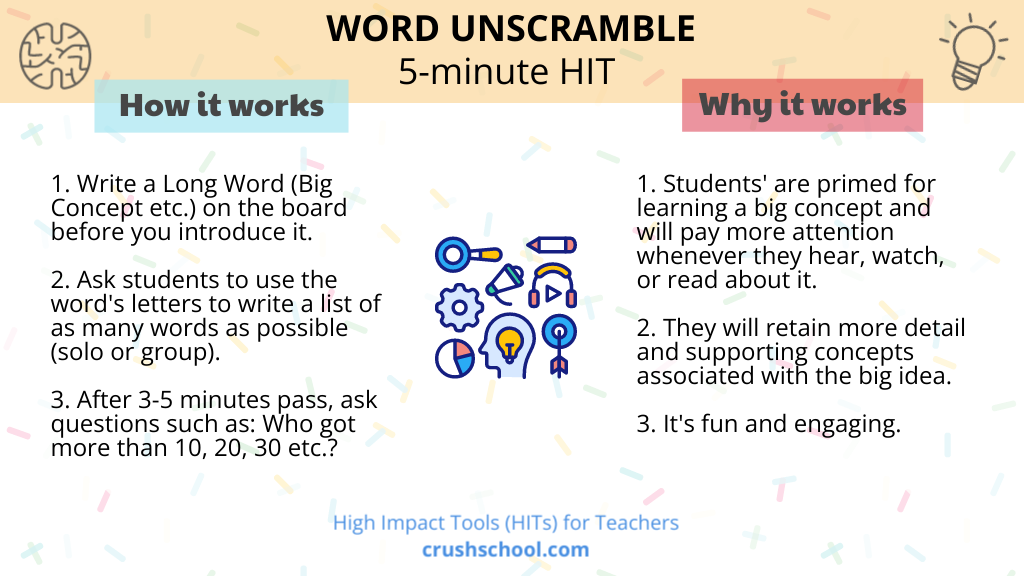
How Word Unscramble Works (5 Minutes)
Before introducing the lesson, write a large academic vocabulary word, concept, or unit term on the board.
Examples:
stoichiometry
characterization
probability
industrialization
Students work individually or in small groups to create as many smaller words as possible using only the letters from the larger word.
No phones. No tech. Just brains and letters from the original word.
Give them 3 minutes. Time it too and give them the 30 second warning and the “3, 2, 1 stop!” countdown.
Then compare totals:
“Who got more than 10?”
“More than 20? 30? 40?”
“Who’s got the weirdest word?”
“Who found the longest word?”
Finally, transition into the lesson connected to the larger concept.
That’s it.
Simple. Fast. Competitive. Engaging.
It’s one of those easy high impact teaching strategies that immediately changes classroom energy.
Why It Helps Learning and Gets Engagement
The Brain is Primed for Learning
One of the most effective brain based teaching strategies is preparing students to notice important information (priming) before instruction or input even starts.
By repeatedly looking at, processing, and manipulating a large academic term, students become more familiar with the structure of the word, spelling patterns, prefixes and suffixes, visual recognition, and pronunciation.
That familiarity makes the concept easier to process later during the lesson.
The brain learns patterns first and Word Unscramble helps build those patterns before content instruction begins and understanding starts forming.
Immediate Attention Activation
The brain pays attention to interesting things: challenges, puzzles, novelty, uncertainty, competition etc.
That’s exactly why this works so well as a bell ringer or engagement hook.
Instead of passively sitting and waiting for class to start, students immediately begin thinking, discussing, searching, and competing. The activity creates instant cognitive engagement without feeling like traditional schoolwork.
This is what effective student-centered learning strategies do—they shift students from passive observers into active participants.
It Improves Encoding and Retention
Students are not just glancing at the word once. They repeatedly process the concept behind it visually and mentally for several minutes.
That repetition improves encoding and recognition.
Later in the lesson, when students encounter the larger academic concept again, it already feels familiar.
This matters because familiarity reduces cognitive load and improves retention. It’s one reason teachers value activating prior knowledge so much—the brain learns new information more effectively when something already feels familiar. It’s also why short, simple, science-backed teaching strategies outperform longer passive, mind-numbing activities that overload attention and working memory.
Simply, the brain values and remembers what it repeatedly notices and uses.
Why Students Actually Enjoy It
Most review activities feel predictable. Students expect worksheets, packets, note-taking, and the teacher talking.
Word Unscramble feels like a game. Students collaborate, compete, laugh, and challenge each other the same way they do outside of class. Even reluctant learners tend to participate because the activity feels low-risk and playful.
That matters a lot during the end-of-the-school-year energy “shortage.”
Pro Tips For Increasing Student Learning and Motivation
Use Long Academic Terms: the longer the word, the better the activity
Examples: photosynthesis, characterization, reconstruction
Keep It Short: the activity works because it stays fast-paced
Use Groups: Small teams increase participation and energy
Transition Into the Lesson Immediately: connect the large word directly to the day’s lesson while students are already mentally engaged.
Bottom Line
Word Unscramble is simple, fast, competitive, and surprisingly effective.
It combines puzzle-solving, vocabulary exposure, and classroom energy into one quick activity that helps students focus before learning even begins.
That’s not just fun. That’s good teaching and learning that works. Because disengaged brains don’t need more information—they need reactivation.
The solution to end-of-year burnout isn’t harsher tone. It’s better structure—one that recognizes the adolescent brain.
Because once students mentally leave for the summer, lectures won’t bring them back.
But active learning just might.
Want more easy to implement, high impact strategies like Word Unscramble?
Sign up below and get 5 Active Learning Strategies You Can Use Today. It’s 5 Editable Activity Slides you can use in your classroom right away—any time, any subject, zero prep required + 5 Teacher Slides with pro tips and rationale.
My new book High Impact Teaching Tools: 100 Brain-Based Strategies for Building Better Learners is set for release on August 1st and I plan to offer it at 50% off to the first 100 buyers, so sign up to get notified when it drops.
BOOKS & TOOLS
Flashcards are okay but there's a better way. The Memory (or Mind) Palace Method is a powerful learning and memorization technique that when mastered allows a student to remember 10, 20, or even 30 vocabulary words or concepts (definitions included) with ease.
And, they actually remember what they learned using memory palaces! This series of lessons (which can be used as classroom handouts) walks students through creating their first memory palace, filling it with information they need to learn, and using it to train their memories. It also contains short readings, a video lesson, memory palace examples, and practice drills.
Fair Use
Feel free to use with your students. Please do not share it with other parties or use for profit. All rights by crushschool.com.

Equity-Promoting Classroom Poster. What does EQUITY in the classroom look like?
Everyone has a different start and finish line
Quality is more important that quantity
Understanding that diversity makes us stronger
Inclusion despite beliefs, appearances, and circumstances
Thoughtfulness lowers barriers and reduces biases
Yesterday's mistakes are today's learning agenda
You can teach your students about equity and make it a daily classroom practice using this inspirational poster, which also includes images that accompany the equity description. You can discuss each letter characteristic with your students as a way of introducing your inclusive classroom and display it prominently as a reminder that diversity makes the classroom community stronger.

In this classroom Mistakes are Expected, Respected, Inspected, Corrected!
Learned helplessness is a result of years of conditioning that mistakes are bad for learning. Nothing is further from the truth - some of the most powerful life lessons come from making mistakes, reflecting on them, and growing as a result.
This is a PNG Poster you can print and display in your classroom to encourage a culture of risk-taking and learning from mistakes.
Make Lesson Planning Easier
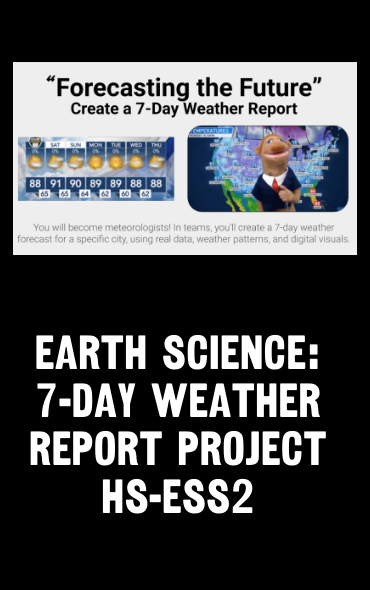
Save planning time with this Atmosphere Unit, 5-day Honors Earth and Space Science Project in which students research, design, create, and present a 7-day weather forecast for a specific city in the US or abroad.
Student Performance and Learning Objectives:
Explain how weather data is collected and interpreted.
Explain how weather patterns may be affected by geography (mountains, plains, valleys etc.).
Explain the atmospheric conditions (pressure, moisture etc.) necessary for different weather (sunny, windy, rainy etc.).
What's included:
16 slides (Google Slides link for easy use and editing to fit your purposes)
Learning Objectives
Group Roles / Jobs (up to 5 with detailed description of jobs)
Detailed Project Directions / Requirements
Materials/Web Resources List
Link to a "Wheel of Names" containing city names - students spin and receive their assigned city.
Link to a grading rubric for student and teacher use (printable doc).
The project follows the guidelines set by the Next Generation Science Standards (NGSS).
Questions?
Email me at oskar@crushschool.com. I’m happy to answer your questions.
Fair Use
Feel free to share and use this resource with your students.
Please do not share it with other parties or use for profit. All rights by crushschool.com.
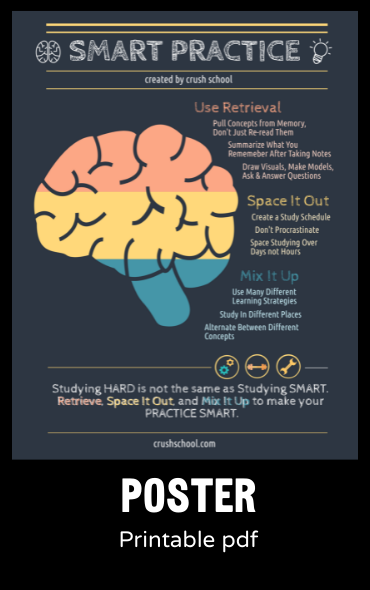
Retrieval Practice, Spaced Practice, and Mixed Practice (Interleaving).
Studying Hard is not the same as Studying Smart. This High Quality printable, digital (PNG) poster is a constant classroom reminder of best practices for teachers and learning the smart way for students.