
5-Minute Classroom Strategies That Motivate and Promote Learning
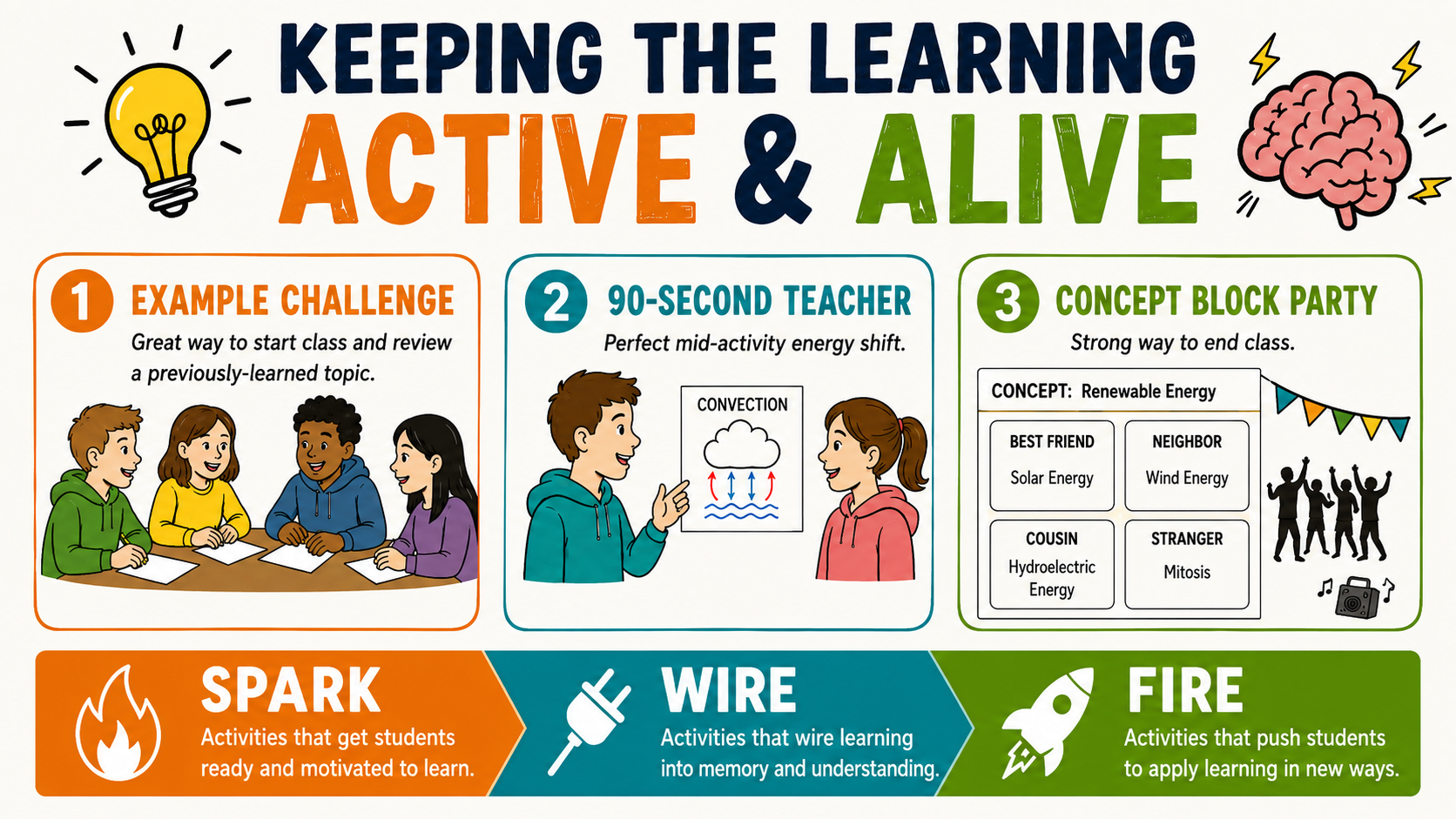
Short classroom strategies like Example Challenge, 90-Second Teacher, and Concept Block Party help students stay engaged before, during, and after longer learning activities.
Long classroom activities can be great.
Labs, projects, discussions, simulations, stations, writing tasks, problem-solving days, and group work all have a place in the classroom and are sometimes exactly what is needed.
But even the best of such activities can lose steam if teachers use them too frequently and students start drifting, rushing, waiting, zoning out, or pretending to work while their brains check out.
That’s where short classroom strategies save the day.
Not cute little activities we toss in when we have time, but intentionally-placed, short classroom engagement strategies that help students start strong, refocus in the middle, or end class with learning still active in their minds.
A quick spark before instruction begins.
A short reset between longer tasks.
A fast retrieval check that solidifies learning before students bounce.
It is precisely such small moves that keep the energy, attention, and thinking from taking a hike—bathroom requests notwithstanding—during a full class period.
Keeping the Learning Active and Alive
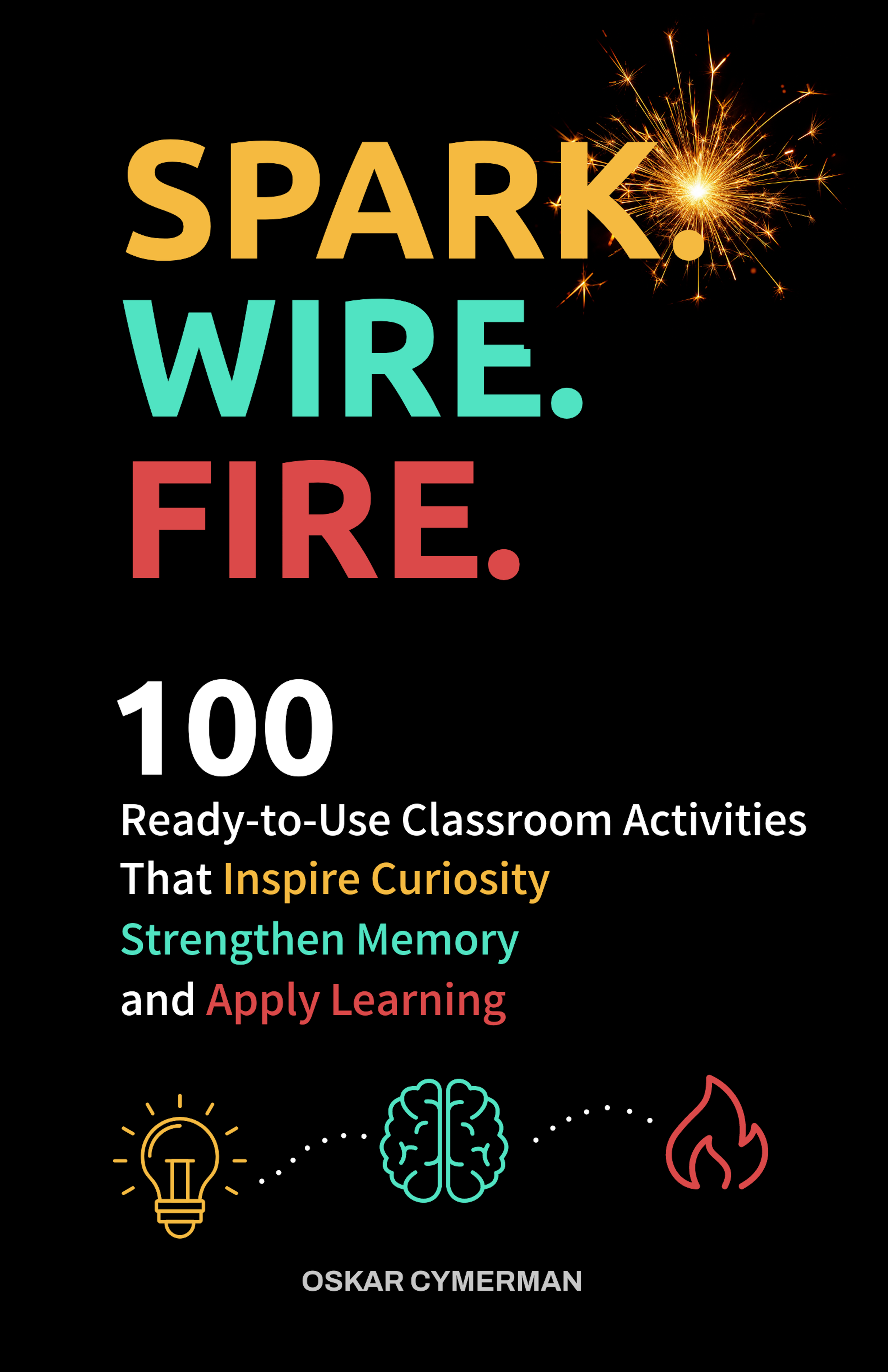
Keeping the learning alive is one of the main themes of Spark. Wire. Fire.
The book organizes activities into three big categories:
Spark activities help student brains get ready and motivated for the learning—bell ringers, lesson hooks, curiosity prompts, prediction activities, and quick challenges that grab attention and activate prior knowledge.
Wire activities wire learning into memory through retrieval practice activities, drawing tasks, partner explanations, concept connections, and review moves that help students remember, organize, and explain what they’re learning.
Fire activities push students to apply learning by asking students to use ideas, defend thinking, solve problems, make decisions, create artifacts, or transfer learning to new situations.
The framework works because student engagement is about helping students do something meaningful with the learning, not about just keeping them busy.
A good 5-minute strategy can work extremely well at the beginning of class, between longer classroom activities, or at the end of the period.
At the beginning, it can wake up curiosity.
In the middle, it can bring students back before attention completely disappears.
At the end, it can help students retrieve, summarize, connect, or apply what they learned.
Here are three examples from Spark. Wire. Fire.
1. Example Challenge
This is a great way to start class and review a previously-learned topic.
Instead of giving students an age-old “What is…” question, put them in small groups and give them a concept, process, vocabulary term, or skill to review.
Ask groups to list as many accurate examples of the concept as possible in 2-3 minutes. When the time is up, groups count their examples, compare totals, and brag who got the most because it’s fun. Then, ask each group to share and explain one example they generated.
This works because students like (read: are actually motivated by) such low-stakes competitions, they have to retrieve what they know, and they have to use it—apply through example-making. They are not just copying the right answer Google or Chat gave them. They are collaborating, generating, comparing, analyzing, and explaining.
And that, my friends, beats “take out your notes and get your pencils ready” one-hundred percent of the time.
2. 90-Second Teacher
This is a perfect “show me what you got” in the middle of a longer activity when students need a quick energy shift.
Give students a concept, process, example, vocabulary term, or problem. They get 90 seconds to prepare a quick explanation for a partner. They can sketch, label, or create a simple example, but they cannot just copy a definition.
They have to teach it in their own words and drawings.
Explaining something forces students to organize their thinking. If they cannot explain the idea in their own words, they probably do not understand it as well as they thought.
It also gives every student a job. Nobody gets to disappear into the furniture for twenty minutes while one student does all the thinking.
3. Concept Block Party
This is a strong way to end class.
Students are given a concept to come up with four "block partiers" for: (1) Best Friend = most closely connected concept, (2) Neighbor = frequently associated concept, (3) Cousin = related but less directly connected concept, and (4) Stranger = Concept that does not belong.
To make it more powerful, have them rationalize their associations. Then they can compare with a partner and discuss disagreements and alternative answers.
This turns the end of class into retrieval practice and application of learning instead of a chaotic countdown to the bell.
Students have to pull information from memory, decide what matters, connect ideas, and notice what they still do not understand. Teachers also get a quick look at what stuck and what needs more attention the next day.
Learning that Works 5 Minutes at a Time
The real power of 5-minute strategies is that they make student thinking visible without taking over the whole lesson. You do not need to redesign your entire class. You just need small moments where students stop passively receiving information and start actively using it.
Start with a spark.
Pause to wire the learning into memory.
End with a fire that pushes students to apply, explain, or connect what they learned.
That is how short activities can support longer classroom activities instead of interrupting them.
Because the goal is not to fill five minutes, but to use them well.
If you want simple ways to turn quiet work into deeper thinking, Spark. Wire. Fire. available on Amazon includes 100+ ready-to-use activities for curiosity, memory, and application. Paperback regular price: $19.95.
The Master Teacher Toolkit app gives you classroom activities you can launch and display instantly when you need something better than “finish this quietly.”
BOOKS & TOOLS
Flashcards are okay but there's a better way. The Memory (or Mind) Palace Method is a powerful learning and memorization technique that when mastered allows a student to remember 10, 20, or even 30 vocabulary words or concepts (definitions included) with ease.
And, they actually remember what they learned using memory palaces! This series of lessons (which can be used as classroom handouts) walks students through creating their first memory palace, filling it with information they need to learn, and using it to train their memories. It also contains short readings, a video lesson, memory palace examples, and practice drills.
Fair Use
Feel free to use with your students. Please do not share it with other parties or use for profit. All rights by crushschool.com.

Equity-Promoting Classroom Poster. What does EQUITY in the classroom look like?
Everyone has a different start and finish line
Quality is more important that quantity
Understanding that diversity makes us stronger
Inclusion despite beliefs, appearances, and circumstances
Thoughtfulness lowers barriers and reduces biases
Yesterday's mistakes are today's learning agenda
You can teach your students about equity and make it a daily classroom practice using this inspirational poster, which also includes images that accompany the equity description. You can discuss each letter characteristic with your students as a way of introducing your inclusive classroom and display it prominently as a reminder that diversity makes the classroom community stronger.
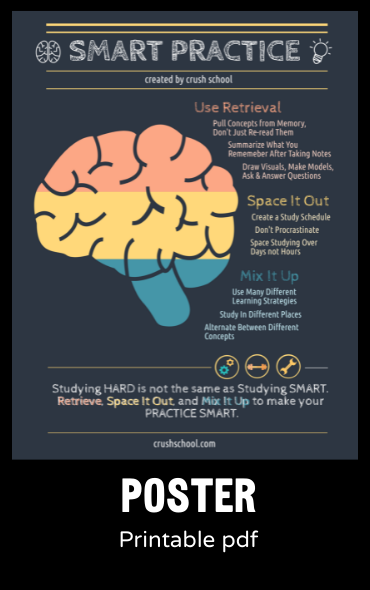
Retrieval Practice, Spaced Practice, and Mixed Practice (Interleaving).
Studying Hard is not the same as Studying Smart. This High Quality printable, digital (PNG) poster is a constant classroom reminder of best practices for teachers and learning the smart way for students.

In this classroom Mistakes are Expected, Respected, Inspected, Corrected!
Learned helplessness is a result of years of conditioning that mistakes are bad for learning. Nothing is further from the truth - some of the most powerful life lessons come from making mistakes, reflecting on them, and growing as a result.
This is a PNG Poster you can print and display in your classroom to encourage a culture of risk-taking and learning from mistakes.
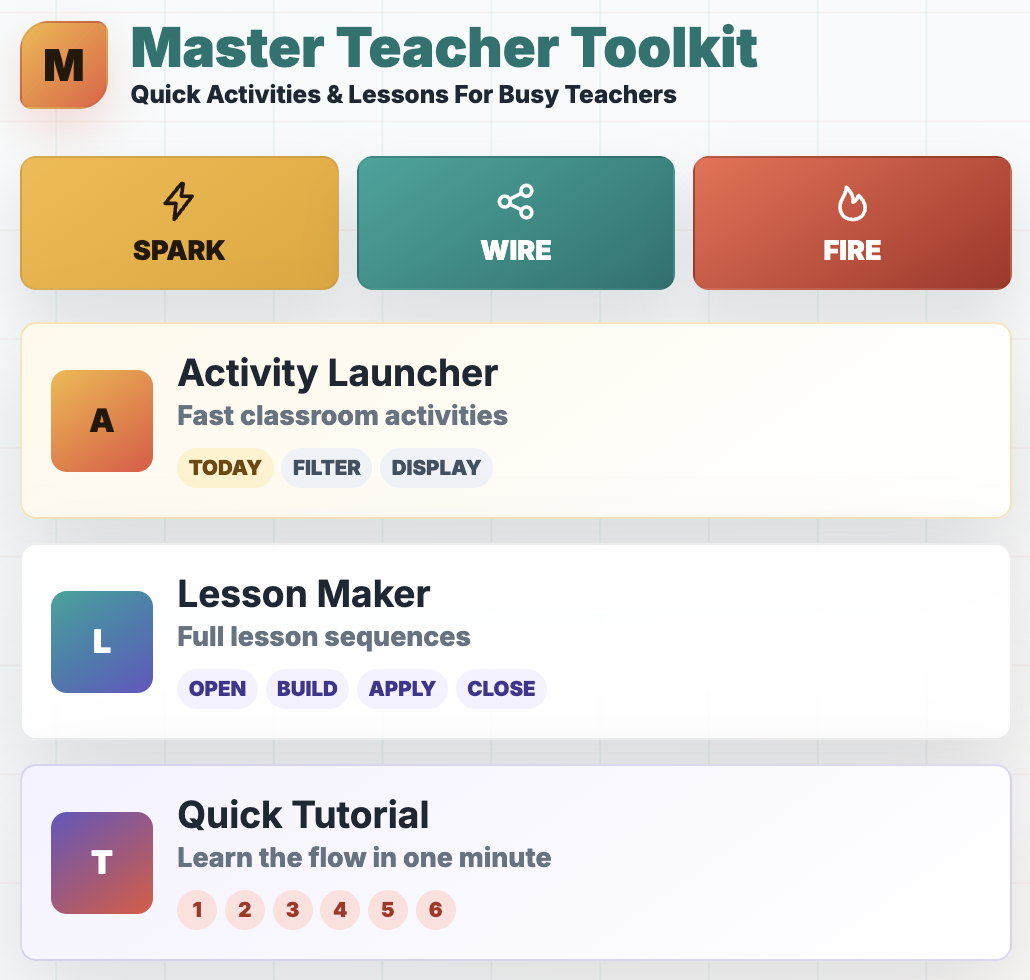
Teaching App
Launch engaging, deeper learning activities and lessons in seconds. Then, launch and display them to students instantly.
NEW BOOK
100+ practical activities teachers can use right away with little or no prep.