
Learning That Works: Science-Backed, High-Impact Teaching Strategies
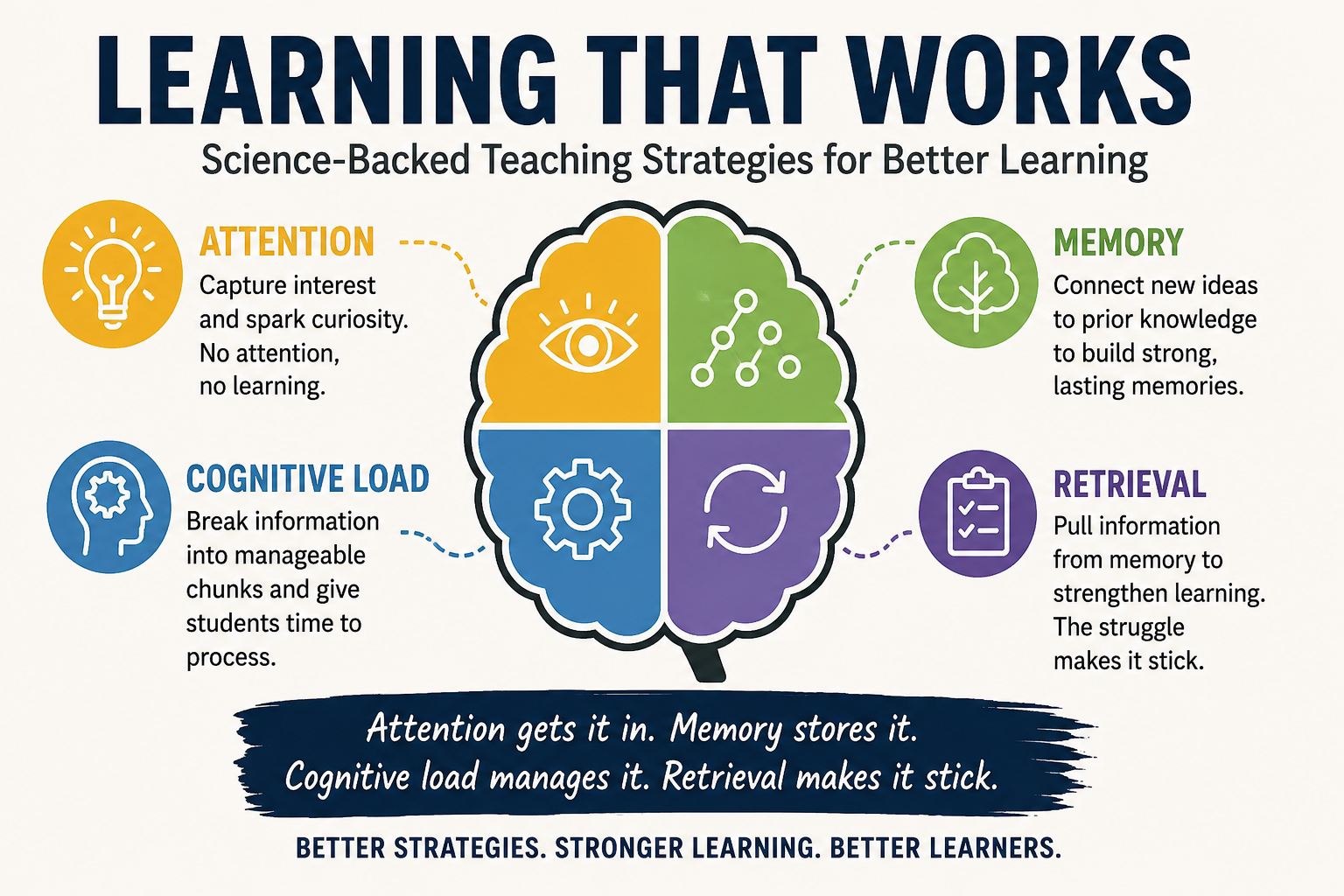
The science of learning is surprisingly simple: attention gets information in, memory stores it, cognitive load determines whether students can process it, and retrieval makes learning stick.
Every teacher has experienced it.
You spend twenty minutes explaining a concept. Students pay attention, nod with approval, and take notes.
But a few days later you ask a seemingly-easy question and are met with: Huh?
What happened?
Most of us were taught how to manage a classroom, write lesson plans, and assess learning. Very few of us left teacher-prep school with a solid grasp on how learning actually works. I know I didn’t.
That's a big status quo bummer because every teaching decision we make either works with our students’ brains or against them.
The good news is that learning that works isn't nearly as mysterious as it used to be. While cognitive science is a massive field, much of what works in a classroom can be explained with four simple ideas: attention, memory, cognitive load, and retrieval.
These ideas are the foundation behind the strategies in my HITS (High Impact Teaching Strategies) collection. They are not activities designed to keep students busy. They are designed to help them learn.
In other words, they are built around learning that works.
Learning Begins With Attention
No matter how brilliant a lesson is, learning cannot happen if students are not paying attention.
The challenge is that attention isn't something teachers can control. Attention is something the brain gives selectively.
The human brain evolved to notice what is new, uncertain, surprising, or rewarding. Predictable experiences quickly fade into the background. This helps explain why students sometimes seem bored before a lesson even starts. Their brains have already recognized the routine.
The slideshow, the worksheet, the teacher talk—the format became so familiar, the brain opts to conserve energy.
This is why some of the most effective classroom engagement strategies begin with curiosity rather than content. A prediction challenge. A strange image. A surprising statement. A quick puzzle.
Activities like Prediction Mystery, Two Truths and a Lie, and Word Unscramble work because they create a small amount of uncertainty. Students suddenly have something they want to figure out.
The goal isn't confusion. It’s curiosity because curiosity opens the door the learning walks through.
Learning Lives in Memory
Many people think learning happens when students encounter information.
But in reality, learning happens when information changes memory.
Thus, if a student cannot remember something, the learning never happened.
The brain doesn't store knowledge like files in a cabinet. New learning must connect to something that’s already there. Hence, prior knowledge. Without it, new information feels disconnected and overwhelming.
Think about trying to assemble furniture without instructions. Every piece feels random. But when you can see and understand how the pieces fit together, the process becomes much easier.
Learning works the same way.
This is why effective teachers spend time helping students activate what they already know before introducing something new. Whether students are sorting ideas, making predictions, building concept maps, or discussing examples, they are preparing mental pathways for new learning to travel along.
Strong learners aren't individuals who know the most facts, but ones who understand how ideas connect and can use them in new situations.
Sometimes Students Aren't Bored
One of the biggest misconceptions in education is that disengagement means students don't care.
Sometimes they might not. Sometimes they care and are overloaded.
Working memory can only handle so much information at once. When too much information arrives too quickly, the brain starts protecting itself. Processing slows down. Attention drifts. Students appear to check out.
From the teacher's perspective, it looks like a motivation problem.
From the brain's perspective, it's a capacity problem.
This is one reason many active learning strategies are so effective. Instead of asking students to sit through long stretches of information, they alternate between receiving information and doing something with it.
Students explain, sketch, discuss, connect, collaborate, and teach each other.
Activities like Dual Coding Blitz, Look Up + Teach, and Silent Switch, Add and Connect are effective not because they're entertaining but because they give working memory a chance to breathe.
Learning becomes manageable.
Manageable learning is far more likely to become lasting learning.
Retrieval Changes Memory
If there is one principle that appears again and again throughout cognitive science, it is retrieval.
Students do not learn best by repeatedly looking at information. They learn best by repeatedly trying to remember it.
Rereading notes feels productive because everything looks familiar. But while recognition might create confidence, it is often mistaken for understanding—the so-called “illusion of learning.”
The real test is: Can students pull the information out of their brain only?
Recall, or retrieval, strengthens memory. Every successful retrieval acts like a rep in the gym. The neural pathway in the brain is used more frequently and thus becomes stronger. As a result, information is accessed more efficiently and learning becomes more durable.
This is why so many strategies I use focus on retrieval. Students answer questions without notes. They explain concepts from memory. They sketch diagrams. They teach partners. They debate ideas. They play review games.
Activities like 3-2-1 Recall, Last Team Standing, and No Notes, Just Brain work because they force students to do the one thing that strengthens memory more than almost anything else: they force themselves; struggle to remember.
The “trying to remember” struggle is real because both failure and success to remember now helps students remember better in the future.
This struggle is both method and evidence that learning is happening.
Why These Strategies Work
Why would students be more engaged during HIT activities than during traditional review?
Though some are very entertaining, entertainment is why they enjoy them, but not why they learn from them. The learning results from the design—the activities are built to align with how the brain learns best.
They capture attention through curiosity. They strengthen memory by activating prior knowledge. They reduce cognitive overload by breaking learning into manageable chunks. And they use retrieval to strengthen long-term retention.
The result is not just higher engagement. It’s better learning.
That is why such strategies consistently show up among the most effective science-backed teaching strategies, brain-based teaching strategies, and student-centered learning strategies used by teachers.
They work because they were built around the learner rather than the lesson.
Learning That Works For The Learner
The best teachers don’t “present” information, but create opportunities for students to use it.
They ask students to predict, connect, explain, retrieve, discuss, sketch, organize, and teach.
Because learning isn't something students get, but something they do.
And when instruction aligns with how the brain actually learns, students remember more, understand better, and become increasingly capable of teaching themselves.
Because self-determination is the ultimate goal of learning.
This is what the Spark-Wire-Fire Framework is designed to do.
Not to just drive engagement, but to create learning that works for the learner.
Want More Learning That Works?
If you enjoyed the ideas in this article, you'll find 100 more inside Spark. Wire. Fire.: 100 Ready-to-Use Classroom Activities that Inspire Curiosity, Strengthen Memory, and Apply Learning.
This practical guide is packed with simple, classroom-tested activities designed to increase engagement, strengthen memory, improve retrieval, and help students become more independent learners. Every strategy is grounded in cognitive science and can be implemented with minimal preparation.
Whether you're looking for new bell ringers, review activities, discussion starters, retrieval practice activities, or effective strategies for distracted students, you'll find ready-to-use ideas that help transform passive classrooms into active learning environments.
Check it out on Amazon and discover more learning that works.
BOOKS & TOOLS
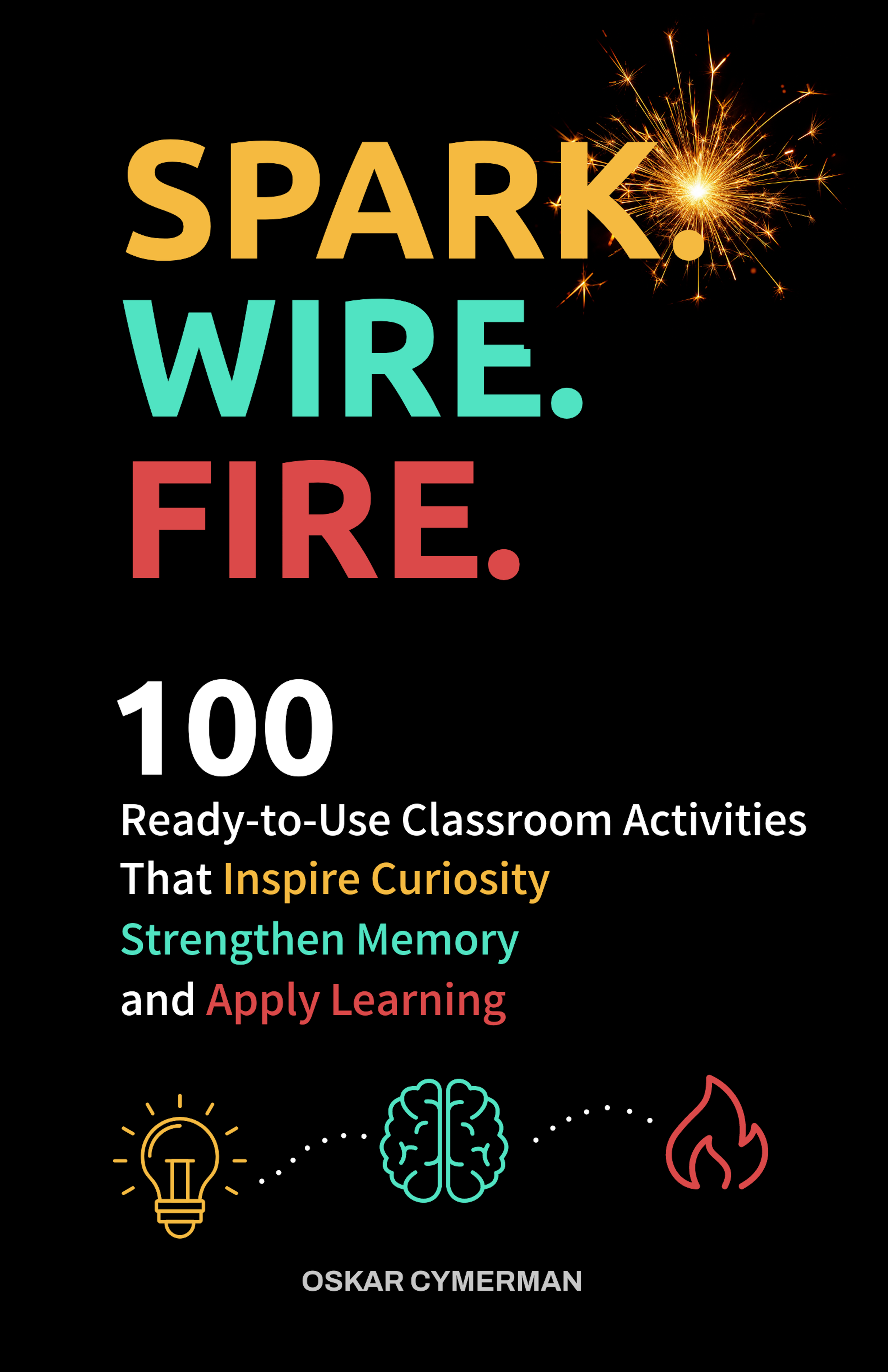
NEW BOOK
100+ practical activities teachers can use right away with little or no prep..
Flashcards are okay but there's a better way. The Memory (or Mind) Palace Method is a powerful learning and memorization technique that when mastered allows a student to remember 10, 20, or even 30 vocabulary words or concepts (definitions included) with ease.
And, they actually remember what they learned using memory palaces! This series of lessons (which can be used as classroom handouts) walks students through creating their first memory palace, filling it with information they need to learn, and using it to train their memories. It also contains short readings, a video lesson, memory palace examples, and practice drills.
Fair Use
Feel free to use with your students. Please do not share it with other parties or use for profit. All rights by crushschool.com.

Equity-Promoting Classroom Poster. What does EQUITY in the classroom look like?
Everyone has a different start and finish line
Quality is more important that quantity
Understanding that diversity makes us stronger
Inclusion despite beliefs, appearances, and circumstances
Thoughtfulness lowers barriers and reduces biases
Yesterday's mistakes are today's learning agenda
You can teach your students about equity and make it a daily classroom practice using this inspirational poster, which also includes images that accompany the equity description. You can discuss each letter characteristic with your students as a way of introducing your inclusive classroom and display it prominently as a reminder that diversity makes the classroom community stronger.

In this classroom Mistakes are Expected, Respected, Inspected, Corrected!
Learned helplessness is a result of years of conditioning that mistakes are bad for learning. Nothing is further from the truth - some of the most powerful life lessons come from making mistakes, reflecting on them, and growing as a result.
This is a PNG Poster you can print and display in your classroom to encourage a culture of risk-taking and learning from mistakes.

In this 3- to 4-day lesson, designed for a high school Earth and Space Science classroom, student groups are assigned and investigate 4 leading solutions to the climate change crisis our planet is experiencing. Then, they are called upon to debate against each other to try to convince others that their solution is the most viable and provide counterarguments against other solutions. It’s an intellectual thunderdome in which students are encouraged to use science to attacks each others points of view on climate change but not character.
Why and how does this learning strategy work?
Rote memorization out; seeking answers and deeper learning in.
The debate-style approach to learning is engaging and motivating for learners, because they are challenged to use real evidence and their wits to outmaneuver their opposition.
Not only do they act as investigators, developing communication, collaboration, and argumentation skills but they learn about viable solutions to the climate change conundrum we all find ourselves in. They learn Earth and Space Science content while investigating and debating solutions to a real-world phenomenon, which is what the Next Generation Science Standards (NGSS) call for.
Student Learning and Performance Objectives:
Research multiple, complex climate change solutions to discover that the world is more complicated than a single TikTok trend.
Articulate scientific arguments with actual evidence.
Listen to opposing viewpoints, to hone "social awareness" skills.
Realize that climate change solutions are multi-faceted, messy, and require more than just good vibes.
Describe and support with, not mere belief but actual evidence, the leading climate solutions proposed by, not the coven of online witches but the scientific community.
What's included:
24 slides that introduce, explain, and guide the teacher and students
Detailed teacher notes on prep, main lesson, and follow up activities
General Lesson flow for teacher to follow to make it all seamless
A short and funny “hook” to increase student buy in
Detailed student directions
A list (research starter pack) of links to legit, scientific websites for students to use.
Group roles (team jobs) with descriptions of what each entails.
4 climate change solutions to assign to 4 different student groups
Student Learning and Performance Objectives
Detailed Grading Rubric to guide students and make assessment easy
Debate Day introduction and format description
Follow up discussion questions (reflection and debrief)
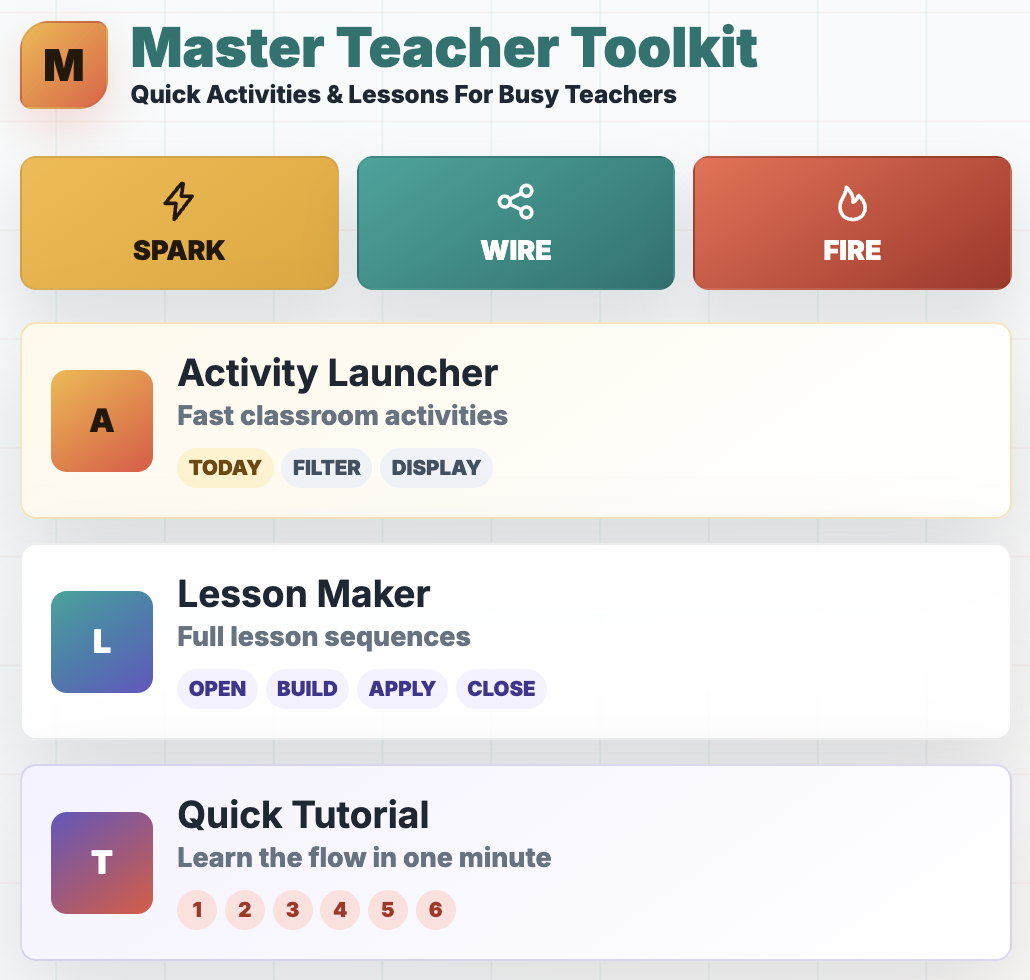
Teaching App
Build engaging lessons in seconds. Then, launch and display them to students instantly.