5 Things Teachers Should Stop Doing Before Summer Break
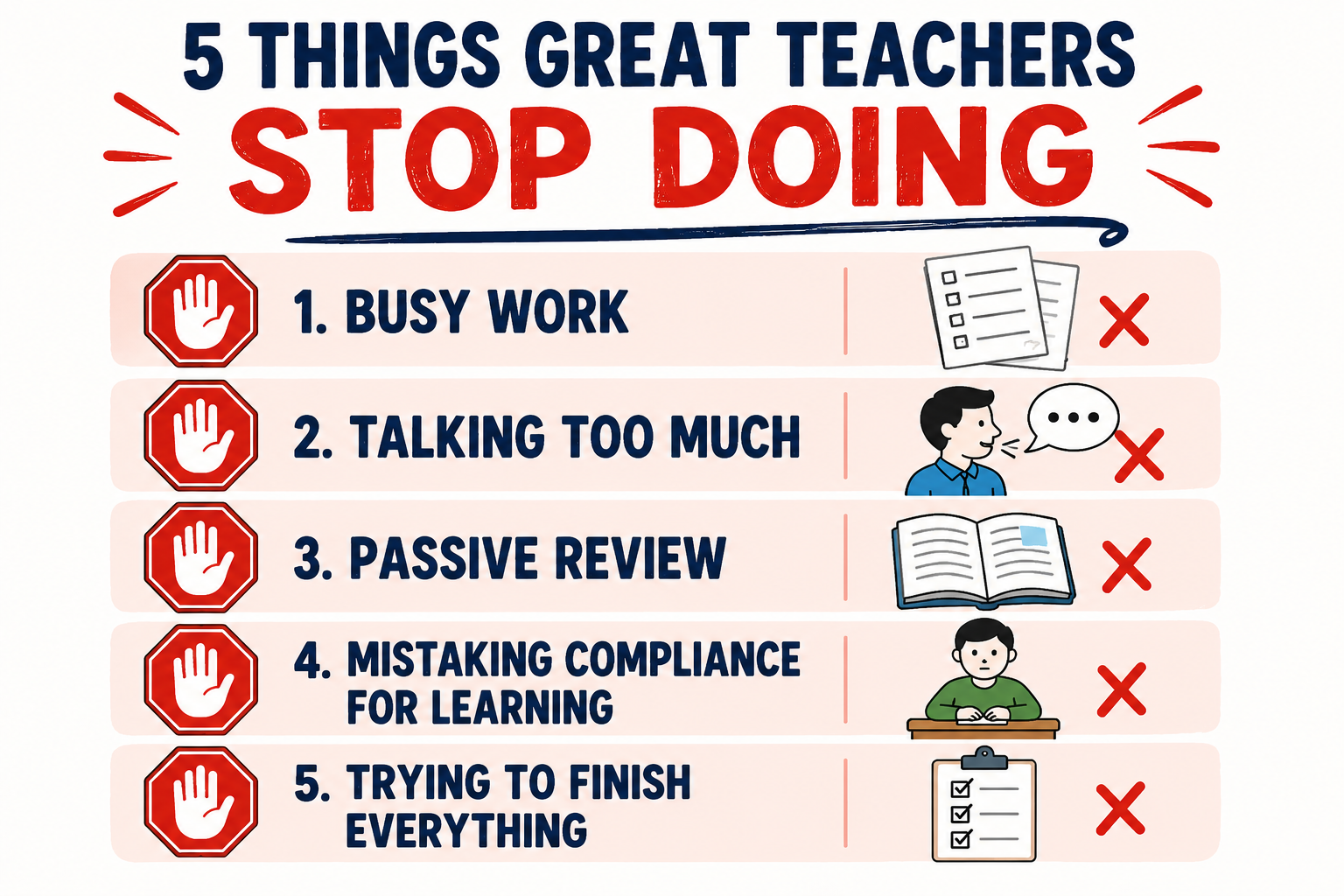
Sometimes finishing the year strong means stopping old habits. Great teachers focus less on busy work and more on keeping students engaged, curious, and thinking.
By the final week of school, teachers are exhausted, grades are mostly done, and attention spans are hanging on by a thread. Yet many of us respond by doubling down on the very things that just don’t work.
The truth is, the last week of school doesn't require more tiring work. It requires different work.
If you're searching for end-of-the-school-year activities, student engagement strategies, or simply trying to survive the final days with your sanity intact, here are five things you might want to stop doing—and what you can do instead.
Stop Assigning Busy Work
Students can see right through assignments designed to fill time. Another review packet or stack of worksheets might keep students occupied, but occupied isn't the same as engaged.
Instead, replace this passive sit down and stay quiet work with Last Team Standing or Chain Reaction. Both activities turn review into retrieval practice and discussion. Students are actively recalling information, building connections, and having fun at the same time. That's a much better use of the last few days than another packet nobody wants.
Stop Talking Too Much
Let's face it. Long lectures or explanations weren't ideal in October, and they definitely aren't ideal when summer break is a few days away. Students need something that captures attention, not something that competes with vacay plans.
Instead, create curiosity. Try Prediction Mystery by pausing a video before the reveal or showing half a graph. Or place a strange object at the front of the room and use Mystery Object to get students asking questions before the lesson even starts. Curiosity is one of the most powerful classroom engagement strategies you'll ever use.
Stop Reviewing Passively
Rereading notes and watching the teacher go over answers feels productive, but familiarity is not the same as learning. Students strengthen memory when they retrieve information, not when they simply look at it.
That's why activities like 3-2-1 Recall, No Notes, Just Brain, and Draw the Definition are perfect end-of-year review activities. They force students to remember, explain, and apply ideas instead of just recognizing them.
Stop Mistaking Compliance for Learning
A quiet classroom can be deceiving. Students may be sitting still, but that doesn't mean they're thinking. Learning becomes visible when students explain ideas, debate evidence, and make connections.
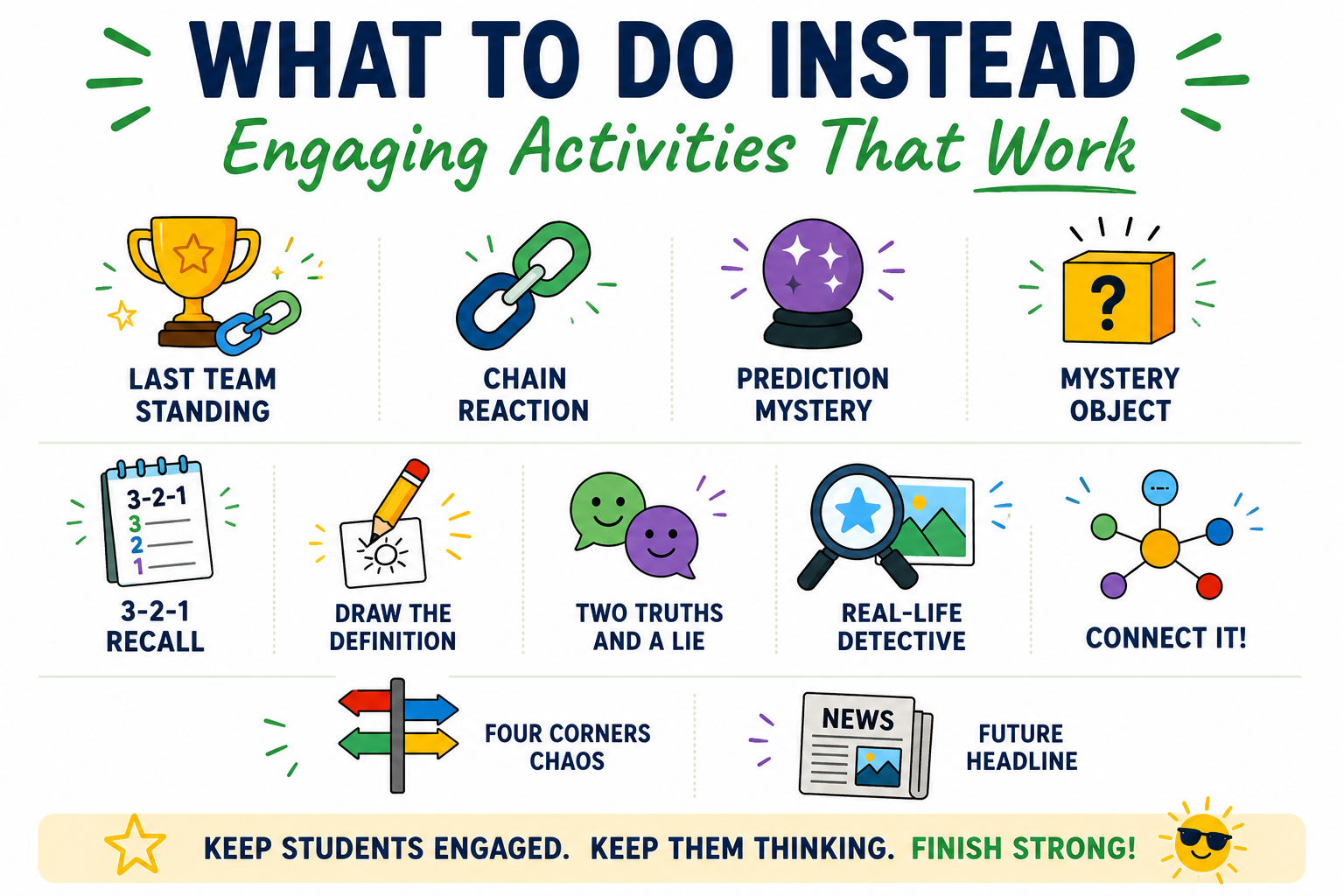
When students are mentally on summer break, engagement matters more than ever. These HITS help students think, talk, connect, and finish the year strong.
Instead, try Real-Life Detective, an engaging activity where you present content-related images and ask students to analyze and gather evidence that helps them identify these concepts concepts. Or use Connect It! to help students organize and explain relationships between ideas. These activities reveal understanding far better than silent completion.
Stop Trying to Finish Everything
Perhaps the hardest lesson for teachers is realizing that students won't remember one more worksheet or one more PowerPoint slide. What they will remember are the experiences.
So don't be afraid to end the year with some energy and fun. Four Corners Chaos gets students moving and debating. Future Headline asks them to imagine what the future might look like using what they've learned. These simple activities help students apply knowledge while creating memorable moments during the final days of school.
Finish Strong, Not Exhausted
The best end-of-the-school-year activities aren't about squeezing in more content. They're about keeping students curious, engaged, and thinking right up until summer break.
Effective teachers don't finish the year by forcing one last push through the curriculum. They finish by creating experiences that students remember and keep energy high through the last day of school.
That's exactly why I love HITS—High Impact Teaching Strategies.
Simple, brain-based classroom activities that work with students instead of against them. And sometimes, especially in the last week of school, that's exactly what everyone needs.
Thanks for reading!
You’ve earned a break—so take it. Rest, recharge, and enjoy your summer.
When you’re ready to think about the classroom again, look for Spark. Wire. Fire.: 100 Ready-to-Use Classroom Activities That Inspire Curiosity, Strengthen Memory, and Apply Learning, coming this August.
It’s packed with practical strategies that engage students without exhausting teachers—so you can begin the new year with fresh ideas and energy to spare.
BOOKS & TOOLS
Flashcards are okay but there's a better way. The Memory (or Mind) Palace Method is a powerful learning and memorization technique that when mastered allows a student to remember 10, 20, or even 30 vocabulary words or concepts (definitions included) with ease.
And, they actually remember what they learned using memory palaces! This series of lessons (which can be used as classroom handouts) walks students through creating their first memory palace, filling it with information they need to learn, and using it to train their memories. It also contains short readings, a video lesson, memory palace examples, and practice drills.
Fair Use
Feel free to use with your students. Please do not share it with other parties or use for profit. All rights by crushschool.com.

Equity-Promoting Classroom Poster. What does EQUITY in the classroom look like?
Everyone has a different start and finish line
Quality is more important that quantity
Understanding that diversity makes us stronger
Inclusion despite beliefs, appearances, and circumstances
Thoughtfulness lowers barriers and reduces biases
Yesterday's mistakes are today's learning agenda
You can teach your students about equity and make it a daily classroom practice using this inspirational poster, which also includes images that accompany the equity description. You can discuss each letter characteristic with your students as a way of introducing your inclusive classroom and display it prominently as a reminder that diversity makes the classroom community stronger.

In this classroom Mistakes are Expected, Respected, Inspected, Corrected!
Learned helplessness is a result of years of conditioning that mistakes are bad for learning. Nothing is further from the truth - some of the most powerful life lessons come from making mistakes, reflecting on them, and growing as a result.
This is a PNG Poster you can print and display in your classroom to encourage a culture of risk-taking and learning from mistakes.

In this 3- to 4-day lesson, designed for a high school Earth and Space Science classroom, student groups are assigned and investigate 4 leading solutions to the climate change crisis our planet is experiencing. Then, they are called upon to debate against each other to try to convince others that their solution is the most viable and provide counterarguments against other solutions. It’s an intellectual thunderdome in which students are encouraged to use science to attacks each others points of view on climate change but not character.
Why and how does this learning strategy work?
Rote memorization out; seeking answers and deeper learning in.
The debate-style approach to learning is engaging and motivating for learners, because they are challenged to use real evidence and their wits to outmaneuver their opposition.
Not only do they act as investigators, developing communication, collaboration, and argumentation skills but they learn about viable solutions to the climate change conundrum we all find ourselves in. They learn Earth and Space Science content while investigating and debating solutions to a real-world phenomenon, which is what the Next Generation Science Standards (NGSS) call for.
Student Learning and Performance Objectives:
Research multiple, complex climate change solutions to discover that the world is more complicated than a single TikTok trend.
Articulate scientific arguments with actual evidence.
Listen to opposing viewpoints, to hone "social awareness" skills.
Realize that climate change solutions are multi-faceted, messy, and require more than just good vibes.
Describe and support with, not mere belief but actual evidence, the leading climate solutions proposed by, not the coven of online witches but the scientific community.
What's included:
24 slides that introduce, explain, and guide the teacher and students
Detailed teacher notes on prep, main lesson, and follow up activities
General Lesson flow for teacher to follow to make it all seamless
A short and funny “hook” to increase student buy in
Detailed student directions
A list (research starter pack) of links to legit, scientific websites for students to use.
Group roles (team jobs) with descriptions of what each entails.
4 climate change solutions to assign to 4 different student groups
Student Learning and Performance Objectives
Detailed Grading Rubric to guide students and make assessment easy
Debate Day introduction and format description
Follow up discussion questions (reflection and debrief)
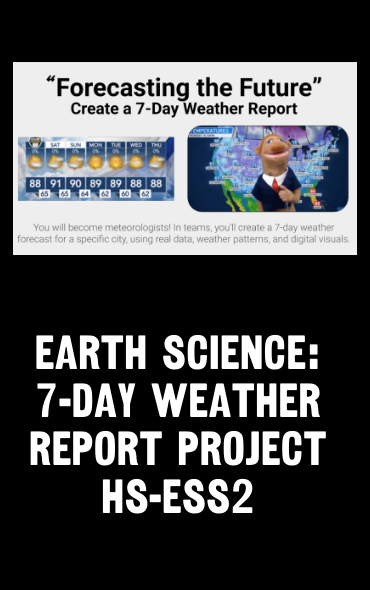
Save planning time with this Atmosphere Unit, 5-day Honors Earth and Space Science Project in which students research, design, create, and present a 7-day weather forecast for a specific city in the US or abroad.
Student Performance and Learning Objectives:
Explain how weather data is collected and interpreted.
Explain how weather patterns may be affected by geography (mountains, plains, valleys etc.).
Explain the atmospheric conditions (pressure, moisture etc.) necessary for different weather (sunny, windy, rainy etc.).
What's included:
16 slides (Google Slides link for easy use and editing to fit your purposes)
Learning Objectives
Group Roles / Jobs (up to 5 with detailed description of jobs)
Detailed Project Directions / Requirements
Materials/Web Resources List
Link to a "Wheel of Names" containing city names - students spin and receive their assigned city.
Link to a grading rubric for student and teacher use (printable doc).
The project follows the guidelines set by the Next Generation Science Standards (NGSS).
Questions?
Email me at oskar@crushschool.com. I’m happy to answer your questions.
Fair Use
Feel free to share and use this resource with your students.
Please do not share it with other parties or use for profit. All rights by crushschool.com.